ISO 50001 Certification in Indonesia | ISO 50001 Consultants in Indonesia
Vertex Certifiers is a global ISO consulting and certification support company offering end-to-end ISO 50001 Certification in Indonesia for organizations looking to improve energy performance, reduce operating costs, and build a structured Energy Management System (EnMS). We provide complete implementation support across Indonesia, including Jakarta, Surabaya, Bandung, Medan, Semarang, Batam, Makassar, Denpasar (Bali), Tangerang, and Bekasi, helping organizations through every stage of the certification journey—from initial gap analysis, energy review, documentation development, EnMS implementation, employee training, internal audits, and certification audit support to post-certification maintenance support. Vertex Certifiers works with a wide range of sectors such as manufacturing, electronics, steel, cement, chemicals, textile, automotive, food processing, packaging, warehousing & logistics, data centers, and commercial buildings, where controlling energy consumption and improving operational efficiency are critical business priorities. In addition to ISO 50001, we also support organizations in Indonesia with integrated consulting for other international standards such as ISO 9001, ISO 14001, ISO 45001, ISO 22000, ISO 27001, ISO 22301, ISO 20000-1, ISO 17025, and GMP, enabling businesses to build stronger, more efficient, and globally aligned management systems.
What is ISO 50001?
ISO 50001 is an internationally recognized Energy Management System (EnMS) standard published by the International Organization for Standardization (ISO) that provides a structured framework for organizations to establish, implement, maintain, and continually improve their energy management practices. The current version, ISO 50001:2018, is designed to help organizations systematically improve energy performance, increase energy efficiency, reduce energy consumption, and control energy-related costs through a data-driven and process-based approach. Instead of treating energy management as an occasional cost-saving exercise, ISO 50001 integrates energy performance into everyday business operations by requiring organizations to establish an energy policy, identify significant energy uses, set measurable energy objectives and targets, monitor energy consumption patterns, analyze performance data, and implement operational controls that drive continual improvement. The standard promotes a risk-based and performance-based management approach, helping organizations identify inefficiencies, optimize equipment and processes, reduce waste, and improve energy performance over time in a measurable and sustainable way.
ISO 50001 is particularly valuable for energy-intensive organizations because it transforms energy management into a strategic business function rather than a purely technical or utility-related issue. Through structured energy reviews, baseline assessments, monitoring of energy performance indicators, and improvement action plans, organizations can make better decisions regarding production efficiency, utility consumption, equipment upgrades, and operational controls. ISO 50001 also aligns strongly with broader ESG, sustainability, carbon reduction, and operational efficiency goals, making it highly relevant for businesses facing rising electricity costs, customer sustainability expectations, and pressure to reduce environmental impact.
What is the Procedure to get ISO 50001 Certification in Indonesia:
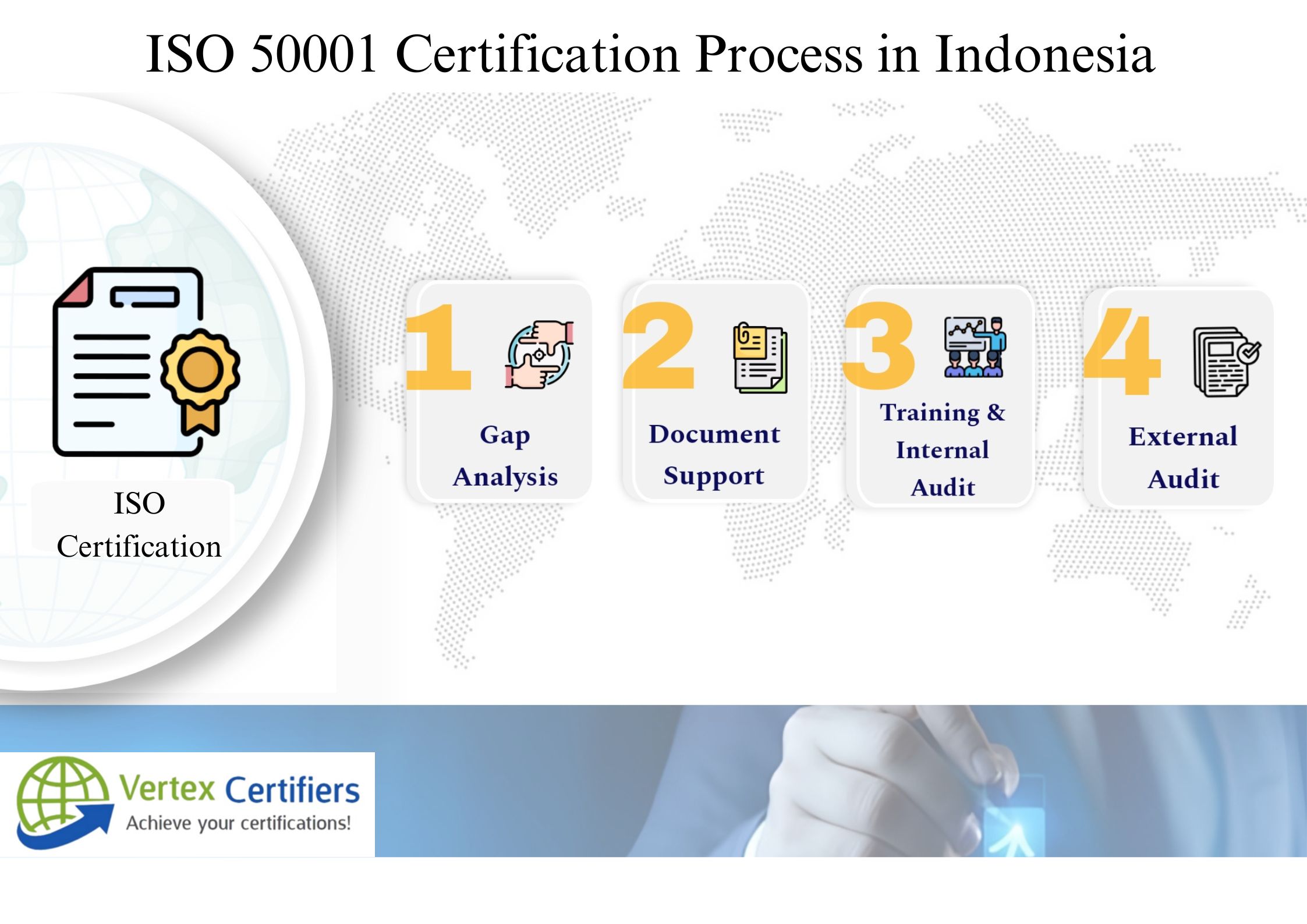
The ISO 50001 certification process in Indonesia follows a structured step-by-step approach that helps organizations build, implement, and maintain an effective Energy Management System (EnMS) aligned with ISO 50001:2018 requirements. The process generally begins with an initial gap analysis, where the organization’s current energy management practices, utility controls, documentation, and performance monitoring systems are reviewed against the requirements of the standard. This is followed by scope definition, where the organization determines which facilities, departments, processes, or business units will be included in the EnMS. Once the scope is finalized, a detailed energy review and baseline assessment is carried out to understand current energy consumption patterns, identify major energy-consuming processes and equipment, and establish a baseline for future performance measurement. At this stage, the organization also identifies its Significant Energy Uses (SEUs) so that the EnMS can focus on the areas with the highest impact on energy performance.
The next phase involves energy data collection and analysis, where historical and current energy consumption data is gathered and analyzed to understand trends, inefficiencies, and opportunities for improvement. Based on this review, the organization develops its energy policy and defines measurable energy objectives, targets, and action plans that align with business priorities, cost-saving goals, and sustainability commitments. Once these strategic elements are established, the organization moves into ISO 50001 documentation development, which includes preparing EnMS procedures, energy planning records, operational controls, monitoring formats, responsibilities, and documented processes required to support implementation. After documentation is in place, the company proceeds with EnMS implementation, where the defined controls, procedures, and improvement actions are deployed in day-to-day operations. This includes establishing operational controls and monitoring mechanisms for significant energy uses, tracking energy performance indicators, and ensuring that energy-efficient practices are integrated into routine operational management.
To make the system effective, organizations must also conduct employee training and awareness programs so that staff understand the energy policy, the importance of energy-saving practices, and their role in achieving energy objectives. After implementation, an internal audit is carried out to verify whether the EnMS conforms to ISO 50001 requirements and is effectively implemented across the defined scope. The findings of the internal audit are then reviewed during a management review meeting, where top management evaluates EnMS performance, resource needs, audit results, energy objectives, and opportunities for continual improvement. Once the organization is satisfied with its readiness, it proceeds to the external certification stage, which consists of Stage 1 Audit and Stage 2 Audit conducted by an accredited certification body. The Stage 1 Audit focuses on reviewing documentation, scope, preparedness, and system design, while the Stage 2 Audit assesses the practical implementation and effectiveness of the EnMS across the organization. If the audit is successful and any nonconformities are adequately addressed, the organization is granted ISO 50001 certification. To maintain certification, the company must undergo annual surveillance audits, which ensure continued compliance, sustained energy performance management, and ongoing improvement of the Energy Management System.
Our Services
Our Local Cities

Why ISO 50001 Certification is Important in Indonesia
ISO 50001 certification is increasingly important in Indonesia because the country is experiencing rapid industrialization, expansion of manufacturing, stronger export activity, and continued growth of energy-intensive operations across industrial zones, factories, logistics networks, and commercial infrastructure. ISO explains that ISO 50001 helps organizations manage energy performance through a structured Energy Management System (EnMS) and improve energy efficiency, energy use, and energy consumption through a systematic approach. [web:98][web:184]
For many Indonesian businesses, rising electricity and fuel costs directly affect profitability, especially in sectors with heavy machinery, continuous production lines, thermal processes, refrigeration loads, data processing, and large facility operations. ISO states that energy is a critical resource for organizations and that efficient energy use can lead to significant cost savings and environmental benefits. [web:184]
Indonesia’s industrial growth also creates greater pressure to improve operational efficiency, control utility costs, and support environmental performance. This is especially relevant as government sustainability priorities, ESG expectations, carbon reduction initiatives, and buyer-driven supply-chain standards continue to influence business decisions.
ISO 50001 helps organizations establish better control over energy consumption by using data, energy objectives, performance monitoring, and continual improvement. ISO notes that the standard provides a framework to develop an energy policy, set objectives and targets, use data to understand energy use, measure results, and continually improve energy management. [web:98]
In Indonesia, this is highly relevant for electronics manufacturing, steel and metal processing, cement plants, chemicals and petrochemicals, textile and garment manufacturing, food and beverage processing, packaging operations, automotive and auto-components manufacturing, warehousing and cold storage, data centers, and large commercial facilities where energy efficiency can create a real competitive advantage.
Benefits of ISO 50001 Certification in Indonesia
ISO 50001 certification helps Indonesian organizations reduce energy-related costs, strengthen operational discipline, improve sustainability performance, and make energy management part of daily business decision-making. ISO highlights benefits such as better energy efficiency, lower energy costs, reduced carbon footprint, improved operational control, and stronger integration with overall management systems. [web:184]
- Reduces energy consumption and energy waste: Helps identify where energy is being lost or used inefficiently. [web:184]
- Lowers electricity and fuel costs: Better energy performance can reduce direct operating expenses. [web:184][web:188]
- Improves energy performance across operations: Supports measurable improvement in energy efficiency, use, and consumption. [web:184]
- Supports sustainability and ESG goals: Better energy management contributes to broader environmental and governance objectives. [web:184]
- Helps identify high-energy-use areas: Encourages analysis of significant energy uses and performance opportunities. [web:187]
- Improves operational control and efficiency: Creates stronger process discipline around energy-related equipment and activities. [web:184]
- Supports legal and regulatory compliance: ISO says the standard supports compliance with applicable legal and regulatory requirements. [web:184]
- Strengthens environmental reputation: Demonstrates a visible commitment to responsible energy management.
- Reduces carbon footprint and emissions: ISO links energy improvement with climate change mitigation and reduced greenhouse gas emissions. [web:184]
- Increases competitiveness with international buyers: Energy-conscious operations can support supplier credibility in global markets.
- Encourages employee awareness of energy efficiency: Ongoing communication and involvement help build an energy-conscious culture. [web:191]
- Helps integrate energy management into day-to-day operations: ISO 50001 is designed to embed energy management into organizational practices. [web:188][web:191]
- Supports long-term cost savings and profitability: Continual improvement can help sustain energy savings over time. [web:187][web:191]
Which Industries Need ISO 50001 Certification in Indonesia?
ISO 50001 is especially valuable for organizations with high energy consumption, large production volumes, utility-intensive operations, or strong sustainability and cost-control objectives. In Indonesia, many industries can benefit significantly from a formal Energy Management System because energy performance directly affects margins, competitiveness, and operational stability.
- Manufacturing plants: Useful for controlling plant-wide electricity, fuel, compressed air, steam, and process-energy use.
- Electronics and semiconductor units: Helps manage high-load production environments and precise operating conditions.
- Steel and metal processing industries: Important for energy-intensive thermal, mechanical, and continuous processing operations.
- Cement and construction material manufacturers: Supports improved performance in highly energy-demanding production systems.
- Chemical and petrochemical companies: Helps monitor and optimize energy use across complex industrial processes.
- Textile and garment factories: Useful for managing power, steam, finishing, and plant utility consumption.
- Food processing and beverage companies: Supports efficiency in heating, cooling, packaging, and continuous production operations.
- Automotive and component manufacturing: Helps optimize energy use across machining, assembly, testing, and facility systems.
- Packaging and plastics manufacturing: Useful where extrusion, molding, sealing, and high-throughput processing consume large amounts of energy.
- Warehouses and logistics facilities: Supports energy control in storage, lighting, handling systems, and transport-linked infrastructure.
- Cold storage operations: Especially important where refrigeration efficiency directly influences cost and continuity.
- Hospitals and healthcare facilities: Helps manage HVAC, lighting, medical-support systems, and 24/7 operational loads.
- Commercial buildings and large office facilities: Useful for improving utility efficiency across large occupied spaces.
- Data centers and IT infrastructure-heavy facilities: Supports tighter control over cooling, power usage, and energy performance metrics.
Cost of ISO 50001 Certification in Indonesia
The cost of ISO 50001 certification in Indonesia depends on the organization’s size, operational complexity, energy profile, and implementation readiness. There is no single fixed certification cost because different companies have different energy-intensive processes, number of sites, documentation maturity, and support requirements.
- Size of the organization: Larger companies generally require wider implementation scope and more audit effort.
- Number of sites / plants: Multi-site organizations usually need broader energy data collection, coordination, and audit coverage.
- Energy intensity of operations: Highly energy-intensive plants often require more detailed analysis and stronger control systems.
- Complexity of manufacturing processes: Complex production environments may need deeper process mapping and energy review.
- Existing management system maturity: Companies that already operate formal ISO systems may implement ISO 50001 more efficiently. ISO notes that ISO 50001 follows the same continual improvement management system model used for standards such as ISO 9001 and ISO 14001, which makes integration easier. [web:98]
- Number of employees: Larger workforces may increase training, awareness, and implementation coordination needs.
- Scope of certification: The more departments, plants, utilities, and activities included, the broader the implementation effort.
- Need for consultant support, training, and audits: The extent of external support required for gap analysis, documentation, training, internal audits, and certification coordination affects total cost.
How Long Does ISO 50001 Certification Take in Indonesia?
The implementation timeline for ISO 50001 depends on organization size, number of sites, availability of energy data, documentation readiness, current management-system maturity, and overall audit preparedness. Companies that already maintain structured operational controls or other ISO systems can often complete implementation faster than organizations starting from zero.
- Small companies: around 30 to 45 days.
- Medium companies: around 45 to 75 days.
- Large / complex manufacturing units: around 75 to 120 days.
The actual timeline can vary depending on documentation readiness, energy data availability, implementation maturity, operational complexity, and readiness for the certification audit.
Why Choose Vertex Certifiers for ISO 50001 Certification in Indonesia?
Vertex Certifiers supports organizations across Indonesia with practical ISO 50001 consulting designed to improve energy performance, reduce implementation complexity, and support efficient certification readiness. Our approach focuses on business practicality, measurable improvement, and structured implementation suited to real industrial and commercial environments.
- Experienced ISO consultants: Support from consultants familiar with energy management system implementation and certification requirements.
- End-to-end implementation support: Assistance from gap assessment to documentation, training, internal audit, and certification coordination.
- Practical energy management approach: Focus on realistic controls, performance monitoring, and improvement opportunities relevant to your operations.
- Documentation, training, audits, and certification support: Complete guidance for building and maintaining an effective EnMS.
- Support across Indonesia cities: Online and onsite support for organizations in major industrial and commercial locations.
- Industry-specific consulting approach: Tailored implementation for manufacturing, processing, logistics, data centers, healthcare, and large facility operations.
- Affordable and structured implementation: Flexible support models for SMEs, growing companies, and large industrial groups.
- Support for integrated systems with ISO 9001 / 14001 / 45001: Easier alignment where businesses already maintain other management systems. ISO notes that ISO 50001 is compatible with other ISO management system standards and follows the PDCA continual-improvement model. [web:184]
How to Apply for ISO 50001 Certification in Indonesia
Apply for ISO 50001 Certification with Vertex Certifiers
If your organization wants to reduce energy costs, improve efficiency, and strengthen sustainability performance, Vertex Certifiers can support your ISO 50001 implementation and certification journey across Indonesia.
- Contact Vertex Certifiers for an initial discussion about your energy management needs.
- Send your inquiry by email or inquiry form to share your company profile, locations, and certification scope.
- Request a free consultation, gap analysis, or quotation based on your business size and operational complexity.
- Get support for implementation and certification across Indonesia through remote and onsite consulting options.
