ISO 20000-1 Certification in Indonesia | ISO 20000-1 Consultants in Indonesia
Vertex Certifiers is a trusted global ISO consulting and certification support company offering end-to-end ISO 20000-1 Certification in Indonesia for organizations seeking to improve IT service quality, strengthen service governance, and build a structured Information Technology Service Management System (ITSMS) aligned with international best practices. We provide complete implementation support across Jakarta, Surabaya, Bandung, Medan, Semarang, Batam, Makassar, Denpasar (Bali), Tangerang, and Bekasi, guiding organizations through every stage of the certification journey—from initial gap analysis, IT service assessment, documentation support, ITSMS implementation, employee training, internal audits, certification audit support, and post-certification maintenance support. Vertex Certifiers works with a wide range of industries in Indonesia, including IT services, software development, SaaS companies, cloud service providers, managed service providers (MSPs), data centers, telecommunications, financial services, FinTech, BPO/shared services, healthcare IT, e-commerce platforms, and government IT & smart services, where reliable service delivery, incident control, customer satisfaction, and operational consistency are critical. In addition to ISO 20000-1, we also support organizations in Indonesia with integrated consulting for other international standards such as ISO 9001, ISO 14001, ISO 45001, ISO 22000, ISO 27001, ISO 22301, ISO 50001, ISO 17025, and GMP, helping businesses build stronger, more resilient, and globally aligned management systems.
What is ISO 20000-1 Certification in Indonesia ?
ISO/IEC 20000-1 is the internationally recognized standard for an Information Technology Service Management System (ITSMS), published jointly by the International Organization for Standardization (ISO) and the International Electrotechnical Commission (IEC). The current version, ISO/IEC 20000-1:2018, provides a structured framework for organizations to plan, establish, implement, operate, monitor, review, maintain, and continually improve the management of IT services. Its primary purpose is to ensure that organizations deliver IT services in a controlled, consistent, reliable, and customer-focused manner. Rather than managing IT operations in an informal or reactive way, ISO 20000-1 helps organizations create a formal service management system that supports service delivery consistency, incident management, problem management, change management, service continuity, service level management, and continual improvement. This makes the standard especially valuable for service-driven organizations that need to meet customer expectations, contractual SLAs, and internal performance targets while reducing disruptions and improving service quality.
At its core, ISO 20000-1 promotes a risk-based service management approach, where organizations systematically identify service-related risks, define service processes, assign responsibilities, monitor service performance, and take corrective actions to improve outcomes. It encourages organizations to establish service management policies, maintain service catalogues, manage incidents and service requests effectively, investigate root causes of recurring problems, control changes to IT infrastructure and applications, and ensure the continuity and availability of critical IT services. The standard also supports stronger customer satisfaction by aligning service delivery with business needs, measurable service commitments, and continual feedback-driven improvement. For Indonesian organizations operating in software, cloud, telecom, FinTech, BPO, and digital service environments, ISO 20000-1 provides a practical structure to standardize service delivery and improve operational maturity.
ISO 20000-1 Certification Process in Indonesia:
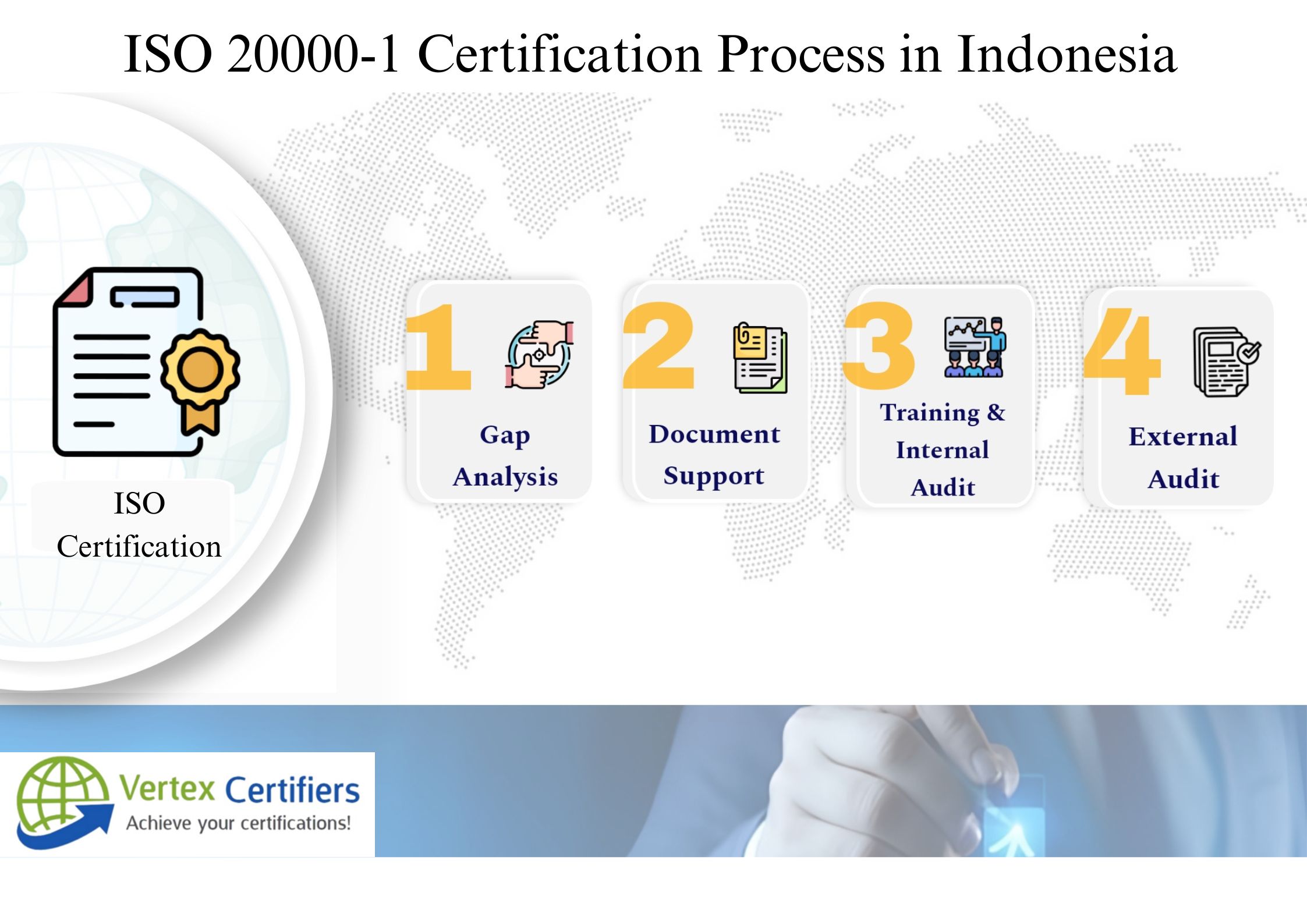
The ISO 20000-1 certification process in Indonesia follows a structured and practical approach to help organizations establish, implement, and maintain an effective Information Technology Service Management System (ITSMS) in line with ISO/IEC 20000-1:2018 requirements. The process typically begins with an initial gap analysis, where the organization’s current IT service management practices are assessed against the requirements of the standard to identify missing controls, weak processes, and improvement opportunities. This is followed by scope definition, where the organization determines which services, departments, business units, applications, support functions, and service delivery locations will be included within the ITSMS. Once the scope is finalized, an IT service assessment is conducted to review the current service environment, including service delivery processes, support structures, SLAs, incident handling, change control, service continuity arrangements, and customer support mechanisms.
Based on this assessment, the organization develops its service management policy and begins formalizing the core service management structure required under ISO 20000-1. This includes service catalogue and SLA review, where the organization defines and standardizes the services it provides, clarifies service commitments, and aligns service levels with customer and business expectations. The next phase involves the design and strengthening of key operational processes such as incident management, problem management, and change management. Incident management processes are developed to ensure timely restoration of services during disruptions, while problem management focuses on identifying root causes of recurring issues and preventing future incidents. Change management processes are designed to ensure that modifications to systems, applications, infrastructure, and service components are assessed, approved, tested, and implemented in a controlled manner. Organizations also establish configuration and asset management controls to maintain visibility and control over IT assets, systems, service components, and relationships between them.
Once the operational processes are defined, the organization moves to service continuity and availability planning, ensuring that critical IT services can continue or recover quickly in the event of service failures, cyber incidents, infrastructure issues, or other disruptions. At the same time, ISO 20000-1 documentation development is carried out, covering policies, procedures, service management records, roles and responsibilities, service review mechanisms, reporting formats, and documented controls required for an effective ITSMS. After documentation is prepared, the organization proceeds with ITSMS implementation, where the defined service management controls and processes are put into day-to-day operation across the in-scope services. To make the system effective, employee training and awareness is conducted so that service teams, technical staff, process owners, and management understand the ITSMS requirements, their operational responsibilities, and the importance of maintaining service quality and consistency.
After implementation, the organization performs an internal audit to verify whether the ITSMS conforms to ISO 20000-1 requirements and is being effectively implemented across the organization. The results of the internal audit are reviewed during a management review, where leadership evaluates service performance, customer issues, process effectiveness, internal audit findings, service risks, resource requirements, and opportunities for continual improvement. Once the organization is satisfied that the ITSMS is mature and audit-ready, it proceeds to the external certification stage. This consists of a Stage 1 Audit, where the certification body reviews the organization’s documentation, scope, preparedness, and system design, followed by a Stage 2 Audit, where the certification body evaluates the practical implementation and effectiveness of the ITSMS across the organization’s service operations. If the audit is successful and any nonconformities are addressed, the organization is granted ISO 20000-1 certification. To maintain certification, the company must undergo annual surveillance audits, which confirm continued compliance, ongoing service management effectiveness, and continual improvement of the IT service management system over time.
Our Services
Our Local Cities

Why ISO 20000-1 Certification is Important in Indonesia
ISO 20000-1 certification is increasingly important in Indonesia because the country’s digital economy is expanding quickly, with rapid growth in software development, SaaS platforms, IT outsourcing, managed services, and cloud-based business models. As more organizations rely on digital services for core operations, there is a stronger need for predictable, well-governed, and consistently delivered IT services.
Indonesia is seeing continuous investment in cloud infrastructure and data centers, growth of telecommunications networks, and expansion of digital platforms in banking, FinTech, e-commerce, healthcare, government, and logistics. Smart city projects and government digitization initiatives also depend on reliable IT service delivery, strong incident management, and controlled changes to systems and applications.
Customers increasingly expect formal Service Level Agreements (SLAs), clear response times, and consistent service quality from IT and digital-service providers. ISO 20000-1 helps organizations put in place structured processes for incident, problem, change, configuration, availability, and service continuity management, improving control over service delivery and performance.
ISO 20000-1 is also relevant because many Indonesian service providers work with international clients, enterprise customers, and global outsourcing arrangements. Certification helps demonstrate that IT services are managed according to an internationally recognized service management framework, aligned with good practices and capable of integrating with information security (ISO 27001), business continuity (ISO 22301), and quality management (ISO 9001).
This is particularly important for software companies, SaaS providers, cloud service providers, managed IT service providers, data centers, telecommunications operators, banking and financial services IT teams, FinTech companies, healthcare IT providers, BPO and support centers, e-commerce and digital marketplaces, and government technology and digital infrastructure providers.
Benefits of ISO 20000-1 Certification in Indonesia
ISO 20000-1 certification helps Indonesian IT and digital-service organizations deliver more reliable, consistent, and well-governed services to their customers and internal users. It provides a structured Service Management System that supports planning, delivery, monitoring, improvement, and integration with other key business controls.
- Improves service quality and service consistency: Establishes standardized processes for planning, delivering, and monitoring IT services.
- Strengthens incident, problem, and change management: Creates clear workflows for handling incidents, diagnosing root causes, and managing changes in a controlled manner.
- Improves customer satisfaction and SLA performance: Supports better response times, communication, and service-level achievement.
- Reduces service disruptions and downtime: Helps identify recurring issues and implement improvements that stabilize services.
- Supports continual improvement in IT operations: Ensures regular review of performance, risks, and improvement opportunities.
- Improves accountability and service governance: Clarifies roles, responsibilities, approvals, and reporting for service management.
- Strengthens confidence of enterprise customers and global clients: Demonstrates that IT services are managed using an internationally recognized service management standard.
- Supports integration with ISO 27001 and ISO 22301: Makes it easier to align service performance with information security and business continuity requirements.
- Improves competitiveness in outsourcing and managed services markets: Certification can be a differentiator in tenders and vendor-selection processes.
- Helps standardize service delivery across teams and locations: Useful for multi-location operations and distributed service teams.
- Supports compliance and operational maturity: Encourages disciplined, repeatable processes that reduce ad-hoc and reactive behavior.
Which Industries Need ISO 20000-1 Certification in Indonesia?
ISO 20000-1 is suitable for any organization that provides IT services to external customers or to internal business units. In Indonesia, it is particularly useful for organizations where service reliability, availability, and governance are critical to business success.
- IT services companies: Providers of infrastructure, support, and managed IT services.
- Software development firms: Especially those that provide long-term support and managed application services.
- SaaS companies: Platforms that must deliver continuous, reliable, and well-supported online services.
- Cloud providers: Organizations offering IaaS, PaaS, or other hosted environments to customers.
- Managed service providers: Companies handling outsourced IT operations, monitoring, and support.
- Telecom operators: Providers of voice, data, and digital communication services with strict service-level expectations.
- Data centers: Facilities that host customer infrastructure and mission-critical applications.
- BPO and customer support centers: Service operations that depend heavily on reliable IT systems and processes.
- Banking and financial services IT teams: Internal teams that manage high-availability systems and customer-facing channels.
- Healthcare technology providers: Organizations delivering health-tech platforms, hospital IT, or clinical information systems.
- E-commerce and digital platform businesses: Online marketplaces and digital-service platforms with large customer bases.
- Government digital service organizations: Public-sector entities responsible for citizen-facing portals and digital infrastructure.
- Large enterprises with internal IT service functions: Organizations that treat internal IT as a formal service provider to business units.
Cost of ISO 20000-1 Certification in Indonesia
The cost of ISO 20000-1 certification in Indonesia varies from one organization to another because service types, scope, and maturity levels are different. There is no single fixed price, as total cost depends on how many services are in scope, how many teams and locations are involved, and how much preparation and consulting support is required.
- Size of the organization: Larger organizations typically have more service lines, stakeholders, and processes to cover.
- Number of IT services covered: A wider service catalogue increases documentation, process mapping, and audit scope.
- Complexity of service delivery processes: Highly integrated or multi-layered service environments require more design and control.
- Number of teams / service locations: Distributed operations add coordination, consistency, and audit-effort requirements.
- Existing maturity of ITSM practices: Organizations already using structured ITSM frameworks may require less change and rework.
- Documentation readiness: Existing policies, procedures, SLAs, and records influence effort and timelines.
- Consultant involvement and audit scope: The level of external guidance and the depth of certification audit both contribute to overall cost.
How Long Does ISO 20000-1 Certification Take in Indonesia?
The implementation timeline depends on organization size, complexity of services, current ITSM maturity, documentation availability, and how quickly internal teams can adapt to new processes. Companies that already use structured service management practices may complete ISO 20000-1 implementation more quickly than those starting from informal or ad-hoc operations.
- Small IT service companies: approximately 30 to 45 days.
- Medium organizations: approximately 45 to 75 days.
- Large / complex service environments: approximately 75 to 120 days.
Actual timelines depend on process maturity, documentation readiness, internal control implementation, resource availability, and readiness for the external certification audit.
Why Choose Vertex Certifiers for ISO 20000-1 Certification in Indonesia?
Vertex Certifiers helps IT and digital-service organizations in Indonesia implement ISO 20000-1 in a way that aligns with real-world service operations, customer expectations, and integration requirements with other standards. The focus is on practical processes, clear documentation, and audit-ready service governance.
- Experienced ISO and IT service management consultants: Support from professionals familiar with both ISO standards and ITSM practices.
- End-to-end implementation support: Assistance from initial gap analysis through to documentation, training, internal audits, and certification coordination.
- Documentation + training + audit readiness support: Structured help to prepare policies, procedures, records, and teams for certification.
- Practical approach aligned with real service operations: Processes designed to fit day-to-day work, not just theoretical models.
- Support across Indonesia cities: Online and onsite support for organizations in major Indonesian technology and business hubs.
- Integration support with ISO 27001 / ISO 22301 / ISO 9001: Guidance for organizations that want a coherent, integrated management system.
- Affordable and structured consulting model: Flexible engagement options for SMEs, growing service providers, and larger enterprises.
How to Apply for ISO 20000-1 Certification in Indonesia
Apply for ISO 20000-1 Certification with Vertex Certifiers
If your organization provides IT or digital services and wants to improve service quality, governance, and competitiveness, Vertex Certifiers can support your ISO 20000-1 implementation and certification across Indonesia.
- Contact Vertex Certifiers to discuss your IT service landscape, target scope, and certification objectives.
- Send your details via email or inquiry form to share information about your services, teams, and locations.
- Request a free consultation, gap analysis, or quotation tailored to your service environment and maturity level.
- Get implementation and certification support across Indonesia through a combination of remote and onsite consulting.
