Vertex Certifiers

ISO 17025 Certification in Indonesia | ISO 17025 Consultants in Indonesia

Vertex Certifiers is a global ISO consulting and compliance support company offering end-to-end ISO/IEC 17025 consulting services in Indonesia for testing and calibration laboratories seeking stronger technical competence, reliable results, and accreditation readiness. We support laboratories across Jakarta, Surabaya, Bandung, Medan, Semarang, Batam, Makassar, Denpasar (Bali), Tangerang, and Bekasi with complete implementation assistance covering initial gap analysis, laboratory system assessment, documentation support, laboratory quality system implementation, internal audits, technical training, method validation support, measurement uncertainty guidance, accreditation audit support, and post-accreditation support. In addition to ISO 17025 consulting, we also support organizations in Indonesia with related standards such as ISO 9001, ISO 14001, ISO 45001, ISO 22000, ISO/IEC 27001, ISO 22301, ISO 50001, ISO/IEC 20000-1, and GMP implementation support. Our ISO 17025 consulting services are relevant for testing laboratories, calibration laboratories, food testing laboratories, pharmaceutical laboratories, environmental laboratories, construction material testing laboratories, medical and clinical support laboratories, textile testing laboratories, electronics testing laboratories, automotive testing laboratories, chemical laboratories, and research & development laboratories that need a structured laboratory management system aligned with international accreditation expectations.

What is ISO 17025?

ISO/IEC 17025 is the internationally recognized standard for the competence of testing and calibration laboratories, published jointly by the International Organization for Standardization and the International Electrotechnical Commission. The current version is ISO/IEC 17025:2017, and it is designed to ensure that laboratories operate competently, generate valid results, and maintain confidence in testing and calibration activities. Unlike general management system standards, ISO 17025 is specifically built for laboratories and combines management system requirements with technical requirements so that the laboratory can consistently produce accurate, reliable, and technically defensible results.

The standard focuses on the competence of laboratory personnel, the validity of test and calibration methods, the reliability of equipment, and the integrity of laboratory operations. It requires laboratories to demonstrate impartiality, maintain consistent procedures, control risks to validity, and implement a management system that supports continual improvement. Laboratories implementing ISO 17025 are expected to establish processes for handling customer requests, reviewing contracts, selecting and validating methods, calibrating equipment, ensuring traceability of measurements, managing sampling and test items, controlling data, and reporting results in a technically sound manner.

Core purpose of ISO 17025 Certification in Indonesia

ISO 17025 helps laboratories establish and maintain a framework for:

  • Laboratory competence – proving that the laboratory has the people, methods, equipment, environment, and controls needed to perform testing or calibration correctly.
  • Validity of test and calibration results – ensuring results are technically accurate, repeatable where applicable, and suitable for customer and regulatory use.
  • Impartiality – reducing risks of bias, conflict of interest, or undue influence that may affect laboratory results.
  • Consistency and reliability of results – using controlled procedures, trained personnel, calibrated equipment, and validated methods to ensure dependable outputs.
  • Laboratory quality management – implementing a structured management system to control documentation, records, nonconformities, corrective actions, audits, and reviews.
  • Technical competence of personnel – ensuring analysts, technicians, reviewers, and signatories are trained, authorized, and periodically evaluated.
  • Equipment calibration and maintenance – controlling instruments, reference standards, and devices so they remain fit for purpose.
  • Method validation / verification – confirming that testing and calibration methods are suitable for intended use and produce valid results.
  • Measurement traceability – linking measurement results to recognized references or standards through an unbroken chain of calibrations where applicable.
  • Measurement uncertainty – evaluating uncertainty where relevant so the laboratory understands and communicates the confidence level of results.
  • Sampling and handling controls – maintaining integrity of samples, test items, storage conditions, transport, and identification.
  • Continual improvement – using internal audits, corrective actions, risk-based thinking, complaints handling, and management reviews to improve the laboratory system over time.

ISO 17025 Certification / Accreditation Process in Indonesia
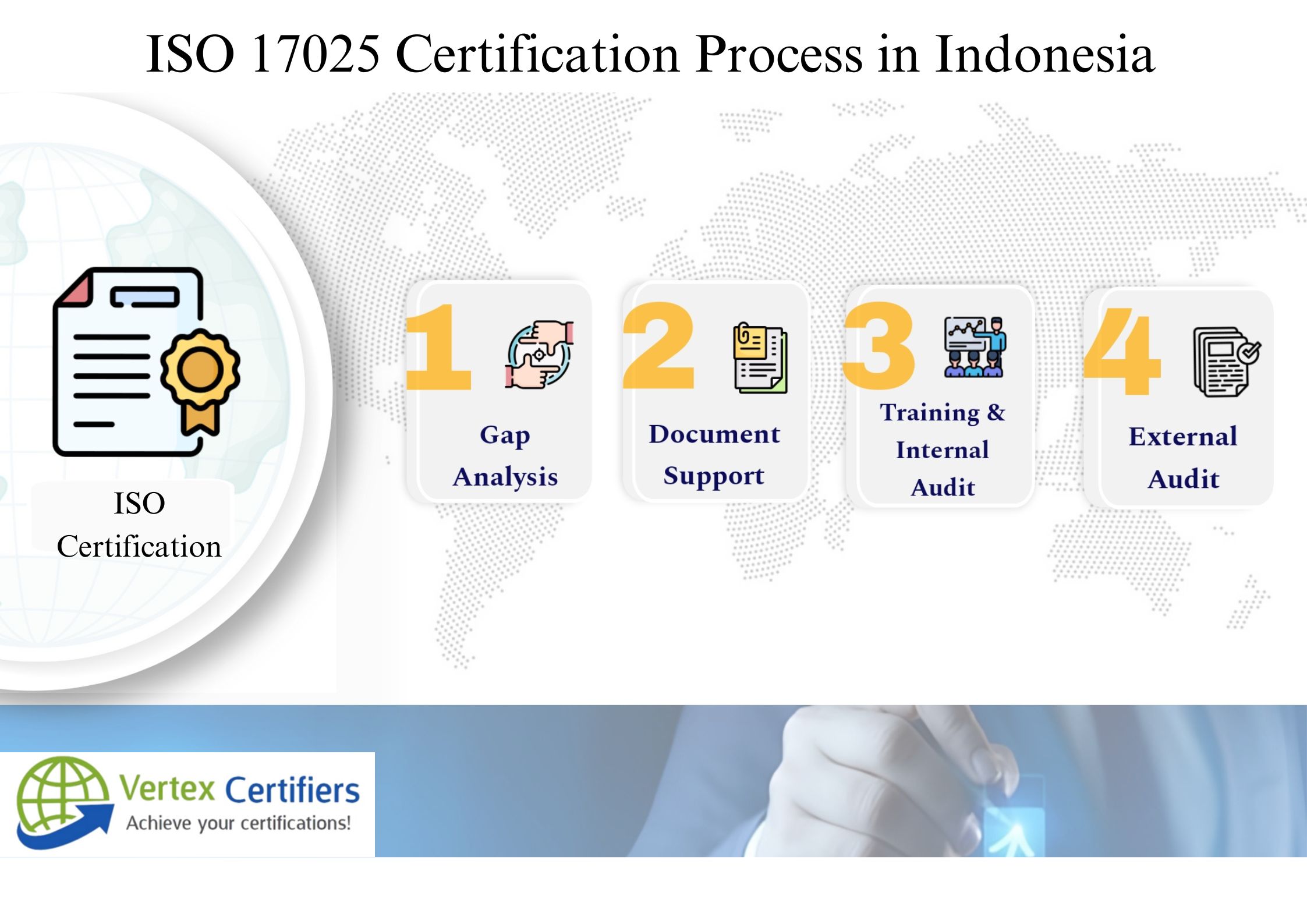
ISO 17025 Certification in Indonesia

Key requirements covered under ISO 17025

An ISO 17025 laboratory management system typically includes the following major elements:

1. Impartiality and confidentiality

Laboratories must identify and manage risks that could compromise impartiality. They must also protect customer information, test results, methods, and records from unauthorized access or disclosure.

2. Structural and resource requirements

The standard expects the laboratory to define responsibilities, authority, competence criteria, infrastructure, environmental conditions, and resource controls necessary for valid results.

3. Process requirements

This is the technical heart of ISO 17025. It covers:

  • Review of requests, tenders, and contracts
  • Selection, verification, and validation of methods
  • Sampling procedures where applicable
  • Handling, transportation, storage, and retention of test or calibration items
  • Technical records and data integrity
  • Evaluation of measurement uncertainty
  • Assuring validity of results through quality control, proficiency testing, replicate testing, or inter-laboratory comparisons
  • Reporting of results and calibration certificates
  • Handling complaints, nonconforming work, and corrective actions

4. Management system requirements

ISO 17025 also requires a controlled management system to support the technical work of the laboratory. This includes:

  • Document control
  • Record control
  • Actions to address risks and opportunities
  • Improvement processes
  • Corrective actions
  • Internal audits
  • Management review

Relationship of ISO 17025 with other standards and accreditation expectations

ISO 17025 vs ISO 9001

ISO 9001 is a general quality management standard that can be applied to almost any organization. It focuses on process consistency, customer satisfaction, leadership, and continual improvement. ISO 17025, on the other hand, is laboratory-specific and goes much deeper into technical competence, method validation, calibration, traceability, uncertainty, and validity of results. A laboratory may use ISO 9001 principles for broader quality management, but ISO 17025 is the more relevant and technically appropriate framework when the goal is laboratory accreditation and recognition of testing or calibration competence.

ISO 17025 vs ISO 15189

ISO 15189 is designed specifically for medical laboratories and includes patient-care and clinical diagnostic requirements that go beyond the scope of ISO 17025. For non-medical testing and calibration laboratories, ISO 17025 is usually the preferred standard. For medical and clinical diagnostic environments, ISO 15189 may be more appropriate depending on the nature of services and regulatory expectations.

ILAC and accreditation requirements

International Laboratory Accreditation Cooperation promotes international acceptance of accredited laboratory results. Laboratories seeking broader market recognition often align their ISO 17025 systems with the expectations of accreditation bodies that operate under ILAC recognition arrangements. This is important for organizations whose reports, test certificates, or calibration results need acceptance by regulators, customers, importers, exporters, or global supply chains.

National accreditation and customer confidence

In practice, ISO 17025 implementation supports national accreditation and strengthens customer confidence because it demonstrates that the laboratory is not merely following documented procedures, but is technically capable of generating trustworthy results. For Indonesian laboratories serving manufacturing, exports, pharmaceuticals, food safety, environmental monitoring, construction materials, electronics, or automotive sectors, ISO 17025 can become a major credibility asset when working with regulators, government agencies, OEMs, and international customers.


    Get Free
    Consultation


    Our Services

    Our Local Cities

    ISO Certification in indonesia

    Why ISO 17025 Certification / Accreditation is Important in Indonesia

    ISO 17025 certification / accreditation is increasingly important in Indonesia because the country’s manufacturing base and export volumes continue to grow, and industries rely heavily on accurate testing and calibration to prove product quality, safety, and compliance. As Indonesian products reach more international markets, buyers and regulators expect test reports and calibration certificates from laboratories that operate under recognized, competence-based standards.

    Reliable laboratory support is essential for sectors such as food and beverage, pharmaceuticals, chemicals, construction, and electronics, where test data directly affect product approval, regulatory clearance, and customer acceptance. ISO 17025-based systems help laboratories demonstrate that their results are technically valid, traceable, and produced under controlled conditions, which supports better decisions in production, safety, and regulatory compliance.

    Industrial development in Indonesia is also driving investment in quality infrastructure, including testing laboratories, calibration centers, and specialized measurement facilities. Traceable and accurate testing and calibration results help manufacturers control process quality, monitor raw materials, verify finished goods, and maintain critical equipment within specified tolerances.

    At the same time, environmental monitoring, pollution control, and sustainability-related testing are becoming more prominent. Environmental laboratories provide data for emissions, effluent, ambient air, water, and soil quality, and ISO 17025 accreditation helps show that these measurements are credible and technically sound.

    ISO 17025 certification / accreditation also supports product quality assurance and supplier approval processes by giving customers confidence in test reports, calibration certificates, and inspection evidence. For many organizations in Indonesia, there is an increased focus on laboratory credibility, technical competence, and integrity of results as a requirement for participation in regulated markets, government contracts, and global supply chains.

    This is particularly important for laboratories involved in food and beverage testing, pharmaceutical and healthcare testing, environmental monitoring, textile and garment testing, electronics and electrical testing, automotive and component testing, construction material and civil engineering testing, chemical and petrochemical analysis, calibration of industrial equipment, and R&D and product testing.

    Benefits of ISO 17025 Certification / Accreditation in Indonesia

    ISO 17025 certification / accreditation helps Indonesian laboratories strengthen technical competence, improve the quality of test and calibration results, and build trust with customers, regulators, and accreditation bodies. It is a powerful tool for laboratories that want to support industrial growth, export competitiveness, and regulatory compliance.

    • Improves credibility of laboratory results: Shows that results are produced under a recognized, competence-based framework.
    • Demonstrates technical competence: Accreditation requires evidence of staff competence, validated methods, and suitable equipment.
    • Improves accuracy and reliability of testing / calibration: Structured method validation, calibration, and quality control help reduce errors and variability.
    • Strengthens customer and regulatory confidence: Customers and regulators are more likely to trust accredited laboratory data for decision-making.
    • Improves method validation and traceability: Methods are validated and results are traceable to reference standards or recognized measurement systems.
    • Reduces errors and retesting: Better control of procedures, equipment, and staff competence lowers the chance of incorrect or inconsistent results.
    • Improves laboratory process control and documentation: Clear procedures, records, and internal checks support consistent, well-documented work.
    • Supports market access and customer approvals: Many customers, export markets, and tenders prefer or require ISO 17025 accredited reports.
    • Helps laboratories meet regulatory and tender requirements: Accreditation often satisfies technical criteria in regulations and procurement specifications.
    • Improves staff competence and accountability: Defined roles, training, and competency evaluation strengthen performance and responsibility.
    • Supports continual improvement in laboratory operations: Nonconformity management, corrective actions, and internal audits drive ongoing improvements.
    • Enhances global acceptance of reports when linked with accreditation frameworks: Accreditation through recognized bodies can support acceptance of reports in international markets and mutual recognition arrangements.

    Which Laboratories and Industries Need ISO 17025 in Indonesia?

    ISO 17025 is applicable to any organization performing testing or calibration, whether it is a standalone laboratory, part of a factory, within a research institution, or operating as a third-party service provider. In Indonesia, many sectors rely on ISO 17025 accredited laboratories to demonstrate product quality, safety, and compliance.

    • Testing laboratories: General testing labs serving multiple industries and product categories.
    • Calibration laboratories: Labs that calibrate instruments used in manufacturing, research, healthcare, and field measurements.
    • Food testing laboratories: Labs verifying food safety, microbiology, contaminants, and nutritional parameters.
    • Pharmaceutical quality control laboratories: Labs supporting drug development, production, and regulatory submissions.
    • Environmental monitoring laboratories: Labs testing air, water, soil, noise, and emissions for regulatory and compliance purposes.
    • Construction material testing laboratories: Labs testing concrete, cement, aggregates, steel, and other civil engineering materials.
    • Textile testing laboratories: Labs assessing fabric properties, color fastness, strength, and regulatory compliance for export markets.
    • Electronics and electrical testing labs: Labs evaluating performance, safety, EMC, and reliability for electronic and electrical products.
    • Automotive testing laboratories: Labs supporting vehicle and component testing, durability, performance, and safety assessments.
    • Chemical laboratories: Labs analyzing raw materials, intermediates, finished products, and industrial chemicals.
    • Oil & gas / petrochemical testing laboratories: Labs handling fuels, lubricants, refinery products, and petrochemical samples.
    • Academic and research laboratories: University and research labs that provide test data for projects, publications, and industry collaboration.
    • Third-party inspection and testing service providers: Organizations providing independent testing or inspection to clients across multiple sectors.

    Cost of ISO 17025 Certification / Accreditation in Indonesia

    The cost of ISO 17025 certification / accreditation in Indonesia varies from one laboratory to another because the scope, test methods, calibration parameters, and technical requirements are different. There is no single fixed price for all laboratories, as the cost depends on how broad the scope is and how much preparation and support are required.

    • Scope of testing / calibration: A wider scope with many tests or calibration services increases documentation, validation, and audit work.
    • Number of methods and parameters covered: More test methods, measurement ranges, and analytical parameters require more validation and technical evidence.
    • Size of laboratory: Larger laboratories with multiple sections generally need more implementation time and resources.
    • Number of technical staff: More staff may require more structured training, competence evaluation, and monitoring.
    • Calibration / validation requirements: Extensive calibration, equipment qualification, and method validation can add to effort and cost.
    • Current maturity of the laboratory system: Laboratories with existing quality systems may require fewer changes than labs starting from basic or informal practices.
    • Accreditation body scope and audit complexity: Different scopes and technical areas may involve varying levels of assessment complexity and duration.
    • Consultant involvement and training needs: The level of external support needed for documentation, method validation, uncertainty evaluation, internal audits, and training will affect total cost.

    How Long Does ISO 17025 Accreditation Take in Indonesia?

    The timeline for achieving ISO 17025 accreditation in Indonesia depends on laboratory size, technical scope, method validation status, equipment readiness, staff competence, and overall documentation maturity. Laboratories with well-documented methods, existing quality systems, and traceable calibrations can often move faster than those starting from minimal structure.

    • Small laboratories: approximately 45 to 60 days.
    • Medium laboratories: approximately 60 to 90 days.
    • Larger / multi-scope laboratories: approximately 90 to 150 days.

    Actual timelines depend on documentation readiness, technical method validation status, calibration traceability, staff competency, internal audit completion, and readiness for external assessment by the accreditation body.

    Why Choose Vertex Certifiers for ISO 17025 Certification in Indonesia?

    Vertex Certifiers supports testing and calibration laboratories in Indonesia through practical ISO 17025 implementation assistance, focusing on both technical requirements and management system expectations. The goal is to help laboratories build robust, audit-ready systems without unnecessary complexity.

    • Experienced ISO 17025 consultants: Guidance from consultants familiar with laboratory operations, technical competence requirements, and accreditation expectations.
    • Support for documentation, method validation, uncertainty, internal audits, and accreditation readiness: Assistance with quality manuals, procedures, test / calibration methods, uncertainty estimation, internal audits, and corrective actions.
    • Practical implementation support for testing and calibration laboratories: Approach tailored to real laboratory workflows and industrial needs.
    • Support across Indonesia cities: Remote and onsite support options for laboratories in major industrial, commercial, and research locations.
    • Integration support with ISO 9001 / ISO 22000 / GMP where relevant: Guidance on aligning ISO 17025 with existing quality and food-safety or GMP systems.
    • Structured and affordable consulting model: Flexible engagement options suitable for small, medium, and larger multi-scope laboratories.

    How to Apply for ISO 17025 Certification in Indonesia

    Apply for ISO 17025 Certification with Vertex Certifiers

    If your laboratory in Indonesia wants to strengthen technical competence, improve credibility of results, and prepare for accreditation, Vertex Certifiers can support you through every stage of ISO 17025 implementation and accreditation readiness.

    • Contact Vertex Certifiers to discuss your laboratory scope, current status, and accreditation objectives.
    • Send your details by email or inquiry form to share information about tests, methods, staff, and equipment.
    • Request a free consultation, gap analysis, or quotation tailored to your laboratory size, scope, and timelines.
    • Get support across Indonesia for implementation and accreditation readiness through a combination of remote guidance and onsite visits as required.
    Contact Vertex Certifiers

      Company Logo

      Get ISO certification


      Fill the details below, one of our executives will contact you shortly


      This will close in 0 seconds

      Call Now Button