Vertex Certifiers

ISO 17100:2015 Certification – ISO 17100 Consultants, Implementation & Certification Services

ISO 17100:2015 Certification is an internationally recognized standard for translation services that helps translation agencies, language service providers (LSPs), localization companies, and multilingual content providers establish a structured and quality-driven translation process. The standard sets requirements for the complete translation workflow, including project management, translator and reviser competence, quality control, resource management, and client communication. Organizations that deliver translation services use ISO 17100 certification to demonstrate that their translation processes are professionally managed, consistently controlled, and aligned with internationally accepted service quality requirements.

Unlike general quality standards, ISO 17100:2015 is specifically designed for the translation services sector. It focuses not only on the final translated output but also on the competence of translators and revisers, the planning and execution of translation projects, the use of appropriate resources, and the implementation of review and revision controls. For translation companies serving legal, technical, medical, financial, software localization, and multilingual content requirements, ISO 17100 implementation can strengthen service reliability, reduce quality issues, and improve client confidence.

Vertex Certifiers provides end-to-end ISO 17100 consulting, implementation, documentation, training, internal audits, and certification support for organizations looking to achieve ISO 17100 compliance. As experienced ISO 17100 consultants, we support businesses through gap analysis, process design, documentation development, implementation guidance, training, audit readiness, and certification audit support. Whether you are a translation agency, localization company, or language service provider, Vertex Certifiers helps you build a practical and compliant framework for translation services certification under ISO 17100:2015.

What is ISO 17100:2015?

ISO 17100:2015 is an international standard that specifies requirements for the provision of translation services. It was developed to establish a globally recognized framework for translation service quality and replaces the earlier European standard EN 15038. ISO 17100 focuses on the full translation service process rather than only the final translated document. This means the standard addresses how translation projects are planned, managed, executed, reviewed, revised, and delivered, with emphasis on competence, control, and consistency throughout the service lifecycle.

The standard defines requirements for the people, processes, and resources involved in translation services. It sets clear expectations for translator competence, reviser competence, project coordination, client communication, technical resources, quality assurance activities, and process controls. A key requirement of ISO 17100 is that translated content should be reviewed and revised by competent personnel through a structured workflow, helping ensure accuracy, consistency, and suitability for the client’s intended purpose.

ISO 17100:2015 is applicable to translation agencies, language service providers (LSPs), localization firms, multilingual content providers, technical translation companies, legal translation providers, medical translation service providers, and organizations managing professional translation projects. The standard covers both human resource requirements and workflow requirements, making it highly relevant for organizations that want to demonstrate professional service delivery and build stronger confidence in translation quality. By implementing ISO 17100, businesses can improve process discipline, reduce translation-related risks, and show clients that their services are managed in accordance with internationally accepted translation service requirements.

ISO 17100 Certification Process

Achieving ISO 17100 certification involves evaluating the organization’s existing translation workflows, aligning them with the requirements of ISO 17100:2015, implementing documented controls, and preparing for certification assessment. The certification journey is not limited to documentation alone; it includes process design, competence management, training, revision controls, internal audits, and readiness for the external certification audit. A structured implementation approach helps translation agencies and language service providers establish consistent, compliant, and quality-focused service delivery processes.

Below is the typical ISO 17100 implementation and certification process followed by organizations seeking certification:
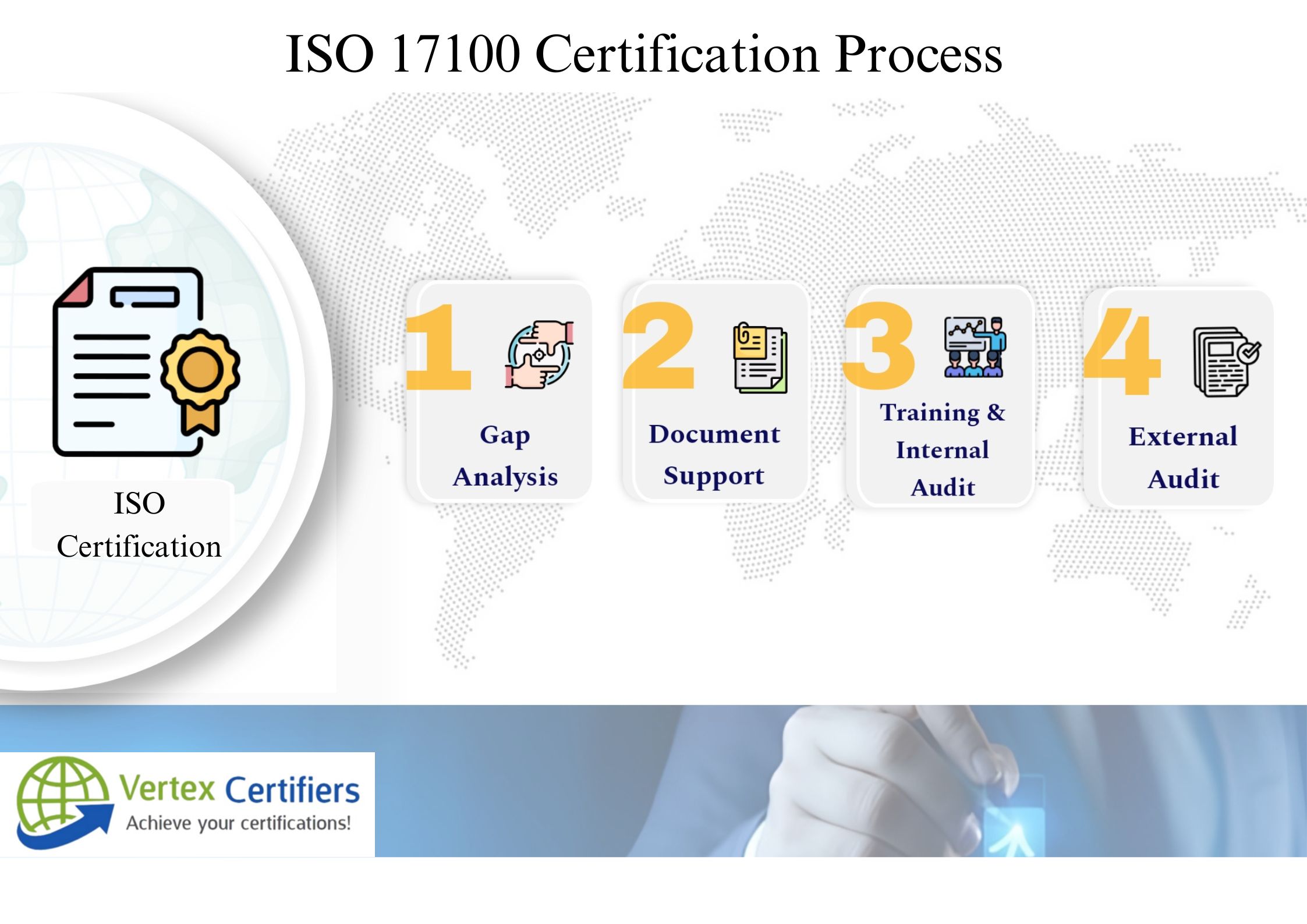
ISO 17100 Certification

Step 1 – Gap Analysis

The first step in ISO 17100 implementation is to perform a gap analysis of the organization’s existing translation services processes. This involves reviewing how translation projects are currently handled, how translators and revisers are selected, how client requirements are captured, how revisions are managed, and what quality controls are already in place. The purpose of the gap analysis is to identify missing controls, documentation gaps, competence gaps, and process weaknesses against the requirements of ISO 17100:2015. This stage provides a clear implementation roadmap and helps the organization understand what changes are required before moving toward certification.

Step 2 – Scope Definition

Once the gap analysis is completed, the next step is to define the scope of the ISO 17100 certification. This includes identifying the translation services, departments, teams, locations, language pairs, and activities that will be covered under the certification scope. For example, the scope may include legal translation, medical translation, technical translation, localization services, or multilingual content management. Clearly defining the scope helps ensure that the implementation, documentation, training, and audit activities are aligned with the actual services delivered by the organization.

Step 3 – Documentation Development

After defining the scope, the organization develops and formalizes the documentation needed to support ISO 17100 compliance. Documentation is an essential part of the standard because it ensures that translation processes are controlled, repeatable, and consistently followed. Depending on the size and complexity of the organization, this stage may include the development of translation process procedures, project management procedures, translator competence evaluation criteria, supplier or freelancer onboarding procedures, revision and review checklists, quality control forms, client requirement review formats, confidentiality controls, complaint handling procedures, and corrective action records. Proper documentation creates the foundation for implementation and helps demonstrate compliance during audits.

Step 4 – Process Implementation

Once the documentation is prepared, the organization begins implementing the ISO 17100 framework across its translation projects and operational teams. This includes deploying the documented procedures, assigning roles and responsibilities, ensuring that translators and revisers meet defined competence criteria, applying project review and planning controls, and establishing structured revision and quality review workflows. Process implementation also involves integrating client requirement review, terminology management, version control, quality checks, and final verification steps into day-to-day project operations. The objective is to ensure that ISO 17100 is not just documented, but actively practiced within the organization.

Step 5 – Training and Awareness

Training is a critical part of successful ISO 17100 implementation. Employees and relevant external resources should understand the requirements of the standard and their role in maintaining compliance. Training and awareness sessions are typically provided for project managers, translators, revisers, reviewers, vendor coordinators, and quality personnel. These sessions help teams understand project workflow requirements, competence expectations, revision responsibilities, documentation practices, confidentiality obligations, and quality assurance controls. Effective training improves implementation consistency and helps reduce nonconformities during internal and certification audits.

Step 6 – Internal Audit

Before applying for certification, the organization should conduct an internal audit to assess whether the ISO 17100 system has been effectively implemented. The internal audit reviews documented procedures, project files, competence records, revision controls, client requirement reviews, and actual implementation practices to identify any nonconformities or weak areas. The purpose of this stage is to verify readiness, ensure compliance with ISO 17100 requirements, and initiate corrective actions where needed. Internal audits are important because they help organizations identify issues early and strengthen the system before the external certification assessment.

Step 7 – Management Review / Readiness Review

After the internal audit, the organization performs a management review or readiness review to evaluate the overall effectiveness of the ISO 17100 system. During this stage, management reviews audit findings, resource adequacy, competence issues, customer complaints, operational challenges, corrective actions, and opportunities for improvement. The readiness review helps confirm whether the organization is prepared for certification and whether the implemented processes are functioning as intended. It also ensures that leadership is actively involved in maintaining service quality and supporting continual improvement within the translation service framework.

Step 8 – Certification Audit

The final step is the ISO 17100 certification audit conducted by an accredited certification body. During this audit, the auditor reviews the organization’s documentation, translation workflow controls, competence records, revision practices, project management processes, and evidence of implementation against the requirements of ISO 17100:2015. If any nonconformities are identified, the organization will need to address them and provide corrective action evidence. Once the certification body is satisfied that the organization meets the standard’s requirements, it will recommend the organization for ISO 17100 certification. After successful certification, the organization must continue maintaining the system through ongoing compliance, internal audits, and periodic surveillance audits.

    Get Free
    Consultation


    Our Services

    ISO 17100:2015 Content Sections | Vertex Certifiers

    Why is ISO 17100 Certification Important?

    ISO 17100:2015 is important because it gives translation companies a recognized framework for delivering controlled, competent, and quality-focused translation services. The standard sets requirements for core processes, resources, and service delivery controls, helping a translation service provider demonstrate that its processes and resources can consistently meet client and applicable specifications.

    Business Importance

    • Demonstrates professional and controlled translation processes across enquiry, planning, execution, revision, verification, and delivery.
    • Builds trust with international clients that expect structured quality controls before outsourcing translation work.
    • Improves translation quality and consistency by requiring defined workflows, competent personnel, and documented checks.
    • Ensures competent translators and revisers are assigned based on qualification, language ability, and subject matter capability.

    Commercial Value

    • Strengthens project planning, communication, and review controls throughout the translation lifecycle.
    • Helps reduce translation errors, rework, avoidable corrections, and client complaints through mandatory revision and verification steps.
    • Supports tender eligibility and global business opportunities where buyers prefer or require internationally recognized service standards.
    • Enhances reputation in the language services market by showing commitment to reliable and professionally managed delivery.

    Who Needs ISO 17100 Certification?

    ISO 17100 is intended for translation service providers of any size. It is especially relevant for organizations that deliver written translation services for clients who expect qualified resources, bilingual revision, documented project control, and dependable service quality.

    • Translation agencies.
    • Language service providers (LSPs).
    • Localization companies.
    • Interpretation and multilingual content companies where translation services are also part of the business scope.
    • Legal translation service providers.
    • Medical and pharmaceutical translation providers.
    • Technical document translation companies.
    • Software and app localization companies.
    • E-learning and publishing translation companies.
    • BPO and KPO firms offering translation services.

    Scope of ISO 17100:2015

    ISO 17100:2015 covers the processes, resources, and controls required for the delivery of a quality translation service. It applies to written translation services and specifically excludes interpreting services as well as raw machine translation output with post-editing as the service model.

    a

    Translation Process Requirements

    • Enquiry handling and feasibility review.
    • Quotation and agreement review.
    • Project planning and project registration.
    • Assignment of competent translators and supporting resources.
    • Terminology, reference material, and linguistic specification management.
    • Translation execution, self-check, revision, review where needed, final verification, and delivery.
    b

    Resource Requirements

    • Qualified translators.
    • Competent revisers and reviewers.
    • Project managers with responsibility for process control.
    • Technical and technological resources needed for project preparation and delivery.
    • Documented procedures, competence records, project files, and service evidence.
    c

    Quality and Control Requirements

    • Review mechanisms and documented service controls.
    • Mandatory revision by someone other than the translator.
    • Corrective actions for process and output nonconformities.
    • Document control, project records, and traceability.
    • Client feedback handling, closing administration, and confidentiality safeguards where relevant.

    Key Requirements of ISO 17100:2015

    ISO 17100 is a process-specific translation services standard, so its requirements go beyond general quality intent and move into operational controls, competence criteria, revision discipline, and project-level accountability.

    7.1 Competence of Translators

    • Translators must have documented evidence of competence and qualification.
    • Evidence can include recognized translation qualifications, other graduate qualifications with translation experience, or equivalent professional experience.
    • Competence should cover language ability, translation ability, cultural understanding, subject matter competence, research skills, and technical ability.

    7.2 Competence of Revisers / Reviewers

    • Revisers must be competent in the source and target languages used in the assignment.
    • They should be able to compare source and translated text accurately.
    • Their role is to check suitability, completeness, accuracy, and consistency for the agreed purpose.

    7.3 Project and Production Process

    • Client requirements, deadlines, subject field, format, terminology, style, and audience must be reviewed before work starts.
    • Resources have to be assigned according to competence and project needs.
    • Communication with the client must be controlled throughout the project.

    7.4 Pre-Production Activities

    • Feasibility review and project specification confirmation are required.
    • Technical preparation, file handling, glossaries, references, and terminology resources should be organized before translation begins.
    • Scope confirmation helps reduce misunderstandings, delays, and quality gaps later in the workflow.

    7.5 Translation Process

    • Translation must be performed by a competent translator.
    • The translator should follow agreed terminology, style guides, client instructions, target audience expectations, and contextual meaning.
    • A self-check is expected before the translation is submitted for further control.

    7.6 Revision

    • Revision is mandatory and must be conducted by a second qualified person.
    • This is a bilingual examination of target content against source content.
    • Errors, omissions, inconsistencies, and suitability issues are identified and corrected before release.

    7.7 Review and Proofreading (if applicable)

    • Review may be used as a monolingual examination of the target text for purpose and usability.
    • Proofreading may be applied for formatting, layout, and pre-publication checks where required.
    • These steps help strengthen linguistic consistency and final presentation quality.

    7.8 Post-Production and Delivery

    • Final verification is required before release to the client.
    • Delivery, project closure, feedback collection, and record retention should be controlled.
    • Good post-production practices improve traceability and future project learning.

    7.9 Confidentiality and Data Handling

    • Client documents should be handled securely throughout the assignment.
    • Translators, revisers, and staff should work under confidentiality obligations.
    • Access control, secure transfer methods, and protection of sensitive project data are important supporting controls.

    Benefits of ISO 17100 Certification

    • Improved translation quality and consistency.
    • Better project planning and workflow control.
    • Stronger confidence among clients and global buyers.
    • Clear qualification criteria for translators and revisers.
    • Reduced risk of translation mistakes and quality complaints.
    • Better handling of technical, legal, medical, and regulated translation projects.
    • Improved efficiency and accountability across translation assignments.
    • Stronger market positioning for tenders and enterprise clients.
    • Enhanced credibility for multilingual and localization services.
    • Better documentation, traceability, and service reliability.

    Who Can Get ISO 17100 Certification?

    Any organization that provides structured written translation services and can demonstrate conformity with the standard’s process and competence requirements can pursue certification. This includes established agencies as well as specialized service networks that operate with documented controls, qualified resources, and managed revision activities.

    Single-language translation agencies Multilingual service providers Freelance translator networks with controlled processes Localization and subtitling firms Medical, legal, technical, and financial translation companies Companies serving international clients with high-quality translation requirements

    Difference Between ISO 17100 and General Quality Standards

    AspectISO 17100ISO 9001 / Internal Review Practices
    PurposeSpecific to translation services and translation workflow control.ISO 9001 is a generic quality management standard, while internal practices may vary by company.
    Competence FocusDefines competence and qualification expectations for translators, revisers, reviewers, and project managers.General quality systems do not define translation-specific competence criteria in the same level of detail.
    Revision RequirementRequires revision by someone other than the translator.Internal review methods may be informal or inconsistent depending on the company.
    Workflow SpecificityAddresses enquiry, quotation, project preparation, translation, revision, review, verification, feedback, and records.ISO 9001 focuses broadly on process quality and customer satisfaction rather than translation-specific controls.
    RecognitionProvides a recognized and structured framework tailored for professional translation services.General quality systems support management quality but do not by themselves prove translation-specific control.

    Challenges in Implementing ISO 17100

    Many translation businesses already perform strong work, but implementation becomes difficult when processes remain informal or depend too heavily on individuals. These challenges can be resolved through structured implementation, documented controls, and practical consulting guidance.

    • Lack of documented workflow and inconsistent project execution.
    • Inconsistent translator onboarding and competence evaluation criteria.
    • Absence of formal revision controls and approval responsibilities.
    • Difficulty maintaining freelancer competence records.
    • Inconsistent terminology handling across projects and languages.
    • Lack of project documentation and traceability.
    • Difficulty meeting client-specific quality expectations across languages.
    • Confidentiality and document handling issues in distributed translation teams.

    How Vertex Certifiers Helps with ISO 17100 Certification

    Vertex Certifiers supports translation companies and multilingual service organizations with structured consulting aligned to ISO 17100:2015 requirements and certification expectations.

    Gap Assessment

    Assessment against ISO 17100:2015 to identify process, competence, and documentation gaps.

    Scope Definition

    Support in defining the appropriate certification scope based on services, teams, and operating locations.

    Documentation Support

    End-to-end support for procedures, formats, records, workflow controls, and templates.

    Implementation Guidance

    Practical support in setting up translation, revision, review, verification, and project management controls.

    Competence Framework Setup

    Support for translator qualification review, competence evaluation, and revision framework development.

    Training and Awareness

    Awareness sessions for translators, revisers, project managers, and management teams.

    Internal Audit Support

    Assistance with internal audits, findings, readiness checks, and compliance review.

    Audit Coordination

    Corrective action closure support, certification audit coordination, and post-certification assistance.

    Vertex supports translation companies, localization providers, multilingual service organizations, and global agencies operating across multiple cities and countries.

    Why Choose Vertex Certifiers for ISO 17100 Consulting

    • Experienced ISO consultants.
    • Practical implementation approach.
    • Documentation and execution support.
    • Remote and onsite consulting support.
    • Cost-effective certification guidance.
    • Support for SMEs and large organizations.
    • Support for multi-location and international service providers.
    • Assistance until successful certification audit closure.

    Industries / Translation Segments Covered

    Vertex supports ISO 17100 implementation across specialized translation sectors where competence, revision, terminology management, and documented controls are essential.

    Legal Translation

    Contracts, case files, compliance documents, and official legal content.

    Medical Translation

    Clinical materials, healthcare information, and patient-facing documentation.

    Pharmaceutical Translation

    Regulatory files, product inserts, pharmacovigilance, and scientific material.

    Financial Translation

    Statements, reports, disclosures, and investor communication.

    Technical & Engineering Translation

    Manuals, specifications, technical documents, and engineering content.

    Software Localization

    Apps, interfaces, strings, product updates, and platform localization.

    Website Localization

    Web pages, portals, landing pages, and multilingual digital content.

    Publishing & E-learning

    Books, training modules, educational content, and digital learning assets.

    Government & Tender Projects

    Public sector translation requirements, tender submissions, and official multilingual communication.

    FAQs on ISO 17100 Certification

    What is ISO 17100:2015 certification?

    It is a certification framework for translation service providers that verifies conformity with translation-specific process, competence, resource, and quality control requirements.

    Who should get ISO 17100 certification?

    Translation agencies, localization firms, multilingual service providers, and specialized translation companies should consider it.

    Is ISO 17100 applicable to freelance translators?

    Freelance translators may be included where they work within structured and documented translation service processes.

    What are the main requirements of ISO 17100?

    Main requirements include competence, project preparation, translation, self-check, revision by a second person, final verification, records, and feedback handling.

    Does ISO 17100 require revision by a second person?

    Yes. Revision is a core requirement and must be completed by someone other than the translator.

    How long does ISO 17100 certification take?

    The timeline depends on existing processes, documentation maturity, team structure, and audit readiness.

    What documents are required for ISO 17100 certification?

    Typical documents include procedures, project templates, competence records, revision evidence, confidentiality controls, client feedback records, and audit support documents.

    What is the difference between ISO 17100 and ISO 9001?

    ISO 17100 is specific to translation services, while ISO 9001 is a general quality management standard.

    Can a localization company get ISO 17100 certified?

    Yes, if written translation services are within the defined scope and required controls are implemented.

    How much does ISO 17100 certification cost?

    The cost depends on organization size, scope, number of locations, consultant support, and certification body charges.

    Can ISO 17100 be integrated with ISO 9001 or ISO 27001?

    Yes, it can be aligned with broader quality and information security systems.

    How can Vertex Certifiers help with ISO 17100 implementation?

    Vertex can support gap analysis, documentation, implementation, training, internal audits, corrective actions, and certification audit coordination.

    Get ISO 17100 Certification Support from Vertex Certifiers

    Strengthen your translation service processes with expert support for documentation, implementation, training, internal audits, and certification readiness.

    • Talk to our ISO consultants for translation services certification.
    • Request a free consultation or gap analysis.
    • Get support for documentation, implementation, training, and audit coordination.

      Company Logo

      Get ISO certification


      Fill the details below, one of our executives will contact you shortly


      This will close in 0 seconds

      Call Now Button