ISO 22000 Certification in Germany:
ISO 22000 Certification in Germany, Vertex Certifiers is an international ISO consulting company providing comprehensive ISO 22000 certification consulting services for organizations across Germany. Our experienced consultants offer complete implementation support, including gap analysis, HACCP risk assessment, Food Safety Management System documentation, FSMS implementation, employee training, internal audits, management review assistance, and certification audit support. Whether your organization operates in Berlin, Hamburg, Munich, Frankfurt, Cologne, Stuttgart, Düsseldorf, Leipzig, Dortmund, Bremen, or any other city in Germany, we provide practical, cost-effective, and customized consulting solutions to help you achieve ISO 22000 certification successfully.
Germany is one of Europe’s largest food manufacturing and food processing economies, with a highly developed agriculture, dairy, meat processing, bakery, confectionery, beverage, and packaged food industry. As German food products are widely distributed across the European Union and exported to global markets, maintaining high standards of food safety has become essential for ensuring regulatory compliance, consumer protection, product quality, and international competitiveness. Implementing ISO 22000 helps organizations strengthen food safety controls, improve traceability, reduce food safety risks, and meet the stringent expectations of retailers, business partners, and international customers.
What is ISO 22000?
ISO 22000:2018 is the internationally recognized standard for establishing, implementing, maintaining, and continually improving a Food Safety Management System (FSMS). Published by the International Organization for Standardization (ISO), the standard provides organizations with a structured framework to identify food safety hazards, establish effective control measures, and consistently produce safe food products that meet customer, legal, and regulatory requirements.
The standard is suitable for every organization involved in the food supply chain, regardless of its size or complexity. This includes agricultural producers, food manufacturers, dairy plants, meat processors, beverage companies, bakeries, food packaging manufacturers, warehouses, logistics providers, supermarkets, restaurants, catering companies, ingredient suppliers, and other businesses whose activities directly or indirectly influence food safety.
ISO 22000 integrates internationally accepted food safety practices with modern management system principles to create a comprehensive and effective Food Safety Management System. The standard is built upon several key elements, including:
- HACCP (Hazard Analysis and Critical Control Point) Principles for identifying, evaluating, and controlling biological, chemical, physical, and allergen hazards throughout the food production process.
- Prerequisite Programs (PRPs) that establish hygienic conditions, sanitation practices, facility maintenance, pest control, supplier management, and other essential operational controls necessary for food safety.
- Operational Prerequisite Programs (OPRPs) to manage significant food safety hazards that require operational control but are not classified as Critical Control Points (CCPs).
- Risk-Based Thinking, enabling organizations to proactively identify, assess, and manage risks and opportunities that could impact food safety performance and business continuity.
- The Plan-Do-Check-Act (PDCA) Cycle, which promotes systematic planning, implementation, monitoring, performance evaluation, and continual improvement of the Food Safety Management System.
Achieving ISO 22000 certification demonstrates an organization’s commitment to producing safe, high-quality food products while continually improving its food safety management practices. Certification enhances customer confidence, strengthens regulatory compliance, supports international trade, reduces food safety risks, and provides a significant competitive advantage in domestic and global food markets.
Procedure to get ISO 22000 Certification in Germany:
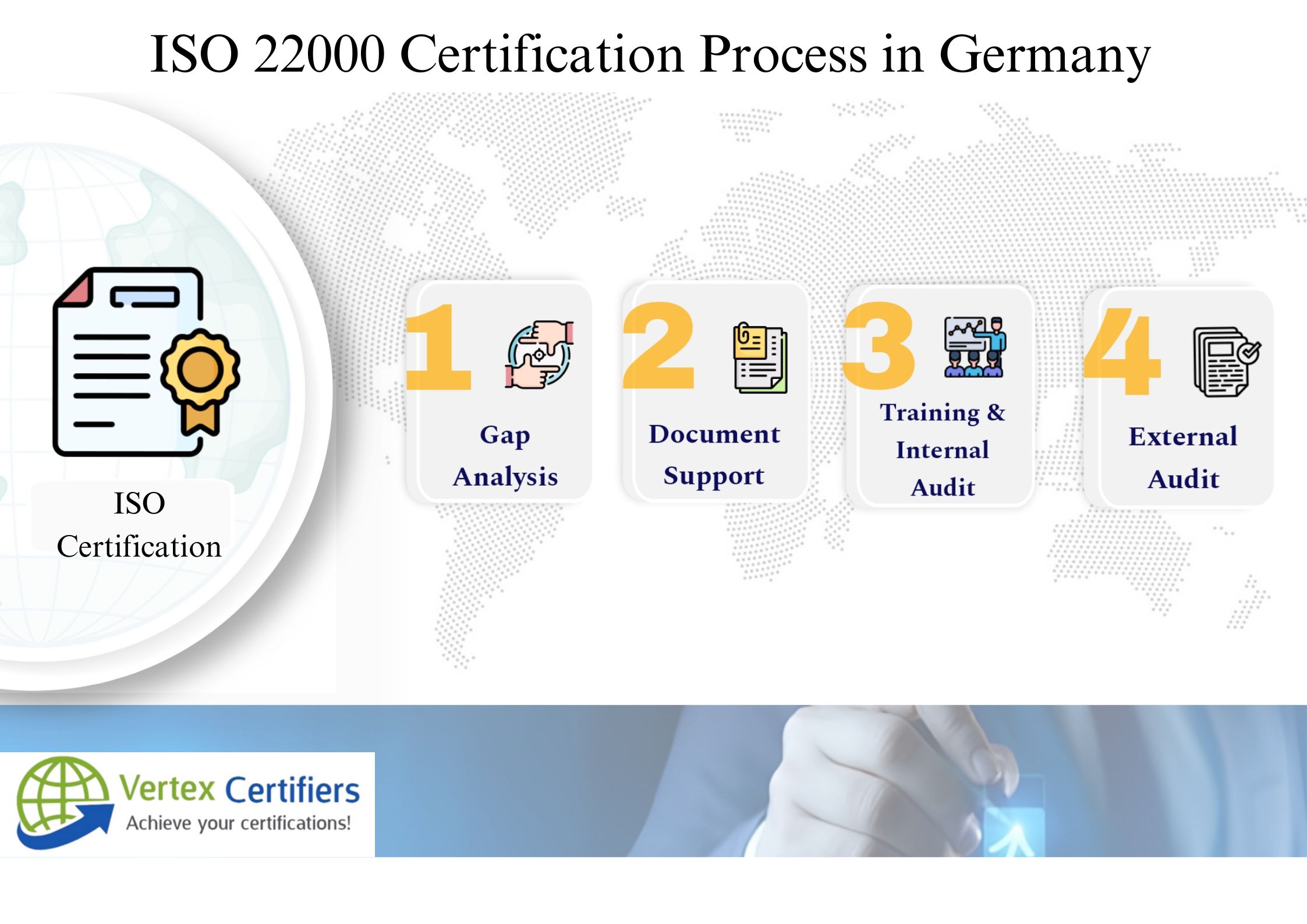
Build a safer, stronger, and more export-ready food business in Germany
Germany has a powerful and quality-focused food industry, and official government information says about one third of German agricultural output is exported while the food industry earns about one third of its turnover from export activities. ISO 22000 gives food businesses a structured food safety management system built around hazard control, communication, prerequisite programs, and HACCP principles, making it highly relevant for companies that want safer operations, stronger customer trust, and better market access.
Why Germany matters for ISO 22000
Germany is recognized for food quality, safety, and strong processed food exports. For organizations operating in this environment, a certified and disciplined FSMS helps align internal controls with buyer expectations, supply chain demands, and legal obligations.
Why ISO 22000 Certification is Important in Germany
ISO 22000 is important in Germany because the country’s food industry is highly quality-driven, export-oriented, and closely linked with European and global supply chains. The standard helps organizations create a systematic food safety framework that supports safe products, disciplined operations, and confidence across the food chain.
Strong food safety performance
- ISO 22000 helps organizations improve food safety performance through a structured FSMS based on hazard identification, prevention, monitoring, and continual control.
- Because HACCP principles are integrated, businesses can control biological, chemical, and physical hazards in a disciplined way.
- This reduces dependence on reactive correction and promotes preventive management throughout operations.
Customer and retailer acceptance
- Retailers, importers, distributors, and large buyers often expect formal food safety controls before onboarding or retaining suppliers.
- Certification gives a strong third-party signal that the organization has implemented recognized food safety requirements.
- This supports supplier approval, tender participation, and contract renewal discussions.
Export support across Europe and globally
- Germany’s food sector is deeply linked to export activity, making internationally recognized systems valuable for cross-border trade.
- ISO 22000 helps products move more confidently across Europe and global markets by showing that food safety hazards are managed through an internationally recognized framework.
- It also makes communication with foreign customers and global supply chains more consistent.
Food safety culture and employee awareness
- Food safety culture becomes stronger when roles, responsibilities, hygiene practices, reporting, and corrective actions are clearly defined.
- ISO 22000 encourages leadership involvement and employee participation, which improves discipline on the shop floor and across support functions.
- Training and documented responsibilities reduce the chance of unsafe shortcuts or inconsistent practices.
Lower contamination risks
- By evaluating hazards and implementing operational controls, organizations can reduce contamination risks before they affect finished products.
- Prerequisite programs, sanitation controls, process checks, and verification activities work together to create safer production conditions.
- This is especially valuable for high-risk operations such as dairy, meat, poultry, seafood, and ready-to-eat foods.
Better traceability and incident response
- ISO 22000 supports better traceability by defining controls over materials, batches, records, suppliers, and finished products.
- Stronger traceability helps organizations react faster during complaints, deviations, withdrawals, or recalls.
- Faster traceability means lower disruption, better accountability, and more credible communication with customers and regulators.
Higher customer confidence
- Customers want assurance that food is produced under controlled and verified conditions.
- Certification improves confidence by showing commitment to recognized food safety practices and independent assessment.
- This is useful for B2B buyers, retailers, institutional customers, and end consumers who increasingly value safety and transparency.
Legal and regulatory alignment
- Food safety in Germany is strongly influenced by EU legislation that applies directly across member states.
- ISO 22000 helps organizations build a management structure that supports compliance with applicable legal, customer, and regulatory expectations.
- It does not replace legal compliance, but it makes compliance management more organized and auditable.
Supplier management and operational efficiency
- Supplier controls become stronger when organizations define approval criteria, communication requirements, incoming checks, and performance review methods.
- Standardized processes improve consistency, reduce avoidable waste, lower rework, and improve coordination between production, quality, procurement, and logistics.
- That means food safety improvement and efficiency improvement can happen together.
Benefits of ISO 22000 Certification
ISO 22000 provides operational, commercial, and reputational advantages for food chain organizations in Germany. It is useful not only for manufacturers, but also for storage, logistics, retail, catering, packaging, farms, and feed-related organizations.
Management & control
- Improved food safety management through a structured FSMS.
- Effective hazard control using HACCP-based risk thinking.
- Better operational control over critical activities and records.
- Reduced operational risks through preventive controls.
- Continual improvement through audits, review, and corrective action.
Business & market value
- International recognition through a globally known standard.
- Increased export opportunities across Europe and other markets.
- Competitive business advantage during buyer evaluation and tenders.
- Stronger brand reputation through visible commitment to food safety.
- Better customer satisfaction due to consistency and trust.
Risk & compliance value
- Improved regulatory compliance management.
- Reduced product recalls through stronger controls and traceability.
- Better supplier evaluation and approval processes.
- Improved incident preparedness and response capability.
- Better evidence for customers, retailers, and interested parties.
Practical business impact
When ISO 22000 is implemented properly, organizations often gain clearer process ownership, stronger hygiene discipline, more reliable documentation, better communication between departments, and greater confidence during customer audits. For export-oriented German businesses, these improvements can directly support market access and supply chain acceptance.
Who Needs ISO 22000 Certification?
ISO 22000 is suitable for any organization involved in the food chain, whether it handles production, processing, packaging, storage, transport, retail, ingredients, farming, or food service. The standard is not limited to large factories; small and medium businesses can also benefit significantly.
Food Manufacturers
For processed food production, hygiene control, and hazard management.
Dairy Companies
For milk, cheese, yogurt, and chilled product safety systems.
Meat Processing Plants
For slaughtering, cutting, handling, and contamination prevention.
Poultry Industry
For hygienic processing, storage, and product control.
Seafood Processing
For cold-chain, freshness, and handling discipline.
Beverage Manufacturers
For water, juices, soft drinks, and beverage safety controls.
Breweries
For controlled brewing, hygiene, packaging, and distribution.
Bakeries
For process consistency, allergen control, and traceability.
Confectionery Manufacturers
For ingredient control, batch traceability, and hygiene checks.
Fruit & Vegetable Processing
For washing, sorting, cutting, freezing, and packing controls.
Frozen Food Manufacturers
For temperature integrity and distribution assurance.
Organic Food Producers
For safety discipline alongside organic product positioning.
Food Packaging Companies
For food-contact material safety and process control.
Cold Storage Facilities
For storage conditions, monitoring, and product protection.
Warehouses
For controlled storage, stock rotation, and traceability.
Food Logistics Companies
For safe transport, handling, and supply chain communication.
Catering Services
For food preparation, hygiene, and service consistency.
Restaurants
For organized food handling and customer confidence.
Hotels
For kitchen operations, supplier control, and safe service.
Supermarkets
For storage, handling, deli counters, and private label confidence.
Food Ingredient Suppliers
For raw material assurance and customer approval support.
Agriculture & Farms
For primary production controls and supply chain alignment.
Animal Feed Manufacturers
For feed safety and food chain support controls.
ISO 22000 Implementation Process
A successful implementation project should be practical, staged, and aligned with the organization’s real processes. Below is a clear 10-step implementation model suitable for businesses in Germany.
Gap Analysis
The project starts by comparing current food safety practices against ISO 22000 requirements. This includes a review of existing HACCP, hygiene controls, records, process flows, supplier controls, traceability, legal practices, and management system maturity. The result is a gap report showing what already exists, what needs improvement, and what needs to be newly developed.
Project Planning
After the gap analysis, the organization defines the project scope, departments involved, implementation team, roles, timeline, and deliverables. Planning should include milestones for documentation, training, process controls, internal audits, and certification preparation. Good planning keeps implementation realistic and avoids confusion later.
HACCP Study
The HACCP study is a core part of ISO 22000. The organization identifies food safety hazards, evaluates risks, determines control measures, defines critical or operational controls where needed, and documents monitoring and corrective actions. This step connects food safety theory with actual production and handling operations.
Food Safety Documentation
Required documents are developed or updated to support the FSMS. This may include the food safety policy, scope, process descriptions, hazard analysis, PRPs, SOPs, work instructions, traceability procedures, cleaning plans, nonconformity controls, internal audit procedures, and management review formats. Documentation should be practical and easy for teams to use.
Employee Training
Employees, supervisors, HACCP team members, internal auditors, and key support staff need training relevant to their roles. Training normally covers food safety awareness, hygiene, process controls, CCP or OPRP responsibilities, documentation use, deviation reporting, and audit readiness. Well-trained employees are essential for implementation success.
FSMS Implementation
At this stage, documented controls are put into real use. Monitoring records are maintained, hygiene and operational controls are followed, supplier management is applied, traceability is tested, and food safety communication becomes part of routine operations. This is where the system moves from paperwork into working practice.
Internal Audit
Internal audits are carried out to verify whether the FSMS is implemented effectively and conforms to ISO 22000 requirements. Audits identify weak areas, missing evidence, process deviations, and opportunities for improvement. The findings help the organization take corrective action before the certification audit.
Management Review
Top management reviews the performance of the FSMS, including audit findings, objectives, customer issues, supplier performance, process results, nonconformities, corrective actions, and improvement needs. This review demonstrates leadership commitment and ensures the system remains suitable, adequate, and effective.
Certification Audit
An accredited certification body conducts the external audit in stages. The auditors review the documented system, implementation evidence, process effectiveness, legal awareness, and overall conformity to ISO 22000. Any nonconformities identified must be corrected within the required timeframe.
ISO 22000 Certification
Once the audit is successfully completed and any findings are closed, the organization receives its ISO 22000 certificate. The company then continues to maintain the system through surveillance audits, internal checks, management reviews, and continual improvement activities.
ISO 22000 Certification Cost in Germany
ISO 22000 certification cost in Germany depends on several business-specific factors rather than a single standard fee. Consulting charges, implementation effort, training needs, internal preparation, and certification body audit fees can vary significantly from one organization to another.
- Organization size and workforce structure.
- Number of employees involved in food safety-related activities.
- Number of production, storage, or distribution locations.
- Product categories and level of operational risk.
- Existing HACCP system maturity and current food safety controls.
- Existing ISO certifications such as ISO 9001 or ISO 14001.
- Documentation readiness and current record management quality.
- Scope of certification and processes included.
- Certification body selected and audit duration.
Vertex Certifiers provides customized and affordable quotations based on organizational requirements, operational complexity, and project scope. This gives businesses a more realistic and cost-effective certification plan.
How to keep certification cost under control
- Start with a proper gap analysis so resources focus on real gaps.
- Use existing HACCP and management system controls where possible.
- Train internal teams early to reduce delays and rework.
- Prepare documentation in a practical and audit-ready format.
- Choose a certification scope that matches actual business needs.
Time Required for ISO 22000 Certification
The implementation timeline depends on the organization’s current level of food safety control, process complexity, and resource availability. Businesses with structured systems and active management support generally move faster.
| Organization Type | Typical Timeline | Notes |
|---|---|---|
| Small businesses | 2–3 months | Suitable when operations are simple and basic controls already exist. |
| Medium organizations | 3–5 months | Common for manufacturers or processors with moderate complexity. |
| Large enterprises | 4–6 months | May require longer due to multiple sites, products, and internal approvals. |
Factors affecting duration
- Existing food safety practices and process maturity.
- Complexity of operations and production flow.
- Number of sites, warehouses, or logistics points.
- Availability of internal resources and decision-making speed.
- Employee involvement and management commitment.
Fast implementation is possible when the organization assigns clear responsibilities, supports staff training, and responds quickly to documentation and corrective action requirements.
Why Choose Vertex Certifiers?
Vertex Certifiers supports organizations in Germany with practical ISO 22000 consulting, HACCP-focused implementation, and audit preparation designed around real operational needs.
Expert implementation support
- International ISO consulting company.
- Experienced ISO 22000 consultants.
- HACCP implementation expertise.
- Practical documentation support.
Flexible project delivery
- Customized implementation approach.
- Remote and on-site consulting across Germany.
- Fast implementation based on business needs.
- Affordable consulting packages.
Certification readiness
- Internal auditor training.
- Certification audit assistance.
- Post-certification support.
- Hands-on help from planning to certification.
Industries We Serve
Vertex Certifiers supports a wide range of food sector organizations with implementation, training, documentation, internal audit, and certification readiness services.
ISO 22000 Certification Services Across Germany
Vertex Certifiers offers both remote and on-site ISO 22000 consulting services throughout Germany, helping businesses implement food safety systems with flexible support options.
Berlin
ISO 22000 consulting, documentation, HACCP support, and audit preparation for food businesses in Berlin.
Hamburg
Remote and on-site services for manufacturers, logistics, seafood, and trading companies in Hamburg.
Munich
Practical food safety consulting for production, hospitality, and packaged food businesses in Munich.
Frankfurt
Support for food manufacturers, distributors, and import-export operations in Frankfurt.
Cologne
ISO 22000 implementation and certification assistance for growing food sector organizations in Cologne.
Stuttgart
Food safety system consulting for industrial food operations and supply chain businesses in Stuttgart.
Düsseldorf
Flexible consulting support for processors, packaging companies, and food service businesses in Düsseldorf.
Leipzig
ISO 22000 guidance for food processing, warehousing, and logistics businesses in Leipzig.
Dortmund
On-site and remote implementation support for food production and distribution organizations in Dortmund.
Bremen
Certification consulting for seafood, logistics, storage, and export-related food businesses in Bremen.
Remote and on-site consulting services are available throughout Germany based on client requirements and project scope.
Frequently Asked Questions
These FAQs help organizations in Germany understand ISO 22000 certification, practical requirements, and business value.
1. What is ISO 22000 Certification?
2. Who needs ISO 22000 certification in Germany?
3. Is ISO 22000 mandatory?
4. How long does certification take?
5. What is the cost of ISO 22000 certification in Germany?
6. Is HACCP included in ISO 22000?
7. Can small food businesses obtain ISO 22000 certification?
8. How long is an ISO 22000 certificate valid?
9. What documents are required?
10. How often are surveillance audits conducted?
11. Can ISO 22000 be integrated with ISO 9001 or ISO 14001?
12. What are the major benefits of ISO 22000?
13. How does ISO 22000 support exports within the EU?
14. How can Vertex Certifiers help organizations achieve certification?
15. What industries benefit most from ISO 22000 certification?
Partner with Vertex Certifiers for ISO 22000 in Germany
Vertex Certifiers supports food businesses across Germany with structured ISO 22000 consulting, HACCP implementation guidance, practical documentation support, internal auditor training, and certification audit coordination. Our team offers both remote and on-site consulting services to help organizations achieve certification faster and with more confidence.
- Customized consulting based on your scope, products, and operations.
- Affordable implementation packages for small, medium, and large organizations.
- Hands-on support from gap analysis to final certification.
Achieve ISO 22000 Certification in Germany with Expert Consultants
Looking to implement an internationally recognized Food Safety Management System (FSMS)? Vertex Certifiers provides complete ISO 22000 consulting, HACCP implementation, documentation, employee training, internal audits, and certification audit support for organizations across Germany. Our experts help food manufacturers, processors, logistics providers, restaurants, and food businesses achieve certification efficiently while complying with international food safety requirements.
