
ISO Certification in Saudi Arabia for Construction Companies:
ISO Certification in Saudi Arabia for Construction Companies, Vertex Certifiers is an international ISO consulting company providing end-to-end ISO certification consulting services for construction companies throughout Saudi Arabia. We assist civil contractors, EPC companies, infrastructure developers, building contractors, MEP contractors, architectural firms, engineering consultants, project management consultants, real estate developers, industrial construction companies, and other organizations in implementing internationally recognized ISO standards, including ISO 9001 (Quality Management System), ISO 14001 (Environmental Management System), ISO 45001 (Occupational Health and Safety Management System), ISO 19650 (Building Information Modelling – Information Management), ISO 27001 (Information Security Management System), ISO 22301 (Business Continuity Management System), ISO 50001 (Energy Management System), ISO 41001 (Facility Management System), and ISO 55001 (Asset Management System). Our comprehensive consulting services include gap analysis, documentation development, risk assessments, employee training, implementation support, internal audits, management review facilitation, and certification audit coordination. We provide both remote and on-site consulting services across Riyadh, Jeddah, Dammam, Khobar, Jubail, Yanbu, Mecca, Medina, Tabuk, Abha, and other cities throughout Saudi Arabia, helping construction organizations achieve ISO certification efficiently while meeting international best practices and project-specific compliance requirements.
Saudi Arabia’s construction industry is experiencing unprecedented growth, driven by Saudi Vision 2030 and the Kingdom’s ambitious economic diversification initiatives. Massive investments in mega infrastructure projects, smart cities, commercial developments, residential communities, industrial zones, transportation infrastructure, oil and gas facilities, and renewable energy projects are transforming the country’s construction landscape. Landmark developments such as NEOM, The Red Sea Project, Qiddiya, Diriyah Gate, and numerous public infrastructure projects continue to create significant opportunities for construction companies while increasing expectations for quality, safety, sustainability, and international best practices.
This rapid expansion has fueled the growth of construction companies, civil contractors, EPC (Engineering, Procurement, and Construction) contractors, infrastructure developers, building contractors, MEP contractors, architectural firms, engineering consultants, Project Management Consultants (PMC), and real estate developers throughout Saudi Arabia. As organizations compete for large-scale public and private sector projects, implementing internationally recognized ISO management systems has become increasingly important for improving operational efficiency, reducing project risks, ensuring regulatory compliance, and delivering projects that consistently meet client expectations.
Process of ISO Certification in Saudi Arabia for Construction Companies
Achieving ISO certification requires a structured implementation process that enables construction companies to establish effective management systems, improve project performance, manage risks, and comply with international standards. At Vertex Certifiers, we guide organizations through every stage of the certification journey, ensuring practical implementation that aligns with both ISO requirements and the operational needs of the construction industry.
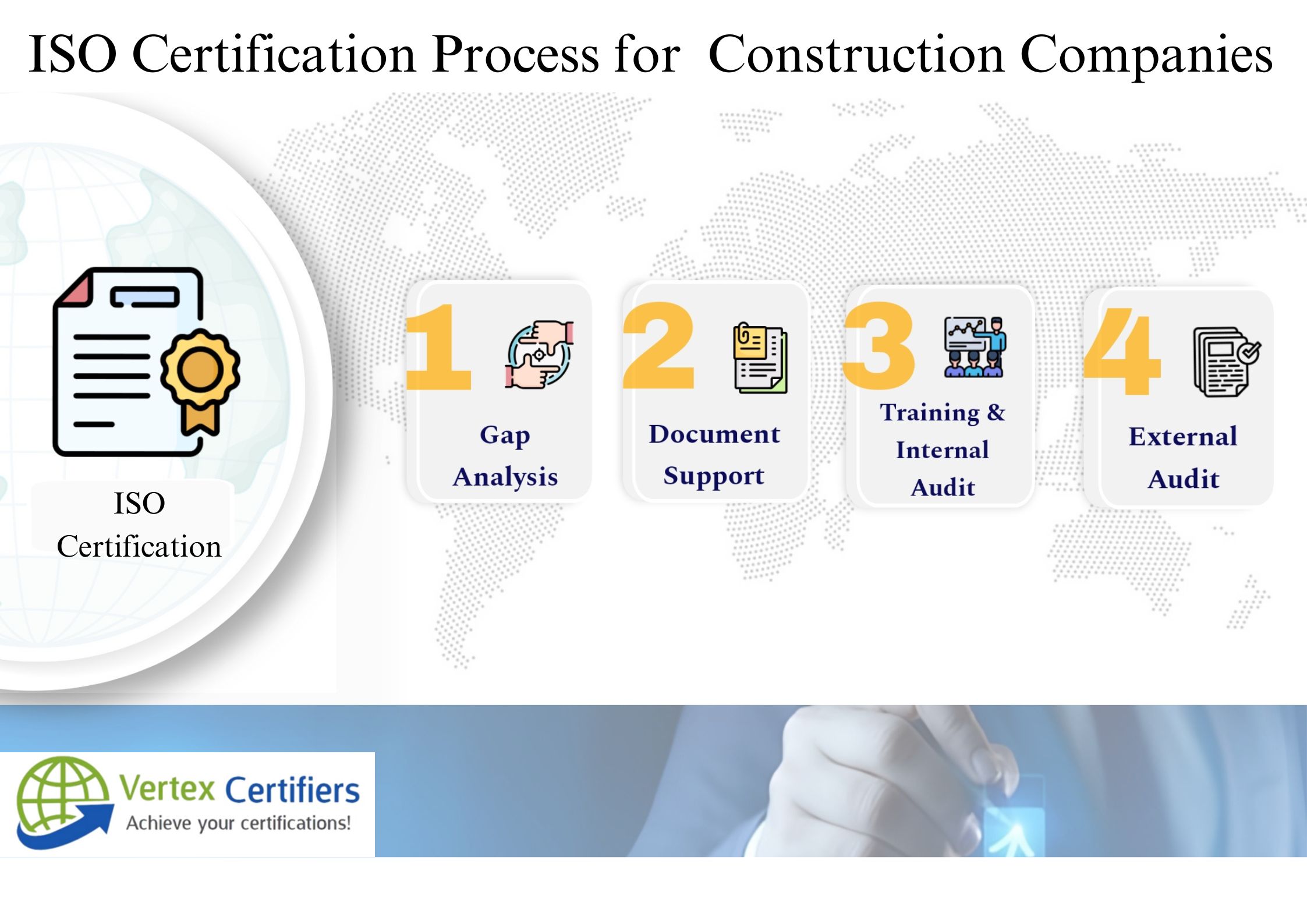
Step 1 – Gap Analysis
The certification process begins with a detailed gap analysis to evaluate the organization’s existing management systems against the requirements of the selected ISO standard. This assessment identifies compliance gaps, operational risks, improvement opportunities, and implementation priorities, creating a clear roadmap for certification.
Step 2 – Planning
Based on the findings of the gap analysis, a comprehensive implementation plan is developed. The project scope, objectives, responsibilities, timelines, resources, and implementation milestones are defined to ensure an organized and efficient certification process.
Step 3 – Documentation
The required management system documentation is developed or updated in accordance with the applicable ISO standard. This includes policies, procedures, process maps, work instructions, risk registers, operational controls, inspection records, forms, and other documented information necessary to support consistent project execution and compliance.
Step 4 – Implementation
Once the documentation has been finalized, the management system is implemented across the organization. Employees begin applying the documented procedures and operational controls within day-to-day construction activities, ensuring the ISO requirements are effectively integrated into project planning, execution, monitoring, and management.
Step 5 – Employee Training
Management, engineers, supervisors, project managers, site personnel, and other employees receive awareness and competency-based training on the implemented management system. The training ensures personnel understand their responsibilities, organizational procedures, compliance obligations, and continual improvement practices required under the selected ISO standard.
Step 6 – Internal Audit
An internal audit is conducted to verify that the management system has been effectively implemented and complies with ISO requirements. The audit identifies any nonconformities, process weaknesses, or opportunities for improvement, enabling corrective actions to be completed before the certification audit.
Step 7 – Management Review
Top management conducts a formal management review to evaluate the overall effectiveness of the management system. This review considers audit results, project performance, customer feedback, organizational objectives, compliance status, resource requirements, risks, opportunities, and continual improvement initiatives to ensure the system remains suitable and effective.
Step 8 – Certification Audit
The final stage involves an independent certification audit performed by an accredited certification body. Auditors assess both the documented management system and its practical implementation throughout the organization. Following successful completion of the audit and closure of any identified nonconformities, the construction company is awarded ISO certification, demonstrating its commitment to quality, safety, environmental responsibility, risk management, and internationally recognized best practices.