Vertex Certifiers is an international ISO consulting company providing end-to-end ISO 14001 consulting, implementation, employee training, internal audits, and certification support for organizations across Poland. Our experienced ISO consultants assist businesses throughout every stage of certification, including gap analysis, environmental aspect and impact assessment, EMS documentation, implementation support, employee awareness training, internal audits, management review, and certification audit coordination. We provide practical, cost-effective, and industry-specific ISO 14001 consulting services to organizations across Warsaw, Kraków, Wrocław, Poznań, Gdańsk, Łódź, Katowice, Lublin, Szczecin, Bydgoszcz, and other cities throughout Poland.
Poland is one of Europe’s leading industrial economies, with strong growth across automotive manufacturing, aerospace, electronics manufacturing, machinery and industrial equipment, food processing, chemical manufacturing, pharmaceuticals, construction, renewable energy, mining, steel and metal fabrication, logistics and warehousing, Information Technology (IT), packaging, textile manufacturing, and furniture manufacturing. As environmental regulations continue to evolve and customers increasingly prioritize sustainable business practices, organizations are expected to adopt internationally recognized Environmental Management Systems that improve operational efficiency while reducing their environmental footprint.
ISO 14001:2015 helps Polish organizations establish a proactive approach to environmental management through environmental aspect identification, pollution prevention, resource efficiency, waste reduction, energy conservation, and continual performance improvement. Businesses implementing ISO 14001 can improve compliance with environmental legislation, strengthen stakeholder confidence, reduce operational risks, optimize the use of natural resources, and enhance their competitiveness in both domestic and international markets. The standard also supports organizations in integrating environmental sustainability into strategic decision-making while promoting responsible and sustainable business operations.
What is ISO 14001 Certification in Poland ?
ISO 14001:2015 is the internationally recognized standard for establishing, implementing, maintaining, and continually improving an Environmental Management System (EMS). Developed by the International Organization for Standardization (ISO), the standard provides organizations with a structured framework for managing environmental responsibilities, improving environmental performance, reducing pollution, and ensuring compliance with applicable environmental laws and regulations. ISO 14001 is applicable to organizations of all sizes and industries, including manufacturing, construction, logistics, healthcare, energy, food processing, engineering, and professional service organizations.
An Environmental Management System (EMS) enables organizations to systematically identify environmental aspects associated with their activities, products, and services while implementing controls to minimize adverse environmental impacts. The EMS integrates environmental objectives into business operations, helping organizations improve resource efficiency, reduce waste generation, conserve energy and water, prevent pollution, and manage environmental risks in a structured and measurable manner.
ISO 14001 is based on the Plan-Do-Check-Act (PDCA) methodology, which supports continual improvement of environmental performance. Organizations establish environmental policies and objectives during the planning phase, implement operational controls and environmental programs, monitor and measure performance, conduct internal audits, evaluate compliance, and implement corrective actions to continually enhance the effectiveness of their Environmental Management System. This systematic approach enables organizations to adapt to changing environmental conditions, regulatory requirements, and stakeholder expectations.
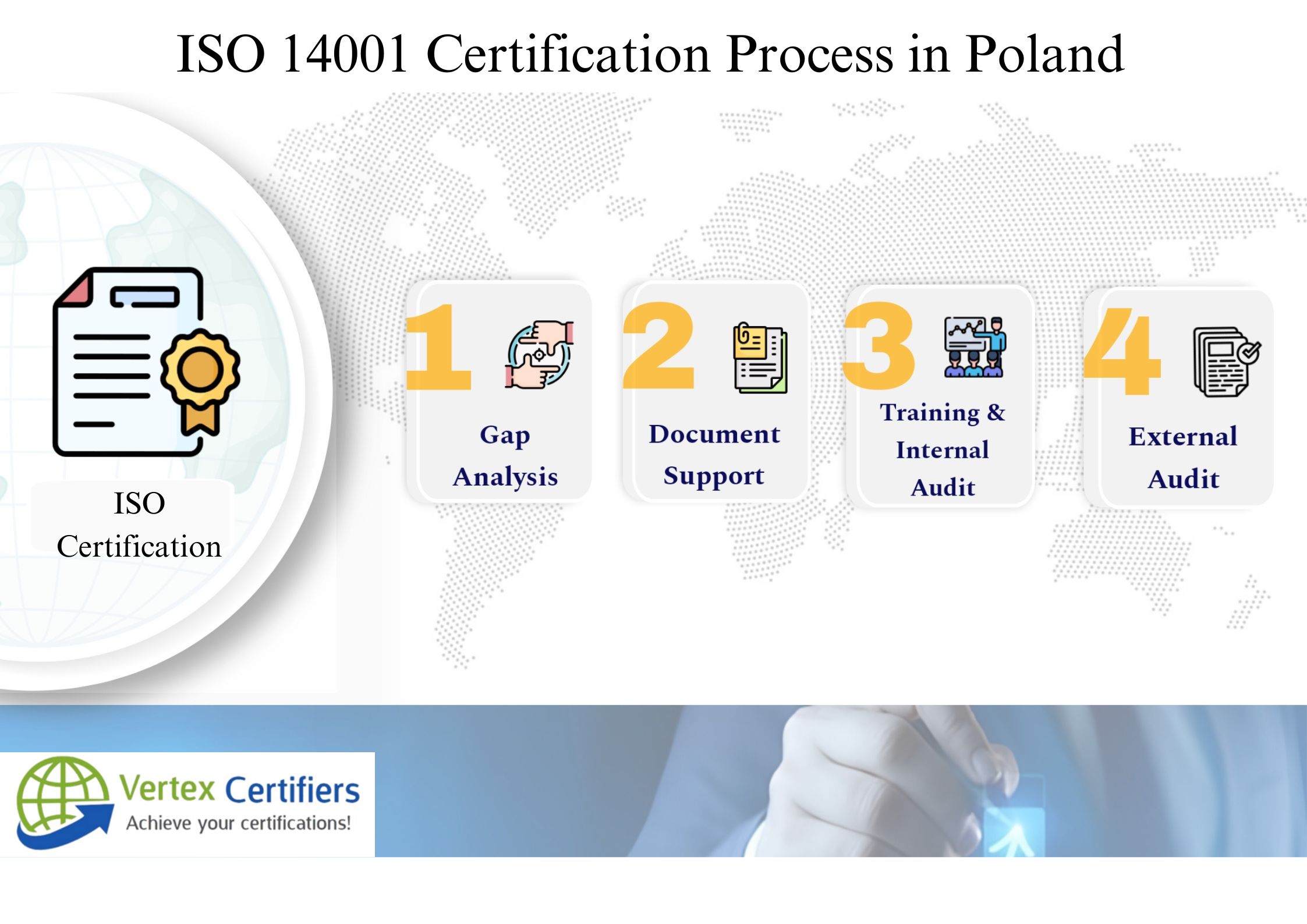
ISO 14001 Certification Process in Poland
Obtaining ISO 14001 Certification in Poland involves a structured implementation process that enables organizations to establish an effective Environmental Management System aligned with international environmental management requirements.
1. Initial Consultation
The certification process begins with understanding the organization’s business activities, environmental objectives, operational processes, legal obligations, and existing environmental management practices. The project scope, implementation strategy, and certification timeline are established.
2. Gap Analysis
A comprehensive gap analysis is conducted to compare the organization’s current environmental management practices with the requirements of ISO 14001:2015. Areas requiring improvement are identified, and a detailed implementation roadmap is prepared.
3. Environmental Aspect & Impact Assessment
Environmental aspects associated with the organization’s activities, products, and services are identified and evaluated to determine their environmental impacts. Significant environmental aspects, environmental risks, legal requirements, and opportunities for improvement are documented to establish appropriate environmental controls.
4. EMS Documentation
The required Environmental Management System documentation is developed, including the environmental policy, objectives, procedures, operational controls, environmental aspect register, legal compliance register, emergency preparedness procedures, monitoring records, and other documented information required by ISO 14001.
5. EMS Implementation
The documented Environmental Management System is implemented across the organization. Environmental controls, operational procedures, waste management practices, pollution prevention measures, resource conservation initiatives, and monitoring activities are integrated into day-to-day business operations.
6. Employee Training
Employees receive awareness and competency training on ISO 14001 requirements, environmental responsibilities, pollution prevention, emergency response, waste management, resource conservation, environmental objectives, and operational procedures to ensure successful implementation of the EMS.
7. Internal Audit
An internal audit is conducted to evaluate the effectiveness of the Environmental Management System, verify compliance with ISO 14001 requirements, identify nonconformities, and recommend corrective actions before the certification audit.
8. Management Review
Top management reviews the overall performance of the Environmental Management System, including environmental objectives, compliance status, audit findings, resource requirements, environmental performance indicators, customer and stakeholder feedback, and opportunities for continual improvement.
9. Certification Audit (Stage 1 & Stage 2)
An accredited certification body conducts the certification audit in two stages. Stage 1 evaluates the organization’s EMS documentation and preparedness, while Stage 2 verifies the practical implementation, operational effectiveness, and compliance of the Environmental Management System with ISO 14001:2015 requirements.
10. ISO 14001 Certification
After successfully completing the certification audit and addressing any identified nonconformities, the organization is awarded ISO 14001 Certification. The certification demonstrates the organization’s commitment to environmental sustainability, pollution prevention, regulatory compliance, continual improvement, and responsible environmental management. Regular surveillance audits ensure the Environmental Management System remains effective and continues to comply with ISO 14001 requirements.
ISO 14001 Certification in Poland | Vertex Certifiers
Vertex Certifiers
ISO 14001 Certification in Poland
Build a stronger environmental management system with ISO 14001 consulting across Poland
Vertex Certifiers supports Polish organizations with ISO 14001 consulting, implementation, environmental training, internal audits, EMS documentation, and certification support across Poland.
3) Why ISO 14001 Certification is Important in Poland
ISO 14001 is important for Polish organizations because it helps them manage environmental responsibilities systematically while improving operational performance. It gives companies a practical framework to reduce impact, comply with regulations, and demonstrate responsible business conduct.
Compliance with environmental regulations
ISO 14001 helps organizations identify legal obligations and build controls that support ongoing compliance. This is valuable for businesses that operate in regulated sectors or handle environmental permits, emissions, waste, and resource usage.
Reduced environmental impact
The system helps businesses identify and control activities that can cause pollution, emissions, waste, and resource depletion. This leads to a more responsible environmental footprint.
Improved resource efficiency
Organizations learn to use materials, energy, water, and other inputs more efficiently. That often improves productivity and lowers avoidable losses.
Lower waste generation
Structured environmental controls help reduce scrap, defective output, packaging waste, and other forms of unnecessary waste. This can also reduce disposal costs.
Energy and water conservation
ISO 14001 encourages businesses to monitor consumption and implement conservation measures. Over time, this can reduce operating costs and improve sustainability performance.
Enhanced corporate reputation
Certification signals that the company takes sustainability and environmental responsibility seriously. That can strengthen trust with customers, investors, employees, and local communities.
Increased customer confidence
Clients are more confident when they see that an organization manages environmental risks through a documented system. This is particularly important in supply chains with ESG expectations.
Competitive advantage
ISO 14001 can help Polish businesses stand out in tenders, supplier evaluations, and export opportunities. It often becomes a strong differentiator in competitive markets.
Better operational efficiency
Clear environmental controls, defined responsibilities, and measurable objectives often lead to smoother operations and fewer inefficiencies. The result is better coordination across departments.
Sustainable business growth
The standard helps organizations grow in a way that is more resilient and responsible. It supports long-term planning, reduced risk, and improved performance.
4) Industries that Need ISO 14001 Certification in Poland
Many industries in Poland benefit from ISO 14001 because they have environmental impacts linked to materials, energy use, emissions, waste, logistics, or complex operations. The sectors below are especially relevant for implementation.
Automotive manufacturers
Auto component manufacturers
Aerospace companies
Electronics manufacturers
Machinery manufacturers
Industrial equipment manufacturers
Food processing companies
Chemical manufacturers
Pharmaceutical companies
Construction companies
Mining companies
Steel manufacturers
Metal fabrication companies
Packaging manufacturers
Textile manufacturers
Furniture manufacturers
Renewable energy companies
Logistics companies
Warehousing companies
Engineering companies
5) Benefits of ISO 14001 Certification
ISO 14001 gives organizations a practical framework for managing environmental performance and improving business discipline. It helps companies reduce impact while creating measurable gains in efficiency and reputation.
Improved environmental performance
The EMS helps organizations monitor and improve how they manage environmental aspects, from raw material use to emissions and disposal. This makes performance more visible and manageable.
Better regulatory compliance
A structured system supports compliance with environmental laws, permits, and reporting requirements. This reduces the risk of missed obligations and related penalties.
Pollution prevention
Organizations can identify sources of pollution early and put controls in place to prevent or minimize them. Prevention is usually more effective than correction after the fact.
Reduced waste and emissions
By managing processes better, businesses can reduce scrap, waste output, air emissions, and disposal volumes. This often produces environmental and financial benefits.
Efficient resource utilization
ISO 14001 encourages smarter use of materials, water, energy, and consumables. Better utilization lowers waste and improves productivity.
Lower operating costs
Reduced waste, lower energy usage, and more efficient processes can lead to meaningful cost savings. These gains may continue as the system matures.
Improved energy efficiency
Organizations can measure energy use, identify inefficiencies, and implement practical actions to improve efficiency. This often supports broader sustainability goals.
Enhanced stakeholder confidence
Customers, regulators, investors, and employees are more likely to trust organizations that can demonstrate environmental responsibility. Certification provides that reassurance.
Better risk management
The standard helps businesses anticipate environmental risks, compliance risks, and operational disruptions. This improves resilience and decision-making.
Stronger brand reputation
A visible commitment to environmental management strengthens brand credibility and supports sustainability claims. This can be valuable in local and international markets.
Increased business opportunities
Certification can help businesses meet customer requirements, prequalification criteria, and supplier expectations. That may open new commercial opportunities.
Continual improvement
ISO 14001 requires regular review, audits, corrective action, and management review. This creates an ongoing cycle of environmental improvement.
6) ISO 14001 Requirements
ISO 14001 is based on a management system approach that helps organizations plan, operate, evaluate, and improve environmental performance. Below is a brief explanation of the main requirements.
Context of the organization
The organization identifies internal and external issues, interested parties, and the scope of its Environmental Management System (EMS).
Leadership
Top management must show commitment, define responsibilities, and ensure the EMS aligns with strategic direction.
Environmental policy
The company defines a policy that reflects commitment to environmental protection, compliance, and continual improvement.
Planning
Environmental risks and opportunities are identified, legal obligations are considered, and objectives are planned.
Support
The organization provides competence, awareness, communication, resources, and documented information needed for the EMS.
Operational control
Processes are controlled to manage environmental aspects and reduce negative impacts during normal and abnormal conditions.
Environmental aspects and impacts
The organization identifies activities, products, and services that can interact with the environment and evaluates their impacts.
Objectives and KPI development
Targets and key performance indicators help track environmental improvement over time.
Performance evaluation
The company monitors, measures, and evaluates environmental performance to verify effectiveness.
Internal audits
Internal audits confirm whether the EMS is implemented as planned and follows ISO 14001 requirements.
Management review
Top management reviews performance data, audit results, compliance status, and improvement needs.
Continual improvement
The organization improves its EMS using audits, corrective actions, and performance analysis.
How Vertex Certifiers Helps
Initial gap assessment.
Environmental aspect identification.
Risk and compliance evaluation.
EMS documentation.
Environmental objectives and KPI development.
Employee awareness training.
Internal audits.
Corrective action support.
Certification audit coordination.
Post-certification support.
Vertex Certifiers supports organizations throughout Poland with practical ISO 14001 implementation and compliance support.
Why Choose Vertex Certifiers?
International ISO consulting experience.
Experienced ISO 14001 consultants.
Practical implementation approach.
Cost-effective consulting.
Fast project execution.
Industry-specific expertise.
Remote and onsite implementation support.
High certification success rate.
End-to-end assistance.
Ongoing compliance support.
10) Industries Served
Vertex Certifiers serves a wide range of industries in Poland with ISO 14001 consulting and certification support.
Automotive
Aerospace
Electronics
Machinery
Manufacturing
Food Processing
Chemicals
Pharmaceuticals
Construction
Mining
Steel & Metal
Packaging
Textiles
Furniture
Renewable Energy
Logistics
Warehousing
Engineering
Information Technology
Professional Services
11) Cities We Serve in Poland
Vertex Certifiers provides ISO 14001 consulting, implementation, environmental training, internal audits, EMS documentation, and certification support across Poland.
Warsaw
We support Warsaw-based organizations with ISO 14001 consulting, EMS implementation, training, and certification coordination for environmental compliance and sustainability goals.
Kraków
Our ISO 14001 services in Kraków help businesses improve environmental controls, reduce impact, and prepare for certification success.
Wrocław
Vertex assists companies in Wrocław with environmental aspect identification, documentation, internal audits, and practical ISO 14001 implementation.
Poznań
We provide ISO 14001 support in Poznań for businesses seeking better compliance, resource efficiency, and stronger environmental performance.
Gdańsk
Vertex Certifiers delivers ISO 14001 consulting in Gdańsk for organizations that want structured EMS development and audit-ready processes.
Łódź
Our Łódź services include EMS documentation, employee awareness training, internal audits, and certification readiness support.
Katowice
We help Katowice organizations implement ISO 14001 with practical controls, compliance evaluation, and ongoing improvement support.
Lublin
Vertex supports Lublin-based businesses with gap assessment, objectives and KPI development, and environmental management support.
Szczecin
Our ISO 14001 consulting in Szczecin is designed for companies that need better environmental control and certification preparation.
Bydgoszcz
We provide ISO 14001 implementation and certification support in Bydgoszcz for organizations across manufacturing, logistics, and services.
12) Frequently Asked Questions (FAQs)
These FAQs answer common questions from Polish organizations exploring ISO 14001 certification.
What is ISO 14001 Certification?
ISO 14001 Certification confirms that an organization has implemented an Environmental Management System to manage environmental aspects, comply with obligations, and improve performance.
Who needs ISO 14001 Certification in Poland?
It is relevant for manufacturers, construction firms, logistics companies, warehouses, engineering firms, and any organization that wants to reduce environmental impact and improve compliance.
How long does ISO 14001 certification take?
The timeline depends on the size of the organization, current environmental controls, complexity of operations, and readiness for audit.
What is the cost of ISO 14001 Certification in Poland?
Cost depends on the company size, number of sites, consulting scope, and certification body fees. More complex operations usually require more implementation effort.
Is ISO 14001 mandatory?
ISO 14001 certification is generally voluntary, but many customers, tenders, and supply chains prefer or require it. Environmental laws and permit obligations still apply regardless of certification status.
What is an Environmental Management System (EMS)?
An EMS is the management framework used to identify environmental aspects, set controls, manage objectives, and improve environmental performance over time.
What are environmental aspects and impacts?
Environmental aspects are activities or processes that interact with the environment, while impacts are the resulting effects, such as emissions, waste, or resource consumption.
How does ISO 14001 help organizations comply with environmental regulations?
It provides a structured way to identify legal requirements, track obligations, implement controls, and review compliance regularly.
How long is an ISO 14001 certificate valid?
ISO 14001 certificates are typically issued for a defined cycle and maintained through surveillance audits and continued system effectiveness.
Can small businesses obtain ISO 14001 Certification?
Yes, small businesses can achieve certification if they implement environmental controls appropriate to their size and risk profile.
What industries benefit most from ISO 14001?
Industries with resource use, emissions, waste, or environmental compliance obligations benefit strongly, including manufacturing, construction, logistics, mining, and energy.
How can Vertex Certifiers help with ISO 14001 implementation and certification?
Vertex Certifiers supports the full process with gap assessment, EMS documentation, training, audits, corrective actions, and certification support across Poland.
Looking for ISO 14001 Certification in Poland?
Vertex Certifiers provides end-to-end ISO 14001:2015 Environmental Management System (EMS)
consulting, environmental aspect & impact assessment, EMS documentation, implementation,
employee training, internal audits, and certification support for organizations across
Poland.
Whether you operate in automotive manufacturing, aerospace, electronics, food processing,
chemicals, construction, renewable energy, logistics, pharmaceuticals, or any other industry,
our experienced ISO consultants help you achieve ISO 14001 certification with practical,
cost-effective, and internationally recognized solutions.