
Vertex Certifiers is a trusted international ISO consulting company providing end-to-end ISO certification services for organizations across Greece. We specialize in helping businesses implement internationally recognized management systems through a practical, efficient, and results-driven approach. Our comprehensive services include Gap Analysis, Documentation Development, System Implementation, Employee Training, Internal Audits, Certification Support, and Post-Certification Assistance, ensuring a smooth certification journey from start to finish. Backed by experienced ISO consultants and industry experts, we help organizations achieve compliance with global standards while improving operational efficiency, reAs Greece continues to strengthen its healthcare infrastructure and expand its life sciences sector, the demand for internationally recognized quality management systems has grown significantly.As Greece continues to strengthen its healthcare infrastructure and expand its life sciences sector, the demand for internationally recognized quality management systems has grown significantly.As Greece continues to strengthen its healthcare infrastructure and expand its life sciences sector, the demand for internationally recognized quality management systems has grown significantly.gulatory confidence, and business performance. Whether you are a medical device manufacturer, healthcare technology company, biotechnology firm, or pharmaceutical organization, Vertex Certifiers delivers reliable ISO consulting services at affordable and competitive consulting fees, enabling your organization to achieve certification efficiently and focus on sustainable business growth across Athens, Thessaloniki, Patras, Heraklion, Larissa, Volos, Ioannina, Chania, Kalamata, Alexandroupoli, and all major cities in Greece.
ISO 13485 Certification in Greece – ISO 13485 Consultants, Implementation & Certification Services
Introduction
The medical device industry is one of the most highly regulated sectors in the world, where product quality, patient safety, and regulatory compliance are essential for business success.This is where ISO 13485 Certification in Greece becomes a valuable asset.By implementing ISO 13485, organizations can establish standardized processes, improve operational efficiency, reduce quality risks, and strengthen confidence among customers, healthcare providers, and regulatory authorities.
As Greece continues to strengthen its healthcare infrastructure and expand its life sciences sector, the demand for internationally recognized quality management systems has grown significantly.In addition, pharmaceutical manufacturers, biotechnology companies, healthcare technology providers, sterilization service providers, medical packaging companies, and Contract Manufacturing Organizations (CMOs) increasingly require robust quality management systems to remain competitive in both domestic and international markets.Implementing ISO 13485 helps these organizations establish standardized processes, improve supplier quality management, strengthen documentation, enhance traceability, and effectively manage risks throughout the entire product lifecycle.
The standard supports organizations in meeting the quality management requirements associated with the European Union Medical Device Regulation (EU MDR 2017/745) and other applicable regulatory frameworks.The standard promotes a process-based approach that integrates risk management into every stage of product realization—from design and development to production, installation, servicing, and customer feedback.
Greece has become an important hub for healthcare innovation and medical manufacturing, supported by growing investments in biotechnology, pharmaceutical production, healthcare technology, and advanced medical devices.As global customers increasingly expect certified quality management systems from their suppliers, ISO 13485 certification provides organizations with a competitive advantage by demonstrating commitment to internationally recognized best practices.
Vertex Certifiers is an international ISO consulting company providing comprehensive ISO 13485 Certification services in Greece for organizations involved in the medical device industry.Our end-to-end services include Gap Analysis, Documentation Development, Quality Management System Implementation, Employee Training, Internal Audits, Certification Support, and Post-Certification Assistance.We proudly provide ISO certification consulting services across Athens, Thessaloniki, Patras, Heraklion, Larissa, Volos, Ioannina, Chania, Kalamata, Alexandroupoli, and all major cities in Greece, helping organizations achieve certification with confidence while enhancing quality, compliance, and long-term business success.
What is ISO 13485 Certification?
ISO 13485 Certification is an internationally recognized certification that demonstrates an organization’s ability to establish, implement, maintain, and continually improve a Medical Device Quality Management System (MDQMS).Unlike general quality management standards, ISO 13485 is specifically designed for the medical device industry, focusing on product safety, regulatory compliance, risk management, documentation control, and consistent product quality.
The primary purpose of an ISO 13485 Medical Device Quality Management System is to ensure that medical devices consistently meet customer requirements and applicable regulatory obligations while maintaining the highest standards of quality and patient safety.ISO 13485 establishes systematic processes for planning, design, manufacturing, validation, inspection, testing, packaging, storage, distribution, installation, servicing, complaint handling, and post-market activities.This structured framework enables businesses to deliver reliable medical devices while minimizing quality failures and regulatory risks.
While ISO 9001 emphasizes customer satisfaction and continual improvement across all industries, ISO 13485 places greater emphasis on regulatory compliance, risk management, documentation, traceability, validation, and maintaining the effectiveness of the quality management system.These requirements help organizations consistently produce safe, compliant, and high-quality medical devices that meet both regulatory expectations and customer requirements.
ather than addressing quality issues only after they occur, ISO 13485 encourages proactive planning and preventive measures throughout the product lifecycle.By integrating risk management into every stage of operations, organizations can reduce defects, prevent product failures, enhance patient safety, and strengthen regulatory compliance while improving overall operational performance.
The standard requires organizations to maintain accurate and controlled documentation for every critical activity, ensuring that records are complete, current, and readily accessible during audits or regulatory inspections.Effective documentation not only demonstrates compliance but also supports product consistency, facilitates investigations, simplifies recalls if necessary, and strengthens customer confidence through complete product traceability.
Organizations must verify that products meet specified design requirements and validate that the finished medical devices perform safely and effectively under intended conditions.Validation activities help reduce the likelihood of product failures, minimize recalls, and ensure that medical devices consistently meet regulatory and customer expectations before reaching the market.
Organizations are required to establish structured procedures for identifying nonconformities, investigating root causes, implementing corrective actions, preventing recurrence, and monitoring effectiveness.Combined with regular internal audits and management reviews, CAPA ensures that the Medical Device Quality Management System remains effective, compliant, and aligned with organizational objectives.
Achieving ISO 13485 Certification in Greece demonstrates an organization’s commitment to quality, patient safety, regulatory compliance, and international best practices. Certification enhances credibility with customers, distributors, healthcare institutions, regulatory authorities, and international business partners while supporting access to global markets. For organizations seeking sustainable growth in the competitive medical device industry, ISO 13485 provides a comprehensive framework for improving operational performance, reducing business risks, strengthening regulatory confidence, and delivering safe, reliable, and high-quality medical devices on a consistent basis.
ISO 13485 Certification Process in Greece
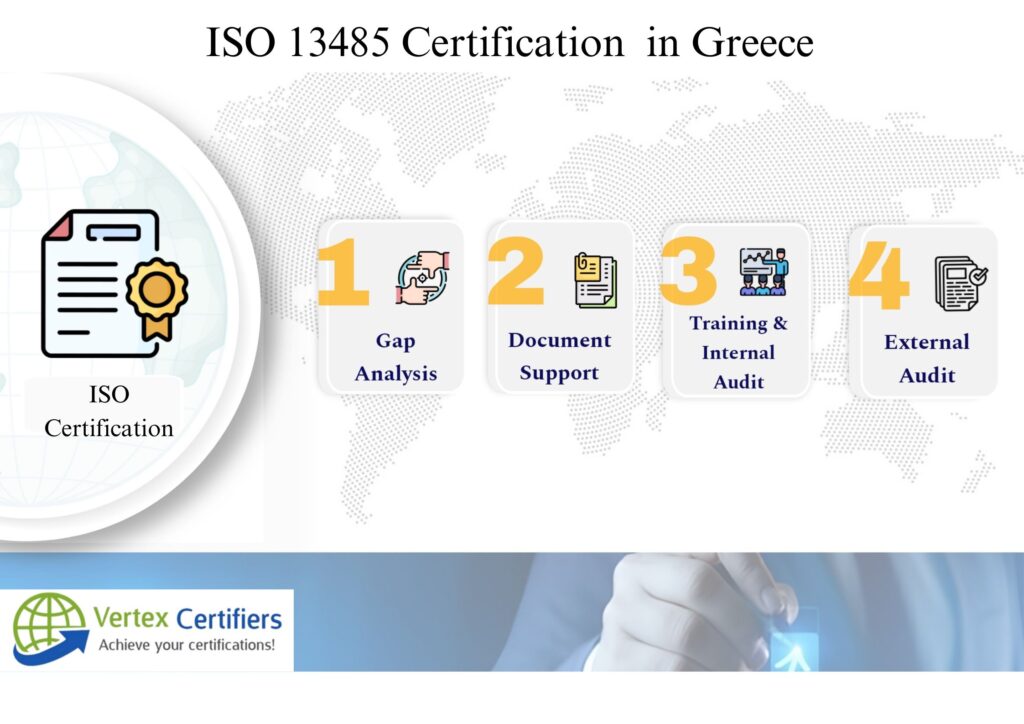
Obtaining ISO 13485 Certification in Greece is a structured and systematic process that helps medical device organizations establish a compliant, efficient, and internationally recognized Medical Device Quality Management System (MDQMS). Rather than focusing solely on achieving certification, the implementation process is designed to improve operational efficiency, strengthen regulatory compliance, enhance product quality, and ensure patient safety throughout the product lifecycle.
At Vertex Certifiers, we provide complete end-to-end ISO 13485 consulting services, guiding organizations through every stage of implementation—from the initial assessment to successful certification and continual improvement. Our practical approach minimizes implementation challenges while ensuring compliance with ISO 13485:2016 requirements and applicable regulatory expectations.
Step 1: Initial Consultation
The certification journey begins with an in-depth consultation to understand your organization’s operations, products, regulatory environment, and business objectives. During this phase, our consultants evaluate your manufacturing processes, organizational structure, quality practices, documentation, customer requirements, and applicable regulatory obligations.
This consultation helps define the certification scope, identify project requirements, establish realistic implementation timelines, allocate responsibilities, and develop an effective certification roadmap that aligns with your business goals.
Step 2: Gap Analysis
Gap Analysis is one of the most critical phases of ISO 13485 implementation. Our consultants compare your existing quality management practices with the requirements of ISO 13485:2016 to identify areas requiring improvement.
The assessment typically covers:
- Existing quality management processes
- Documentation and record control
- Risk management practices
- Design and development controls
- Supplier evaluation
- Production and process controls
- Validation procedures
- Calibration systems
- Complaint handling
- CAPA processes
- Internal auditing
- Management review activities
The findings are documented in a detailed Gap Analysis Report, which serves as the foundation for the implementation plan and helps prioritize improvement activities.
Step 3: Project Planning
After identifying compliance gaps, a detailed implementation plan is developed. This project plan defines implementation milestones, departmental responsibilities, documentation schedules, employee training programs, internal audit timelines, management review meetings, and certification preparation activities.
A structured project plan ensures smooth implementation, minimizes disruptions to daily operations, and keeps the organization on track toward certification.
Step 4: Documentation Development
ISO 13485 places significant emphasis on controlled documentation because accurate records are essential for product quality, regulatory compliance, and traceability.
Vertex Certifiers develops documentation tailored to your organization’s operations rather than providing generic templates. This practical approach ensures that employees can easily implement and maintain the Quality Management System.
Documentation generally includes:
- Quality policies
- Quality objectives
- Standard Operating Procedures (SOPs)
- Work Instructions
- Process Flow Charts
- Forms and Records
- Risk Management documentation
- Validation procedures
- Inspection procedures
- Supplier evaluation procedures
- Complaint handling procedures
- CAPA procedures
- Internal audit procedures
Well-designed documentation improves consistency, accountability, and audit readiness across the organization.
Step 5: Quality Manual Development
The Quality Manual serves as the foundation of the Medical Device Quality Management System.
It defines:
- Organizational scope
- Quality policy
- Business processes
- Process interactions
- Roles and responsibilities
- Regulatory commitments
- Documented procedures
- Quality objectives
A properly structured Quality Manual provides employees, customers, and certification auditors with a clear understanding of how the organization manages quality throughout its operations.
Step 6: Standard Operating Procedure (SOP) Development
Standard Operating Procedures translate ISO requirements into practical day-to-day activities.
SOPs may include procedures for:
- Purchasing
- Supplier approval
- Incoming inspection
- Production
- Process validation
- Equipment maintenance
- Calibration
- Packaging
- Storage
- Distribution
- Product release
- Complaint handling
- Nonconforming product control
- Internal audits
- CAPA
- Record management
Clear SOPs ensure that employees consistently perform activities according to approved processes, reducing variability and improving product quality.
Step 7: Risk Management File Development
Risk management is a core requirement of ISO 13485.
Organizations must establish a systematic process for identifying, evaluating, controlling, and monitoring risks associated with medical devices throughout their lifecycle.
The Risk Management File typically includes:
- Hazard identification
- Risk analysis
- Risk evaluation
- Risk control measures
- Residual risk assessment
- Risk-benefit analysis
- Risk monitoring
- Post-market feedback
Effective risk management helps prevent product failures, protects patient safety, and demonstrates regulatory compliance.
Step 8: Device Master Record (DMR)
The Device Master Record (DMR) contains all technical information required to manufacture a medical device consistently.
Typical contents include:
- Product specifications
- Engineering drawings
- Bill of Materials
- Manufacturing procedures
- Assembly instructions
- Inspection criteria
- Packaging specifications
- Labeling requirements
- Testing procedures
- Acceptance criteria
Maintaining an accurate DMR ensures every product is manufactured according to approved specifications.
Step 9: Device History Record (DHR)
The Device History Record provides evidence that each manufactured batch or unit was produced according to the approved Device Master Record.
A DHR generally contains:
- Production records
- Inspection results
- Test reports
- Calibration records
- Operator approvals
- Equipment information
- Batch numbers
- Traceability records
- Product release authorization
These records provide complete traceability and are invaluable during audits, customer investigations, or regulatory inspections.
Step 10: Implementation of the Quality Management System
Once documentation is completed, the Quality Management System is implemented throughout the organization.
Departments begin following approved procedures in their daily activities.
Implementation includes:
- Process execution
- Documentation control
- Record maintenance
- Supplier monitoring
- Product inspections
- Equipment calibration
- Production monitoring
- Quality inspections
- Complaint handling
- CAPA implementation
During this phase, organizations start generating objective evidence required for certification.
Step 11: Employee Training
Even the most comprehensive quality management system cannot succeed without competent employees.
Training programs ensure personnel understand:
- ISO 13485 requirements
- Organizational quality policies
- Departmental responsibilities
- SOP implementation
- Documentation practices
- Risk management
- Product quality controls
- Traceability requirements
- Regulatory awareness
- Internal reporting procedures
Well-trained employees reduce operational errors and contribute significantly to maintaining compliance.
Step 12: Internal Audit
Before the certification audit, trained internal auditors evaluate whether the Medical Device Quality Management System has been effectively implemented.
Internal audits verify:
- Compliance with ISO 13485
- Compliance with organizational procedures
- Documentation accuracy
- Process effectiveness
- Employee awareness
- Regulatory compliance
- Risk management implementation
- Record availability
Any nonconformities identified are documented and addressed before the external audit.
Step 13: Management Review
Top management reviews the overall effectiveness of the Quality Management System to ensure it continues to support business objectives and regulatory obligations.
Management Review typically evaluates:
- Audit findings
- Customer complaints
- Process performance
- Product quality
- Supplier performance
- CAPA status
- Risk management effectiveness
- Regulatory updates
- Resource requirements
- Improvement opportunities
Management involvement demonstrates leadership commitment and drives continual improvement.
Step 14: Corrective Actions
Any issues identified during internal audits, management reviews, customer complaints, or routine operations are addressed through a structured Corrective and Preventive Action (CAPA) process.
The CAPA process generally involves:
- Identifying the nonconformity
- Investigating the root cause
- Implementing corrective actions
- Preventing recurrence
- Verifying effectiveness
- Updating documentation where required
An effective CAPA system strengthens operational performance and reduces future quality risks.
Step 15: Stage 1 Certification Audit
The certification body conducts the Stage 1 Audit to evaluate the organization’s readiness for certification.
During this audit, auditors review:
- Quality Manual
- Documented procedures
- Certification scope
- Regulatory compliance
- Internal audit records
- Management Review records
- Implementation status
- Organizational preparedness
If any concerns are identified, organizations are given the opportunity to address them before proceeding to Stage 2.
Step 16: Stage 2 Certification Audit
Stage 2 is the comprehensive certification audit where auditors evaluate the actual implementation and effectiveness of the Medical Device Quality Management System.
Auditors assess:
- Manufacturing operations
- Production controls
- Design controls
- Validation activities
- Traceability
- Supplier management
- Employee competence
- Risk management
- CAPA implementation
- Complaint handling
- Product realization
- Process performance
- Regulatory compliance
Successful completion of this audit demonstrates that the organization consistently operates in accordance with ISO 13485:2016 requirements.
Step 17: ISO 13485 Certification
Once all audit requirements have been successfully satisfied and any identified nonconformities have been appropriately addressed, the certification body issues the ISO 13485:2016 Certificate.
Certification demonstrates that your organization has established an internationally recognized Medical Device Quality Management System capable of consistently delivering safe, reliable, and compliant medical devices. It enhances credibility with customers, healthcare institutions, distributors, regulators, and international business partners while strengthening confidence in your quality management practices.
For organizations in Greece, ISO 13485 certification also reinforces readiness to meet applicable medical device regulatory expectations and supports expansion into international markets where certified quality systems are highly valued.
Step 18: Surveillance Audits
ISO 13485 certification is not a one-time achievement. Certification bodies conduct periodic surveillance audits to verify that the Quality Management System continues to be effectively maintained and improved.
During surveillance audits, auditors review:
- Continued compliance with ISO 13485 requirements
- Effectiveness of implemented processes
- Customer feedback and complaint management
- CAPA effectiveness
- Internal audit performance
- Management review activities
- Regulatory compliance updates
- Risk management activities
- Ongoing improvement initiatives
Regular surveillance audits encourage organizations to maintain consistent quality standards and sustain certification over the long term.
Step 19: Continual Improvement
Continual improvement is a fundamental principle of ISO 13485. Organizations are expected to regularly evaluate the performance of their Medical Device Quality Management System and identify opportunities to enhance quality, efficiency, compliance, and customer satisfaction.
Continual improvement activities may include:
- Monitoring quality objectives and key performance indicators (KPIs)
- Analyzing customer feedback and complaints
- Reviewing process performance and product quality trends
- Updating risk assessments and control measures
- Strengthening supplier evaluation and monitoring
- Enhancing employee competence through ongoing training
- Implementing process automation and digital quality systems
- Adapting to changes in regulatory requirements and industry best practices
By embedding continual improvement into everyday operations, organizations can reduce operational risks, improve product consistency, increase customer confidence, and maintain long-term regulatory compliance.
At Vertex Certifiers, we remain your trusted partner beyond certification by providing ongoing guidance, periodic system reviews, audit support, and continuous improvement assistance. Our end-to-end ISO 13485 consulting services help medical device manufacturers, healthcare technology companies, biotechnology firms, pharmaceutical organizations, diagnostic laboratories, and related businesses across Athens, Thessaloniki, Patras, Heraklion, Larissa, Volos, Ioannina, Chania, Kalamata, Alexandroupoli, and all major cities in Greece build a resilient quality management system that supports sustainable growth and global business success.