ISO 14001 Certification in France
At Vertex Certifiers, we provide comprehensive, end-to-end ISO certification consulting services in France to help organizations achieve internationally recognised management system certifications efficiently and affordably. Our experienced consultants support businesses through every stage of the certification journey, including gap analysis, documentation, implementation, employee training, internal audits, and certification audit coordination. Whether you are seeking ISO 14001 Certification in France or other ISO standards, we deliver customised solutions tailored to your industry, business size, and compliance requirements. With a commitment to quality, timely project completion, and cost-effective services, Vertex Certifiers helps organisations strengthen environmental performance, meet regulatory obligations, and achieve sustainable business growth with confidence.
ISO 14001 Certification in France: A Complete Guide to Environmental Management Systems
Introduction
France is widely recognised as one of Europe’s leading industrial, manufacturing, and economic powerhouses, with a strong commitment to sustainable development and environmental protection.As the world’s seventh-largest economy and one of the European Union’s most influential nations, France has made environmental responsibility a national priority through ambitious climate policies, renewable energy investments, and circular economy initiatives. Industries across the country are increasingly adopting sustainable business practices to reduce their environmental footprint while maintaining competitiveness in both domestic and international markets.This growing emphasis on responsible business operations has significantly increased the demand for ISO 14001 Certification in France, enabling organisations to demonstrate their commitment to environmental excellence while complying with national and international environmental regulations.
The French government actively supports green innovation, sustainable manufacturing, resource conservation, and waste reduction through various environmental policies aligned with the European Green Deal.At the same time, customers, investors, business partners, and regulatory authorities expect organisations to operate transparently while demonstrating measurable environmental performance.
France’s diverse industrial landscape includes globally recognised sectors such as manufacturing, automotive, aerospace, food and beverage, pharmaceuticals, chemicals, construction, renewable energy, oil and gas, logistics, electronics, agriculture, packaging, textiles, healthcare, and retail.Organisations are therefore under increasing pressure to strengthen environmental compliance, prevent pollution, improve waste management, reduce carbon emissions, optimise resource utilisation, and establish sustainable supply chains.Implementing a comprehensive Environmental Management System enables organisations to identify environmental aspects, manage compliance obligations, reduce operational risks, improve efficiency, and support sustainable business growth while maintaining a competitive advantage in international markets.
ISO 14001 is the internationally recognised standard for Environmental Management Systems (EMS), providing organisations with a systematic framework for identifying, controlling, monitoring, and continually improving their environmental performance.
At Vertex Certifiers, we provide comprehensive end-to-end ISO 14001 Certification consulting services in France, helping organisations successfully implement Environmental Management Systems that comply with international standards and regulatory requirements. Our experienced consultants support businesses through every stage of the certification journey, including gap analysis, environmental review, documentation, implementation, employee training, internal audits, management review, and certification audit support.With industry-specific expertise, practical implementation methodologies, and a customer-focused approach, Vertex Certifiers helps organisations achieve ISO 14001 certification efficiently while strengthening environmental performance, improving operational sustainability, and enhancing business credibility in both French and international markets.
What is ISO 14001 Certification?
ISO 14001 Certification is an internationally recognised certification that verifies an organisation has established, implemented, maintained, and continually improved an effective Environmental Management System (EMS) in accordance with the requirements of the ISO 14001:2015 standard.Applicable to organisations of all sizes and industries, ISO 14001 helps businesses integrate environmental responsibility into strategic planning and daily operations while supporting sustainable growth and long-term business resilience.
Instead of addressing environmental issues reactively, an EMS helps businesses proactively identify environmental aspects, assess potential impacts, establish environmental objectives, monitor performance, and implement continual improvements.By implementing a structured Environmental Management System, organisations can reduce operational inefficiencies while strengthening environmental stewardship and corporate sustainability.
One of its core principles is the Plan-Do-Check-Act (PDCA) methodology, which promotes continual improvement through systematic planning, implementation, monitoring, evaluation, and corrective action.The implementation phase focuses on operational controls, employee awareness, resource allocation, and process execution.Performance is then monitored through environmental measurements, internal audits, and compliance evaluations before management reviews overall system effectiveness and drives continual improvement. This cyclical process ensures that environmental performance continues to improve over time rather than remaining static.
This broader perspective supports sustainable procurement, environmentally responsible supply chain management, waste minimisation, and efficient resource utilisation.The standard also strengthens legal compliance by ensuring organisations systematically identify and monitor applicable environmental regulations while reducing the likelihood of non-compliance.As sustainability increasingly influences procurement decisions and international trade, ISO 14001 certification enables organisations to differentiate themselves from competitors while strengthening long-term business resilience.
By implementing a robust Environmental Management System, businesses can reduce environmental risks, improve resource efficiency, support corporate sustainability goals, and build lasting trust among stakeholders.
Step-by-Step ISO 14001 Certification Process in France
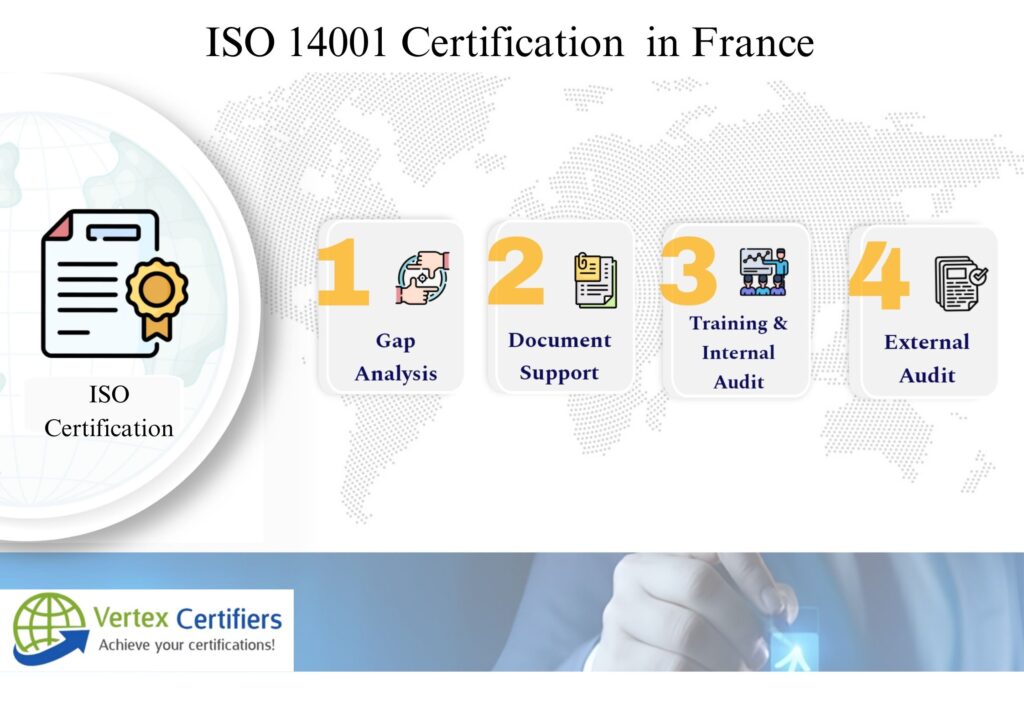
Obtaining ISO 14001 Certification in France is a structured process that enables organisations to establish, implement, maintain, and continually improve an effective Environmental Management System (EMS).Whether your organisation operates in manufacturing, construction, aerospace, automotive, food processing, healthcare, logistics, renewable energy, or any other industry, following a systematic implementation approach ensures a smooth certification journey while maximising business benefits.
Step 1: Conduct a Gap Analysis
The certification journey begins with a comprehensive Gap Analysis, which evaluates the organisation’s existing environmental management practices against the requirements of ISO 14001:2015. This assessment helps identify strengths, weaknesses, compliance gaps, and areas requiring improvement before implementation begins.
During the gap analysis, experienced ISO consultants assess current environmental policies, operational processes, legal compliance obligations, documentation, waste management practices, energy usage, pollution controls, emergency preparedness, and environmental objectives. They also review how environmental responsibilities are assigned throughout the organisation.
The findings provide a clear implementation roadmap, enabling management to prioritise improvement initiatives and allocate the necessary resources. A well-executed gap analysis significantly reduces implementation challenges and helps organisations achieve certification more efficiently.
Step 2: Perform an Environmental Review
The next step involves conducting a detailed Environmental Review to identify how business activities, products, and services interact with the environment.
This review typically includes evaluating:
- Air emissions
- Water consumption
- Waste generation
- Energy usage
- Chemical handling
- Noise pollution
- Natural resource utilisation
- Greenhouse gas emissions
- Environmental risks
- Emergency situations
Organisations also identify their significant environmental aspects and assess the environmental impacts associated with their operations. Understanding these impacts enables management to establish priorities for improvement while ensuring compliance with French and European environmental regulations.
An effective environmental review provides the foundation for developing a practical and effective Environmental Management System.
Step 3: Plan the Environmental Management System (EMS)
Once environmental aspects have been identified, the organisation develops a structured Environmental Management System (EMS) aligned with ISO 14001 requirements.
Planning involves:
- Defining the EMS scope
- Establishing environmental objectives
- Identifying compliance obligations
- Assessing environmental risks and opportunities
- Allocating responsibilities
- Setting measurable environmental targets
- Developing implementation timelines
Environmental objectives should support the organisation’s strategic goals while promoting pollution prevention, waste reduction, energy conservation, water efficiency, and continual improvement.
A properly planned EMS ensures environmental management becomes an integral part of business operations rather than a standalone compliance activity.
Step 4: Develop Required Documentation
Documentation forms the backbone of an effective ISO 14001 Environmental Management System. Proper documentation ensures consistency, accountability, and compliance across all business functions.
Typical documentation includes:
- Environmental Policy
- EMS Scope
- Environmental Objectives
- Environmental Aspect Register
- Legal Compliance Register
- Operational Procedures
- Emergency Response Procedures
- Waste Management Procedures
- Monitoring Procedures
- Internal Audit Procedure
- Management Review Procedure
- Corrective Action Procedure
- Training Records
- Performance Monitoring Records
The documentation should accurately reflect actual business practices and remain easy for employees to understand and implement.
Step 5: Implement the Environmental Management System
Following documentation, organisations begin implementing the Environmental Management System throughout all relevant departments.
Implementation involves integrating environmental controls into everyday business activities, including:
- Waste segregation
- Pollution prevention measures
- Energy-saving initiatives
- Water conservation practices
- Chemical management
- Sustainable procurement
- Operational controls
- Environmental monitoring
- Emergency preparedness
Management must ensure sufficient resources, employee involvement, communication, and operational discipline throughout implementation.
Successful implementation transforms documented procedures into practical environmental improvements that support continual sustainability.
Step 6: Employee Training and Awareness
Employees play a critical role in the success of any Environmental Management System. ISO 14001 requires organisations to ensure personnel understand their environmental responsibilities and are competent to perform their assigned duties.
Training programmes generally cover:
- Environmental policy
- EMS objectives
- Environmental impacts
- Waste management
- Pollution prevention
- Emergency response
- Operational procedures
- Legal compliance
- Incident reporting
- Continual improvement
Regular awareness sessions encourage employees to participate actively in sustainability initiatives while strengthening the organisation’s environmental culture.
A knowledgeable workforce significantly improves EMS effectiveness and long-term environmental performance.
Step 7: Conduct Internal Audits
Once the Environmental Management System has been implemented for an appropriate period, organisations perform comprehensive Internal Audits.
Internal audits verify whether:
- ISO 14001 requirements have been implemented correctly
- Procedures are being followed consistently
- Environmental objectives are progressing
- Legal obligations are fulfilled
- Records are maintained properly
- Operational controls remain effective
Auditors also identify nonconformities, improvement opportunities, and potential environmental risks before the certification audit.
Conducting internal audits helps organisations correct weaknesses proactively and demonstrates commitment to continual improvement.
Step 8: Management Review
Top management plays an essential role in ensuring the Environmental Management System remains effective and aligned with organisational objectives.
During the Management Review, leadership evaluates:
- Internal audit findings
- Environmental performance
- Compliance status
- Achievement of environmental objectives
- Customer feedback
- Interested party expectations
- Resource requirements
- Risks and opportunities
- Corrective actions
- Improvement initiatives
Management reviews ensure strategic decisions support continual environmental improvement while reinforcing leadership commitment to sustainability.
Step 9: Certification Audit – Stage 1
After internal implementation is complete, the chosen certification body conducts the Stage 1 Audit.
This audit primarily reviews:
- EMS documentation
- Scope of certification
- Environmental policy
- Legal compliance framework
- Environmental objectives
- Internal audit records
- Management review records
- Readiness for Stage 2
The auditor identifies any areas requiring attention before the final certification assessment.
Successfully completing Stage 1 confirms the organisation is adequately prepared for the next phase of certification.
Step 10: Certification Audit – Stage 2
The Stage 2 Audit is the final and most comprehensive assessment.
Auditors evaluate how effectively the Environmental Management System has been implemented across the organisation by examining:
- Operational activities
- Employee awareness
- Environmental controls
- Monitoring processes
- Waste management
- Emergency preparedness
- Resource efficiency
- Compliance with ISO 14001 requirements
- Continual improvement activities
Auditors interview employees, inspect facilities, review records, and verify implementation through objective evidence.
If minor nonconformities are identified, the organisation is typically given an opportunity to implement corrective actions before certification is recommended.
Step 11: Issue of ISO 14001 Certificate
Once the certification body verifies that all ISO 14001 requirements have been successfully met, the organisation is awarded ISO 14001 Certification.
Certification demonstrates that the organisation has established an internationally recognised Environmental Management System capable of managing environmental responsibilities effectively while supporting sustainable business practices.
Achieving certification enhances organisational credibility and demonstrates commitment to environmental protection, legal compliance, operational excellence, and continual improvement. It also strengthens relationships with customers, regulators, investors, and business partners who increasingly value environmentally responsible organisations.
Many organisations also find that ISO 14001 certification improves eligibility for supplier approvals, government tenders, export opportunities, and environmentally conscious procurement programmes.
Step 12: Annual Surveillance Audits and Continual Improvement
ISO 14001 certification is not the end of the journey—it marks the beginning of an ongoing commitment to environmental excellence.
To ensure the Environmental Management System continues to meet ISO 14001 requirements, the certification body conducts annual surveillance audits. These periodic assessments verify that the EMS remains effectively implemented, maintained, and continually improved.
During surveillance audits, auditors typically review:
- Environmental objectives and performance
- Compliance with legal and regulatory requirements
- Internal audit results
- Corrective and preventive actions
- Management review outcomes
- Operational controls
- Employee competence and awareness
- Monitoring and measurement records
- Improvement initiatives
Organisations are expected to demonstrate continual improvement by reducing environmental impacts, enhancing operational efficiency, improving resource utilisation, and strengthening sustainability performance year after year.
Businesses that actively maintain and improve their Environmental Management System not only retain their certification but also gain long-term advantages through reduced environmental risks, increased stakeholder confidence, improved operational resilience, and stronger competitiveness in both French and global markets.
Our Services
- GMP Certification
- GLP Certification
- GDP Certification
- Halal Certificate
- Organic Certificate
- CE Marking Certification
- RoHS Certification
- FDA Certification
- CMMI Certification
- Cyber Security
- VAPT Testing
- Security Assessment
Why ISO 14001 Certification is Important in France
France places strong emphasis on environmental protection through its Environmental Code, public-policy action on ecological transition, and alignment with European Union environmental legislation. This makes ISO 14001 certification highly relevant for organizations that want a structured environmental management system capable of supporting legal compliance, operational discipline, and long-term sustainability performance. [web:10][page:1][page:2]
Across France, businesses are expected to manage environmental impacts responsibly in areas such as waste, emissions, energy use, pollution prevention, product stewardship, and site-level controls. In practice, organizations often need to demonstrate that environmental risks are identified, obligations are monitored, and performance is reviewed systematically. ISO 14001 helps turn these expectations into a repeatable management framework rather than a reactive compliance exercise. [web:2][web:10][page:1]
- France’s environmental regulations: France’s legal system is anchored in the French Environmental Code, which consolidates rules governing environmental protection and creates a serious compliance environment for companies operating in industrial, service, logistics, and infrastructure sectors. [web:10][web:3]
- EU environmental directives: Organizations in France are also affected by wider EU policy goals that focus on protecting biodiversity, minimizing risks to human health, and accelerating the transition to a circular economy. [page:2]
- Climate policies: France’s ecological transition agenda includes adaptation, electrification, and broader climate-related policy measures, making environmental management increasingly strategic for businesses. [page:1]
- Corporate sustainability requirements: Sustainability is no longer treated as a side topic; it is becoming part of corporate governance, procurement expectations, investor scrutiny, and market credibility. [web:8][page:2]
- Environmental permits: Many organizations need permits, authorizations, monitoring routines, or documented controls depending on their activities, processes, materials, and site risk profile. ISO 14001 supports better control of these obligations through documented procedures and compliance tracking. [web:10][web:2]
- Carbon reduction initiatives: Environmental performance now increasingly includes energy efficiency, electrification, emissions reduction, and carbon-conscious operations. ISO 14001 gives organizations a formal way to set measurable targets and monitor progress. [page:1]
- Circular economy policies: EU environmental policy is actively moving from simple waste management toward circular economy principles, including keeping materials in use longer and increasing recycled content. [page:2]
- Waste management regulations: Waste segregation, handling, storage, reuse, recycling, and disposal controls are critical for many sectors in France, especially manufacturing, construction, chemicals, healthcare, and logistics. ISO 14001 improves consistency in these controls. [page:2][web:10]
- Green procurement: Buyers in both public and private markets increasingly prefer suppliers that can show credible environmental controls, sustainability commitments, and continuous improvement practices. [page:2]
- ESG reporting: Sustainability reporting obligations in Europe continue to evolve, and French companies are watching the application of CSRD-related requirements closely. Even where full reporting is not mandatory, organizations benefit from building structured environmental data and governance systems early. [web:8]
Compliance with French environmental authorities becomes easier when responsibilities, procedures, monitoring methods, and corrective actions are clearly defined. ISO 14001 helps organizations maintain evidence of environmental control, prepare for inspections or audits, and reduce the risk of overlooked obligations. [web:10][web:2]
Compliance with EU environmental legislation also becomes more manageable because ISO 14001 encourages organizations to identify applicable legal requirements, assess environmental aspects, establish controls, and review changes regularly. This is especially useful in sectors dealing with chemicals, waste, product lifecycle issues, and operational emissions. [web:2][page:2]
At the same time, ISO 14001 aligns well with international environmental standards and global customer expectations. For organizations in France that export, serve multinational clients, or operate across multiple sites, certification provides a recognized framework that supports credibility across borders. [page:2]
Customers increasingly prefer environmentally responsible organizations because environmental responsibility is now associated with quality, reliability, lower risk, and stronger long-term values. Clients, investors, procurement teams, and end users want to work with companies that reduce waste, use resources efficiently, and demonstrate visible commitment to sustainability rather than making generic green claims. [page:2][web:8]
Need ISO 14001 Certification Support in France?
Vertex Certifiers helps organizations implement practical environmental management systems that support compliance, sustainability, and certification readiness.
Benefits of ISO 14001 Certification in France
ISO 14001 certification offers far more than a certificate. In the French market, it supports legal awareness, operational control, resource efficiency, sustainability performance, and stronger trust among customers, regulators, and business partners. [web:10][page:1][page:2]
Improved Environmental Performance
ISO 14001 helps organizations identify their environmental aspects, assess impacts, set objectives, and monitor results in a structured way. This leads to better control over emissions, waste, water usage, and pollution risks across daily operations. [web:10][web:2]
Compliance with Environmental Regulations
France has a serious environmental compliance framework under the Environmental Code, and many businesses must also consider EU-linked obligations. ISO 14001 helps companies track legal requirements, assign responsibilities, and reduce the chance of missed compliance actions. [web:10][web:3][page:2]
Better Resource Efficiency
Certification encourages organizations to analyze how materials, utilities, and raw inputs are consumed. Once those patterns are visible, companies can improve process efficiency and reduce unnecessary resource use. [page:2]
Reduced Waste Generation
Waste prevention is often more valuable than waste disposal. ISO 14001 supports better planning, segregation, handling, reuse, and process improvement, helping companies reduce waste at source. [page:2]
Lower Energy Consumption
France’s policy direction includes electrification and ecological transition, making energy performance more strategically important. ISO 14001 supports energy-focused targets, operational controls, and monitoring practices that can reduce avoidable consumption. [page:1]
Reduced Carbon Footprint
As customers and regulators give more attention to climate impact, companies benefit from a management system that supports emissions awareness and carbon reduction planning. ISO 14001 helps connect environmental objectives with measurable improvement actions. [page:1][page:2]
Improved Corporate Reputation
Certified organizations are often seen as more disciplined, responsible, and future-focused. In France, where sustainability expectations are becoming more visible across sectors, ISO 14001 can strengthen brand credibility. [page:1][web:8]
Increased Customer Confidence
Customers prefer suppliers that can demonstrate control over environmental impacts instead of relying on informal claims. Certification gives buyers more confidence that environmental commitments are backed by processes, records, and regular review. [page:2]
Better Risk Management
Environmental incidents can lead to legal, operational, financial, and reputational consequences. ISO 14001 helps organizations identify risks early, implement controls, and strengthen response planning. [web:10][web:2]
Reduced Environmental Incidents
With documented procedures, training, monitoring, and emergency preparedness, organizations can reduce the likelihood of spills, non-compliant disposal, uncontrolled releases, or process-related environmental failures. [web:2][web:10]
Competitive Advantage
In tenders, B2B contracts, and supply-chain approvals, certification can distinguish an organization from competitors that lack formal environmental management. This is especially useful in regulated or export-oriented sectors. [page:2]
Improved Operational Efficiency
Environmental controls often reveal broader process inefficiencies. When organizations streamline material handling, maintenance, monitoring, and waste reduction, operational performance usually improves alongside sustainability outcomes. [page:2]
Increased Business Opportunities
Many customers, global buyers, and public-sector procurement processes prefer or expect suppliers with recognized management systems. ISO 14001 can therefore open new business opportunities and strengthen prequalification success. [page:2]
Better Supplier Relationships
Companies with certified environmental systems often work more effectively with suppliers because expectations, controls, and sustainability goals are clearer. This helps create more stable and transparent supply-chain relationships. [page:2]
Easier International Trade
ISO 14001 is internationally recognized, which makes it valuable for French organizations serving overseas markets or multinational customers. It provides a familiar assurance model for environmental management across borders. [page:2]
Support for ESG & Sustainability Goals
As sustainability reporting and ESG expectations continue to evolve, organizations benefit from stronger environmental governance, documented objectives, and reliable performance data. ISO 14001 creates a practical foundation that supports those wider sustainability goals. [web:8][page:2]
Build a Practical ISO 14001 System
Get expert support to implement an environmental management system that works for your sector, sites, and compliance obligations in France.
Which Organizations Need ISO 14001 Certification in France?
ISO 14001 is useful for nearly any organization that affects the environment through operations, materials, energy use, transport, emissions, waste, or site activities. In France, the standard is especially valuable where environmental controls, stakeholder confidence, and regulatory awareness are business-critical. [web:10][page:1][page:2]
- Manufacturing: Helps control waste, emissions, resource use, and permit-related environmental obligations.
- Automotive: Supports supply-chain expectations, material controls, and sustainability commitments.
- Aerospace: Useful for high-control environments where environmental risk, chemicals, and supplier credibility matter.
- Electronics: Helps manage hazardous materials, waste streams, and resource efficiency.
- Food Processing: Supports control of water, waste, packaging, utilities, and environmental hygiene practices.
- Pharmaceuticals: Important for controlled processes, chemical handling, waste management, and environmental monitoring.
- Chemical Industries: Highly relevant due to compliance sensitivity and environmental risk exposure. [web:2]
- Construction Companies: Helps manage site waste, dust, noise, material usage, and local environmental impacts.
- Engineering Firms: Useful for environmentally responsible project planning and customer confidence.
- Packaging Industries: Supports circular economy goals, waste reduction, and material optimization. [page:2]
- Textile Manufacturers: Helps control water use, chemical handling, waste, and sustainability claims.
- Agriculture: Supports better environmental management of land, water, inputs, and waste streams.
- Renewable Energy Companies: Strengthens environmental governance while supporting sustainability positioning.
- Logistics Companies: Helps address fuel use, emissions, packaging waste, and transport efficiency.
- Warehousing: Useful for energy performance, waste segregation, storage controls, and operational discipline.
- Ports: Important due to complex environmental interfaces involving transport, storage, waste, and potential pollution risks.
- Oil & Gas: Supports stronger control over environmental aspects, incidents, and emergency preparedness.
- Mining: Valuable where land, waste, water, and operational environmental impacts must be tightly managed.
- Waste Management: Directly relevant because environmental control is central to the core business model. [page:2]
- Water Treatment Plants: Helps manage environmental performance, operational reliability, and compliance-related records.
- Hospitals: Useful for medical waste, chemicals, utilities, and environmentally sensitive facility operations.
- Hotels: Supports waste reduction, energy efficiency, water conservation, and stronger sustainability branding.
- Universities: Helps coordinate environmental goals across campuses, labs, facilities, and procurement activities.
- Government Organizations: Supports accountability, green procurement, and structured environmental improvement. [page:2]
- SMEs: Small and medium businesses benefit through better control, market trust, and more organized compliance management.
- Export Companies: Certification improves international credibility and supports customer qualification requirements. [page:2]
In simple terms, any organization in France that wants stronger environmental control, better legal awareness, and improved sustainability credibility can benefit from ISO 14001. The need is strongest where environmental impacts are significant, supply-chain scrutiny is high, or customers expect formal proof of responsible business practices. [web:10][page:2]
ISO 14001 Requirements
ISO 14001 is built around a structured environmental management system that helps organizations identify impacts, manage obligations, improve performance, and drive continual improvement. Its core requirements are designed to integrate environmental thinking into leadership, planning, operations, evaluation, and improvement activities. [page:2][web:10]
- Context of Organization: Understand internal and external issues, interested parties, and the scope of the environmental management system.
- Leadership: Top management must show commitment, provide direction, and integrate environmental management into business processes.
- Environmental Policy: The organization must define a policy that supports environmental protection, compliance obligations, and continual improvement.
- Planning: Plan how the organization will address risks, opportunities, environmental aspects, and compliance obligations.
- Environmental Aspects: Identify activities, products, and services that interact with the environment and determine significant impacts.
- Compliance Obligations: Determine legal and other requirements that apply to the organization.
- Environmental Objectives: Set measurable objectives and establish plans to achieve them.
- Support: Provide resources, infrastructure, and system support for effective implementation.
- Competence: Ensure employees performing relevant work are competent based on education, training, or experience.
- Awareness: Personnel must understand the policy, significant aspects, and their contribution to the EMS.
- Communication: Define what, when, and how environmental information is communicated internally and externally.
- Documented Information: Maintain the documentation and records needed to operate and demonstrate control.
- Operational Control: Establish controls for processes linked to significant environmental aspects and obligations.
- Emergency Preparedness: Prepare for potential environmental emergencies and test response readiness.
- Performance Evaluation: Monitor, measure, analyze, and evaluate environmental performance and EMS effectiveness.
- Internal Audit: Conduct audits at planned intervals to verify conformity and effectiveness.
- Management Review: Top management must review the EMS to ensure suitability, adequacy, and effectiveness.
- Continual Improvement: Take corrective action and improve the EMS over time based on findings and results.
These requirements are especially valuable in France because they help organizations build a practical link between policy expectations, site-level operations, legal awareness, and measurable environmental outcomes. Rather than treating compliance and sustainability as separate issues, ISO 14001 brings them into one management structure. [web:10][page:1][page:2]
ISO 14001 Documentation Requirements
ISO 14001 does not require unnecessary paperwork, but it does require the right documented information to ensure environmental controls are defined, implemented, and verifiable. Good documentation also helps organizations in France manage regulatory awareness, operational consistency, and audit readiness more effectively. [web:10][web:2]
- Environmental Policy: A formal statement of environmental commitment and direction.
- Scope: Defines which activities, sites, products, and services are covered by the EMS.
- Objectives: Documented environmental goals and related action plans.
- Environmental Aspects Register: A record of environmental aspects, impacts, and significance evaluations.
- Legal Register: A structured list of applicable legal and other compliance obligations.
- Risk Assessment: Documented assessment of environmental risks and opportunities.
- Operational Controls: Procedures or work instructions for activities needing control.
- Emergency Response Plan: Actions to be taken in case of spills, leaks, releases, fire, or other environmental emergencies.
- Waste Management Procedures: Controls for segregation, handling, storage, transport, recycling, and disposal.
- Monitoring Records: Evidence of inspections, measurements, checks, and environmental performance tracking.
- Internal Audit Reports: Audit findings, conclusions, and follow-up actions.
- Management Review Records: Evidence that top management reviews the EMS.
- Corrective Actions: Records showing how nonconformities are addressed and prevented from recurring.
- Training Records: Evidence of competence, awareness, and environmental training activities.
The exact level of documentation depends on the size, complexity, and environmental risk of the organization. A small company may need simpler records, while a multi-site or highly regulated operation in France will typically require more detailed documentation and tighter control. [web:10][web:2]
Cost of ISO 14001 Certification in France
The cost of ISO 14001 certification in France varies from one organization to another, so it is better to explain cost drivers than to quote fixed pricing. Certification cost is influenced by the scope of operations, implementation effort, and the level of support needed before the external audit. [web:10]
- Organization size: Larger organizations usually require more planning, coordination, and audit time.
- Number of employees: More employees often mean broader awareness, training, and operational coverage requirements.
- Number of sites: Multi-site certification generally increases complexity and audit scope.
- Complexity: Complex processes, significant environmental aspects, or higher operational risk usually increase effort.
- Industry: Sectors such as chemicals, manufacturing, waste management, or heavy industry often need more extensive environmental controls. [web:2]
- Existing management systems: Organizations already certified to standards such as ISO 9001 may find implementation more efficient.
- Documentation status: If documentation is incomplete or outdated, more work will be needed before certification.
- Certification body: Audit fees differ depending on the certification body and audit scope.
- Consultancy support: External consultants can reduce internal effort and delays, but this also affects total project cost.
In most cases, organizations should think of ISO 14001 cost as an investment in compliance support, resource efficiency, operational discipline, and market credibility. A well-planned implementation often reduces waste, improves control, and prevents much costlier environmental failures over time. [page:2][web:10]
How Long Does ISO 14001 Certification Take?
The time required for ISO 14001 certification in France depends on organizational size, number of sites, environmental complexity, existing system maturity, and how quickly leadership and teams support implementation. There is no single universal timeline, but project duration typically increases with complexity and operational spread. [web:10][web:2]
- SMEs: Small and medium-sized businesses can often implement faster because decision-making is simpler and processes are less layered.
- Medium businesses: These usually need more structured documentation, broader training, and stronger cross-functional coordination.
- Large enterprises: Large organizations often require longer timelines due to complexity, departmental coordination, and broader audit readiness activities.
- Multi-location organizations: Extra time is often needed to align sites, standardize controls, and confirm implementation consistency.
Key factors affecting duration include the availability of internal resources, the condition of existing documentation, the number of significant environmental aspects, legal-compliance complexity, and readiness for internal audits and management review. Organizations that already use formal management systems generally move faster because many control principles are already familiar. [web:10][web:2]
Why Choose Vertex Certifiers for ISO 14001 Certification in France?
Vertex Certifiers offers end-to-end consulting support for organizations seeking ISO 14001 certification in France. The goal is not just to prepare documents, but to build a practical environmental management system that supports compliance, performance improvement, and successful certification. [web:10][page:2]
- End-to-end consulting: Support from initial planning to final certification coordination.
- Gap assessment: Clear identification of what is already in place and what must be improved.
- Documentation support: Assistance in developing required environmental policies, registers, procedures, and records.
- Implementation assistance: Practical help in converting documentation into day-to-day operational control.
- Employee training: Awareness and role-based guidance so teams understand their responsibilities.
- Internal audits: Pre-certification audits to identify weaknesses before the certification body visits.
- Certification support: Coordination and guidance for stage 1 and stage 2 audit readiness.
- Experienced consultants: Professional support tailored to environmental management and compliance needs.
- Affordable pricing: Cost-conscious consulting structured around actual business needs.
- Quick project completion: A focused implementation approach to avoid unnecessary delays.
- Global expertise: Useful for businesses serving international customers or multi-country supply chains.
- Customized solutions: The EMS is adapted to the size, industry, risk profile, and scope of each client.
- Ongoing support: Continued guidance for surveillance audits, updates, and system improvement.
For businesses in France, this kind of structured support can make the difference between a theoretical compliance exercise and a useful management system that adds real business value. Vertex Certifiers focuses on usability, certification readiness, and long-term sustainability alignment. [page:1][page:2]
Start Your ISO 14001 Project with Vertex Certifiers
Speak with our team for practical consulting support, documentation guidance, training, internal audits, and certification assistance across France.
Major Cities We Serve in France
Vertex Certifiers provides ISO 14001 consulting services across all cities and regions of France. Whether your organization operates from a single office, a factory, a logistics center, a hospital, or multiple sites, our team supports implementation and certification readiness throughout the country. [web:10][page:1]
Our ISO 14001 consulting services are available in major business and industrial locations including Paris, Marseille, Lyon, Toulouse, Nice, Nantes, Strasbourg, Montpellier, Bordeaux, Lille, Rennes, Reims, Le Havre, Saint-Étienne, Toulon, Grenoble, Dijon, Angers, Nîmes, and Clermont-Ferrand. We also support organizations in surrounding cities, industrial zones, and regional business clusters across France. [page:1]
With growing attention to environmental performance, sustainability governance, and circular economy expectations in Europe, organizations across France are increasingly seeking structured environmental management support. Vertex Certifiers helps businesses in every region build systems that align with ISO 14001 and support practical compliance outcomes. [page:2][web:8]
Frequently Asked Questions
1. What is ISO 14001 Certification in France?
ISO 14001 certification in France is formal recognition that an organization has implemented an environmental management system aligned with ISO 14001 requirements. It helps businesses manage environmental impacts, monitor obligations, and improve performance systematically. [web:10]
2. Who needs ISO 14001 certification?
Any organization that has environmental aspects related to its operations can benefit, including manufacturers, logistics firms, hospitals, construction companies, food processors, and SMEs. It is especially useful where customer expectations, legal obligations, or environmental risks are significant. [web:10][page:2]
3. Is ISO 14001 mandatory in France?
ISO 14001 certification itself is generally voluntary, but environmental compliance obligations under French and EU frameworks can be mandatory depending on the activity. Many organizations choose certification to manage those obligations more effectively. [web:10][web:2][page:2]
4. How much does ISO 14001 certification cost in France?
Cost depends on factors such as organization size, number of employees, number of sites, operational complexity, industry risk, existing systems, documentation status, certification body, and consultancy support. Fixed pricing should be avoided without understanding the project scope. [web:10][web:2]
5. How long does certification take?
The timeline depends on company size, site count, internal readiness, environmental complexity, and management commitment. Small businesses may implement faster, while large or multi-site organizations usually need longer preparation. [web:10][web:2]
6. What documents are required?
Common documents include the environmental policy, scope, objectives, aspects register, legal register, risk assessment, operational controls, emergency plans, monitoring records, audit reports, management reviews, corrective actions, and training records. The exact depth depends on the organization’s context. [web:10][web:2]
7. What are the benefits of ISO 14001?
Key benefits include improved environmental performance, better compliance support, lower waste, stronger resource efficiency, increased customer confidence, and stronger support for sustainability and ESG goals. It also improves operational discipline and market credibility. [page:2][web:8]
8. Can small businesses get ISO 14001 certification?
Yes. Small businesses can implement ISO 14001 as long as the system is scaled to their size, activities, and environmental risks. In many cases, SMEs benefit greatly from the structure it provides. [web:10]
9. How often are surveillance audits conducted?
After certification, surveillance audits are typically conducted periodically during the certification cycle to verify ongoing conformity and effectiveness. The exact schedule depends on the certification arrangement and audit program. [web:10]
10. Can ISO 14001 be integrated with ISO 9001?
Yes. Organizations often integrate ISO 14001 with ISO 9001 because both standards follow a management-system structure that supports aligned documentation, audits, and improvement processes. This can reduce duplication and improve efficiency. [web:10]
11. What industries benefit the most?
Industries with significant waste, emissions, chemical handling, energy use, resource consumption, or customer scrutiny benefit the most. Examples include manufacturing, chemicals, automotive, construction, healthcare, logistics, and waste management. [web:2][web:10]
12. Does ISO 14001 help with legal compliance?
Yes. While certification does not replace legal obligations, it helps organizations identify applicable requirements, assign responsibility, implement controls, and maintain records that support better compliance management. [web:10][web:2]
13. How long is the certificate valid?
ISO 14001 certification is generally maintained through an audit cycle that includes surveillance activities and recertification. Continued validity depends on ongoing conformity and successful audit outcomes. [web:10]
14. Why choose Vertex Certifiers?
Vertex Certifiers offers practical support across gap assessment, documentation, implementation, training, internal audits, and certification coordination. This helps organizations in France move toward certification with clearer structure and less confusion. [page:1][page:2]
15. How can I apply for ISO 14001 Certification in France?
You can start by defining your scope, assessing your current environmental controls, identifying compliance obligations, preparing documentation, implementing the EMS, and scheduling certification audits. Working with an experienced consulting team often speeds up the process and improves audit readiness. [web:10][web:2]
Apply for ISO 14001 Certification in France
Get step-by-step consulting support for documentation, implementation, training, internal audits, and certification coordination.
Conclusion
Environmental sustainability has become a serious business priority in France, shaped by national environmental regulation, ecological transition policies, and broader EU environmental goals. For organizations that want to stay credible, compliant, and competitive, ISO 14001 provides a practical management framework that connects environmental responsibility with business performance. [web:10][page:1][page:2]
By implementing ISO 14001, organizations can strengthen regulatory compliance, improve environmental performance, and use resources more efficiently. The standard helps reduce waste, lower energy consumption, control environmental risks, and support more disciplined operations across departments and sites. [web:10][web:2][page:1]
It also supports business growth in a market where customers, procurement teams, and international partners increasingly expect responsible environmental behavior. Certified organizations are often better positioned to win trust, satisfy supplier requirements, support ESG objectives, and compete more effectively in both domestic and export markets. [web:8][page:2]
Perhaps most importantly, ISO 14001 promotes continual improvement. Instead of treating environmental compliance as a one-time project, it encourages organizations to review impacts regularly, update controls, engage employees, and build a stronger long-term sustainability culture. In France, where environmental expectations continue to evolve, this makes ISO 14001 a valuable strategic investment for organizations of all sizes. [web:10][page:1][page:2]
Ready to Get ISO 14001 Certified in France?
Partner with Vertex Certifiers for reliable, end-to-end ISO 14001 consulting support across France.
