
ISO 14001 Certification in France
At Vertex Certifiers, we provide comprehensive, end-to-end ISO certification services in France to help businesses achieve internationally recognized management system standards efficiently and cost-effectively. Our experienced team of ISO consultants supports organizations of all sizes through every stage of the certification journey, including gap analysis, documentation, implementation, employee training, internal audits, and certification audit assistance. Whether you are seeking ISO 14001 Certification in France or other ISO standards, we deliver practical, customized solutions that ensure compliance with international requirements while improving operational performance, environmental sustainability, and business credibility. With a customer-focused approach, industry expertise, and affordable consulting services, Vertex Certifiers is your trusted partner for achieving ISO certification smoothly and successfully.
ISO 14001 Certification in France: Complete Guide to Environmental Management Systems
Introduction
France has long been recognised as one of Europe’s leading economies, renowned for its advanced manufacturing capabilities, world-class agricultural sector, innovative industries, and strong commitment to sustainable development.Alongside economic growth, the French government has made environmental sustainability a national priority by implementing ambitious climate policies, promoting green technologies, and encouraging businesses to minimise their environmental impact.As businesses continue expanding into international markets, adopting globally recognised environmental standards has become a strategic necessity rather than merely a regulatory requirement.
The country continues to invest heavily in renewable energy sources such as solar, wind, hydrogen, and its well-established nuclear energy infrastructure to support sustainable economic development.Environmental protection, pollution prevention, efficient waste management, resource conservation, sustainable supply chains, and ESG (Environmental, Social, and Governance) reporting have become integral components of corporate strategy across France.
Across major commercial and industrial cities including Paris, Lyon, Marseille, Toulouse, Nice, Bordeaux, Lille, Nantes, Strasbourg, Grenoble, Rennes, Montpellier, Rouen, Dijon, and Reims, organisations are actively integrating sustainability into their daily operations.ndustries such as manufacturing, automotive, aerospace, food processing, pharmaceuticals, chemicals, construction, engineering, electronics, packaging, agriculture, logistics, retail, hospitality, and energy & utilities are continuously seeking ways to improve environmental performance while maintaining profitability and competitiveness.Consequently, ISO 14001 France has become one of the most respected certifications for organisations seeking to improve regulatory compliance, reduce operational waste, optimise energy consumption, minimise environmental risks, strengthen brand reputation, and expand into global markets.
Another significant factor driving the adoption of ISO 14001 Certification in France is the growing emphasis on sustainable business practices throughout global supply chains.Organisations that proactively manage their environmental responsibilities often gain a competitive advantage during tenders, export opportunities, and partnership negotiations.
At Vertex Certifiers, we specialise in providing end-to-end ISO 14001 Certification in France for organisations across diverse industries. Our experienced ISO consultants work closely with businesses to design and implement Environmental Management Systems that comply with ISO 14001:2015 requirements while aligning with organisational objectives and regulatory obligations.With a practical, customer-focused approach and extensive international consulting experience, Vertex Certifiers helps organisations simplify the certification journey, strengthen environmental performance, improve compliance, and achieve globally recognised ISO certification efficiently.
What is ISO 14001 Certification?
ISO 14001 Certification is an internationally recognised standard for Environmental Management Systems (EMS) developed and published by the International Organization for Standardization (ISO).Applicable to organisations of all sizes and sectors, ISO 14001 enables businesses to integrate environmental responsibility into their day-to-day operations, making sustainability an integral part of strategic decision-making.
The implementation phase focuses on allocating resources, defining operational controls, training employees, and integrating environmental management into daily business activities.Finally, management reviews the EMS, identifies opportunities for improvement, implements corrective actions, and continually enhances environmental performance.
The primary objectives of ISO 14001 Certification in France are to prevent pollution, improve environmental compliance, reduce waste generation, conserve natural resources, optimise energy consumption, minimise environmental risks, and enhance overall environmental performance.This risk-based approach supports businesses in reducing their carbon footprint, improving resource efficiency, strengthening sustainable supply chains, and contributing to national and international sustainability goals while maintaining operational excellence.
These include understanding the context of the organisation, demonstrating leadership commitment, conducting effective planning through risk and opportunity assessment, providing adequate support through resources and competence development, implementing robust operational controls, conducting regular performance evaluation using monitoring and internal audits, and driving continual improvement through corrective actions and management reviews.For businesses operating in today’s environmentally conscious marketplace, ISO 14001 is more than a certification—it is a strategic management tool that enhances resilience, operational efficiency, and long-term competitiveness while reinforcing a strong commitment to environmental stewardship.
Why ISO 14001 Certification is Important in France
As businesses face increasing expectations from regulators, customers, investors, and international markets, environmental responsibility has become a key factor in long-term business success.Rather than simply fulfilling regulatory obligations, ISO 14001 enables organisations to build resilient operations that reduce environmental impacts while improving efficiency, reputation, and competitiveness.
rance enforces comprehensive environmental legislation through the French Environmental Code, which governs pollution control, waste management, water conservation, air quality, hazardous substances, and industrial emissions.Implementing an Environmental Management System (EMS) aligned with ISO 14001 provides businesses with a structured framework for identifying applicable legal requirements, monitoring compliance obligations, reducing environmental risks, and maintaining documented evidence of regulatory conformity.
France’s commitment to achieving carbon neutrality by 2050 has further accelerated the adoption of environmental management systems across industries.Organisations are increasingly investing in renewable energy, sustainable manufacturing processes, circular economy initiatives, and environmentally responsible supply chain management to minimise their environmental footprint.Whether reducing waste generation, lowering energy consumption, conserving natural resources, or preventing pollution, organisations implementing Environmental Management System France can effectively align their operations with national sustainability priorities while achieving measurable business benefits.
Rather than following the traditional “take, make, and dispose” approach, businesses are encouraged to maximise resource efficiency by reducing waste, increasing recycling, promoting product reuse, and extending product life cycles.By evaluating environmental aspects throughout the product lifecycle, businesses can optimise raw material usage, minimise waste generation, improve recycling practices, and reduce overall environmental impacts.
Another major driver behind ISO 14001 Certification in France is the growing importance of Environmental, Social, and Governance (ESG) performance. Investors, multinational corporations, financial institutions, and customers increasingly evaluate organisations based on their environmental commitments and sustainability initiatives.ISO 14001 provides credible evidence that an organisation has implemented internationally recognised environmental management practices and is committed to continual improvement.
Green public procurement has also become a significant opportunity for certified organisations in France.multinational companies frequently require suppliers and subcontractors to maintain internationally recognised environmental certifications before awarding long-term contracts.Certification demonstrates that environmental risks are effectively managed and that the organisation operates according to globally accepted sustainability standards.
The automotive industry uses ISO 14001 to reduce manufacturing emissions, improve energy efficiency, and manage hazardous materials responsibly.Chemical and pharmaceutical companies implement ISO 14001 to manage environmental risks associated with hazardous substances, waste disposal, and pollution prevention.Energy companies, including those involved in renewable energy, nuclear power, and utilities, apply ISO 14001 to improve environmental performance while supporting France’s clean energy transition.
Electronics manufacturers implement the standard to manage electronic waste, reduce hazardous substances, and improve resource efficiency throughout production.Across these sectors, ISO 14001 serves as a strategic business tool that not only protects the environment but also drives operational excellence, improves compliance, strengthens stakeholder confidence, and supports sustainable business growth.
Organisations that proactively manage environmental responsibilities are better equipped to respond to changing regulations, satisfy customer expectations, attract environmentally conscious investors, and compete in international markets.
Step-by-Step ISO 14001 Certification Process in France
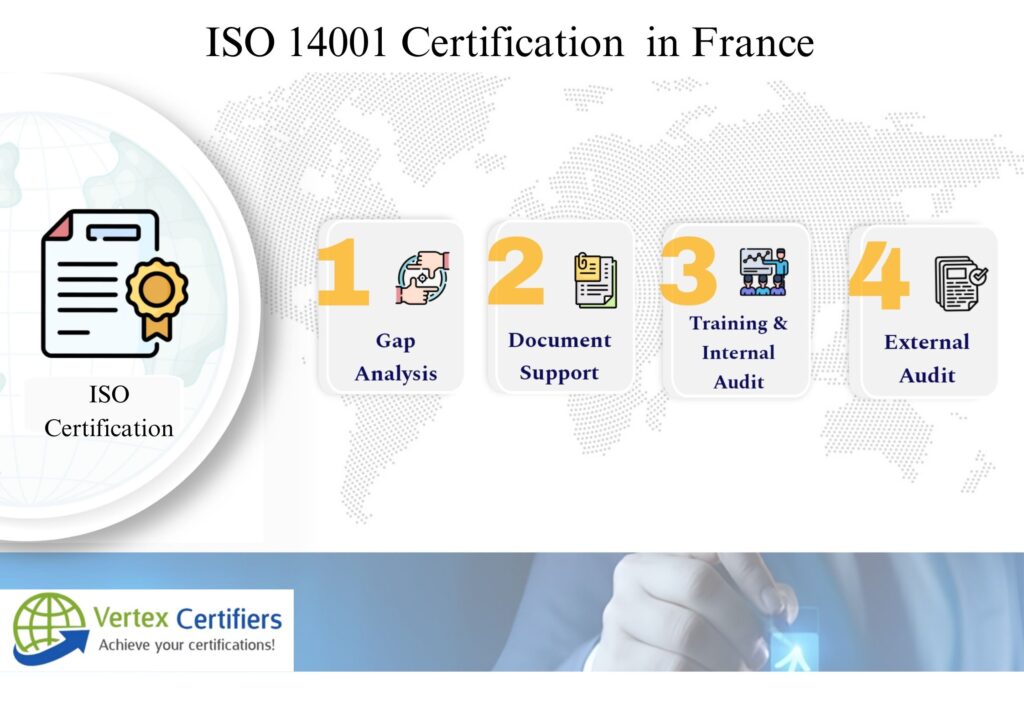
Achieving ISO 14001 Certification in France is a structured process that helps organisations establish an effective Environmental Management System (EMS) aligned with the requirements of ISO 14001:2015.A systematic implementation approach ensures that environmental risks are identified, legal obligations are addressed, operational controls are established, and continual improvement becomes part of the organisation’s culture.
Step 1: Gap Analysis
The certification journey begins with a comprehensive gap analysis. This initial assessment evaluates the organisation’s existing environmental practices, operational controls, legal compliance status, documentation, and management systems against the requirements of ISO 14001:2015. The purpose is to identify strengths, weaknesses, compliance gaps, and improvement opportunities before implementation begins.
During the gap analysis, consultants review environmental aspects, operational processes, waste management practices, energy consumption, pollution control measures, emergency preparedness, and existing policies. The findings form the foundation for a detailed implementation roadmap that guides the organisation throughout the certification project.
Step 2: Project Planning
Once the gap analysis is completed, the organisation develops a structured implementation plan. Project planning involves defining objectives, assigning responsibilities, establishing timelines, allocating resources, and determining milestones for EMS implementation.
Top management plays a vital role during this phase by demonstrating leadership commitment, approving environmental objectives, and ensuring sufficient resources are available. Effective planning helps coordinate activities across departments while ensuring that implementation progresses efficiently without disrupting normal business operations.
Step 3: Environmental Review
An environmental review is conducted to identify how the organisation’s activities, products, and services interact with the environment. This review examines resource consumption, emissions, waste generation, water usage, energy consumption, hazardous materials, environmental risks, and legal obligations.
The organisation identifies significant environmental aspects that require operational controls and establishes priorities based on environmental impact, legal requirements, stakeholder expectations, and business objectives. This assessment becomes the foundation for developing an effective Environmental Management System.
Step 4: EMS Documentation
Documentation is an essential component of ISO 14001 implementation. During this stage, organisations develop the policies, procedures, manuals, registers, and records required to support the Environmental Management System.
Typical documentation includes the Environmental Policy, environmental objectives, environmental aspect and impact register, legal compliance register, operational control procedures, emergency preparedness plans, monitoring procedures, corrective action processes, internal audit procedures, and management review records. Well-structured documentation ensures consistency, accountability, traceability, and compliance throughout the organisation.
Step 5: Environmental Policy
The organisation establishes a formal Environmental Policy that reflects its commitment to environmental protection, pollution prevention, legal compliance, and continual improvement. The policy serves as the foundation of the Environmental Management System and provides clear direction for environmental management across all organisational levels.
Top management must approve, communicate, and support the policy, ensuring employees understand their environmental responsibilities. The Environmental Policy should be available to relevant stakeholders and integrated into daily operational decision-making.
Step 6: Risk Assessment
Risk assessment is a critical part of ISO 14001 implementation. Organisations identify environmental risks and opportunities associated with their activities, products, services, and operational processes. These may include pollution risks, hazardous material handling, waste management, resource depletion, emergency situations, climate-related risks, and regulatory compliance issues.
After identifying environmental risks, the organisation establishes appropriate operational controls, mitigation measures, monitoring systems, and contingency plans. By proactively managing environmental risks, businesses can prevent incidents, improve operational resilience, reduce liabilities, and support continual environmental improvement.
Step 7: Employee Training
An Environmental Management System can only succeed when employees understand their roles and actively contribute to achieving the organisation’s environmental objectives. Therefore, employee training is one of the most important stages in obtaining ISO 14001 Certification in France. Every individual, from senior management to operational staff, should be aware of the organisation’s Environmental Policy, significant environmental aspects, legal obligations, operational controls, emergency procedures, and environmental objectives.
Training programmes should be tailored to different job functions and departments. For example, production employees should understand waste segregation, pollution prevention, chemical handling, and energy conservation practices, while managers should be trained on environmental risk management, legal compliance, performance monitoring, and continual improvement. Regular awareness sessions also encourage employees to identify environmental improvement opportunities and report potential environmental risks before they become major issues.
A well-trained workforce not only ensures successful ISO 14001 implementation but also creates a culture of environmental responsibility throughout the organisation. Employee involvement significantly improves compliance, reduces environmental incidents, enhances operational efficiency, and strengthens the long-term success of the Environmental Management System.
Step 8: EMS Implementation
After planning, documentation, and employee training are completed, the organisation begins implementing the Environmental Management System across all applicable departments and operational activities. This stage transforms documented procedures into practical business processes that become part of everyday operations.
Implementation involves applying environmental controls to activities such as waste management, resource conservation, pollution prevention, energy management, emergency preparedness, supplier evaluation, environmental monitoring, and legal compliance. Organisations should ensure that environmental responsibilities are clearly assigned, procedures are consistently followed, and performance is regularly monitored against established objectives.
Businesses should also maintain documented records demonstrating compliance with ISO 14001 requirements. These records may include environmental monitoring data, waste disposal records, energy consumption reports, training records, maintenance logs, inspection reports, incident reports, and corrective action records.
Successful implementation enables organisations to improve environmental performance while integrating sustainability into normal business operations rather than treating it as a separate initiative.
Step 9: Internal Audit
Once the Environmental Management System has been implemented for a reasonable period, the organisation conducts an internal audit to evaluate whether the EMS complies with ISO 14001:2015 requirements and whether it is effectively implemented.
Internal audits provide an independent assessment of the management system and help identify areas requiring improvement before the external certification audit. Auditors review documentation, interview employees, inspect operational activities, verify compliance with environmental procedures, and assess whether environmental objectives are being achieved.
The internal audit typically evaluates:
- Compliance with ISO 14001 requirements
- Environmental legal compliance
- Effectiveness of operational controls
- Waste management practices
- Pollution prevention measures
- Emergency preparedness
- Employee awareness and competence
- Environmental monitoring activities
- Corrective action effectiveness
Any nonconformities identified during the audit should be documented and corrected before proceeding to the certification audit. Internal audits also provide valuable opportunities for continual improvement and strengthen confidence in the Environmental Management System.
Step 10: Management Review
Management review is an essential requirement of ISO 14001:2015 and demonstrates leadership’s commitment to environmental management. Senior management periodically reviews the performance of the Environmental Management System to determine whether it remains suitable, adequate, effective, and aligned with the organisation’s strategic objectives.
During the review, management evaluates various aspects of EMS performance, including:
- Achievement of environmental objectives
- Internal audit findings
- Compliance status
- Environmental incidents
- Corrective actions
- Resource requirements
- Stakeholder feedback
- Opportunities for improvement
- Changes in legal or regulatory requirements
- Environmental performance indicators
Following the review, management establishes new objectives, approves improvement initiatives, allocates necessary resources, and ensures continual enhancement of environmental performance. Strong leadership involvement is one of the key factors influencing successful ISO 14001 certification.
Step 11: Certification Audit
After the organisation has successfully implemented its Environmental Management System, completed internal audits, addressed identified nonconformities, and conducted a management review, it is ready for the certification audit conducted by an accredited certification body.
The certification audit is typically divided into two stages.
Stage 1 Audit
The Stage 1 Audit primarily focuses on reviewing the organisation’s Environmental Management System documentation and assessing its readiness for the final certification audit.
During this stage, auditors verify:
- Scope of the EMS
- Environmental Policy
- Environmental objectives
- Risk and opportunity assessments
- Legal compliance processes
- Documented procedures
- Internal audit reports
- Management review records
- Overall preparedness for Stage 2
If any gaps are identified, the organisation is given an opportunity to address them before progressing to the next stage.
Stage 2 Audit
The Stage 2 Audit is the comprehensive evaluation of the implemented Environmental Management System. Auditors visit the organisation’s facilities and assess whether the EMS is effectively implemented and operating in accordance with ISO 14001:2015 requirements.
Activities during this audit include:
- Employee interviews
- Site inspections
- Process observations
- Verification of environmental controls
- Review of operational records
- Assessment of legal compliance
- Evaluation of continual improvement activities
- Verification of environmental objectives
Auditors assess how effectively the organisation manages its environmental responsibilities while ensuring compliance with documented procedures.
Certification Approval
Once the certification body confirms that the Environmental Management System complies with ISO 14001:2015 requirements and any identified nonconformities have been satisfactorily addressed, the organisation is recommended for certification.
Certification enhances credibility with customers, regulators, investors, suppliers, and business partners while reinforcing the organisation’s commitment to environmental sustainability and continual improvement.
Surveillance Audits
Surveillance audits verify that:
- The Environmental Management System remains operational.
- Environmental objectives continue to be monitored and achieved.
- Legal and regulatory compliance is maintained.
- Internal audits and management reviews are conducted regularly.
- Corrective actions are implemented effectively.
- Continual improvement activities are ongoing.
These audits encourage organisations to sustain environmental performance improvements and adapt to changing regulatory and operational requirements.
Recertification
The recertification process involves a comprehensive assessment of the Environmental Management System to ensure continued conformity with ISO 14001:2015 requirements.
The recertification audit evaluates:
- Overall EMS effectiveness
- Achievement of environmental objectives
- Continual improvement initiatives
- Compliance with updated legal requirements
- Environmental performance trends
- Leadership commitment
- Organisational changes
- Future environmental objectives
Successful recertification demonstrates the organisation’s ongoing commitment to environmental excellence and provides continued assurance to customers, regulators, and stakeholders.
Achieve ISO 14001 Certification in France with Vertex Certifiers
Environmental sustainability has become a critical component of business success in France.mplementing an Environmental Management System based on ISO 14001:2015 enables businesses to minimise environmental impacts, optimise resource utilisation, support ESG initiatives, and build a resilient, future-ready organisation.
At Vertex Certifiers, we are committed to helping organisations across France achieve internationally recognised ISO 14001 Certification through professional, practical, and result-oriented consulting services. Our experienced consultants provide complete end-to-end support, including gap analysis, Environmental Management System documentation, implementation guidance, employee training, internal audits, management review assistance, and certification audit coordination.
Whether your organisation is implementing an Environmental Management System for the first time or enhancing an existing framework, Vertex Certifiers offers expert guidance throughout the certification journey.Our systematic approach helps businesses streamline implementation, strengthen environmental compliance, improve operational performance, and demonstrate a genuine commitment to sustainable development. Partner with Vertex Certifiers to achieve ISO 14001 Certification in France confidently and position your organisation for long-term growth, international recognition, and environmental excellence.