ISO 14001 Certification in Nepal
Vertex Certifiers provides end-to-end ISO certification support to organizations seeking to improve their management systems, strengthen compliance, and achieve internationally recognized certification. Our services cover the complete certification journey, including gap analysis, documentation, implementation support, employee training, internal audits, management review, and certification audit preparation. With experienced ISO consultants and industry-focused solutions, we help businesses simplify the certification process while offering cost-effective and affordable solutions tailored to their size, industry, and specific requirements. Our objective is to make ISO certification practical, efficient, and accessible for organizations across Nepal and international markets.
ISO 14001 Certification in Nepal – Complete Guide to Environmental Management Systems
Introduction
Nepal is experiencing steady economic and industrial development, with growing activity across manufacturing, construction, hydropower, tourism, hospitality, agriculture, food processing, pharmaceuticals, infrastructure, logistics, and service sectors.Organizations are now expected not only to focus on productivity and profitability but also to demonstrate responsible use of natural resources, effective waste management, pollution prevention, regulatory compliance, and continual environmental improvement.
Nepal’s unique geographical and environmental conditions make responsible environmental management particularly important.Organizations may face environmental challenges associated with industrial pollution, increasing waste generation, wastewater, air emissions, excessive resource consumption, hazardous materials, construction activities, and emergency situations.
ISO 14001 is an internationally recognized standard for Environmental Management Systems.It provides organizations with a systematic framework for identifying environmental aspects, understanding applicable obligations, managing environmental risks, establishing objectives, controlling operational processes, monitoring performance, and pursuing continual improvement. The standard can be applied to organizations of different sizes and across a wide range of industries.
It takes a broader management-system approach.Organizations evaluate how their activities, products, and services interact with the environment and determine which environmental aspects require control. They can then establish appropriate operational controls, responsibilities, monitoring mechanisms, emergency preparedness arrangements, training programs, and improvement objectives.
Organizations in Nepal from manufacturing, construction, hydropower, hospitality, food processing, pharmaceuticals, logistics, healthcare, IT, agriculture, engineering, and other sectors can implement ISO 14001 according to their operational context and defined certification scope. The certification process generally involves understanding the organization’s current practices, conducting a gap analysis, developing or improving the EMS, implementing the required processes, training employees, performing internal audits, conducting management review, and undergoing an independent certification audit.
A competent consultant can help an organization understand the standard, identify gaps, develop appropriate documentation, implement environmental controls, train employees, conduct internal audits, and prepare for the certification audit.
Vertex Certifiers provides end-to-end ISO certification support for organizations seeking to establish effective management systems and achieve internationally recognized certification. Our support can cover gap analysis, documentation, implementation, training, internal auditing, management review support, and certification audit preparation. We work with organizations to simplify the ISO certification journey and provide practical, industry-specific solutions designed around their operational requirements.
For Nepalese organizations looking to strengthen environmental performance, demonstrate responsible business practices, improve operational controls, and build confidence among customers and stakeholders, ISO 14001 Certification in Nepal can provide a structured foundation for continual environmental improvement.
What is ISO 14001?
ISO 14001 is an internationally recognized standard that specifies requirements for an Environmental Management System (EMS).The commonly referenced edition is ISO 14001:2015, which follows a management-system approach based on organizational context, leadership, planning, support, operation, performance evaluation, and improvement.
The Environmental Management System includes considering issues such as waste, energy consumption, water use, emissions, raw materials, chemicals, resource utilization, pollution prevention, and emergency situations.
ISO 14001 Certification Process in Nepal
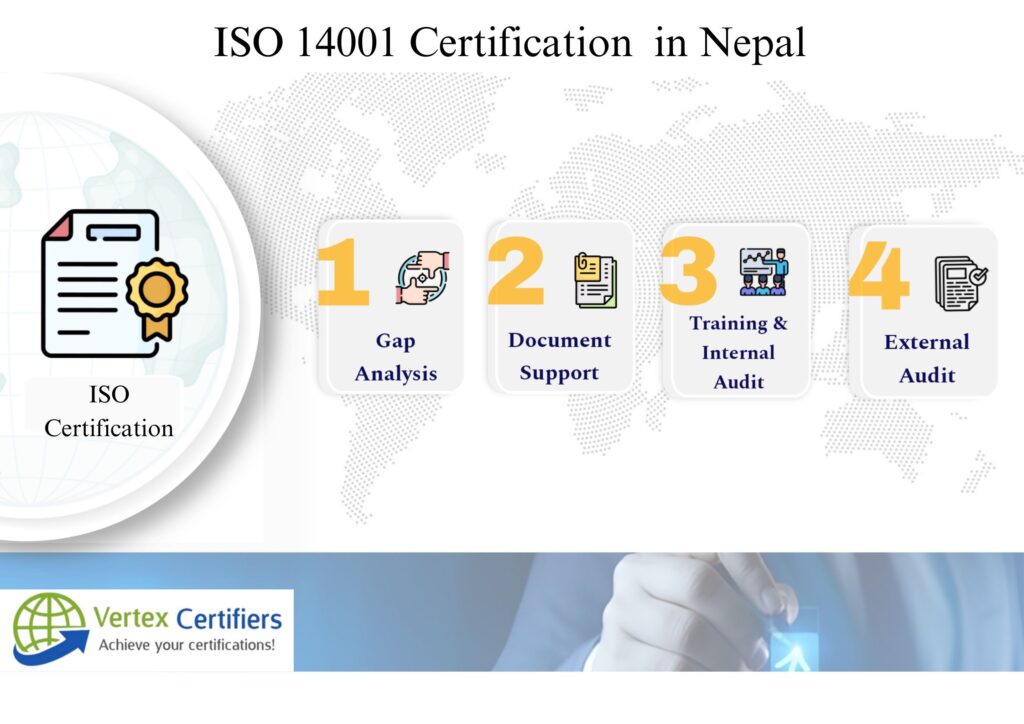
Obtaining ISO 14001 certification in Nepal involves several stages. The exact implementation approach depends on the organization’s size, industry, operational complexity, environmental aspects, number of locations, and existing management practices.
A structured certification process generally includes the following stages.
Step 1 – Initial Consultation
The first stage is understanding the organization’s business operations and certification requirements.
During the initial consultation, an ISO consultant may review:
- Organization profile
- Products and services
- Operational activities
- Number of employees
- Locations
- Existing management systems
- Environmental aspects
- Existing environmental controls
- Applicable compliance obligations
- Certification scope
- Current level of EMS implementation
This assessment helps determine the most appropriate approach for implementing ISO 14001.
At Vertex Certifiers, we begin by understanding the organization’s actual processes rather than applying a generic documentation package. This allows the EMS to be developed around the organization’s operational requirements.
Step 2 – Gap Analysis
A gap analysis compares the organization’s existing environmental management practices against the applicable ISO 14001 requirements.
The purpose is to identify:
- Existing practices that already meet requirements
- Missing processes
- Documentation gaps
- Implementation gaps
- Environmental control gaps
- Training requirements
- Monitoring requirements
- Internal audit requirements
- Areas requiring corrective action
The gap analysis provides a clear roadmap for implementation.
Instead of attempting to implement every requirement simultaneously, organizations can prioritize the areas that require the greatest attention.
Step 3 – EMS Documentation
Once the gaps are identified, the required Environmental Management System documentation is developed or improved.
Depending on the organization’s requirements, documentation may include:
- Environmental Policy
- EMS scope
- Environmental aspects and impacts register
- Compliance obligations
- Environmental objectives
- Environmental management programs
- Operational control procedures
- Emergency preparedness procedures
- Monitoring and measurement processes
- Competence and training processes
- Communication arrangements
- Internal audit procedures
- Management review processes
- Corrective action procedures
Documentation should be practical and relevant to the organization.
The objective is not to create unnecessary paperwork. Instead, documentation should help employees understand responsibilities, establish consistent processes, maintain evidence, and support effective environmental management.
Step 4 – Implementation
After developing the EMS framework, the organization implements the requirements across relevant departments and operations.
Implementation may involve:
- Establishing environmental responsibilities
- Communicating the environmental policy
- Implementing operational controls
- Managing waste
- Controlling significant environmental aspects
- Monitoring environmental performance
- Implementing emergency procedures
- Maintaining required records
- Evaluating compliance obligations
- Establishing environmental objectives
Employee involvement is essential at this stage.
An EMS becomes effective when employees understand how their daily activities can affect environmental performance and what controls they need to follow.
Vertex Certifiers can provide implementation support to help organizations move beyond documentation and establish processes that work effectively within their operations.
Step 5 – Employee Training and Awareness
Employees play an important role in the successful implementation of ISO 14001.
Training and awareness programs can cover:
- Environmental policy
- ISO 14001 requirements
- Environmental aspects and impacts
- Significant environmental aspects
- Operational controls
- Waste management
- Emergency response
- Environmental objectives
- Employee responsibilities
- Reporting environmental incidents
- Continual improvement
Training should be appropriate to employees’ roles and responsibilities.
For example, production employees may require awareness of waste, emissions, chemicals, and operational controls, while management may require a broader understanding of environmental objectives, compliance obligations, risks, performance evaluation, and continual improvement.
Step 6 – Internal Audit
Before proceeding to the certification audit, the organization should conduct an internal ISO 14001 audit.
The purpose of an internal audit is to determine whether the EMS:
- Meets applicable ISO 14001 requirements
- Has been properly implemented
- Is maintained effectively
- Is producing intended results
- Has appropriate evidence
- Identifies and addresses nonconformities
Internal auditors review processes and objective evidence rather than simply checking documents.
Potential findings may relate to:
- Environmental controls
- Documentation
- Monitoring
- Employee awareness
- Compliance evaluation
- Emergency preparedness
- Objectives
- Corrective actions
- Operational processes
Identified nonconformities should be addressed before the certification audit wherever appropriate.
Step 7 – Management Review
Management review provides top management with an opportunity to evaluate the performance and effectiveness of the Environmental Management System.
Management review can consider:
- Internal audit results
- Environmental performance
- Achievement of environmental objectives
- Compliance evaluation
- Environmental incidents
- Nonconformities
- Corrective actions
- Changes affecting the organization
- Resource requirements
- Risks and opportunities
- Opportunities for improvement
The management review demonstrates that environmental management is supported at the leadership level.
Top management should use the results of the review to determine appropriate actions and improvements.
Step 8 – Certification Audit
Once the EMS has been implemented and the organization is prepared, an independent certification body conducts the certification audit.
The certification audit generally consists of two stages.
Stage 1 Audit
Stage 1 focuses primarily on understanding the organization’s management system and determining its readiness for the next stage.
The auditor may review:
- EMS scope
- Organizational context
- Environmental policy
- Environmental aspects
- Compliance obligations
- Environmental objectives
- Documentation
- Organizational preparedness
- Key operational processes
Stage 1 helps determine whether the organization is sufficiently prepared for Stage 2.
Stage 2 Audit
Stage 2 evaluates the implementation and effectiveness of the Environmental Management System.
Auditors may examine actual processes and objective evidence across relevant functions and locations.
The audit may include:
- Interviews with employees
- Site observations
- Review of operational controls
- Examination of records
- Environmental performance monitoring
- Compliance evaluation
- Internal audit records
- Management review records
- Corrective action records
- Evaluation of environmental objectives
The organization must demonstrate that the EMS has been implemented effectively within the defined certification scope.
Any audit findings must be addressed according to the certification body’s requirements before certification can be granted.
Step 9 – ISO 14001 Certificate Issuance
Following successful completion of the certification process and closure of applicable audit findings, the certification body can issue the ISO 14001 certificate for the approved scope.
The certificate demonstrates that the organization’s Environmental Management System has been independently assessed against the applicable ISO 14001 requirements.
The certification scope identifies the organization’s relevant activities, products, services, locations, or processes covered by certification.
Organizations can then communicate their certification status to relevant customers, stakeholders, and business partners in accordance with the certification body’s requirements.
Step 10 – Surveillance Audits
ISO 14001 certification is not the end of the environmental management journey.
Certified organizations undergo periodic surveillance activities to evaluate whether the EMS continues to be implemented and maintained effectively.
Surveillance audits may examine:
- Environmental objectives
- Operational controls
- Internal audits
- Management review
- Corrective actions
- Environmental performance
- Compliance evaluation
- Changes within the organization
- Continual improvement
Organizations should therefore treat ISO 14001 as an ongoing management system rather than a one-time certification exercise.
Continual evaluation and improvement help ensure that the EMS remains relevant as the organization’s activities, environmental risks, regulatory requirements, technologies, and stakeholder expectations evolve.
Our Services
- GMP Certification
- GLP Certification
- GDP Certification
- Halal Certificate
- Organic Certificate
- CE Marking Certification
- RoHS Certification
- FDA Certification
- CMMI Certification
- Cyber Security
- VAPT Testing
- Security Assessment
Our Clients


Why is ISO 14001 Certification Important in Nepal?
Nepal's expanding industrial, infrastructure, energy, tourism, manufacturing, and service sectors are increasing the need for systematic environmental management. As organizations grow, environmental considerations such as waste generation, resource consumption, pollution prevention, emissions, wastewater, energy use, and emergency preparedness become increasingly important.
ISO 14001 Certification in Nepal provides organizations with a structured framework for identifying environmental aspects, managing environmental risks, meeting applicable obligations, monitoring performance, and continually improving their Environmental Management System (EMS).
Why does ISO 14001 matter? It helps organizations move from reactive environmental management to a structured system where environmental responsibilities are planned, implemented, monitored, reviewed, and continuously improved.
Growing Industrialization
Nepal's economic development is creating opportunities across multiple industries. As business operations expand, organizations increasingly need processes for controlling their environmental impacts and demonstrating responsible business practices.
Important sectors include:
- Manufacturing
- Construction and infrastructure
- Hydropower
- Cement manufacturing
- Food processing
- Pharmaceuticals
- Hotels and hospitality
- Tourism
- Agriculture and agro-processing
- IT and service industries
For these organizations, an Environmental Management System can help establish clearer environmental responsibilities, operational controls, monitoring processes, and improvement objectives.
Increasing Environmental Regulations
Organizations operating in Nepal need to understand and manage the environmental obligations applicable to their activities. Depending on the industry and operational scope, environmental considerations may include pollution control, waste management, environmental assessments, resource conservation, and regulatory monitoring.
- Environmental compliance: Identify and monitor applicable environmental obligations.
- Environmental impact assessments: Understand and manage environmental impacts associated with relevant projects and activities.
- Pollution control: Establish controls to prevent or reduce undesirable environmental impacts.
- Waste management: Improve the systematic handling, storage, treatment, recycling, and disposal of waste.
- Resource conservation: Identify opportunities to improve the efficient use of energy, water, materials, and other resources.
- Regulatory monitoring: Establish processes for evaluating compliance with applicable obligations.
International Trade and Supply Chains
For Nepalese organizations working with international customers, multinational companies, export markets, contractors, or global supply chains, environmental management can become an important part of business relationships.
ISO 14001 certification can help organizations demonstrate that environmental management is supported by a recognized management-system framework. This can strengthen confidence among customers, procurement teams, international partners, and other stakeholders evaluating suppliers and business partners.
- International buyers
- Multinational companies
- Export-oriented organizations
- International contractors
- Global supply-chain partners
Sustainability and ESG Expectations
Environmental responsibility is increasingly connected with broader sustainability and ESG expectations. Organizations are under growing pressure from customers, investors, employees, communities, and business partners to demonstrate responsible environmental practices.
ISO 14001 can provide a structured foundation for organizations seeking to strengthen their environmental governance and sustainability practices.
- Environmental responsibility
- Sustainable operations
- Climate-related considerations
- Corporate sustainability
- Stakeholder confidence
Who Needs ISO 14001 Certification in Nepal?
ISO 14001 can be implemented by organizations of different sizes and sectors. The standard is particularly relevant to businesses whose activities, products, services, facilities, or supply chains have environmental aspects that need systematic management.
Manufacturing Industries
- Cement
- Steel
- Textiles
- Food processing
- Beverage
- Chemicals
- Pharmaceuticals
- Plastics
- Paper
- Electronics
Construction & Infrastructure
- Construction companies
- Engineering contractors
- Infrastructure developers
- Road projects
- Hydropower projects
Energy & Hydropower
- Hydropower developers
- Renewable energy companies
- Energy service providers
- Energy infrastructure organizations
Hospitality & Tourism
- Hotels
- Resorts
- Travel organizations
- Tourism businesses
- Eco-tourism organizations
Other Organizations
- Hospitals
- Educational institutions
- Logistics companies
- Warehouses
- IT companies
- Government organizations
- Professional service providers
ISO 14001:2015 Requirements in Nepal
Organizations implementing ISO 14001:2015 should establish an Environmental Management System appropriate to their organizational context, environmental aspects, compliance obligations, risks, opportunities, and operational requirements.
The standard is structured around ten clauses, with Clauses 4 to 10 containing the principal management-system requirements.
Clause 4 – Context of the Organization
The organization determines the internal and external issues that can affect its ability to achieve the intended outcomes of the Environmental Management System.
- Internal and external issues
- Interested parties and their relevant needs
- EMS scope
- Environmental conditions relevant to the organization
Clause 5 – Leadership
Top management plays an important role in establishing, supporting, and maintaining the Environmental Management System.
- Top management commitment
- Environmental policy
- Roles and responsibilities
- Accountability for EMS performance
Clause 6 – Planning
Planning is a central part of ISO 14001. Organizations identify environmental aspects, compliance obligations, risks, opportunities, and objectives that need to be managed.
- Environmental aspects and impacts
- Compliance obligations
- Risks and opportunities
- Environmental objectives
- Environmental planning and action
Clause 7 – Support
Organizations must provide the resources and support necessary for the Environmental Management System to function effectively.
- Resources
- Competence
- Employee awareness
- Internal and external communication
- Documented information
Clause 8 – Operation
Operational planning and control ensure that processes associated with significant environmental aspects are managed appropriately.
- Operational controls
- Life-cycle perspective considerations
- Procurement and outsourced process controls where applicable
- Emergency preparedness and response
- Environmental process controls
Clause 9 – Performance Evaluation
Organizations need to evaluate whether their EMS is performing effectively and whether environmental objectives and controls are achieving intended results.
- Monitoring and measurement
- Analysis and evaluation
- Compliance evaluation
- Internal audits
- Management review
Clause 10 – Improvement
ISO 14001 requires organizations to address nonconformities and continually improve the suitability, adequacy, and effectiveness of the Environmental Management System.
- Nonconformity management
- Corrective action
- Continual improvement
ISO 14001 Certification Requirements in Nepal
A practical Environmental Management System should include the processes and evidence necessary to demonstrate that environmental responsibilities are systematically managed.
- Environmental Policy
- Defined EMS Scope
- Environmental Aspects and Impacts Register
- Applicable Legal and Compliance Obligations
- Environmental Objectives
- Environmental Management Programs
- Operational Controls
- Emergency Preparedness and Response Procedures
- Competence and Training Records
- Communication Processes
- Monitoring and Measurement Procedures
- Internal Audit Program
- Management Review Records
- Corrective Action Procedures
- Continual Improvement Mechanisms
Important: ISO 14001 certification is not about creating documents simply for an audit. The documentation and processes should support the organization's actual environmental management activities and help employees consistently control relevant environmental aspects.
ISO 14001 Documentation Required in Nepal
Documentation is an important part of an ISO 14001 Environmental Management System, but organizations should avoid creating unnecessary paperwork. The objective is to maintain appropriate documented information that supports effective environmental management and provides evidence that required processes are being implemented.
EMS Documentation
- Environmental Policy
- EMS Scope
- EMS Manual, where applicable
- Environmental Objectives
- Environmental Management Programs
Environmental Planning
- Environmental Aspects & Impacts Register
- Legal Requirements Register
- Compliance Obligations
- Risks and Opportunities
Operational Controls
- Operational Control Procedures
- Waste Management Procedures
- Emergency Response Procedures
- Environmental Monitoring Records
Performance & Improvement
- Training Records
- Internal Audit Reports
- Management Review Minutes
- Corrective Action Records
- Monitoring & Measurement Records
The exact documentation required depends on the organization's activities, size, environmental aspects, operational complexity, and management-system needs. A practical approach focuses on useful documentation rather than excessive paperwork.
How Long Does ISO 14001 Certification Take in Nepal?
The time required to implement and certify an Environmental Management System varies from one organization to another. There is no universal timeline because organizations differ in size, operational complexity, number of locations, environmental aspects, existing systems, and employee involvement.
A typical certification journey can include:
Gap Analysis
Review existing processes and identify gaps against ISO 14001 requirements.
Documentation
Develop or improve the documentation and processes required for the EMS.
Implementation
Deploy the Environmental Management System across relevant operations.
Training
Train employees and build awareness of environmental responsibilities and operational controls.
Internal Audit
Evaluate implementation and identify areas requiring corrective action.
Management Review
Top management evaluates EMS performance and determines improvement actions.
Certification Audit
An independent certification body evaluates the implemented Environmental Management System.
Factors that can influence the implementation timeline include organization size, existing EMS maturity, operational complexity, number of locations, employee involvement, and overall certification readiness.
Benefits of ISO 14001 Certification in Nepal
Implementing ISO 14001 can provide environmental, operational, commercial, and organizational benefits when the system is effectively implemented and maintained.
Environmental Benefits
- Reduced environmental impacts
- Improved waste management
- Better resource utilization
- Improved pollution prevention
- Better emergency preparedness
- Improved environmental performance monitoring
Business Benefits
- Improved operational efficiency
- Better environmental risk management
- More efficient resource utilization
- Improved organizational processes
- Clearer environmental responsibilities
Market Benefits
- Increased customer confidence
- Support for international business opportunities
- Improved supplier qualification potential
- Stronger competitive positioning
- Demonstration of environmental commitment
Compliance Benefits
- Better identification of environmental obligations
- Improved compliance monitoring
- More systematic environmental controls
- Reduced risk of overlooked environmental requirements
Sustainability Benefits
- Supports environmental sustainability initiatives
- Encourages continual improvement
- Strengthens environmental responsibility
- Supports stakeholder confidence
ISO 14001 Certification for Major Industries in Nepal
ISO 14001 can be adapted to the environmental context of different industries. The environmental aspects, controls, objectives, and monitoring requirements will depend on the organization's activities.
ISO 14001 for Manufacturing Companies in Nepal
Manufacturing organizations may need to manage environmental aspects associated with energy use, raw materials, production processes, emissions, wastewater, waste generation, chemicals, packaging, and resource consumption. ISO 14001 provides a structured framework for establishing controls and monitoring environmental performance.
ISO 14001 for Construction Companies in Nepal
Construction companies and contractors may face environmental considerations involving construction waste, dust, noise, fuel consumption, material usage, water, land disturbance, transportation, and emergency situations. An EMS can help organizations establish systematic controls across construction activities.
ISO 14001 for Hydropower Companies in Nepal
Hydropower projects involve complex environmental considerations that can vary according to project scope and location. ISO 14001 can support systematic environmental planning, operational controls, monitoring, emergency preparedness, and continual improvement.
ISO 14001 for Cement Companies in Nepal
Cement manufacturing can involve environmental aspects related to energy consumption, emissions, raw materials, dust, waste, transportation, and resource use. A structured EMS can help organizations establish appropriate environmental controls and performance-monitoring processes.
ISO 14001 for Hotels and Resorts in Nepal
Hotels and resorts may manage environmental aspects associated with water consumption, energy use, food waste, wastewater, solid waste, cleaning chemicals, and resource consumption. ISO 14001 can help hospitality organizations establish systematic environmental management practices.
ISO 14001 for Food Processing Companies in Nepal
Food processing organizations may have environmental considerations related to water consumption, energy, food waste, wastewater, packaging, cleaning processes, and resource use. An EMS can help establish operational controls and improvement objectives relevant to these activities.
ISO 14001 for Pharmaceutical Companies in Nepal
Pharmaceutical organizations may need to carefully manage environmental aspects associated with chemicals, waste, energy, water, emissions, and controlled processes. ISO 14001 can provide a structured framework for identifying and managing relevant environmental aspects.
ISO 14001 for IT and Service Companies in Nepal
Service and IT organizations may have environmental aspects related to energy consumption, electronic equipment, e-waste, office resources, transportation, facilities, and waste management. ISO 14001 can be scaled according to the organization's actual environmental context.
ISO 14001 Internal Audit in Nepal
An internal audit is an important part of maintaining an effective Environmental Management System. It provides an opportunity for an organization to evaluate whether its processes are implemented as planned and whether the EMS meets applicable ISO 14001 requirements.
Purpose of Internal Auditing
The purpose of an ISO 14001 internal audit is to provide objective information about the conformity and effectiveness of the Environmental Management System.
Audit Planning
An audit program should consider the importance of environmental processes, changes affecting the organization, previous audit results, and relevant operational areas.
Environmental Compliance Evaluation
Internal audits can include reviewing how the organization identifies, monitors, and evaluates applicable environmental compliance obligations.
Process-Based Auditing
Auditors evaluate actual processes and objective evidence rather than simply checking whether documents exist.
Identifying Nonconformities
Where requirements are not adequately implemented, the audit can identify nonconformities and opportunities for improvement.
Corrective Actions
Organizations should investigate the causes of identified nonconformities and implement appropriate corrective actions.
Follow-Up Audits
Follow-up activities help verify whether corrective actions have been effectively implemented and whether identified issues have been addressed.
Why do internal audits matter? Internal audits help organizations determine whether their Environmental Management System is implemented, maintained, effective, and aligned with applicable ISO 14001 requirements.
ISO 14001 Certification vs Environmental Compliance in Nepal
ISO 14001 certification and environmental regulatory compliance are related but different concepts. Organizations should understand the distinction between a management-system certification and compliance with applicable laws, regulations, permits, and statutory requirements.
| ISO 14001 Certification | Environmental Compliance |
|---|---|
| International environmental management-system standard | Compliance with applicable laws and regulations |
| Focuses on systematic environmental management | Focuses on applicable legal and regulatory requirements |
| Includes continual improvement of the EMS | Depends on the environmental obligations applicable to the organization |
| Assessed through independent third-party certification | May be assessed or enforced by relevant authorities |
| Applies to a defined organizational certification scope | Applies according to applicable legal requirements and activities |
Important: ISO 14001 certification does not replace environmental permits, licenses, approvals, or other statutory environmental requirements. Instead, the standard provides a systematic framework for managing environmental responsibilities and applicable compliance obligations.
How to Choose an ISO 14001 Certification Body in Nepal
Choosing an appropriate certification body is an important part of the certification journey. Organizations should conduct their own due diligence and evaluate the certification body's credentials, competence, scope, and recognition.
- Accreditation: Verify the certification body's accreditation status and applicable scope.
- Auditor competence: Consider the qualifications and relevant industry experience of auditors.
- Industry experience: Evaluate experience with organizations operating in your sector.
- Certification scope: Confirm that the certification body can assess the intended organizational scope.
- International recognition: Review whether the certification is suitable for your customers and target markets.
- Audit methodology: Understand how the certification audit will be conducted.
- Transparency: Request clear information about the certification process and applicable services.
- Surveillance arrangements: Understand ongoing surveillance and certification maintenance requirements.
A consultant can assist with implementation and certification preparation, but the certification decision should be made independently by the certification body.
Role of an ISO 14001 Consultant in Nepal
An ISO 14001 consultant provides implementation and advisory support to help organizations understand the standard and develop an Environmental Management System appropriate to their operations.
Assessment & Planning
- Gap analysis
- EMS implementation roadmap
- Environmental aspects identification
- Risk and opportunity assessment
System Development
- EMS development
- Documentation support
- Environmental objectives
- Operational controls
Implementation Support
- Employee training
- Awareness programs
- Implementation guidance
- Corrective actions
Audit Preparation
- Internal audits
- Pre-audit assessment
- Certification audit preparation
- Management review support
The consultant and certification body have different roles. A consultant supports the organization in developing and implementing its management system, while an independent certification body conducts the certification assessment and makes the certification decision.
Why Choose Vertex Certifiers for ISO 14001 Certification Support in Nepal?
Implementing ISO 14001 becomes easier when organizations have structured guidance from experienced consultants who understand both management-system requirements and practical business operations.
Vertex Certifiers provides end-to-end ISO certification support for organizations seeking to establish effective management systems and prepare for internationally recognized certification. Our approach is focused on practical implementation rather than documentation alone.
Gap Analysis
Identify gaps between existing environmental practices and ISO 14001 requirements.
Documentation Support
Develop practical EMS documentation aligned with organizational processes.
Implementation Assistance
Support the organization in implementing environmental controls and processes.
Employee Training
Build awareness and competence across relevant departments and functions.
Internal Audit Support
Evaluate EMS implementation and identify areas requiring corrective action.
Certification Audit Preparation
Help organizations prepare for the independent certification assessment.
Our end-to-end approach can cover gap analysis, documentation, implementation, training, internal audit, management review support, and certification audit preparation. We work with organizations to understand their industry, processes, environmental aspects, and certification objectives before developing an appropriate implementation approach.
Whether your organization is implementing ISO 14001 for the first time or strengthening an existing Environmental Management System, Vertex Certifiers can provide structured support throughout the certification journey.
Ready to Start ISO 14001 Certification in Nepal?
Build a structured Environmental Management System with professional guidance from Vertex Certifiers. Our team can support you from gap analysis and documentation through implementation, training, internal audit, and certification audit preparation.
Frequently Asked Questions About ISO 14001 Certification in Nepal
What is ISO 14001 certification in Nepal?
ISO 14001 certification in Nepal is the independent assessment of an organization's Environmental Management System against the applicable requirements of ISO 14001. It demonstrates that the organization has established a structured approach to managing relevant environmental aspects and continually improving its environmental performance.
Is ISO 14001 mandatory in Nepal?
ISO 14001 certification is not universally mandatory for every organization. However, specific customer, contractual, industry, procurement, regulatory, or supply-chain requirements may make environmental management particularly important for certain organizations.
How long does ISO 14001 certification take?
The timeline depends on the organization's size, operational complexity, number of locations, existing EMS, environmental aspects, employee involvement, and certification readiness. The process generally includes gap analysis, documentation, implementation, training, internal audit, management review, and certification audit.
Who can obtain ISO 14001 certification?
Organizations from a wide range of sectors can implement ISO 14001, including manufacturing, construction, hydropower, infrastructure, cement, food processing, pharmaceuticals, hospitality, tourism, healthcare, logistics, IT, education, and professional services.
What documents are required for ISO 14001?
Documentation may include the Environmental Policy, EMS scope, environmental aspects and impacts information, compliance obligations, environmental objectives, operational controls, emergency preparedness arrangements, monitoring records, internal audit records, management review records, and corrective action records.
Is ISO 14001 applicable to small businesses?
Yes. ISO 14001 can be implemented by organizations of different sizes. The Environmental Management System should be appropriate to the organization's activities, environmental aspects, operational complexity, risks, and certification scope.
Can a company obtain ISO 14001 without an Environmental Management System?
An organization seeking certification needs to establish and implement an Environmental Management System that meets the applicable ISO 14001 requirements. Consultants can help organizations develop and implement the necessary system before the independent certification audit.
What is the difference between ISO 14001 certification and environmental compliance?
ISO 14001 is an international Environmental Management System standard, while environmental compliance refers to meeting applicable laws, regulations, permits, licenses, and statutory obligations. ISO 14001 does not replace environmental compliance; it provides a structured framework for managing environmental responsibilities.
How often does ISO 14001 certification need to be renewed?
ISO 14001 certification follows a certification cycle with periodic surveillance activities and a subsequent recertification process according to the arrangements of the certification body. Organizations should maintain and continually improve their EMS throughout the certification cycle.
Can ISO 14001 help companies working with international customers?
ISO 14001 can help organizations demonstrate a structured approach to environmental management, which may strengthen confidence among international customers, procurement teams, contractors, supply-chain partners, and other stakeholders.
How do I find an ISO 14001 consultant in Nepal?
When selecting an ISO 14001 consultant, consider relevant consulting experience, understanding of ISO 14001, industry knowledge, implementation methodology, internal audit capability, training support, and experience preparing organizations for independent certification audits.
Get Expert ISO 14001 Support in Nepal
Start your ISO 14001 journey with a practical, structured, and end-to-end implementation approach from Vertex Certifiers.
