
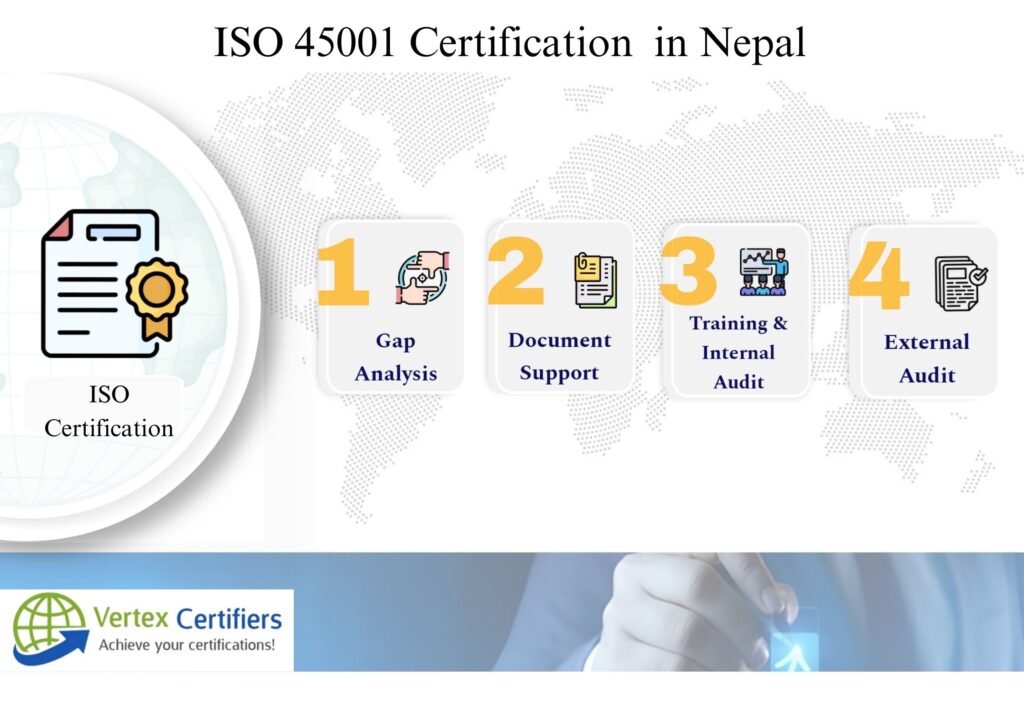
ISO 45001 Certification in Nepal
ISO 45001 Certification in Nepal: Complete Guide for Occupational Health and Safety
ISO 45001 certification helps organizations in Nepal identify workplace hazards, control occupational health and safety risks, protect workers, and demonstrate a structured commitment to continual improvement.
Why Is ISO 45001 Certification Important in Nepal?
Nepal is experiencing growth in infrastructure, hydropower, construction, manufacturing, tourism, healthcare, logistics, and other sectors. As business operations become larger and more complex, organizations need a systematic method to identify hazards, assess risks, meet applicable obligations, and prevent workplace injuries and ill health.
ISO 45001:2018 provides an internationally recognized framework for establishing, implementing, maintaining, and continually improving an occupational health and safety management system. The standard can help Nepalese organizations strengthen safety performance while improving customer confidence, tender eligibility, employee participation, and business reputation.
Growing Industrialization and Infrastructure Development
Industrialization and infrastructure development are creating new employment opportunities and expanding the scale of operations across Nepal. This growth also introduces additional workplace hazards that require formal controls and management oversight.
- Construction: Building, road, bridge, and civil engineering projects involve excavation, lifting, scaffolding, electrical work, traffic movement, and work at height.
- Hydropower: Hydropower projects may involve tunnels, remote locations, heavy equipment, electrical systems, blasting activities, and challenging terrain.
- Manufacturing: Production facilities commonly use machinery, electrical systems, raw materials, chemicals, compressed air, and material-handling equipment.
- Cement: Cement production can expose workers to dust, high temperatures, heavy machinery, noise, vibration, and chemical substances.
- Steel and metal industries: Welding, cutting, fabrication, molten materials, sharp edges, cranes, and hot work can create significant risks.
- Mining: Mining and quarrying may involve blasting, excavation, vehicle movement, unstable ground, dust, noise, and heavy equipment.
- Food processing: Workers may face machinery hazards, wet floors, cold environments, manual handling, cleaning chemicals, and repetitive work.
- Pharmaceuticals: Pharmaceutical operations require controls for chemicals, biological materials, laboratory processes, equipment, and waste handling.
- Infrastructure projects: Large projects often involve multiple contractors, temporary worksites, shifting work conditions, and geographically dispersed teams.
Expansion increases the need for systematic safety controls because informal safety practices may not be sufficient when organizations have more workers, contractors, locations, equipment, shifts, and operational processes. ISO 45001 helps management move from reactive accident response to proactive risk prevention.
Workplace Health and Safety Risks
Nepalese organizations may encounter a wide range of occupational health and safety risks depending on their sector, location, processes, equipment, and workforce. Common risks include:
- Machinery-related accidents and entanglement hazards.
- Electrical shocks, arc flash, short circuits, and faulty wiring.
- Falls from height, scaffolding, ladders, roofs, and elevated platforms.
- Construction-site hazards involving excavation, lifting, vehicles, and temporary structures.
- Exposure to chemicals, dust, fumes, gases, and hazardous substances.
- Fire, explosion, hot-work, fuel, and combustible-material risks.
- Manual handling, repetitive movements, awkward postures, and ergonomic strain.
- Noise and vibration from machinery, tools, vehicles, and industrial equipment.
- Occupational injuries, work-related illnesses, fatigue, and stress.
- Contractor-related risks caused by inconsistent training, supervision, or safety procedures.
Increasing Regulatory and Compliance Expectations
Organizations are increasingly expected to understand and address their occupational health and safety obligations. These obligations may arise from applicable workplace safety legislation, labor requirements, environmental controls, contractual conditions, project specifications, customer requirements, and other compliance commitments.
ISO 45001 encourages organizations to identify applicable requirements, evaluate compliance, assign responsibilities, and retain documented evidence. Inspection reports, training records, risk assessments, incident investigations, emergency drills, and audit reports can help demonstrate that safety controls are being implemented rather than merely documented.
Maintaining reliable records is especially important when organizations need to demonstrate compliance to customers, project owners, development agencies, international contractors, certification auditors, or government authorities.
International Projects and Supply Chains
Nepalese organizations working with international contractors, development projects, multinational companies, international buyers, foreign investors, and global supply chains may increasingly encounter occupational health and safety requirements during vendor qualification, tender evaluation, contract review, or project execution.
ISO 45001 certification can provide recognizable evidence that an organization has established a formal OH&S management system. It may also help businesses communicate safety responsibilities more clearly across contractors, suppliers, project partners, and customers.
Improving Employee Safety Culture
ISO 45001 treats worker participation as an important part of effective safety management. The standard encourages organizations to involve employees in hazard identification, risk assessment, incident reporting, consultation, training, and improvement activities.
- Employee participation in safety decisions.
- Improved workplace safety awareness.
- Simple and accessible hazard-reporting processes.
- Worker consultation before changes are introduced.
- Visible leadership involvement.
- Preventive action based on trends, observations, and near misses.
Key Requirements of ISO 45001:2018
ISO 45001:2018 follows the Annex SL high-level structure used by several ISO management system standards. This structure makes it easier to integrate ISO 45001 with standards such as ISO 9001 for quality management and ISO 14001 for environmental management.
Context of the Organization
The organization must understand internal and external issues that can affect its occupational health and safety management system. It should also identify relevant interested parties, determine their applicable needs and expectations, and define the scope of the OH&S management system.
The scope should explain the locations, activities, products, services, workers, and organizational processes covered by the system. It should reflect the actual operational boundaries of the organization and not exclude relevant activities without proper justification.
Leadership and Worker Participation
Top management is responsible for demonstrating leadership and accountability for OH&S performance. Management should establish an OH&S policy, provide resources, assign responsibilities, and ensure that safety objectives support the organization's strategic direction.
Workers should be consulted and encouraged to participate in hazard identification, risk assessment, incident investigation, safety planning, and continual improvement. Clear roles, responsibilities, authority, and accountability should be communicated throughout the organization.
Planning
Planning includes the identification of hazards, assessment of OH&S risks and opportunities, determination of applicable legal and regulatory requirements, and establishment of measurable OH&S objectives.
The organization should prepare plans explaining what will be achieved, who is responsible, what resources are required, when actions will be completed, and how results will be evaluated.
Support
ISO 45001 requires organizations to provide adequate resources and ensure that workers are competent for the tasks they perform. Support processes may include training, awareness programs, communication, consultation, and control of documented information.
- Resources for implementing and maintaining safety controls.
- Competence requirements for employees and contractors.
- Training and awareness activities.
- Internal and external communication processes.
- Control of policies, procedures, forms, and records.
Operation
Operational planning and control ensures that identified risks are managed in day-to-day activities. Controls should consider the hierarchy of controls, management of change, procurement, contractor management, outsourced processes, and emergency preparedness.
Organizations should establish suitable controls for routine and non-routine activities, communicate relevant requirements to contractors and visitors, and prepare for foreseeable emergency situations.
Performance Evaluation
Performance evaluation involves monitoring, measurement, analysis, and review of OH&S results. Organizations should evaluate compliance, conduct internal audits, perform management reviews, and use suitable safety performance indicators.
Useful indicators may include incident frequency, near-miss reports, safety observations, training completion, inspection findings, corrective-action closure, absenteeism, and emergency-drill performance.
Improvement
Organizations must investigate incidents, manage nonconformities, implement corrective actions, and continually improve OH&S performance. Corrective action should address the root cause instead of only treating the immediate symptom.
Who Needs ISO 45001 Certification in Nepal?
ISO 45001 can apply to organizations of different sizes and sectors. It is suitable for businesses with a small office workforce as well as complex organizations operating multiple sites, shifts, contractors, and high-risk processes.
Construction Companies
Construction companies, building contractors, civil engineering firms, and infrastructure developers can use ISO 45001 to manage site hazards, work at height, excavation, lifting, electrical work, temporary structures, traffic movement, subcontractors, and emergency response.
Manufacturing Industries
Engineering, automotive components, metal fabrication, textile, machinery, and consumer-product manufacturers can apply the standard to machinery safety, production processes, chemicals, maintenance, material handling, fire protection, and worker competence.
Hydropower and Energy Companies
Hydropower and energy companies face construction-stage risks, electrical hazards, work-at-height activities, heavy equipment, tunnel or underground work, remote project locations, difficult access, and multiple contractor interfaces.
Cement, Mining and Quarrying Industries
Cement, mining, and quarrying organizations require effective controls for heavy machinery, dust, noise, vibration, chemicals, explosive risks, unstable ground, vehicle movement, and material handling.
Hotels, Tourism and Hospitality
Hotels and hospitality businesses can address employee safety, kitchen hazards, slips and falls, fire safety, chemical handling, electrical systems, maintenance activities, food-service equipment, and emergency preparedness.
Healthcare and Pharmaceuticals
Healthcare organizations, laboratories, and pharmaceutical companies may need controls for biological hazards, chemical exposure, laboratory risks, medical waste, sharp instruments, infection-related risks, radiation-related activities, and ergonomic hazards.
Logistics and Transportation
Logistics and transportation companies can use ISO 45001 to manage driver safety, vehicle operations, loading and unloading, warehousing, traffic movement, fatigue, material handling, and contractor or fleet risks.
IT and Service Organizations
Even lower-risk office environments can benefit from structured controls for ergonomics, electrical safety, fire emergencies, workplace stress, indoor conditions, commuting risks, first aid, and emergency preparedness.
ISO 45001 Certification Documentation Requirements
ISO 45001 does not require organizations to create unnecessary paperwork. Documentation should support effective planning, operational control, communication, evidence-based decision-making, and continual improvement.
Core ISO 45001 Documents
- OH&S policy.
- OH&S objectives and action plans.
- Scope of the OH&S management system.
- Context and interested-party analysis.
- Hazard identification and risk assessment methodology.
- Legal and other requirements register.
- Operational control procedures and work instructions.
- Emergency preparedness and response plans.
- Competence, training, and awareness records.
- Communication and consultation procedures.
- Internal audit procedure and audit program.
- Management review agenda, inputs, and records.
- Incident investigation procedure and investigation records.
- Nonconformity and corrective-action records.
ISO 45001 Records
Records provide objective evidence that the OH&S management system is operating. Examples include:
- Workplace inspection reports.
- Training attendance and competence evaluation.
- Toolbox meeting and safety briefing records.
- Emergency-drill reports.
- Incident, accident, and near-miss reports.
- Risk assessment and job-safety analysis records.
- Personal protective equipment issue records.
- Monitoring and measurement results.
- Internal audit reports.
- Management review minutes.
ISO 45001 Hazard Identification and Risk Assessment in Nepal
What Is Hazard Identification?
Hazard identification is the process of recognizing sources, situations, activities, or conditions that could cause injury, illness, property damage, environmental harm, or other adverse outcomes. Organizations should consider routine and non-routine activities, workers, contractors, visitors, equipment, materials, work locations, and foreseeable emergencies.
Common Workplace Hazards in Nepal
- Physical hazards: Noise, vibration, temperature, radiation, poor lighting, and working conditions.
- Chemical hazards: Solvents, fuels, gases, dust, fumes, acids, cleaning agents, and other hazardous substances.
- Biological hazards: Infectious materials, bacteria, viruses, medical waste, and contaminated surfaces.
- Electrical hazards: Live conductors, damaged cables, overloaded circuits, and inadequate grounding.
- Ergonomic hazards: Manual handling, repetitive work, awkward postures, and poorly designed workstations.
- Mechanical hazards: Moving machinery, rotating parts, sharp edges, conveyors, tools, and lifting equipment.
- Fire hazards: Flammable materials, hot work, fuel storage, electrical faults, and blocked escape routes.
- Work-at-height hazards: Roofs, ladders, scaffolds, platforms, towers, and elevated work areas.
- Traffic and vehicle hazards: Trucks, forklifts, reversing vehicles, public-road travel, and site traffic.
- Psychosocial risks: Excessive workload, fatigue, stress, harassment, poor communication, and inadequate rest.
Risk Assessment and Risk Control
A practical ISO 45001 risk-management process follows this sequence:
Hazard → Risk → Risk Evaluation → Control Measures → Monitoring → Improvement
Organizations should evaluate the likelihood and potential severity of harm, prioritize significant risks, implement suitable controls, and review the assessment when processes, equipment, materials, personnel, locations, or legal requirements change.
Hierarchy of Controls
- Elimination: Remove the hazard completely where reasonably possible.
- Substitution: Replace the hazardous material, process, or equipment with a safer alternative.
- Engineering controls: Use guards, barriers, ventilation, automation, isolation, or physical design changes.
- Administrative controls: Apply procedures, training, job rotation, supervision, permits, signage, and scheduling.
- Personal protective equipment: Provide suitable PPE such as helmets, gloves, footwear, eye protection, hearing protection, harnesses, or respiratory protection.
PPE is important, but it should not be the only control where higher-level measures are reasonably available.
Benefits of ISO 45001 Certification in Nepal
Improved Workplace Safety
ISO 45001 helps organizations identify workplace risks systematically and implement preventive controls. This can support safer work conditions and reduce the likelihood of incidents and occupational injuries.
Better Legal and Regulatory Compliance
The standard encourages organizations to identify, access, evaluate, and maintain applicable OH&S requirements. It also supports documented evidence that compliance obligations are being addressed.
Reduced Workplace Accidents and Costs
Stronger risk controls can help reduce injuries, downtime, operational disruption, investigation costs, compensation-related expenses, and productivity losses. Better planning can also improve the reliability of day-to-day operations.
Improved Employee Participation
ISO 45001 encourages workers to report hazards, participate in consultations, attend training, contribute to investigations, and support safety improvements.
Improved Business Reputation
Certification can strengthen confidence among customers, employees, contractors, investors, business partners, project owners, and international clients.
Competitive Advantage
ISO 45001 may support organizations competing for contracts, tenders, infrastructure projects, international business, and supply-chain opportunities where formal safety management is a selection criterion.
Better Contractor and Supplier Management
Construction, hydropower, manufacturing, and infrastructure organizations often rely on contractors and suppliers. ISO 45001 helps establish requirements for selection, communication, induction, supervision, performance monitoring, and coordination.
Continual Improvement in OH&S Performance
Monitoring, audits, incident investigations, corrective actions, and management reviews create a continual improvement cycle. Organizations can use the results to identify recurring problems and improve controls over time.
How Much Does ISO 45001 Certification Cost in Nepal?
There is no single fixed ISO 45001 certification price in Nepal. The overall cost depends on the size, risk profile, number of locations, number of workers, scope, operational complexity, existing safety practices, and selected certification body.
Factors Affecting ISO 45001 Certification Cost
- Organization size and number of employees.
- Number of locations and operational sites.
- Certification scope and number of activities covered.
- Industry risk level and complexity of hazards.
- Number of processes, departments, and shifts.
- Existing OH&S management system and documentation.
- Training and awareness requirements.
- Internal audit and management review requirements.
- Certification audit duration.
- Travel, accommodation, and audit-related expenses.
Consultant Cost vs Certification Body Cost
Consulting and certification are separate services. An ISO consultant may support gap analysis, documentation, implementation, training, internal audits, and certification preparation. The certification body independently audits the management system and decides whether certification requirements have been met.
| Cost Area | Typical Purpose |
|---|---|
| Consulting and implementation | Gap assessment, system development, implementation guidance, and audit preparation. |
| Training | ISO 45001 awareness, internal auditor training, risk assessment, and worker training. |
| Internal audit | Evaluation of system implementation before the certification audit. |
| Certification audit | Independent audit performed by a certification body. |
| Surveillance audits | Periodic follow-up audits during the certification cycle. |
Requesting a scope-based quotation is the best way to obtain a realistic estimate for your organization.
How Long Does ISO 45001 Certification Take in Nepal?
The time required for ISO 45001 certification depends on organizational complexity, existing safety controls, documentation readiness, worker participation, audit availability, and the speed at which corrective actions are completed.
| Organization Type | Indicative Timeline |
|---|---|
| Small organization | Approximately 1–2 months. |
| Medium organization | Approximately 2–4 months. |
| Large or complex organization | Approximately 4–6 months or longer. |
Important timeline factors include the number of employees and sites, industry risk, existing safety management systems, documentation development, employee training, internal audit completion, management review, certification-audit scheduling, and corrective-action closure. These ranges are indicative and actual timelines may vary.
ISO 45001 Certification vs OHSAS 18001
OHSAS 18001 has been withdrawn and replaced by ISO 45001. Organizations that previously held OHSAS 18001 certification should transition to ISO 45001 to maintain alignment with the current international occupational health and safety management system standard.
| ISO 45001 | OHSAS 18001 |
|---|---|
| Current international OH&S management standard. | Withdrawn standard. |
| Uses a risk-based approach. | Places stronger emphasis on hazards and controls. |
| Greater emphasis on organizational context. | Less emphasis on organizational context. |
| Stronger requirements for worker participation. | Comparatively less emphasis on worker participation. |
| Uses the Annex SL management-system structure. | Uses an older management-system structure. |
| Focuses on continual improvement in OH&S performance. | Focuses primarily on the OH&S management system. |
ISO 45001 Certification vs ISO 9001 and ISO 14001
| Standard | Main Focus |
|---|---|
| ISO 9001 | Quality management. |
| ISO 14001 | Environmental management. |
| ISO 45001 | Occupational health and safety management. |
Can ISO 45001 Be Integrated with Other ISO Standards?
Yes. Organizations can develop an integrated management system combining ISO 9001, ISO 14001, and ISO 45001. Integration can reduce duplication and create a consistent approach to planning, implementation, monitoring, auditing, and improvement.
Common integrated elements include policies, document-control structures, risk and opportunity processes, internal audits, management reviews, training systems, corrective-action processes, objectives, and performance monitoring.
Role of an ISO 45001 Consultant in Nepal
An ISO 45001 consultant can help an organization understand the standard, build practical controls, involve workers, and prepare for an independent certification audit. The consultant should adapt the management system to the organization's actual activities rather than provide generic documents.
- Conducting an initial gap analysis.
- Performing hazard identification and OH&S risk assessment.
- Evaluating applicable legal and other requirements.
- Developing policies, procedures, registers, and records.
- Supporting system implementation.
- Delivering employee and management training.
- Conducting or supporting internal audits.
- Preparing management review inputs and records.
- Supporting incident investigation and corrective action.
- Preparing the organization for the certification audit.
Why Choose a Competent ISO 45001 Consultant?
- Relevant industry experience.
- Qualified and competent consultants.
- Knowledge of Nepalese workplace and compliance expectations.
- Practical implementation approach.
- Experience with management-system audits.
- Post-certification support for continual improvement.
How to Choose an ISO 45001 Certification Body in Nepal?
Organizations should evaluate a certification body carefully before scheduling an audit. Certification-body selection can influence the quality, credibility, and acceptance of the certification.
- Accreditation status and scope of accreditation.
- Auditor competence and relevant industry experience.
- International recognition of the issued certificate.
- Audit methodology and communication process.
- Certification validity and certification-cycle requirements.
- Surveillance-audit process.
- Ability to audit multiple locations or complex operations.
- Client communication and support before and after the audit.
An independent certification body conducts the conformity assessment and issues the certificate when requirements are met. An ISO consultant provides guidance and implementation support but should not make the certification decision for the client.
ISO 45001 Certification for Different Industries in Nepal
ISO 45001 Certification for Construction Companies in Nepal
Construction companies can use ISO 45001 to control work-at-height activities, excavation, lifting operations, scaffolding, electrical work, traffic movement, site access, emergency response, subcontractors, and temporary work conditions.
ISO 45001 Certification for Hydropower Companies in Nepal
Hydropower organizations can address tunnel work, construction-stage risks, electrical hazards, heavy equipment, remote locations, difficult terrain, blasting-related activities, contractor coordination, and emergency rescue planning.
ISO 45001 Certification for Manufacturing Companies in Nepal
Manufacturing companies can implement controls for machinery, production lines, maintenance, chemicals, material handling, noise, vibration, fire prevention, machine guarding, lockout procedures, and worker competence.
ISO 45001 Certification for Cement Companies in Nepal
Cement companies can focus on dust control, kiln and furnace operations, heavy machinery, high temperatures, conveyors, maintenance, confined spaces, noise, vehicle movement, and emergency preparedness.
ISO 45001 Certification for Mining Companies in Nepal
Mining organizations can manage excavation, unstable ground, blasting, heavy equipment, dust, noise, vehicle movement, material handling, contractor activities, and emergency response.
ISO 45001 Certification for Hotels in Nepal
Hotels can improve controls for kitchen operations, fire safety, slips and falls, cleaning chemicals, maintenance, electrical systems, lifting, food-service activities, housekeeping, and emergency evacuation.
ISO 45001 Certification for Healthcare Organizations in Nepal
Healthcare organizations can address biological hazards, infection risks, sharps, chemical exposure, medical waste, laboratory activities, ergonomic risks, patient handling, and emergency situations.
ISO 45001 Certification for IT Companies in Nepal
IT companies can use ISO 45001 to manage workstation ergonomics, electrical safety, fire emergencies, workplace stress, emergency preparedness, office facilities, and employee well-being.
Common Challenges in Implementing ISO 45001 in Nepal
Organizations may face implementation challenges when safety management depends mainly on informal practices or when responsibilities are not clearly assigned. Common challenges include:
- Lack of employee awareness.
- Resistance to new procedures.
- Inadequate safety documentation.
- Weak hazard identification practices.
- Limited management involvement.
- Poor incident and near-miss reporting.
- Inconsistent PPE usage.
- Contractor-management difficulties.
- Limited internal-auditing expertise.
- Difficulty maintaining reliable records.
- Uncertainty about applicable legal requirements.
How Organizations Can Overcome These Challenges
| Challenge | Practical Solution |
|---|---|
| Low employee awareness | Provide role-specific induction, toolbox talks, awareness training, and visible safety communication. |
| Resistance to procedures | Involve workers in developing practical controls and explain how the changes reduce risk. |
| Weak documentation | Create simple, controlled formats that reflect actual work rather than unnecessary paperwork. |
| Poor risk assessment | Use multidisciplinary teams and include workers who understand the activities. |
| Limited leadership involvement | Set management responsibilities, review safety indicators, visit worksites, and allocate resources. |
| Poor incident reporting | Make reporting easy, protect good-faith reporters, investigate root causes, and communicate lessons learned. |
| Inconsistent PPE usage | Provide suitable PPE, train employees, supervise usage, maintain equipment, and address unsafe behavior. |
| Contractor risks | Prequalify contractors, communicate requirements, conduct inductions, supervise work, and evaluate performance. |
| Limited audit expertise | Train internal auditors and use an audit program based on risk, process importance, and previous findings. |
| Legal-requirement uncertainty | Maintain a legal register and periodically review requirements with competent advisers. |
ISO 45001 Certification Audit Checklist
- ☐ OH&S policy established.
- ☐ Certification scope defined.
- ☐ Organizational context determined.
- ☐ Interested parties identified.
- ☐ Hazards identified.
- ☐ OH&S risks assessed.
- ☐ Legal and other requirements identified.
- ☐ OH&S objectives established.
- ☐ Operational controls implemented.
- ☐ Emergency plans established and tested.
- ☐ Employee training completed.
- ☐ Worker consultation conducted.
- ☐ Incident and near-miss reporting implemented.
- ☐ Internal audit completed.
- ☐ Management review completed.
- ☐ Corrective actions closed or actively managed.
Frequently Asked Questions About ISO 45001 Certification in Nepal
What Is ISO 45001 Certification in Nepal?
ISO 45001 certification in Nepal is an independent confirmation that an organization's occupational health and safety management system conforms to the applicable requirements of ISO 45001:2018.
Is ISO 45001 Mandatory in Nepal?
ISO 45001 certification is generally a voluntary management-system certification. However, customers, contractors, project owners, tenders, investors, or supply-chain partners may require or prefer evidence of a formal OH&S system. Organizations should independently confirm the specific legal and contractual requirements applicable to their activities.
Who Can Obtain ISO 45001 Certification in Nepal?
Organizations of different sizes and sectors can obtain certification, including construction, hydropower, manufacturing, cement, mining, hospitality, healthcare, logistics, IT, and professional-service organizations.
How Much Does ISO 45001 Certification Cost in Nepal?
The cost depends on organization size, employees, locations, scope, risk level, processes, shifts, documentation, training, consultant support, certification-audit duration, and travel requirements. A customized quotation is required for an accurate estimate.
How Long Does ISO 45001 Certification Take?
A small organization may complete implementation in approximately 1–2 months, a medium organization in 2–4 months, and a large or complex organization in 4–6 months or longer. Actual timelines vary according to readiness and operational complexity.
What Documents Are Required for ISO 45001?
Common documents include the OH&S policy, scope, context analysis, interested-party analysis, risk assessments, legal register, objectives, operational controls, emergency plans, training records, internal audit records, management review records, incident investigations, and corrective-action records.
Can a Small Business Obtain ISO 45001 Certification?
Yes. ISO 45001 can be scaled to the size, risks, processes, and resources of a small business. The system should be practical and proportionate rather than unnecessarily complex.
Is ISO 45001 Applicable to Construction Companies?
Yes. It is highly relevant to construction companies because it provides a structured approach to managing work at height, excavation, lifting, machinery, electrical work, site traffic, subcontractors, and emergency response.
Is ISO 45001 Useful for Hydropower Companies?
Yes. Hydropower projects may involve remote locations, tunnels, heavy machinery, electrical work, construction hazards, difficult terrain, contractors, and emergency situations. ISO 45001 helps coordinate controls across these activities.
What Is the Difference Between ISO 45001 and OHSAS 18001?
ISO 45001 is the current international OH&S management standard, while OHSAS 18001 has been withdrawn. ISO 45001 places greater emphasis on organizational context, worker participation, leadership, risk-based planning, and continual improvement.
Can ISO 45001 Be Integrated with ISO 9001?
Yes. ISO 45001 and ISO 9001 use compatible management-system structures. Organizations can integrate policies, objectives, document control, internal audits, management reviews, corrective actions, and improvement processes.
How Often Is ISO 45001 Certification Audited?
Certification normally involves an initial certification audit followed by periodic surveillance audits during the certification cycle. The exact schedule is determined by the certification body and applicable certification rules.
Does ISO 45001 Certification Expire?
ISO 45001 certificates are issued for a defined certification cycle and require successful surveillance audits and recertification activities. The certification body determines the specific audit schedule and validity conditions.
How Do I Get ISO 45001 Certification in Nepal?
Begin with a gap analysis, define the scope, identify hazards, assess risks, determine applicable requirements, develop the OH&S system, train workers, conduct an internal audit, complete a management review, address findings, and apply for an independent certification audit.
Get ISO 45001 Certification in Nepal
Vertex Certifiers can support your organization throughout the ISO 45001 certification journey. Our implementation approach can be adapted to your industry, workforce, locations, operational risks, and business objectives.
- ISO 45001 gap analysis.
- OH&S documentation development.
- Hazard identification and risk assessment.
- Legal and compliance evaluation.
- Management-system implementation.
- Employee and internal-auditor training.
- Internal audit support.
- Management review preparation.
- Certification audit support.
- Corrective-action support.
Ready to improve occupational health and safety performance in your organization?
Contact Vertex Certifiers for ISO 45001 certification consulting and implementation support in Nepal.
Email us directly: info@vertex.com