
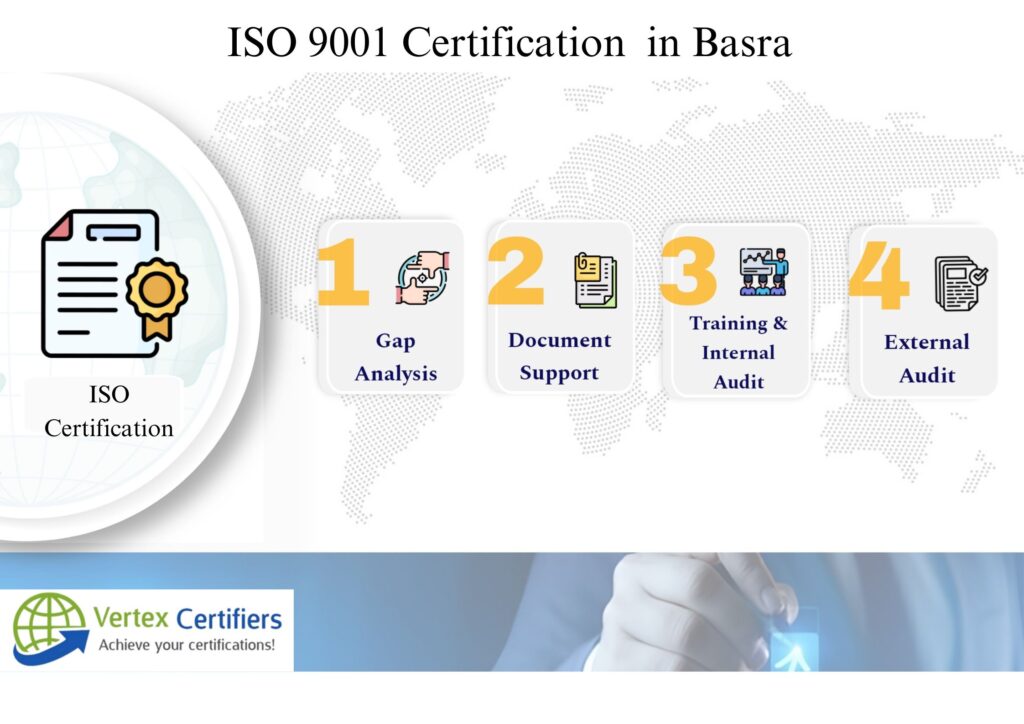
ISO 9001 Certification in Basra
Build a consistent, customer-focused, and continually improving Quality Management System with practical ISO 9001 consulting and certification support in Basra, Iraq.
ISO 9001 certification helps organizations establish structured processes for consistently delivering products and services that meet customer and applicable regulatory requirements. In Basra, it can support businesses operating in oil and gas, construction, engineering, manufacturing, logistics, trading, healthcare, information technology, and other sectors.
What is ISO 9001 Certification?
ISO 9001 is an internationally recognized standard for a Quality Management System (QMS). In simple terms, it gives an organization a practical framework for controlling, managing, and improving the way it performs its business activities.
The standard helps an organization understand customer expectations, control important processes, manage risks, monitor performance, address problems, and continually improve. It promotes a process-based approach, meaning that activities are managed as connected processes rather than as isolated tasks.
What Does ISO 9001 Certification Mean?
ISO 9001 certification means that an independent certification body has assessed an organization's Quality Management System and determined that it meets the applicable requirements of ISO 9001:2015.
Certification is different from implementation. Implementation involves establishing and operating the QMS, while certification involves an independent assessment by a certification body.
| Activity | Meaning |
|---|---|
| ISO 9001 implementation | Establishing, documenting, operating, monitoring, and improving the organization's Quality Management System. |
| ISO 9001 certification | An independent certification body evaluates the QMS and issues a certificate when the requirements have been successfully met. |
Why is ISO 9001 Certification Important in Basra?
Basra is an important commercial and industrial center with business activity connected to oil and gas, construction, infrastructure, engineering, logistics, supply chains, and public and private sector projects. A structured Quality Management System can help local organizations control operational risks and demonstrate that their processes are managed professionally.
Supporting Oil and Gas Operations
Oil and gas-related companies often work with strict customer specifications, technical requirements, approved suppliers, maintenance schedules, inspection activities, and extensive documentation. ISO 9001 can help these organizations establish consistent processes for quality control, supplier management, equipment maintenance, project execution, recordkeeping, and customer communication.
A well-managed QMS can also help identify process risks before they affect delivery, service quality, safety-related interfaces, equipment reliability, or customer satisfaction. ISO 9001 does not replace sector-specific legal, technical, or safety requirements, but it can provide a structured system for managing applicable requirements.
Improving Construction and Engineering Quality
Construction contractors and engineering companies in Basra can use ISO 9001 to control project activities from planning through completion. The system can support the management of:
- Project plans, schedules, drawings, and technical specifications.
- Materials, equipment, and inspection requirements.
- Subcontractor selection and performance.
- Site inspections, testing, and approval activities.
- Project documentation and controlled records.
- Client requirements, changes, complaints, and feedback.
- Nonconforming work, corrective actions, and rework.
Strengthening Supply Chain Management
ISO 9001 encourages organizations to evaluate suppliers according to defined criteria, communicate clear purchasing requirements, inspect incoming products or services, and monitor supplier performance. This can improve purchasing reliability and reduce the risk of receiving unsuitable materials, delayed deliveries, or inconsistent services.
Increasing Customer Confidence
Certification provides evidence that an organization has established a structured approach to quality management. It can give customers, project owners, contractors, and business partners greater confidence that the organization monitors its processes and works toward meeting agreed requirements.
Supporting Business Growth and Tenders
ISO 9001 certification can strengthen an organization's profile when participating in corporate procurement, large projects, contractor selection, supplier registration, tender opportunities, and international business activities.
Key Requirements of ISO 9001:2015
ISO 9001:2015 is based on several connected areas of quality management. The following overview explains the main requirements in practical language.
Context of the Organization
Understand internal and external issues, interested parties, customer requirements, business processes, and the scope of the QMS.
Leadership
Top management must demonstrate commitment, establish a quality policy, assign responsibilities, and maintain a strong focus on customers.
Planning
Establish quality objectives, identify risks and opportunities, and plan actions for changes that may affect the QMS.
Support
Provide resources, competent employees, awareness, communication, and appropriate documented information.
Operation
Control customer requirements, service delivery, purchasing, suppliers, production, operational processes, and changes.
Performance Evaluation
Monitor and measure performance, customer satisfaction, internal audits, and management review results.
Improvement
Manage nonconformities, implement corrective actions, and continually improve the suitability and effectiveness of the QMS.
Context of the Organization
The organization needs to understand the internal and external issues that may affect its ability to achieve intended quality results. It should also identify interested parties, understand customer requirements, define the QMS scope, and determine the business processes necessary for effective operations.
Leadership
Top management is responsible for demonstrating commitment to the QMS. This includes establishing a quality policy, assigning roles and responsibilities, promoting customer focus, providing resources, and ensuring that quality objectives support the organization's strategic direction.
Planning
Organizations need to establish measurable quality objectives and identify risks and opportunities that may affect process performance. Planning should also address actions required to manage changes affecting the QMS.
Support
The QMS should be supported with suitable resources, employee competence, awareness, communication, and controlled documented information. Training and competence records should demonstrate that employees are capable of performing work that affects quality.
Operation
Operational controls may include reviewing customer requirements, controlling product or service delivery, managing purchasing and suppliers, controlling production or service processes, and managing operational changes.
Performance Evaluation
Organizations should monitor and measure relevant processes, evaluate customer satisfaction, conduct internal audits, and perform management reviews. These activities help management understand whether the QMS is implemented and achieving its intended results.
Improvement
When nonconformities occur, the organization should react to the problem, investigate its cause, implement corrective action, and verify whether the action was effective. Continual improvement should be supported by performance data, audits, complaints, customer feedback, and process results.
How to Implement ISO 9001 Certification in Basra?
ISO 9001 certification should be approached as an operational improvement project rather than only a documentation exercise. The following steps provide a practical implementation pathway for organizations in Basra.
Conduct a Gap Analysis
Assess current processes against ISO 9001 requirements and identify the organization's current level of readiness.
- Existing process controls.
- Missing procedures or responsibilities.
- Documentation and recordkeeping gaps.
- Operational risks.
- Customer and compliance gaps.
Define the QMS Scope
Define which locations, departments, products, services, and business activities will be covered by the Quality Management System. The scope should accurately represent the organization's activities and customer commitments.
Develop ISO 9001 Documentation
Depending on the organization's size, activities, risks, and complexity, documented information may include:
- Quality policy and quality objectives.
- Process procedures and work instructions.
- Forms and operational records.
- Supplier evaluation and monitoring records.
- Inspection and monitoring records.
- Customer feedback and complaint records.
- Corrective action records.
- Internal audit records.
Documentation should be appropriate to the organization. Creating unnecessary paperwork does not automatically produce an effective QMS.
Implement the QMS
Put the documented processes into actual operation. Employees should understand their responsibilities, process requirements, quality objectives, required records, and how to report problems or potential improvements.
Conduct an Internal Audit
Perform an internal audit to determine whether processes are implemented, effective, and compliant with ISO 9001 requirements. Audits should identify both nonconformities and opportunities for improvement.
Conduct a Management Review
Top management should review the performance and suitability of the QMS, including:
- QMS performance and process results.
- Internal and external audit results.
- Customer feedback and satisfaction.
- Quality objectives.
- Risks and opportunities.
- Corrective actions.
- Improvement opportunities and resource requirements.
Complete the Certification Audit
The certification audit generally involves two main stages:
- Stage 1 Audit: The certification body reviews QMS readiness, scope, documentation, and preparedness for the detailed assessment.
- Stage 2 Audit: The certification body evaluates the implementation and effectiveness of the QMS through interviews, records, observations, and process assessments.
If the requirements are successfully met and any identified issues are addressed, the certification body issues the ISO 9001 certificate.
Documents Required for ISO 9001 Certification
There is no single fixed document list that applies to every organization. The documented information required depends on the organization's size, activities, risks, products, services, customer requirements, and operational complexity.
Common documented information may include:
- QMS scope.
- Quality policy.
- Quality objectives and performance indicators.
- Process information and process controls.
- Risk and opportunity records.
- Competence, training, and awareness records.
- Supplier evaluation and monitoring records.
- Customer requirement and contract review records.
- Inspection, testing, and monitoring records.
- Internal audit reports.
- Management review records.
- Nonconformity and corrective action records.
ISO 9001 Certification Cost in Basra
The cost of ISO 9001 certification in Basra depends on the organization's scope, structure, readiness, number of employees, number of locations, and certification audit requirements. A reliable quotation should be prepared after understanding the organization's activities and QMS scope instead of using an unrealistic fixed price.
Organization Size
Larger organizations generally require more preparation, resources, process assessment, employee involvement, and certification audit time.
Scope of Certification
A broader scope covering multiple activities, departments, products, services, or locations may increase the overall implementation and audit cost.
Number of Employees
Employee numbers can influence certification audit duration because auditors may need to evaluate more functions, roles, work activities, and records.
Existing QMS
Organizations that already have documented processes, performance monitoring, internal audits, and corrective action systems may require less implementation work than organizations starting from the beginning.
Consultant and Certification Body Fees
The total cost may include:
- Gap assessment.
- ISO 9001 consulting and implementation support.
- Documentation development.
- Employee training and awareness sessions.
- Internal audit support.
- Management review guidance.
- Certification body audit fees.
- Corrective action and certification coordination.
- Periodic surveillance audits.
Organizations should request a customized quotation based on their employee count, locations, activities, QMS scope, existing controls, and desired certification timeline.
Industries That Can Obtain ISO 9001 Certification in Basra
ISO 9001 can be adapted to different organizational processes and is suitable for organizations of various sizes and sectors, including:
Benefits of ISO 9001 Certification in Basra
Better Process Control
ISO 9001 helps organizations establish consistent methods for performing important activities and controlling process inputs, outputs, responsibilities, and records.
Fewer Errors and Rework
Process monitoring, inspections, root-cause analysis, and corrective action can help organizations identify recurring problems and reduce avoidable errors and rework.
Improved Customer Satisfaction
Organizations can systematically monitor customer requirements, feedback, complaints, delivery performance, and satisfaction to identify areas requiring attention.
Better Supplier Performance
Supplier evaluation, purchasing controls, incoming inspections, and supplier monitoring can improve supply reliability and help organizations manage purchasing risks.
Improved Employee Accountability
Clearly defined roles, responsibilities, authorities, and process requirements help employees understand how their work contributes to quality performance.
Continual Improvement
Organizations can use performance data, internal audits, customer complaints, feedback, nonconformities, and corrective actions to improve processes over time.
Choosing an ISO 9001 Consultant in Basra
The right consultant should help the organization develop a QMS that works in its actual business environment. When evaluating an ISO 9001 consultant, look for practical support in the following areas:
- ISO 9001 gap analysis.
- Documentation and process development.
- QMS implementation assistance.
- Employee awareness and training.
- Internal audit support.
- Management review guidance.
- Certification audit preparation.
- Corrective action support.
ISO 9001 Certification Services in Basra by Vertex Certifiers
Vertex Certifiers is an ISO consulting organization providing end-to-end ISO 9001 consulting and certification support in Basra. Our services can include gap analysis, documentation development, employee training, QMS implementation, internal audit support, management review guidance, corrective action assistance, and certification coordination. Our approach can be adapted to organizations operating in oil and gas, construction, engineering, manufacturing, logistics, trading, healthcare, IT, and professional service sectors. Vertex Certifiers supports organizations in developing practical Quality Management System processes rather than relying only on generic documentation.
In addition to ISO 9001, Vertex Certifiers provides consulting support for standards such as ISO 14001, ISO 45001, ISO 27001, ISO 22000, ISO 22301, ISO 50001, ISO 13485, ISO 20000-1, ISO 41001, ISO 19650, ISO 27701, ISO 37001, and ISO 10002.
Start Your ISO 9001 Journey in Basra
Contact Vertex Certifiers to discuss your organization’s activities, certification scope, implementation requirements, and audit readiness.
Frequently Asked Questions About ISO 9001 Certification in Basra
Is ISO 9001 certification mandatory in Basra?
ISO 9001 certification is generally voluntary. However, it may be required by specific customers, contracts, tenders, business partners, supplier registration programs, or applicable regulatory requirements.
How much does ISO 9001 certification cost in Basra?
The cost depends on factors such as organization size, QMS scope, number of locations, employee count, existing processes, consulting requirements, and certification audit requirements. A customized quotation is recommended.
How long does ISO 9001 certification take?
Implementation timelines vary according to organizational readiness, business complexity, number of locations, employee involvement, existing documentation, and the time required to operate and evaluate the QMS.
Can small businesses in Basra obtain ISO 9001 certification?
Yes. ISO 9001 can be implemented according to the organization's size, activities, risks, and complexity. Small businesses can establish a practical QMS without creating unnecessary procedures or paperwork.
Can ISO 9001 be integrated with other ISO standards?
Yes. ISO 9001 can be integrated with standards such as ISO 14001 for environmental management, ISO 45001 for occupational health and safety, or ISO 27001 for information security where appropriate. Integrated systems can reduce duplication and create a more coordinated management approach.
Does ISO 9001 certification improve tender opportunities?
Certification can strengthen supplier and contractor credentials and may support participation in procurement and tender processes. However, eligibility depends on the individual tender requirements and the conditions established by the customer or project owner.
Conclusion
ISO 9001 certification can help organizations in Basra establish consistent processes, improve quality, manage risks, increase customer satisfaction, strengthen supplier performance, and demonstrate their commitment to internationally recognized quality management practices.
Organizations should begin with a practical gap analysis and implementation plan rather than treating certification as only a documentation exercise. A well-implemented QMS should support real business performance and continual improvement.