Why is ISO 14001 Certification Important in Rwanda?
ISO 14001 certification provides Rwandan organizations with a structured, internationally recognized framework to manage environmental responsibilities while supporting sustainable growth. [4][13]
Growing Focus on Environmental Sustainability
As Rwanda continues to pursue sustainable development and climate-related objectives, systematic environmental management has become essential for long-term business resilience. [2] The Rwanda Environment Management Authority (REMA) has a mandate that includes environmental protection, pollution control, climate-related action, and the integration of environmental concerns into national development planning. [1][2] ISO 14001 helps organizations align their operations with these national priorities by establishing clear environmental policies, objectives, and controls.
Managing Environmental Risks
Businesses in Rwanda face a range of environmental risks that can affect operations, compliance, and reputation. Common risks include waste generation, water and energy consumption, air emissions, wastewater discharge, chemical handling, soil contamination, noise and pollution, resource depletion, and unexpected environmental incidents. [1] An ISO 14001 Environmental Management System (EMS) enables organizations to identify, assess, and control these risks through preventive measures, operational procedures, and emergency preparedness plans.
Meeting Environmental Compliance Obligations
An ISO 14001 EMS helps organizations systematically identify and manage applicable legal and regulatory requirements, including those enforced by REMA. [1][2] It is important to distinguish between ISO 14001 certification and statutory environmental approvals: ISO 14001 is a voluntary management-system certification, while environmental permits, audits, and approvals are legal obligations. [1][4] Under Rwanda's environmental compliance framework, applicable projects may be required to submit environmental audit reports to REMA and obtain an Environmental Audit Certificate. [1]
Improving Business Reputation
Credible environmental management strengthens confidence among customers, investors, regulators, suppliers, and international business partners. [4] ISO 14001 certification signals that an organization takes its environmental responsibilities seriously, which can enhance brand reputation, support supplier qualification processes, and open doors to markets where recognized environmental management systems are expected.
Benefits of ISO 14001 Certification in Rwanda
ISO 14001 certification delivers practical, measurable benefits that go beyond generic advantages, helping Rwandan organizations improve performance, reduce costs, and strengthen stakeholder confidence. [4][13]
Improved Environmental Performance
The standard requires systematic identification and control of significant environmental aspects, along with the establishment of measurable environmental objectives and targets. [4] This structured approach enables organizations to track progress, reduce negative impacts, and demonstrate continuous improvement.
Better Waste Management
ISO 14001 supports waste reduction, reuse, recycling, and controlled disposal practices. [1] Organizations can improve tracking of waste streams, implement segregation procedures, and ensure compliant disposal, reducing both environmental impact and disposal costs.
Efficient Use of Resources
The EMS framework enables better control of energy, water, raw materials, fuel, and packaging. [4] By monitoring consumption and setting efficiency targets, organizations can reduce resource use, lower operating costs, and minimize environmental footprints.
Reduced Environmental Risks
Preventive controls and emergency preparedness procedures reduce the likelihood and impact of environmental incidents such as spills, leaks, or unauthorized emissions. [1] This proactive risk management protects both the environment and business continuity.
Improved Regulatory Management
Organizations maintain registers of applicable environmental requirements and periodically evaluate compliance. [1][2] This systematic approach helps ensure ongoing adherence to REMA regulations and other legal obligations, reducing the risk of noncompliance penalties.
Increased Market Opportunities
Certification can support supplier qualification and customer requirements, particularly where international customers expect recognized environmental management systems. [4] ISO 14001 can differentiate Rwandan businesses in regional and global supply chains.
Cost and Operational Efficiency
Resource conservation and waste reduction contribute to lower operating costs. [4] The Rwanda Standards Board (RSB) identifies benefits including resource conservation, improved efficiency, reduced costs, stronger stakeholder confidence, attracting new markets, and improved environmental awareness. [4][13]
Who Should Get ISO 14001 Certification in Rwanda?
ISO 14001 is suitable for any organization whose activities, products, or services have environmental aspects. [4][13] This includes manufacturing companies, food-processing businesses, agriculture and agro-processing organizations, construction companies, mining organizations, hotels and tourism businesses, hospitals and healthcare organizations, logistics and transport companies, energy companies, waste-management companies, oil and fuel-related businesses, packaging companies, government institutions, NGOs, and service organizations. [1] The standard does not prescribe a specific environmental performance level; instead, it establishes a management framework for controlling environmental aspects and improving performance over time. [4]
ISO 14001 Requirements for Organizations in Rwanda
ISO 14001:2015 specifies requirements for an Environmental Management System (EMS) that organizations can use to enhance environmental performance. [4][5] The standard follows a Plan-Do-Check-Act cycle and includes the following key components:
Context of the Organization
Organizations must understand internal and external environmental issues relevant to their purpose, identify interested parties and their expectations, and define the scope of the EMS. [4] This ensures the system is aligned with the organization's strategic direction and operational reality.
Leadership and Environmental Policy
Top management must demonstrate commitment by establishing an environmental policy, defining roles and responsibilities, and ensuring the EMS is integrated into business processes. [4] Leadership involvement is critical for driving environmental performance and accountability.
Environmental Planning
Planning covers environmental aspects and impacts, compliance obligations, environmental risks and opportunities, environmental objectives, and action plans to achieve them. [4] This proactive approach ensures risks are addressed and opportunities for improvement are captured.
Support
Organizations must provide adequate resources, ensure competence through training, raise awareness, establish communication channels, and maintain documented information. [4] These elements ensure the EMS is properly supported and understood across the organization.
Operational Control
Controls must be established for significant environmental aspects, including waste, chemicals, energy, water, emissions, procurement, contractors, and emergency situations. [1][4] Operational procedures ensure environmental risks are managed consistently in day-to-day activities.
Performance Evaluation
Organizations must monitor and measure environmental performance, evaluate compliance, conduct internal audits, and perform management reviews. [4] These activities provide assurance that the EMS is functioning effectively and identify areas for improvement.
Improvement
The standard requires corrective actions, incident response, and continual improvement of both environmental performance and the EMS itself. [4] This ensures the system evolves and adapts to changing conditions and emerging opportunities.
Documents Required for ISO 14001 Certification
The exact documented information depends on the organization's size, activities, environmental risks, and EMS scope. [4] Potential documented information and records include: EMS scope, environmental policy, environmental aspects and impacts register, compliance obligations/legal register, environmental objectives and targets, environmental management programmes, operational control procedures, emergency preparedness and response procedures, monitoring and measurement records, waste-management records, training and competency records, internal audit reports, corrective action records, management review records, and supplier/contractor environmental controls. [4][10] Not every organization needs identical documents; the key is to maintain information that supports effective environmental management and demonstrates compliance with ISO 14001 requirements.
How Much Does ISO 14001 Certification Cost in Rwanda?
There is no single fixed ISO 14001 certification price applicable to every organization. [4] Costs are influenced by organization size, number of employees, number of locations, scope of certification, complexity of operations, environmental aspects and risks, existing EMS maturity, certification audit duration, consultant involvement, and training requirements. [4] Potential costs can be separated into gap analysis/consulting, documentation and implementation, training, internal audit, certification audit, and surveillance audits. [10] Businesses are encouraged to request a quotation based on their specific scope and organizational complexity rather than relying on generic price estimates.
How Long Does ISO 14001 Certification Take in Rwanda?
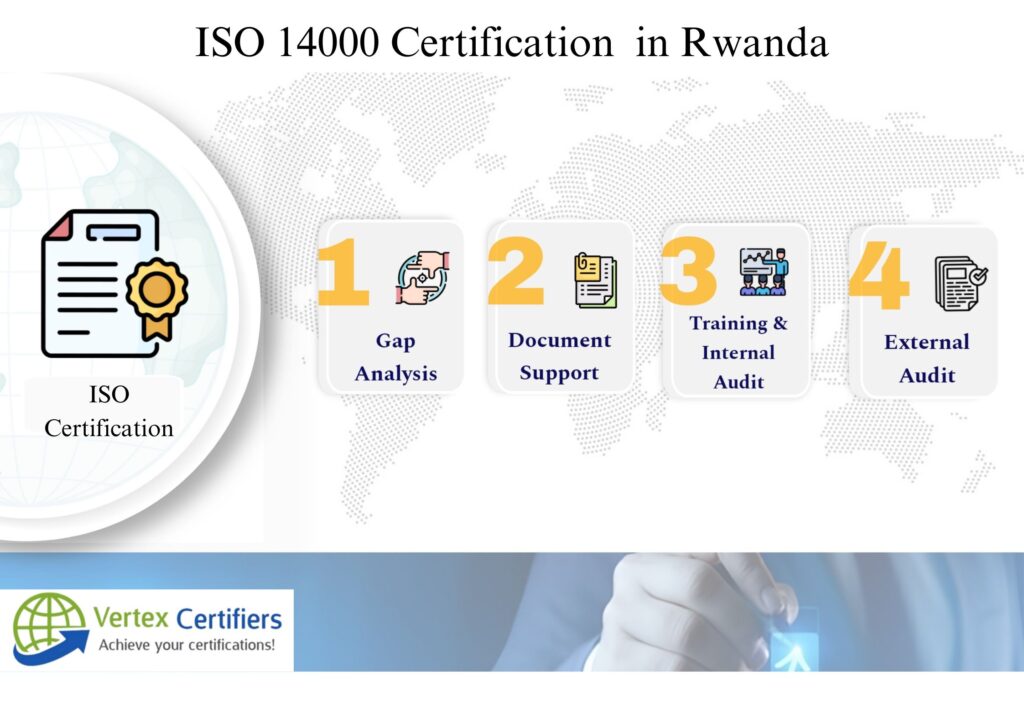
Implementation time varies depending on organizational readiness and complexity. [4] Smaller organizations with established environmental controls may progress faster, while organizations with multiple sites, complex production processes, significant environmental risks, or weak existing controls may require more time. [4] The typical sequence includes: gap analysis → implementation → training → internal audit → management review → certification audit → corrective action → certification. [10] Certification should focus on developing an effective EMS rather than simply completing documentation.
ISO 14001 Certification Bodies in Rwanda
It is important to distinguish between a consultant (who helps implement the EMS), a certification body (which independently audits the EMS and makes the certification decision), and a regulator (which oversees statutory environmental requirements). [4] The Rwanda Standards Board (RSB) is a national organization that provides certification services against RS ISO 14001:2015. [4][5][13] Organizations should verify a certification body's competence, accreditation or recognition, applicable scope, and certification arrangements before selecting one. [4] Consultants cannot independently issue ISO certificates; certification must be performed by an authorized certification body.
ISO 14001 and Rwanda Environmental Regulations
ISO 14001 should complement, not replace, Rwanda's environmental regulatory requirements. [1][2] REMA (Rwanda Environment Management Authority) is the national authority responsible for environmental protection, conservation, environmental management, and climate-related responsibilities. [1][2] Rwanda has specific environmental regulatory processes covering environmental audits, environmental impact assessment, pollution control, waste management, plastic-related controls, and chemicals and hazardous substances. [1][7] Applicable projects may have statutory environmental audit requirements separate from ISO 14001 certification; REMA states that certain listed projects must undergo regular environmental audits and submit reports for certification. [1] ISO 14001 provides a management framework; legal permits, approvals, audits, and regulatory obligations remain separate requirements. [4]
ISO 14001 Certification for Different Industries in Rwanda
The EMS can be applied across sectors, tailored to each industry's specific environmental aspects. [4] In manufacturing, key areas include energy, raw materials, emissions, waste, chemicals, and wastewater. [1] Agriculture and agro-processing focus on water use, fertilizers, agricultural waste, and energy and resource efficiency. [1] Construction involves construction waste, dust, noise, fuel, materials, and site environmental impacts. [1] Mining requires controls for land disturbance, water, waste, chemicals, emissions, and rehabilitation. [1] Hospitality addresses water, energy, food waste, wastewater, plastics, and general waste. [1] Logistics and transportation focus on fuel consumption, vehicle emissions, maintenance waste, and spill prevention. [1]
How Can Businesses Prepare for ISO 14001 Certification in Rwanda?
A practical preparation checklist includes: define the EMS scope, obtain top-management commitment, conduct a gap assessment, identify environmental aspects and impacts, identify applicable environmental compliance obligations, establish environmental objectives, develop operational controls, train employees, maintain required records, conduct an internal audit, complete management review, correct identified nonconformities, and select an appropriate certification body. [4][10] Organizations should prioritize actual implementation and environmental performance, not merely preparing documents for an audit. [4]
Why Choose Vertex Certifiers for ISO 14001 Certification in Rwanda?
Vertex Certifiers is an ISO consulting and certification-support organization that helps Rwandan businesses achieve ISO 14001 certification efficiently and effectively. [4] Services include gap analysis, EMS documentation, ISO 14001 implementation, employee training, internal audit support, management review guidance, and certification audit preparation. [4][10] Consulting support helps organizations understand ISO 14001 requirements and establish an EMS appropriate to their operations. Contact Vertex Certifiers to discuss your ISO 14001 certification requirements in Rwanda.
📧 Email Us: info@vertexcertifiers.com
📞 Contact Us
Frequently Asked Questions About ISO 14001 Certification in Rwanda
Is ISO 14001 certification mandatory in Rwanda?
ISO 14001 certification is generally a voluntary management-system certification. [4] However, organizations may separately have mandatory environmental regulatory obligations depending on their activities, such as environmental audits or permits required by REMA. [1][2]
Is ISO 14001 recognized in Rwanda?
Yes. Rwanda has adopted RS ISO 14001:2015, and the Rwanda Standards Board (RSB) provides certification services against the standard. [4][5][13]
Does ISO 14001 replace an Environmental Audit Certificate?
No. ISO 14001 certification and statutory environmental certifications or approvals serve different purposes. [1][4] ISO 14001 is a voluntary management-system standard, while an Environmental Audit Certificate is a legal requirement for certain projects under REMA regulations. [1]
Can a small business obtain ISO 14001 certification?
Yes. ISO 14001 can be applied to organizations of different sizes and types, from small businesses to large corporations. [4][13] The standard is scalable and can be tailored to the organization's context and environmental aspects.
How often is ISO 14001 certification audited?
After the initial certification audit, certification bodies typically conduct periodic surveillance audits (often annually) and a recertification audit every three years, subject to the certification body's applicable certification scheme. [4][10]
Can ISO 14001 be integrated with ISO 9001 or ISO 45001?
Yes. Organizations can develop an integrated management system because ISO 14001, ISO 9001, and ISO 45001 share common management-system structures and principles (the High-Level Structure). [4][13] This integration can reduce duplication and improve overall efficiency.
Conclusion
ISO 14001 provides Rwandan organizations with a structured approach to environmental management that delivers better environmental performance, improved resource efficiency, stronger environmental risk management, better control of compliance obligations, increased stakeholder confidence, and support for sustainable business growth. [4][13] Certification should be viewed as part of a broader environmental-management strategy rather than merely an audit requirement. [4] Rwanda's active environmental governance framework, led by REMA, underscores the importance of environmental management and compliance. [1][2]
If your organization is planning ISO 14001 certification in Rwanda, contact Vertex Certifiers for gap assessment, implementation, training, internal audit, and certification support.
📧 Email Us: info@vertexcertifiers.com
📞 Contact Us