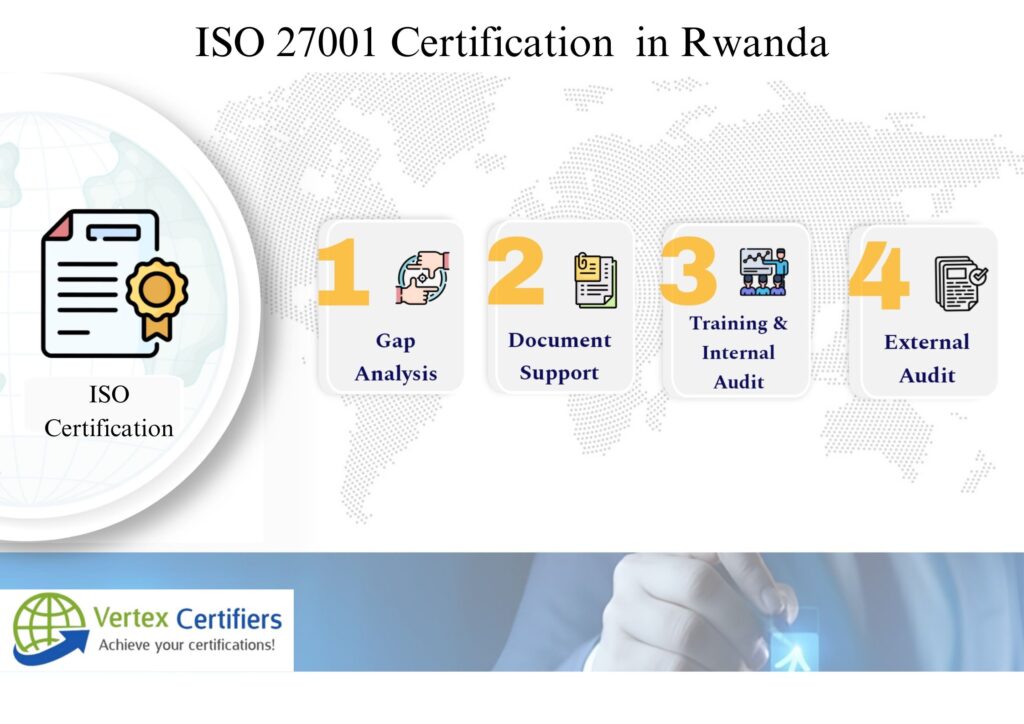
ISO 27001 Certification in Rwanda | Vertex CertifiersISO 27001 Certification in Rwanda
Protect your organization's information assets and demonstrate commitment to international security standards with ISO 27001 certification in Rwanda. Vertex Certifiers provides end-to-end support for implementing an effective Information Security Management System (ISMS) aligned with your business objectives and Rwanda's evolving data protection requirements.
Why is ISO 27001 Certification Important in Rwanda?
Increasing Dependence on Digital Systems
Rwanda has experienced remarkable digital transformation in recent years, with organizations across all sectors increasingly relying on sophisticated IT infrastructure, cloud services, databases, applications, and online platforms to conduct business operations. [web:1][web:15] This digital dependence creates both opportunities and vulnerabilities, making robust information security management essential for business continuity and competitiveness.
From government services to private sector operations, the integration of technology into daily business processes means that information security incidents can have far-reaching consequences. ISO 27001 provides a systematic framework to protect these critical digital assets while supporting Rwanda's vision of becoming a technology-enabled economy.
Protecting Customer and Business Information
Organizations in Rwanda handle vast amounts of sensitive information that requires protection through appropriate security controls. ISO 27001 certification helps safeguard:
- Customer data - Personal information, contact details, and transaction histories
- Employee information - HR records, payroll data, and performance evaluations
- Financial information - Banking details, payment records, and financial statements
- Intellectual property - Trade secrets, proprietary processes, and innovations
- Business records - Operational documentation and strategic plans
- Login credentials - User authentication information and access tokens
- Confidential contracts - Legal agreements and partnership terms
An effective ISMS ensures that appropriate controls are implemented to protect this information from unauthorized access, disclosure, modification, or destruction.
Supporting Rwanda's Data Protection Requirements
Rwanda's Law No. 058/2021 relating to the protection of personal data and privacy establishes comprehensive requirements for organizations processing personal data. [web:5][web:12][web:14] This law designates the National Cyber Security Authority (NCSA) as the supervisory authority responsible for overseeing implementation. [web:4][web:12]
An ISO 27001-certified ISMS can help organizations establish systematic information-security controls that support their data-protection obligations under Rwandan law. The standard's risk-based approach aligns well with the law's requirement for data controllers and processors to implement appropriate technical and organizational measures. [web:14]
Important note: While ISO 27001 certification demonstrates a structured approach to information security, it does not automatically equate to full legal compliance with Rwanda's data protection law. Organizations must still ensure they meet all specific requirements of Law No. 058/2021, including registration with the Data Protection and Privacy Office, appointment of data protection officers where required, and implementation of law-specific provisions. [web:11][web:13]
Managing Cybersecurity Risks
Rwandan organizations face diverse cybersecurity threats that can compromise information security and business operations. ISO 27001 provides a framework to identify, assess, and treat risks including:
- Phishing - Deceptive emails and messages attempting to steal credentials
- Malware - Malicious software designed to damage or gain unauthorized access
- Ransomware - Attacks that encrypt data and demand payment for restoration
- Unauthorized access - Breaches of systems and data by unauthorized individuals
- Data breaches - Incidents involving exposure of sensitive information
- Insider threats - Security risks from employees or contractors
- Weak passwords - Inadequate authentication credentials
- System vulnerabilities - Software and hardware weaknesses
- Social engineering - Manipulation tactics to bypass security controls
Rwanda's NCSA maintains national cybersecurity guidance and standards covering public institutions, financial services, essential service providers, and network and information systems. [web:2][web:6][web:8] ISO 27001 implementation can help organizations align with these sector-specific requirements while building comprehensive security capabilities.
Building Customer and Business Trust
ISO 27001 certification demonstrates to stakeholders that your organization has implemented a structured, internationally recognized approach to information-security management. This certification is particularly valuable when:
- Working with international customers who require evidence of security commitments
- Engaging with suppliers and partners in global supply chains
- Attracting investors who prioritize risk management
- Collaborating with technology partners on sensitive projects
- Participating in tenders requiring security certifications
The certification provides independent verification that your ISMS meets international best practices, enhancing your organization's reputation and competitive position in both domestic and international markets.
Key Benefits of ISO 27001 Certification in Rwanda
Organizations pursuing ISO 27001 certification in Rwanda can expect to realize multiple strategic and operational benefits:
| Benefit Category | Specific Advantages |
|---|
| Security Improvements | Improved information security posture, systematic risk identification and treatment, better protection of sensitive information, reduced likelihood and impact of security incidents |
| Organizational Capabilities | Improved employee security awareness, stronger access and information controls, better business continuity and resilience, continuous improvement of information-security processes |
| Business Opportunities | Improved customer confidence, support for contractual and tender requirements, greater international business opportunities, enhanced reputation and trust |
These benefits extend beyond compliance, creating tangible value through improved operational efficiency, reduced incident costs, and enhanced market positioning.
Who Needs ISO 27001 Certification in Rwanda?
ISO 27001 is relevant to any organization in Rwanda that handles valuable or sensitive information. Sectors that particularly benefit from certification include:
- Banks and financial institutions - Protecting customer accounts and transaction data
- Insurance companies - Safeguarding policyholder information and claims data
- Fintech companies - Securing digital payment platforms and financial applications
- Telecommunications companies - Protecting network infrastructure and customer communications
- IT companies and software developers - Securing development environments and client data
- Data centers and cloud service providers - Ensuring infrastructure security and availability
- Government organizations - Protecting citizen data and public sector information
- Healthcare organizations and hospitals - Safeguarding patient records and medical information
- Educational institutions - Protecting student data and research information
- E-commerce companies - Securing online transactions and customer information
- Logistics companies - Protecting shipment data and supply chain information
- Consulting and professional service firms - Safeguarding client confidential information
- Manufacturing companies - Protecting intellectual property and operational data
- NGOs and international organizations - Securing beneficiary data and program information
Regardless of organization size or sector, any entity processing personal data or handling sensitive business information can benefit from ISO 27001's systematic approach to information security.
What Does ISO 27001 Cover?
Information Security Risk Management
ISO 27001 requires organizations to establish a systematic risk management process that includes:
- Identifying information-security risks across the organization
- Assessing the likelihood and potential impact of identified risks
- Determining appropriate treatment measures (avoid, transfer, mitigate, or accept)
- Documenting risk assessment results and treatment decisions
This risk-based approach ensures that security controls are proportionate to actual threats and aligned with business priorities.
Information Security Policies
Organizations must develop and maintain comprehensive security policies, including:
- Information security policy - Overall security objectives and commitments
- Acceptable-use policies - Guidelines for appropriate use of information assets
- Access-control policies - Rules governing who can access what information
- Incident-management policies - Procedures for responding to security events
- Backup policies - Requirements for data protection and recovery
These policies provide the governance framework for consistent security practices across the organization.
Access Control
ISO 27001 requires robust access control measures to prevent unauthorized information access:
- User access management - Processes for granting and revoking access rights
- Authentication - Verification of user identity before granting access
- Password management - Requirements for strong, secure passwords
- Privileged access - Enhanced controls for administrative accounts
- Role-based access - Access rights aligned with job responsibilities
Effective access control reduces the risk of unauthorized data exposure and supports the principle of least privilege.
Asset Management
Organizations must identify and protect their information assets through:
- Identifying information assets (hardware, software, data, documentation)
- Establishing clear ownership and accountability for each asset
- Classifying assets based on sensitivity and criticality
- Implementing appropriate protection measures based on classification
This systematic approach ensures that valuable information receives appropriate levels of protection.
Incident Management
ISO 27001 requires organizations to establish capabilities for managing security incidents:
- Incident identification - Detecting security events and anomalies
- Reporting - Procedures for escalating incidents to appropriate personnel
- Response - Actions to contain and mitigate incident impact
- Investigation - Analysis to understand root causes
- Corrective action - Measures to prevent recurrence
Effective incident management minimizes damage and supports continuous improvement of security controls.
Business Continuity
The standard requires organizations to ensure information availability during disruptions:
- Backup and recovery - Regular data backups and restoration capabilities
- Disaster recovery - Plans for restoring systems after major incidents
- Availability of critical information - Ensuring essential data remains accessible
- Continuity planning - Strategies for maintaining operations during disruptions
Business continuity measures protect organizational resilience and support rapid recovery from incidents.
Supplier and Third-Party Security
ISO 27001 addresses security risks from external relationships:
- Vendor risk assessment - Evaluating security practices of suppliers
- Contractual security requirements - Including security obligations in agreements
- Monitoring suppliers and service providers - Ongoing oversight of third-party security
Given the interconnected nature of modern business, managing third-party security is essential for comprehensive risk management.
ISO 27001 Certification Audit Stages
Stage 1 Audit
The initial certification audit focuses on documentation and readiness:
- Review ISMS documentation (policies, procedures, risk assessments)
- Evaluate organizational readiness for Stage 2 audit
- Review scope definition and risk-management approach
- Identify any major gaps requiring attention before Stage 2
Stage 1 is typically conducted remotely or on-site and provides feedback to help organizations prepare for the full certification audit.
Stage 2 Audit
The Stage 2 audit evaluates practical implementation:
- Evaluate practical implementation of ISMS controls
- Interview employees to verify understanding and adherence
- Review records and evidence of ISMS operation
- Assess effectiveness of implemented controls
This comprehensive audit determines whether the ISMS meets ISO 27001 requirements and is functioning effectively.
Corrective Actions
If the audit identifies nonconformities, organizations must:
- Address nonconformities identified during the audit
- Implement corrective actions within agreed timeframes
- Provide evidence that corrective actions are effective
Minor nonconformities typically must be resolved before certification is issued, while major nonconformities may require additional audit activities.
Certification
Certification is issued following successful completion of the certification process:
- Certification body reviews audit findings and corrective actions
- Certificate is issued confirming ISO 27001 compliance
- Certification is valid for three years with annual surveillance audits
Organizations must maintain their ISMS and undergo regular audits to retain certification status.
Documents Required for ISO 27001 Certification
Documentation requirements depend on the organization's scope, size, and risks, but commonly include:
- ISMS scope - Definition of boundaries and applicability
- Information-security policy - Overall security commitments and objectives
- Risk assessment methodology - Approach for identifying and evaluating risks
- Risk assessment and risk treatment records - Documentation of identified risks and treatment decisions
- Statement of Applicability - List of controls and justification for inclusions/exclusions
- Information-security objectives - Measurable security goals
- Asset inventory - Comprehensive list of information assets
- Access-control procedures - Processes for managing user access
- Incident-management procedures - Steps for responding to security incidents
- Business continuity procedures - Plans for maintaining operations during disruptions
- Supplier-security controls - Requirements for third-party security
- Internal audit records - Evidence of internal ISMS audits
- Management review records - Documentation of management oversight
- Corrective-action records - Evidence of improvements and issue resolution
- Employee training and awareness records - Documentation of security training
Vertex Certifiers can help you develop efficient documentation that meets ISO 27001 requirements without unnecessary complexity.
ISO 27001 Certification Cost in Rwanda
ISO 27001 certification costs vary significantly based on multiple factors. Rather than providing arbitrary fixed prices, organizations should consider these cost drivers:
- Organization size - Larger organizations typically require more extensive implementation
- Number of employees - Affects training requirements and scope complexity
- Number of locations - Multiple sites increase audit and implementation complexity
- ISMS scope - Broader scope requires more controls and documentation
- Complexity of IT infrastructure - Sophisticated systems require more detailed controls
- Number of information assets - More assets require more extensive asset management
- Existing security controls - Mature security practices reduce implementation effort
- Gap between current practices and ISO 27001 requirements - Larger gaps require more work
- Consultancy and implementation requirements - External support adds to costs
- Certification-body audit fees - Vary by certifier and organization size
- Training requirements - Employee awareness and specialized training needs
How to Reduce ISO 27001 Certification Costs
Organizations can optimize certification costs through strategic planning:
- Define an appropriate scope - Focus on critical business areas initially
- Conduct a proper gap analysis - Identify existing controls to leverage
- Use existing processes where possible - Integrate with current management systems
- Prioritize risks - Focus resources on highest-risk areas
- Train internal employees - Build internal capability to reduce ongoing consultancy needs
- Prepare documentation efficiently - Avoid over-documentation
- Avoid unnecessary controls outside the defined scope - Stay focused on what matters
Vertex Certifiers provides cost-effective implementation support that helps organizations achieve certification efficiently without compromising quality.
How Long Does ISO 27001 Certification Take in Rwanda?
Implementation time varies depending on organizational size, complexity, existing controls, scope, and readiness. A typical implementation framework includes:
- Gap analysis - Assessing current state against ISO 27001 requirements
- Planning - Developing implementation roadmap and resource allocation
- Risk assessment - Identifying and evaluating information security risks
- Documentation - Developing policies, procedures, and records
- Implementation - Deploying controls and processes across the organization
- Training - Building employee awareness and capabilities
- Internal audit - Verifying ISMS effectiveness before certification audit
- Management review - Senior management evaluation of ISMS performance
- Certification audit - Stage 1 and Stage 2 audits by certification body
Smaller organizations with existing security practices may complete implementation in 3-6 months, while larger or more complex organizations may require 9-18 months. Vertex Certifiers can help you develop a realistic timeline based on your specific circumstances.
ISO 27001 Certification vs ISO 27001 Compliance
Understanding the distinction between certification and compliance is important:
| Aspect | ISO 27001 Compliance | ISO 27001 Certification |
|---|
| Definition | Organization implements ISO 27001 requirements and controls internally | Organization's ISMS is audited by an independent certification body |
| Verification | May conduct internal assessments or self-declarations | Requires successful completion of external certification audit |
| Outcome | Organization claims alignment with ISO 27001 | Organization receives formal certificate from accredited body |
| Recognition | Limited external recognition | Internationally recognized credential |
Important clarification: ISO 27001 certification should not automatically be presented as proof of compliance with every requirement of Rwanda's data-protection law. While the standard supports information security objectives, organizations must still ensure they meet all specific legal requirements under Law No. 058/2021. [web:5][web:14]
ISO 27001 and Rwanda's Data Protection & Privacy Law
This section addresses the important relationship between ISO 27001 and Rwanda's data protection framework.
Rwanda's Law No. 058/2021 relating to protection of personal data and privacy applies to organizations processing personal data, whether established in Rwanda or processing data of subjects located in Rwanda. [web:5][web:13] The law establishes comprehensive requirements for data controllers and processors.
Key Provisions of Law No. 058/2021
- Applicability - Covers processing of personal data by electronic or other means using automated or non-automated platforms [web:5][web:13]
- Supervisory Authority - The National Cyber Security Authority (NCSA) serves as the supervisory authority through its Data Protection and Privacy Office [web:4][web:12]
- Data Controller and Processor Responsibilities - Organizations must implement appropriate technical and organizational measures for protecting personal data [web:14]
- Technical and Organizational Measures - Requirements include measures such as tokenization, pseudonymization, or encryption where appropriate [web:14]
- Data Protection Officer - Certain organizations must appoint data protection officers with specific responsibilities [web:9]
- Breach Notification - Data controllers must notify the Data Protection and Privacy Office within 48 hours of becoming aware of a personal data breach [web:15]
- Registration Requirements - Data controllers and processors must register with the supervisory authority [web:11]
Relationship Between ISO 27001 and Data Protection
ISO 27001 and Rwanda's data protection law are complementary but distinct:
- Information-Security Management - ISO 27001 provides a framework for managing information security risks across all information assets
- Data-Protection Governance - Law No. 058/2021 establishes legal requirements specifically for personal data processing
- Supporting Role - An ISO 27001-certified ISMS can support data-protection objectives by implementing robust security controls
- Not a Replacement - ISO 27001 certification does not replace the need to comply with specific legal requirements under Rwandan law
SEO/Content Positioning: ISO 27001 should be positioned as a framework that can support data-protection and cybersecurity objectives in Rwanda, not as a replacement for legal compliance requirements. Organizations should pursue both ISO 27001 certification and ensure adherence to Law No. 058/2021 for comprehensive information governance. [web:5][web:14]
Need help aligning ISO 27001 with Rwanda's data protection requirements? Our experts understand both the international standard and local legal framework.
📧 info@vertexcerfiers.com
📞 Contact Us Why Choose Vertex Certifiers for ISO 27001 Certification in Rwanda?
Vertex Certifiers provides end-to-end ISO 27001 consultancy services tailored to Rwandan organizations. Our comprehensive support includes:
- Gap analysis - Assessing current state against ISO 27001 requirements
- ISMS documentation - Developing policies, procedures, and records aligned with your business
- Risk assessment support - Identifying and treating information security risks
- ISO 27001 implementation - Practical deployment of controls and processes
- Employee awareness training - Building security culture across your organization
- Internal audit - Verifying ISMS effectiveness before certification audit
- Management review support - Facilitating senior management oversight
- Certification audit preparation - Ensuring readiness for Stage 1 and Stage 2 audits
- Corrective-action support - Addressing any nonconformities identified
- Ongoing improvement - Supporting continuous enhancement of your ISMS
Our Value Proposition
- Practical Implementation - We focus on controls that work in real business environments, not just theoretical compliance
- Experienced Consultants - Our team brings deep expertise in ISO 27001 and information security
- End-to-End Support - From initial gap analysis through certification and beyond
- Cost-Effective Certification Assistance - Efficient implementation that optimizes your investment
- Local Context - Understanding of Rwandan business environment and regulatory landscape
Partner with Vertex Certifiers to achieve ISO 27001 certification that delivers real business value while supporting your information security objectives.
ISO 27001 Certification in Kigali and Other Cities in Rwanda
Organizations across Rwanda can implement an ISO 27001 ISMS regardless of their location, provided the certification scope is appropriately defined. We support clients in:
- Kigali - Rwanda's capital and primary business hub, hosting numerous financial institutions, technology companies, and international organizations
- Huye - Home to educational institutions and growing business sectors
- Rubavu - Important commercial center in western Rwanda
- Musanze - Business hub in northern Rwanda with tourism and service sectors
- Rusizi - Commercial activities in western Rwanda
- Other major business locations - Including Rwamagana, Muhanga, and emerging economic centers
Whether your organization is headquartered in Kigali or operates from other cities across Rwanda, Vertex Certifiers provides flexible engagement models including remote support and on-site visits as needed. The certification scope can be defined to cover specific locations, business units, or the entire organization based on your strategic priorities.
Frequently Asked Questions About ISO 27001 Certification in Rwanda
What is ISO 27001 certification in Rwanda?
ISO 27001 certification in Rwanda is formal recognition by an accredited certification body that an organization's Information Security Management System (ISMS) meets the requirements of the ISO/IEC 27001 international standard. The certification demonstrates that the organization has implemented systematic controls to protect information assets and manage information security risks.
Is ISO 27001 certification mandatory in Rwanda?
ISO 27001 certification is not legally mandatory in Rwanda. However, certain sectors may face contractual or regulatory requirements that effectively necessitate certification. Some organizations pursue certification to meet tender requirements, customer expectations, or international partnership obligations. Additionally, Rwanda's data protection law requires appropriate security measures, which ISO 27001 can help implement.
How much does ISO 27001 certification cost in Rwanda?
Costs vary based on organization size, complexity, scope, existing controls, and implementation approach. Factors include consultancy fees, certification body audit fees, training costs, and internal resource allocation. Rather than fixed pricing, organizations should obtain customized quotes based on their specific circumstances. Vertex Certifiers provides transparent, competitive pricing tailored to your needs.
How long does ISO 27001 certification take?
Implementation time varies from 3-18 months depending on organizational size, complexity, existing security practices, scope, and resource availability. Smaller organizations with mature security controls may complete implementation faster, while larger or more complex organizations require more time. A realistic timeline should be developed based on gap analysis results.
Who can get ISO 27001 certification in Rwanda?
Any organization in Rwanda that handles information assets can pursue ISO 27001 certification, regardless of size, sector, or type. This includes businesses, government agencies, non-profits, educational institutions, healthcare organizations, and more. The standard is scalable and can be adapted to organizations of all sizes.
Is ISO 27001 applicable to small businesses?
Yes, ISO 27001 is absolutely applicable to small businesses. The standard is designed to be scalable and can be implemented proportionately based on the organization's size, complexity, and risk profile. Small businesses often benefit significantly from the structured approach to information security that ISO 27001 provides.
What documents are required for ISO 27001 certification?
Required documentation includes ISMS scope, information security policy, risk assessment methodology and records, Statement of Applicability, information security objectives, asset inventory, access control procedures, incident management procedures, business continuity procedures, internal audit records, management review records, and training records. The exact documentation depends on organizational context and risks.
What is the difference between ISO 27001 and Rwanda's data protection law?
ISO 27001 is an international standard for information security management covering all information assets. Rwanda's Law No. 058/2021 is national legislation specifically governing personal data processing. ISO 27001 can support compliance with the law's security requirements, but certification does not automatically constitute legal compliance. Organizations should address both frameworks appropriately.
Can ISO 27001 help with data protection compliance in Rwanda?
Yes, ISO 27001 can significantly support data protection compliance by providing a systematic framework for implementing security controls required under Law No. 058/2021. The standard's risk-based approach, access controls, incident management, and other requirements align well with data protection obligations. However, organizations must still ensure they meet all specific legal requirements beyond security controls.
Is ISO 27001 certification recognized internationally?
Yes, ISO 27001 is internationally recognized and accepted worldwide. Certification from an accredited body is valid globally and demonstrates compliance with an internationally agreed standard. This recognition is particularly valuable for Rwandan organizations working with international partners, customers, or investors.
How often is ISO 27001 certification audited?
After initial certification, organizations undergo annual surveillance audits to verify continued compliance. The certification is valid for three years, after which a recertification audit is required. Organizations must maintain their ISMS throughout the certification cycle and address any nonconformities identified during surveillance audits.
Can Vertex Certifiers help with ISO 27001 certification in Rwanda?
Yes, Vertex Certifiers provides comprehensive ISO 27001 implementation and certification support throughout Rwanda. Our services include gap analysis, ISMS documentation, risk assessment, implementation support, training, internal audits, management review facilitation, and certification audit preparation. Contact us at info@vertexcerfiers.com to discuss your requirements.
Conclusion
Information security has become increasingly critical for Rwandan organizations as digital transformation accelerates across all sectors. The growing dependence on IT systems, cloud services, and online platforms creates both opportunities and vulnerabilities that require systematic management. [web:1][web:15]
ISO 27001 certification provides a proven framework for establishing an effective Information Security Management System that protects valuable information assets, manages cybersecurity risks, and supports business objectives. The standard's risk-based approach aligns well with Rwanda's evolving cybersecurity and data-protection environment, including requirements under Law No. 058/2021. [web:5][web:14]
Organizations across Rwanda—from Kigali to Huye, Rubavu, Musanze, Rusizi, and beyond—can benefit from implementing ISO 27001 regardless of size or sector. The certification demonstrates commitment to information security, enhances customer confidence, and opens doors to international business opportunities.
Before beginning your certification journey, we recommend conducting a thorough gap analysis to understand your current state and develop a realistic implementation plan. This assessment helps identify existing controls to leverage, prioritize risks, and optimize your investment in ISO 27001 implementation.
Vertex Certifiers provides end-to-end support for ISO 27001 implementation and certification across Rwanda. Our experienced consultants will guide you through every step—from gap analysis to certification audit—ensuring practical implementation that delivers real business value.