# ISO 22000 Certification in Ivory Coast – Complete Guide for Businesses
Ivory Coast (Côte d’Ivoire) is an important agricultural, food-processing, manufacturing, trading, and export-oriented economy in West Africa. With Abidjan serving as a major commercial and industrial center, organizations across the country are increasingly involved in food production, agro-processing, packaging, storage, transportation, distribution, hospitality, and retail. As these activities expand, maintaining effective food safety controls throughout the supply chain becomes increasingly important for protecting consumers, satisfying customer expectations, and maintaining business reputation.
ISO 22000 certification in Ivory Coast provides a structured framework for establishing a Food Safety Management System (FSMS). ISO 22000:2018 applies to organizations throughout the food chain and incorporates key elements including interactive communication, system management, prerequisite programmes (PRPs), and HACCP principles.
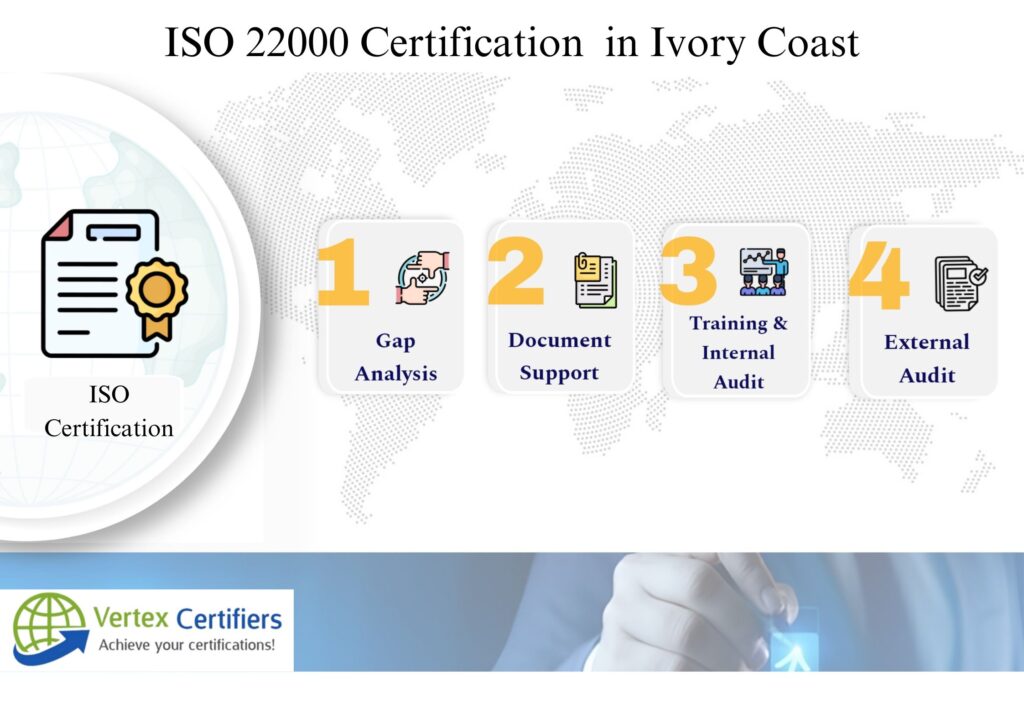
At Vertex Certifiers, we provide end-to-end ISO 22000 consulting and certification support, including gap analysis, documentation, training, implementation, internal auditing, corrective-action support, and certification coordination. Our practical approach helps organizations establish food safety systems that are aligned with their actual operations and business objectives.
What is ISO 22000 Certification in Ivory Coast?
Definition of ISO 22000
ISO 22000 is an international standard specifying requirements for a Food Safety Management System. It enables organizations to establish a systematic approach for identifying food safety hazards, determining appropriate controls, monitoring processes, managing incidents, and continually improving food safety performance.
Rather than concentrating only on testing finished food products, ISO 22000 takes a management-system approach to controlling food safety risks throughout relevant processes and the food chain. It can be applied by organizations of different sizes and across different stages of the food chain.
What Does ISO 22000 Certification Mean?
ISO 22000 certification provides independent third-party confirmation that an organization's Food Safety Management System has been assessed against the applicable requirements of ISO 22000. Certification can provide customers, business partners, and other interested parties with confidence that the organization has established a structured approach to managing food safety hazards.
It is useful to distinguish four related activities:
- ISO 22000 implementation: Establishing and putting the required Food Safety Management System into operation.
- ISO 22000 consulting: Providing expert guidance, documentation support, training, implementation assistance, and preparation support.
- ISO 22000 audit: A systematic assessment of the FSMS to determine whether it conforms to defined requirements.
- ISO 22000 certification: Independent third-party conformity assessment resulting in certification when applicable requirements have been satisfactorily met.
ISO does not itself issue ISO 22000 certificates. Certification is performed by independent third-party certification bodies.
ISO 22000:2018 and Current Standard Status
ISO 22000:2018 remains the published ISO 22000 standard currently referenced for certification. It has also been supplemented by ISO 22000:2018/Amd 1:2024, titled “Climate action changes,” which was published in February 2024.
At the same time, ISO/DIS 22000 is currently under development as the next edition. The draft is not the current published certification standard, and organizations should therefore verify the applicable certification requirements and transition arrangements with their certification body when planning a long-term implementation project.
Why is ISO 22000 Certification Important in Ivory Coast?
Strengthening Food Safety Controls
Food businesses can face a wide range of hazards throughout production, processing, storage, transportation, and distribution. These can include biological hazards, chemical contamination, physical hazards, allergens, cross-contamination, poor temperature control, inadequate sanitation, and unsafe food handling.
An effective FSMS helps organizations identify these risks systematically, establish appropriate control measures, monitor critical activities, and take corrective action when controls are not effective. This preventive approach can help organizations build greater consistency into their food safety operations.
Supporting Regulatory and Food Safety Requirements
Food businesses in Ivory Coast need to manage applicable statutory and regulatory food safety requirements alongside customer, contractual, and organizational requirements. ISO 22000 can help organizations establish a structured process for identifying and managing applicable obligations within their FSMS.
However, ISO 22000 does not replace Ivorian laws, regulatory approvals, inspections, permits, or other statutory requirements. Certification demonstrates conformity of the management system to the applicable ISO requirements; it does not mean that an ISO certification body has assumed the role of government regulators.
Improving Customer Confidence
Food safety is directly connected to customer trust. ISO 22000 certification can provide objective evidence that an organization has established a structured FSMS for managing food safety hazards.
This can be valuable when dealing with:
- Customers
- Retailers
- Importers
- Export customers
- Distributors
- Business partners
Supporting Domestic and International Market Opportunities
Organizations supplying regional and international markets often need to demonstrate that their food safety processes are systematically managed. ISO 22000 certification can help businesses communicate their food safety capabilities to customers and supply-chain partners and may support supplier approval or contractual requirements where certification is requested.
Reducing Food Safety Incidents and Operational Losses
Food safety failures can result in complaints, rejected shipments, product wastage, recalls, rework, production interruptions, and reputational damage. Preventive controls, traceability, monitoring, and corrective-action processes can help organizations identify issues earlier and respond to food safety incidents more systematically.
Who Needs ISO 22000 Certification in Ivory Coast?
ISO 22000 can apply across the food chain, including organizations whose activities directly or indirectly affect food safety.
Agriculture and Primary Production
- Farms and agricultural producers
- Livestock operations
- Fisheries
- Aquaculture businesses
- Food and feed producers
Food and Beverage Manufacturing
- Processed-food manufacturers
- Dairy businesses
- Meat and poultry processors
- Seafood processors
- Beverage manufacturers
- Bakeries
- Packaged-food manufacturers
- Edible-oil businesses
- Cocoa and cocoa-product businesses
Food Processing and Agro-Processing
- Grain processing
- Fruit and vegetable processing
- Cocoa processing
- Coffee processing
- Palm-oil-related processing
- Other agricultural value-added operations
Food Packaging Organizations
- Food-contact packaging manufacturers
- Packaging suppliers
- Labeling-related operations
Storage and Distribution
- Warehouses
- Cold-storage facilities
- Food logistics providers
- Transport companies
- Distribution centers
Retail and Food Service
- Supermarkets
- Restaurants
- Hotels
- Catering companies
- Institutional kitchens
- Food-service providers
Supporting Organizations
- Cleaning and sanitation providers
- Equipment suppliers
- Ingredient suppliers
- Contract manufacturers
- Other organizations whose activities can affect food safety
Key Principles and Components of ISO 22000
ISO identifies four key components of ISO 22000: interactive communication, system management, prerequisite programmes, and HACCP principles.
Interactive Communication
Food safety depends on effective communication throughout the food chain. Organizations may need to communicate relevant information with suppliers, employees, customers, regulators, contractors, distributors, and other food-chain organizations.
Effective communication helps ensure that information relating to hazards, specifications, changes, incidents, requirements, and controls reaches the appropriate people at the right time.
System Management
ISO 22000 uses a management-system approach that connects food safety objectives with organizational processes. This includes establishing policies, defining responsibilities, managing resources, monitoring performance, conducting reviews, addressing nonconformities, and pursuing continual improvement.
Prerequisite Programmes (PRPs)
PRPs provide the basic hygiene and operational conditions needed to maintain a suitable environment for safe food production and handling. Depending on the organization's activities, these controls can include:
- Cleaning and sanitation
- Pest control
- Personal hygiene
- Facility maintenance
- Equipment hygiene
- Waste management
- Water quality
- Supplier controls
- Storage controls
- Temperature management
- Prevention of cross-contamination
ISO's food safety guidance also highlights practical PRP-related activities such as cleaning schedules, temperature controls, material segregation, supplier checks, pest monitoring, traceability, and recall readiness.
HACCP Principles
HACCP principles are an important part of the ISO 22000 food safety approach. Organizations need to systematically identify hazards, analyze their significance, establish appropriate control measures, determine applicable critical control points and critical limits where required, monitor controls, take corrective action, verify effectiveness, and maintain appropriate documented information.
Risk-Based Thinking and Continual Improvement
An effective FSMS is not static. Organizations need to consider food safety risks and opportunities, monitor processes, investigate problems, implement corrective actions, conduct internal audits, review system performance, and continually improve their food safety management arrangements.
ISO 22000 Requirements for Businesses in Ivory Coast
Context of the Organization
Organizations need to understand relevant internal and external issues, identify interested parties, determine the scope of their FSMS, and consider relationships and activities throughout the relevant food chain.
Leadership and Food Safety Policy
Top management plays an important role in establishing food safety direction. This includes commitment to the FSMS, establishing a food safety policy, defining responsibilities and accountability, and ensuring that appropriate food safety roles and resources are available.
Planning
Planning includes establishing appropriate food safety objectives, addressing relevant risks and opportunities, and managing changes that could affect the effectiveness of the FSMS.
Support
The organization needs appropriate resources, infrastructure, competence, awareness, communication, and documented information to support the operation and effectiveness of the FSMS.
Operation
Operational requirements include planning and control, PRPs, traceability, emergency preparedness, hazard analysis, hazard control, verification activities, and product withdrawal or recall arrangements where applicable.
Performance Evaluation
Organizations should monitor and measure relevant processes, analyze results, conduct internal audits, and perform management reviews to determine whether the FSMS remains suitable and effective.
Improvement
Continual improvement involves identifying nonconformities, implementing corrective actions, evaluating effectiveness, and updating the FSMS when changes or new information affect food safety.
Benefits of ISO 22000 Certification in Ivory Coast
Better Food Safety Risk Management
Systematic hazard identification and control can help organizations strengthen food safety performance and establish preventive controls across relevant processes.
Improved Operational Control
ISO 22000 can help establish standardized processes, defined responsibilities, consistent monitoring, and better control of process variation.
Increased Customer Confidence
Certification provides an independent demonstration that the organization's FSMS has undergone third-party conformity assessment, giving customers and business partners additional evidence of a structured approach to food safety.
Improved Traceability and Recall Readiness
Effective traceability arrangements can support batch identification, supplier traceability, product traceability, and more organized responses to food safety incidents.
Reduced Waste and Food Safety-Related Losses
Better preventive controls can help organizations address issues that may otherwise result in rejected products, spoilage, contamination, rework, complaints, or recalls.
Improved Supplier Management
Organizations can establish more systematic approaches to supplier evaluation, incoming-material controls, supplier performance monitoring, and food safety requirements.
Support for Export and Supply-Chain Requirements
An internationally recognized FSMS can help organizations demonstrate their food safety capabilities to customers and supply-chain partners. Certification may also be requested by particular customers, retailers, manufacturers, procurement processes, or international buyers.
Integration With Other ISO Management Systems
ISO 22000 can be integrated with other management-system standards where appropriate, including ISO 9001, ISO 14001, ISO 45001, and ISO 27001. This can help organizations establish a more coordinated management-system framework instead of maintaining completely separate systems.
Documents Required for ISO 22000 Certification in Ivory Coast
The exact documentation required depends on the organization's activities, processes, risks, scope, and operational complexity. Common categories include the following.
Core FSMS Documents
- FSMS scope
- Food safety policy
- Food safety objectives
- Organizational responsibilities
- Process information
- Document-control arrangements
Food Safety Documentation
- Hazard analysis
- HACCP plan
- PRP documentation
- Operational control procedures
- Monitoring plans
- Verification procedures
Operational Records
- Cleaning records
- Temperature records
- Pest-control records
- Inspection records
- Supplier evaluation records
- Training records
- Calibration records
- Traceability records
- Corrective-action records
Emergency and Recall Documentation
- Emergency response plans
- Product withdrawal procedure
- Product recall procedure
- Mock recall records
- Incident investigation records
Audit and Management Review Records
- Internal audit reports
- Corrective-action reports
- Management review minutes
- Performance monitoring records
How Long Does ISO 22000 Certification Take in Ivory Coast?
There is no universal implementation timeline for ISO 22000 certification. The time required depends on the organization's size, complexity, existing food safety controls, readiness, number of sites, product and process complexity, employee competence, HACCP readiness, PRP implementation, corrective-action response, and certification-body scheduling.
Factors Affecting the Timeline
- Existing food safety controls
- Documentation maturity
- Employee competence
- HACCP readiness
- PRP implementation
- Number of sites
- Product and process complexity
- Speed of corrective actions
- Certification-body scheduling
Typical Implementation Stages
- Initial assessment
- Gap analysis
- Documentation
- Training
- Implementation
- Internal audit
- Management review
- Certification audit
- Corrective action
- Certification decision
At Vertex Certifiers, we assess your organization's current readiness first and then develop a practical implementation plan rather than promising an identical timeline for every business.
ISO 22000 Certification vs HACCP in Ivory Coast
| Area | HACCP | ISO 22000 |
|---|
| Main focus | Food safety hazard control | Food Safety Management System |
| Management-system approach | Limited | Comprehensive |
| HACCP principles | Core | Integrated |
| PRPs | Important | Integrated |
| Internal audit | Depends on the applicable system or scheme | Part of the management-system approach |
| Management review | Not equivalent to the ISO management-system requirement | Included within the management-system framework |
| Continual improvement | More limited framework | Management-system requirement |
| Certification | Depends on the applicable scheme | Third-party ISO certification |
| Applicability | Food safety hazard control | Organizations throughout the relevant food chain |
In simple terms, HACCP focuses strongly on controlling food safety hazards, while ISO 22000 places HACCP principles within a broader Food Safety Management System. ISO identifies HACCP principles as one of the key components of ISO 22000.
ISO 22000 vs FSSC 22000
What is the Difference?
ISO 22000 is an international standard specifying requirements for a Food Safety Management System. FSSC 22000 is a food safety certification scheme that builds on ISO 22000 together with additional prerequisite-programme requirements and scheme-specific requirements.
FSSC 22000 may be appropriate where particular customers, industries, or supply chains specifically require that certification scheme. Organizations should therefore determine their customer and market requirements before selecting the most appropriate certification route.
The choice should not be based simply on which certification sounds more advanced. The appropriate framework depends on the organization's activities, customers, markets, and contractual requirements.
Common Challenges in Implementing ISO 22000 in Ivory Coast
Lack of Employee Awareness
Employees are directly involved in food safety controls. Without appropriate awareness and training, procedures may not be consistently followed. Building employee understanding and food safety culture is therefore an important part of implementation.
Incomplete Hazard Analysis
Organizations may struggle to identify and evaluate all relevant biological, chemical, physical, or other food safety hazards. A structured hazard-analysis process helps ensure that significant hazards are appropriately considered.
Weak PRPs
Weaknesses in cleaning, pest control, personal hygiene, temperature control, facility maintenance, or equipment hygiene can undermine food safety controls. PRPs should be appropriate to the organization's operations and risks.
Poor Documentation and Record-Keeping
Documentation defines processes, while records provide evidence that activities have actually been performed. Missing, incomplete, or inconsistent records can make it difficult to demonstrate effective implementation during an audit.
Supplier-Control Problems
Food safety can be affected by the quality and safety of incoming materials. Organizations should establish suitable supplier evaluation, incoming inspection, specification, monitoring, and documentation processes.
Traceability Challenges
Organizations need appropriate arrangements to identify and trace relevant materials and products. Strong traceability can support faster investigation and response when a food safety issue occurs.
Resistance to Process Changes
Implementing an FSMS can require employees to change established working practices. Management commitment, communication, training, and employee involvement can help make these changes more effective.
Treating ISO 22000 as a Documentation Exercise
One of the most common mistakes is creating manuals and procedures without effectively implementing them. ISO 22000 certification focuses on the effectiveness of the management system, so organizations need evidence that processes are actually operating as planned.
How to Prepare for an ISO 22000 Certification Audit
Review Your FSMS Scope
Ensure that the scope accurately describes the relevant products, processes, sites, activities, and organizational boundaries covered by the FSMS.
Verify PRPs
Review practical controls covering:
- Hygiene
- Cleaning
- Pest control
- Water
- Waste
- Storage
- Personnel practices
- Equipment
Validate HACCP and Hazard Controls
- Review the hazard analysis.
- Verify control measures.
- Confirm monitoring arrangements.
- Check corrective actions.
- Review verification activities.
Check Records
Records should be complete, accurate, current, traceable, and appropriately authorized where applicable. Employees responsible for maintaining records should understand what information is required and why it matters.
Conduct an Internal Audit
An internal audit should evaluate whether the FSMS conforms to applicable requirements and whether it is effectively implemented. Using a suitably competent and objective internal auditor can help identify potential weaknesses before the certification audit.
Conduct Management Review
Top management should review relevant FSMS performance information, audit results, objectives, complaints, incidents, corrective actions, and improvement opportunities.
Train Employees
Employees should understand their responsibilities, the food safety policy, relevant procedures, hygiene requirements, incident-reporting expectations, and corrective-action requirements.
Role of ISO 22000 Consultants in Ivory Coast
Implementing ISO 22000 can be more structured with the support of an experienced consultant who understands both management-system requirements and practical food safety operations.
Gap Assessment
Consultants assess existing practices and identify gaps that need to be addressed before certification.
Documentation Support
Consultants can help develop or improve applicable policies, procedures, HACCP documentation, PRPs, monitoring arrangements, and other FSMS documentation.
HACCP and Food Safety Support
Expert support can assist with hazard analysis, food safety team activities, PRPs, monitoring, verification, and related food safety controls.
Employee Training
Training helps employees understand the purpose of ISO 22000 and how their daily activities contribute to food safety.
Internal Audit Support
Consultants can conduct internal audits to identify nonconformities and improvement opportunities before the independent certification assessment.
Certification Audit Support
Consultants can help organizations prepare for Stage 1 and Stage 2 certification audits and ensure that relevant processes and records are ready for assessment.
Corrective Action Support
When nonconformities are identified, consultants can support root-cause analysis, corrective-action planning, implementation, and effectiveness evaluation.
Why Choose Vertex Certifiers for ISO 22000 Certification in Ivory Coast?
End-to-End ISO 22000 Support
Vertex Certifiers provides comprehensive support throughout the ISO 22000 certification journey, including:
- Gap analysis
- FSMS documentation
- ISO 22000 training
- Implementation support
- Internal audit
- Corrective-action support
- Certification coordination
Practical and Industry-Focused Approach
We believe an effective FSMS should reflect how your organization actually operates. Our consultants work to align documentation, controls, responsibilities, and monitoring processes with the organization's products, facilities, operations, and food safety risks.
Affordable ISO Certification Support
Vertex Certifiers focuses on providing practical and cost-effective ISO certification support without compromising the quality of implementation. Our objective is to help organizations achieve certification through an efficient and business-focused approach.
Support for Different Business Sizes
Our consulting approach can be adapted to the needs of:
- Small businesses
- Medium-sized enterprises
- Large organizations
- Multi-site organizations
Certification Body Coordination
Vertex Certifiers can support your organization in preparing for an independent certification audit and coordinating the certification process. However, the final certification decision remains the responsibility of the independent certification body.
ISO 22000 Certification in Abidjan and Other Locations in Ivory Coast
ISO 22000 Certification in Abidjan
Abidjan is an important commercial, industrial, logistics, and business center in Ivory Coast. Organizations involved in food manufacturing, distribution, warehousing, food service, hospitality, logistics, and export activities can benefit from establishing systematic food safety controls.
Vertex Certifiers can support organizations seeking ISO 22000 implementation and certification support in Abidjan based on their specific processes and certification scope.
ISO 22000 Certification in Other Ivorian Business Locations
ISO 22000 consulting and certification support can also be relevant to organizations operating in other locations, including:
- Bouaké
- San-Pédro
- Yamoussoukro
- Korhogo
- Daloa
- Other commercial and agricultural regions of Ivory Coast
The appropriate FSMS scope and implementation approach should always be determined according to the organization's actual activities and operational locations.
ISO 22000 Certification Checklist for Ivory Coast Businesses
- ☐ Define the FSMS scope
- ☐ Identify internal and external issues
- ☐ Identify interested parties
- ☐ Establish a food safety policy
- ☐ Define responsibilities and accountability
- ☐ Establish the food safety team
- ☐ Identify applicable legal and regulatory requirements
- ☐ Establish prerequisite programmes
- ☐ Conduct hazard analysis
- ☐ Develop HACCP controls
- ☐ Establish traceability
- ☐ Establish emergency procedures
- ☐ Establish recall and withdrawal procedures
- ☐ Train employees
- ☐ Maintain required records
- ☐ Conduct an internal audit
- ☐ Conduct management review
- ☐ Correct identified nonconformities
- ☐ Select an appropriate certification body
- ☐ Complete the certification audit
- ☐ Maintain and continually improve the FSMS
Frequently Asked Questions About ISO 22000 Certification in Ivory Coast
Is ISO 22000 certification mandatory in Ivory Coast?
ISO 22000 certification itself is not a requirement of the ISO standard. Organizations can use ISO 22000 without certification. Where certification is required by a customer, contract, tender, or market, the organization can seek independent third-party certification. Applicable Ivorian laws and regulatory requirements remain separate obligations.
Who issues ISO 22000 certificates in Ivory Coast?
ISO does not issue ISO 22000 certificates. Certification is performed by independent third-party certification bodies that assess whether an organization's FSMS meets the applicable requirements.
Can a small food business obtain ISO 22000 certification?
Yes. ISO 22000 is designed for organizations throughout the food chain and can be applied by organizations of different sizes. The FSMS should be appropriate to the organization's activities, processes, risks, and scope.
How long does ISO 22000 certification take?
The timeline depends on organization size, operational complexity, existing food safety controls, documentation, employee readiness, HACCP and PRP implementation, corrective actions, and certification-body scheduling.
Is HACCP required for ISO 22000?
HACCP principles form a fundamental component of ISO 22000's food safety approach. ISO specifically identifies HACCP principles as one of the key components of the standard.
Can ISO 22000 be integrated with ISO 9001?
Yes. Organizations can integrate ISO 22000 with other management systems such as ISO 9001 where appropriate. This can help coordinate common management-system processes while maintaining the specific food safety requirements of ISO 22000.
Is ISO 22000 useful for food exporters?
Yes. An internationally recognized FSMS can help food businesses demonstrate systematic food safety controls to customers and supply-chain partners. The value of certification will depend on the requirements of individual customers, markets, contracts, and regulatory frameworks.
What is the difference between ISO 22000 and FSSC 22000?
ISO 22000 is an international Food Safety Management System standard. FSSC 22000 is a separate certification scheme built around ISO 22000 together with relevant prerequisite-programme and scheme-specific requirements. Organizations should determine their customer and market requirements before selecting a certification framework.
Does ISO 22000 replace food-safety laws in Ivory Coast?
No. ISO 22000 does not replace national laws, permits, regulatory approvals, inspections, or statutory food safety requirements. Certification evaluates conformity of the FSMS and does not replace the responsibilities of regulatory authorities.
Conclusion
ISO 22000 certification in Ivory Coast provides organizations with a structured approach to managing food safety risks throughout relevant processes and the food chain. By integrating communication, system management, prerequisite programmes, HACCP principles, monitoring, verification, and continual improvement, organizations can develop a more systematic approach to food safety.
For food manufacturers, agricultural businesses, agro-processors, packaging organizations, warehouses, distributors, food-service businesses, logistics providers, and other organizations connected to the food chain, an effective FSMS can support better food safety controls, improved traceability, stronger operational processes, supplier management, customer confidence, and supply-chain opportunities.
Successful certification, however, requires more than preparing documents. Organizations need to implement their processes, train employees, maintain records, monitor controls, conduct internal audits, perform management reviews, address nonconformities, and continually improve the FSMS.
Vertex Certifiers provides end-to-end ISO 22000 support in Ivory Coast, from initial gap analysis and documentation through training, implementation, internal auditing, corrective-action support, and certification coordination. If your organization is planning ISO 22000 certification, our consultants can help you build a practical Food Safety Management System aligned with your operations and certification objectives.