Vertex Certifiers

ISO 14001 Certification in Ivory Coast – Complete Guide for Businesses

Vertex Certifiers provides end-to-end ISO certification services to organizations in Ivory Coast, helping businesses establish, implement, and maintain internationally recognized management systems. Our services cover the complete certification journey, including gap analysis, documentation, implementation support, employee training, internal audits, corrective-action assistance, and certification audit coordination. With experienced ISO consultants and a practical, organization-specific approach, we help businesses achieve their certification objectives efficiently and at an affordable, competitive cost. Whether you are pursuing ISO 14001 or another ISO management-system standard, Vertex Certifiers provides reliable guidance and comprehensive support from initial assessment through successful certification.

ISO 14001 Certification in Ivory Coast – Complete Guide for Businesses

Côte d’Ivoire (Ivory Coast) has emerged as one of West Africa’s important economic, commercial, and industrial markets, with Abidjan serving as a major centre for business, trade, manufacturing, logistics, and infrastructure development. As organizations expand across sectors such as manufacturing, agriculture and agro-processing, construction, mining, energy, transportation, and services, managing environmental impacts has become increasingly important. ISO 14001 provides an internationally recognized framework for establishing an Environmental Management System (EMS) that helps organizations manage environmental aspects, fulfil applicable compliance obligations, improve resource efficiency, prevent pollution, and continually improve environmental performance. The current edition is ISO 14001:2026, which builds on the established environmental-management framework while strengthening its focus on environmental protection and business outcomes.For businesses in Ivory Coast looking to demonstrate responsible environmental practices and strengthen their market credibility, ISO 14001 certification can provide valuable independent confirmation of their EMS. Vertex Certifiers supports organizations throughout the certification journey with practical, end-to-end ISO consulting, implementation, training, internal auditing, and certification support.

What is ISO 14001 Certification in Ivory Coast?

ISO 14001 is the international standard for Environmental Management Systems (EMS). It provides organizations with a structured approach to identifying environmental aspects, managing environmental risks and opportunities, meeting applicable environmental obligations, establishing objectives, monitoring performance, and pursuing continual improvement. ISO 14001:2026 is applicable to organizations of different sizes and sectors and can be adapted to the nature, scale, and environmental impacts of their activities.

ISO 14001 certification in Ivory Coast means that an independent certification body has assessed an organization’s Environmental Management System against the applicable requirements of ISO 14001 and determined that it conforms to the standard. ISO itself does not issue ISO 14001 certificates; certification is performed by external certification bodies.

It is useful to distinguish between several related services:

  • ISO 14001 implementation: Establishing and putting the EMS into operation.
  • ISO 14001 consulting: Receiving professional guidance throughout implementation and certification preparation.
  • ISO 14001 internal audit: Evaluating the EMS internally before the certification audit.
  • ISO 14001 certification: Independent third-party assessment of the implemented EMS.

ISO 14001:2026 – Current Standard

ISO 14001:2026 is the current edition of the Environmental Management Systems standard. Organizations preparing for new certification should therefore work toward the current 2026 requirements rather than treating ISO 14001:2015 as the current edition.

Organizations that already have ISO 14001:2015 certification should coordinate with their certification body regarding the applicable transition arrangements and timelines.

The 2026 edition retains the familiar management-system approach while providing clearer structure and stronger alignment with current environmental priorities.

ISO 14001 Certification Process in Ivory Coast
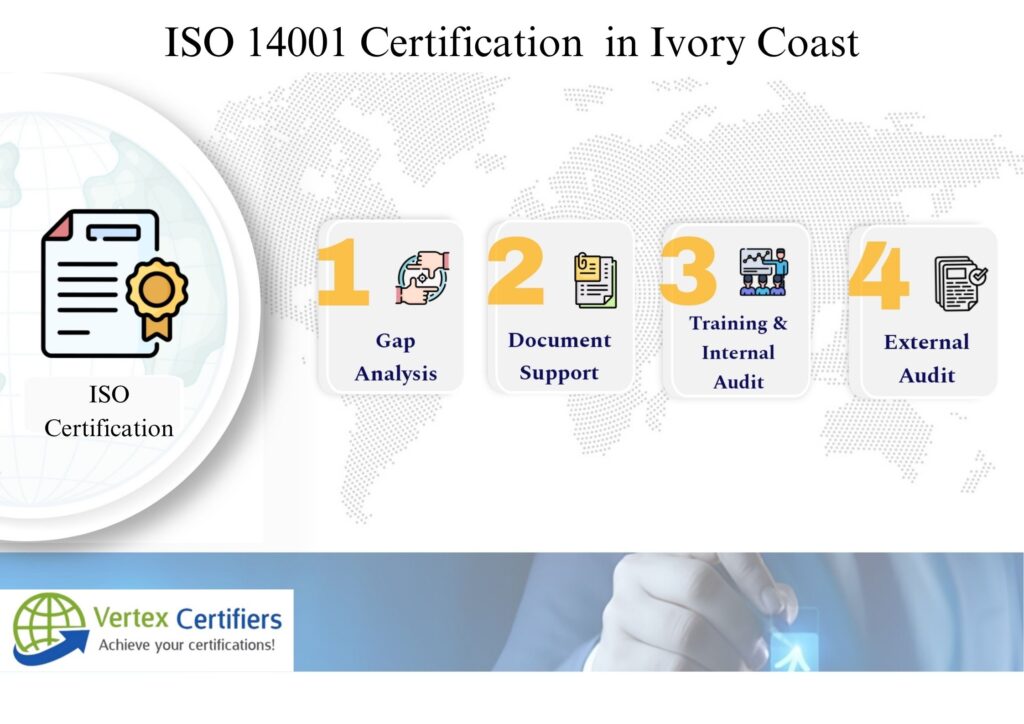
The certification process should be approached systematically. Vertex Certifiers can support organizations through each stage, from the initial assessment through certification preparation.

Step 1: Initial Consultation

The process begins with understanding the organization’s activities, locations, products, services, environmental concerns, existing management systems, and certification objectives.

This helps determine an appropriate EMS scope and implementation approach.

Step 2: Gap Analysis

A gap analysis compares existing processes and environmental practices against ISO 14001 requirements.

The assessment helps identify:

  • Existing controls
  • Missing processes
  • Documentation gaps
  • Environmental risks
  • Compliance-related gaps
  • Areas requiring improvement

The resulting gap-analysis report provides a practical roadmap for implementation.

Step 3: Define EMS Scope

The organization determines which activities, departments, locations, products, services, and processes will fall within the Environmental Management System.

A clearly defined scope helps ensure that the EMS reflects the organization’s actual operations and environmental responsibilities.

Step 4: Environmental Aspects and Impacts Assessment

The organization identifies environmental aspects associated with its activities, products, and services and evaluates their potential environmental impacts.

This may include considerations such as:

  • Energy consumption
  • Water use
  • Waste generation
  • Emissions
  • Wastewater
  • Raw-material consumption
  • Chemical use
  • Transportation
  • Land use
  • Emergency situations

The assessment helps determine which environmental aspects require greater attention and operational control.

Step 5: Legal and Compliance Evaluation

Applicable environmental compliance obligations are identified, evaluated, maintained, and incorporated into the EMS.

This is particularly important for organizations operating in environmentally sensitive industries or undertaking activities with significant environmental impacts.

Step 6: EMS Documentation

Based on the organization’s activities and requirements, relevant EMS information and documented processes are developed or updated.

These may include:

  • Environmental policy
  • EMS scope
  • Environmental objectives
  • Environmental aspects and impacts register
  • Compliance obligations
  • Operational controls
  • Environmental procedures
  • Emergency preparedness arrangements
  • Monitoring records
  • Training records
  • Internal audit records
  • Management review records
  • Corrective-action records

ISO 14001 is designed to provide a framework rather than prescribe an identical set of documents for every organization. The level of documented information should be appropriate to the organization’s circumstances and processes.

Step 7: Implementation

Documentation alone is not enough. The EMS must be implemented throughout the defined scope.

Employees need to understand their environmental responsibilities, operational controls need to be applied, records need to be maintained, and environmental objectives need to be monitored.

Step 8: Employee Training and Awareness

Employees play an important role in the effectiveness of an Environmental Management System.

Training and awareness can cover:

  • Environmental policy
  • Environmental aspects
  • Operational controls
  • Waste management
  • Emergency response
  • Individual responsibilities
  • Environmental objectives
  • Reporting environmental incidents

Step 9: Internal Audit

Before the certification audit, an internal audit is conducted to evaluate whether the EMS has been effectively implemented and whether it conforms to applicable requirements.

Internal auditing can identify nonconformities and improvement opportunities before the external certification assessment.

Step 10: Management Review

Top management reviews the performance and suitability of the EMS.

The review can consider audit results, environmental performance, objectives, compliance-related information, changes affecting the organization, and opportunities for improvement.

Step 11: Certification Audit

An independent certification body conducts the certification assessment.

The auditors evaluate whether the organization’s Environmental Management System conforms to ISO 14001 requirements and is effectively implemented within the defined scope.

ISO emphasizes that certification is performed by an independent external certification body rather than by ISO itself.

Step 12: Certification and Continual Improvement

After successfully completing the certification process, the organization receives its ISO 14001 certificate from the certification body.

However, certification is not the end of the process. The organization must continue monitoring environmental performance, conducting internal audits, reviewing the EMS, addressing nonconformities, and pursuing continual improvement.

    Get Free
    Consultation


    Our Services

    ISO 14001 Certification in Ivory Coast | Vertex Certifiers

    Why is ISO 14001 Certification Important in Ivory Coast?

    ISO 14001 certification provides organizations in Ivory Coast with a systematic framework to manage environmental responsibilities while improving operational efficiency and compliance with environmental regulations. [1][2]

    Growing Industrial and Commercial Activities

    Ivory Coast's economy is experiencing significant growth across multiple sectors, creating increased demand for robust environmental management systems:

    • Manufacturing: Industrial facilities require structured approaches to minimize environmental impacts from production processes
    • Construction: Infrastructure development projects need environmental controls for waste, emissions, and resource consumption
    • Mining: Extractive industries face stringent environmental oversight and need systematic management of ecological impacts
    • Agriculture and agro-processing: Cocoa, coffee, and food processing operations benefit from sustainable resource management practices
    • Oil and gas: Energy sector organizations require comprehensive environmental risk management frameworks
    • Energy and utilities: Power generation and distribution companies need to address emissions and resource efficiency
    • Logistics and transportation: Supply chain operations must manage fuel consumption, emissions, and waste
    • Food and beverage: Processing facilities require water management, waste control, and pollution prevention systems
    • Telecommunications: Infrastructure deployment and maintenance need environmental impact controls
    • Hospitality: Hotels and tourism operators benefit from sustainable resource management and waste reduction

    Managing Environmental Impacts

    An Environmental Management System (EMS) based on ISO 14001 helps organizations systematically address critical environmental aspects:

    • Waste generation: Implement controls to reduce, reuse, and recycle materials
    • Water consumption: Monitor and optimize water usage across operations
    • Energy consumption: Identify opportunities for energy efficiency and conservation
    • Air emissions: Control and reduce atmospheric pollutants from operations
    • Wastewater: Manage discharge quality and treatment processes
    • Resource efficiency: Optimize use of raw materials and natural resources
    • Pollution prevention: Implement proactive measures to prevent environmental contamination
    • Environmental risks: Identify and mitigate potential environmental incidents
    • Climate-related considerations: Address climate change impacts and contribute to mitigation efforts [4][8]

    ISO 14001:2026 provides a framework for improving environmental performance, meeting compliance obligations, and achieving environmental objectives through continual improvement. [2][13]

    Supporting Environmental Compliance

    ISO 14001 requires organizations to identify and manage applicable compliance obligations systematically. [2] For organizations operating in Ivory Coast, this means:

    • Identifying relevant environmental legal and regulatory requirements at national and local levels
    • Understanding how these requirements apply to specific operations and activities
    • Establishing processes to ensure ongoing compliance with identified obligations
    • Monitoring changes in environmental legislation and regulations
    • Documenting compliance evaluation results and corrective actions

    It's important to note that ISO 14001 certification itself does not guarantee legal compliance, but it provides a structured approach to identify, understand, and manage compliance obligations effectively. [2][13]

    Improving Business Reputation and Market Opportunities

    ISO 14001 certification delivers significant business advantages beyond environmental performance:

    • Customer confidence: Demonstrates commitment to environmental responsibility
    • Supplier qualification: Meets requirements of environmentally conscious buyers
    • International business opportunities: Facilitates trade with global partners requiring certified suppliers
    • Tender and procurement requirements: Qualifies for contracts specifying environmental management certification
    • Supply-chain credibility: Enhances position within environmentally responsible supply chains
    • Stakeholder confidence: Builds trust with investors, communities, and regulators

    Key Benefits of ISO 14001 Certification in Ivory Coast

    Organizations implementing ISO 14001:2026 realize multiple benefits across operational, financial, and reputational dimensions:

    • Improved environmental performance: Measurable reductions in environmental impacts
    • Better waste management: Systematic approaches to waste reduction and disposal
    • More efficient use of energy and resources: Cost savings through optimized consumption
    • Improved environmental risk management: Proactive identification and mitigation of risks
    • Better control of compliance obligations: Structured approach to regulatory requirements
    • Reduced environmental incidents: Fewer spills, violations, and emergency situations
    • Increased operational efficiency: Streamlined processes and reduced waste
    • Stronger stakeholder confidence: Enhanced reputation with customers and communities
    • Support for sustainable business practices: Alignment with sustainability goals
    • Easier integration with other ISO management systems: Compatible structure with ISO 9001, 45001, and other standards [2][7]

    ISO identifies benefits including environmental performance, regulatory compliance, risk management, cost savings, operational excellence, and stakeholder trust. [2][13]

    Who Needs ISO 14001 Certification in Ivory Coast?

    ISO 14001:2026 is designed for organizations regardless of size, type, or nature. [2] The standard applies to any organization seeking to improve environmental performance through systematic management.

    Manufacturing Companies

    • Production facilities across all industries
    • Chemical industries and processing plants
    • Automotive and component manufacturing
    • Packaging manufacturers
    • Industrial processing operations

    Agriculture and Agro-Processing

    • Farms and agricultural operations
    • Cocoa processing facilities
    • Coffee and agricultural processing plants
    • Food-processing facilities
    • Agricultural exporters

    Mining and Extractive Industries

    • Mining companies
    • Mineral processing operations
    • Quarrying operations
    • Supporting contractors and service providers

    Construction and Infrastructure

    • Construction companies
    • Engineering firms
    • Infrastructure contractors
    • Real-estate developers

    Other Organizations

    • Hotels and hospitality establishments
    • Hospitals and healthcare facilities
    • Logistics companies
    • Transport organizations
    • Energy companies
    • IT and telecommunications providers
    • Government and public-sector organizations

    ISO 14001 Requirements

    The current ISO 14001 framework follows the familiar management-system structure covering context, leadership, planning, support, operation, performance evaluation, and improvement. [2][7]

    Context of the Organization

    • Internal and external environmental issues
    • Interested parties and their requirements
    • EMS scope definition
    • Environmental conditions relevant to the organization [13]

    Leadership

    • Environmental policy
    • Top-management involvement and commitment
    • Roles and responsibilities
    • Accountability for environmental performance [2]

    Planning

    • Environmental aspects and impacts
    • Risks and opportunities
    • Compliance obligations
    • Environmental objectives
    • Planning actions to achieve objectives [2][13]

    Support

    • Resources
    • Competence
    • Awareness
    • Communication
    • Documented information [2]

    Operation

    • Operational planning and control
    • Life-cycle perspective
    • Outsourced processes
    • Emergency preparedness and response [2][13]

    Performance Evaluation

    • Monitoring and measurement
    • Compliance evaluation
    • Internal audits
    • Management review [2]

    Improvement

    • Nonconformity and corrective action
    • Continual improvement
    • Improving environmental performance [2][13]

    Documents Required for ISO 14001 Certification

    Commonly required EMS information and records include:

    • Environmental policy
    • EMS scope
    • Environmental aspects and impacts register
    • Compliance obligations register
    • Environmental objectives and targets
    • Environmental management plans
    • Operational control procedures
    • Emergency preparedness procedures
    • Monitoring and measurement records
    • Training records
    • Internal audit records
    • Management review records
    • Corrective-action records
    • Environmental performance records

    Documentation requirements depend on the organization's size, activities, risks, and EMS scope. ISO 14001:2026 emphasizes effectiveness over excessive documentation. [2][7]

    How Long Does ISO 14001 Certification Take in Ivory Coast?

    There is no single fixed timeframe for ISO 14001 certification. The timeline depends on multiple factors:

    • Organization size
    • Number of locations
    • Scope of certification
    • Existing environmental controls
    • EMS maturity
    • Number of employees
    • Complexity of operations
    • Availability of records
    • Audit readiness

    Typically, organizations can expect the certification process to take between 6 to 18 months, depending on the factors above and the level of implementation support required.

    Cost of ISO 14001 Certification in Ivory Coast

    ISO 14001 certification cost depends on several variables:

    • Organization size
    • Number of employees
    • Number of sites
    • Certification scope
    • Operational complexity
    • Existing EMS
    • Consulting requirements
    • Audit duration
    • Certification body

    What Does the ISO 14001 Certification Cost Include?

    • Consulting/implementation costs: Gap analysis, documentation development, training
    • Documentation and training: EMS manuals, procedures, employee awareness programs
    • Internal audit: Pre-certification audit preparation
    • Certification-body audit fees: Stage 1 and Stage 2 audit costs
    • Travel/site-visit expenses: Where applicable for auditor travel
    • Surveillance and recertification costs: Ongoing audit fees to maintain certification

    A realistic cost estimate requires assessing the organization's specific circumstances. Contact us for a tailored quotation based on your requirements.

    ISO 14001 Certification Audit in Ivory Coast

    Auditors generally assess the following during ISO 14001 certification audits:

    • EMS implementation
    • Environmental policy
    • Environmental aspects and impacts
    • Compliance obligations
    • Operational controls
    • Environmental objectives
    • Monitoring and measurement
    • Internal audits
    • Management review
    • Corrective actions
    • Continual improvement [2]

    Stage 1 Audit

    Stage 1 audit focuses on readiness and documentation assessment. Auditors review:

    • EMS documentation completeness
    • Understanding of standard requirements
    • Readiness for Stage 2 audit
    • Scope and context definition
    • Compliance obligations identification

    Stage 2 Audit

    Stage 2 audit assesses actual EMS implementation and effectiveness:

    • On-site verification of EMS implementation
    • Interviews with employees at all levels
    • Review of records and evidence
    • Assessment of environmental performance
    • Verification of compliance evaluation processes
    • Identification of nonconformities (if any)

    Surveillance and Recertification Audits

    Certification is maintained through ongoing assessment rather than being a one-time activity:

    • Surveillance audits: Conducted annually to verify continued compliance
    • Recertification audits: Full reassessment every three years
    • Transition audits: Required when moving to ISO 14001:2026 from 2015 version [4][6]

    ISO 14001 Certification vs ISO 14001 Implementation

    ISO 14001 ImplementationISO 14001 Certification
    Establishes the EMSProvides third-party conformity assessment
    Can be conducted internally or with consultantsConducted by an independent certification body
    Focuses on meeting standard requirementsFocuses on verifying conformity
    Does not automatically provide a certificateResults in certification when requirements are met

    ISO 14001 and Other ISO Standards

    Organizations can integrate ISO 14001 with other management system standards:

    • ISO 9001 – Quality Management: Integrate environmental and quality objectives
    • ISO 45001 – Occupational Health & Safety: Combine environmental and safety management
    • ISO 27001 – Information Security: Address information security alongside environmental concerns
    • ISO 22000 – Food Safety: Integrate for food processing organizations
    • ISO 50001 – Energy Management: Enhance energy efficiency within environmental framework

    ISO 14001's management-system structure (High-Level Structure) facilitates seamless integration with other ISO management systems. [2][7]

    ISO 14001 Certification in Abidjan and Other Cities in Ivory Coast

    Vertex Certifiers provides ISO 14001 certification support across major commercial and industrial centers in Ivory Coast:

    • Abidjan: Economic capital with diverse manufacturing, logistics, and service sectors
    • San-Pédro: Port city with significant agricultural processing and export operations
    • Yamoussoukro: Political capital with government and public-sector organizations
    • Bouaké: Central hub for agriculture, trade, and light manufacturing
    • Korhogo: Northern commercial center with agricultural and trading activities
    • Daloa: Agricultural processing and regional trade center

    How Vertex Certifiers Can Help with ISO 14001 Certification in Ivory Coast

    Vertex Certifiers provides end-to-end ISO certification support tailored to your organization's needs:

    • Initial consultation: Understanding your requirements and objectives
    • Gap analysis: Assessing current practices against ISO 14001:2026 requirements
    • EMS documentation: Developing policies, procedures, and records
    • Environmental aspects assessment: Identifying and evaluating environmental impacts
    • Implementation support: Practical guidance on EMS deployment
    • Employee training: Building awareness and competence across your organization
    • Internal audit: Preparing your team for certification audit
    • Management review support: Facilitating leadership engagement
    • Certification audit preparation: Ensuring readiness for external audit
    • Corrective-action support: Addressing any nonconformities identified
    • Certification coordination: Liaising with certification bodies

    We emphasize practical implementation and cost-effective support rather than simply selling documentation. Our approach ensures your EMS delivers real environmental and business value.

    Why Choose Vertex Certifiers?

    • Experienced ISO consultants: Deep expertise in ISO 14001:2026 and related standards
    • End-to-end implementation support: From gap analysis through certification
    • International service coverage: Supporting organizations across multiple markets
    • Practical, organization-specific approach: Tailored solutions for your industry
    • Support from gap analysis through certification: Comprehensive guidance throughout
    • Affordable and transparent consulting approach: Clear pricing with no hidden costs
    • Support for organizations across different industries: Manufacturing, agriculture, mining, construction, services, and more

    Ready to Start Your ISO 14001 Certification Journey?

    Get expert support for ISO 14001:2026 implementation and certification in Ivory Coast

    📧 Email Us: info@vertexcertifiers.com 📞 Contact Us

    Our team will respond within 24 hours with a customized proposal for your organization

    Frequently Asked Questions About ISO 14001 Certification in Ivory Coast

    H3: What is ISO 14001 certification in Ivory Coast?

    ISO 14001 certification in Ivory Coast is third-party verification that an organization's Environmental Management System meets the requirements of ISO 14001:2026. It demonstrates commitment to environmental responsibility and systematic management of environmental impacts. [2][13]

    H3: Is ISO 14001:2026 the current version?

    Yes, ISO 14001:2026 is the current version, published in April 2026. It replaces ISO 14001:2015, and organizations have until approximately May 2029 to transition to the new edition. [1][4][6]

    H3: Is ISO 14001 certification mandatory in Ivory Coast?

    ISO 14001 certification is not legally mandatory in Ivory Coast. However, it may be required by certain customers, tenders, or supply-chain partners. Some sectors may have regulatory requirements that ISO 14001 helps address.

    H3: How much does ISO 14001 certification cost in Ivory Coast?

    Cost varies based on organization size, complexity, number of sites, and existing environmental controls. A realistic estimate requires assessment of your specific circumstances. Contact us for a tailored quotation.

    H3: How long does ISO 14001 certification take?

    Typically 6 to 18 months, depending on organization size, existing environmental controls, EMS maturity, and implementation support. The timeline varies based on multiple factors specific to each organization.

    H3: Who can issue an ISO 14001 certificate?

    Only accredited certification bodies (also called registrars or conformity assessment bodies) can issue ISO 14001 certificates. ISO itself does not issue certificates. [2][13]

    H3: Can a small business in Ivory Coast get ISO 14001 certification?

    Yes, ISO 14001:2026 is designed for organizations regardless of size, type, or nature. Small businesses can implement scaled-down EMS appropriate to their operations and achieve certification. [2]

    H3: What documents are required for ISO 14001 certification?

    Required documentation includes environmental policy, EMS scope, aspects and impacts register, compliance obligations register, objectives, operational procedures, emergency procedures, and various records. Documentation depends on organization size and complexity. [2][13]

    H3: Can ISO 14001 be integrated with ISO 9001 and ISO 45001?

    Yes, ISO 14001 uses the High-Level Structure (HLS) shared with ISO 9001 and ISO 45001, making integration straightforward. Organizations can implement integrated management systems covering quality, environment, and occupational health and safety. [2][7]

    H3: Is ISO 14001 certification valid internationally?

    Yes, ISO 14001 is an international standard recognized globally. Certificates issued by accredited bodies are valid internationally, facilitating trade and supply-chain relationships across borders. [2][13]

    H3: What is the difference between ISO 14001 implementation and certification?

    Implementation establishes the EMS within your organization, while certification provides third-party verification that your EMS meets ISO 14001 requirements. Implementation can be done internally or with consultants; certification requires an independent certification body. [2]

    Conclusion

    ISO 14001 certification provides organizations in Ivory Coast with a systematic framework for environmental management, compliance with regulatory obligations, resource efficiency, pollution prevention, and continual improvement. [2][13]

    With the transition to ISO 14001:2026 now underway, organizations preparing for certification today should ensure their EMS aligns with the latest requirements, including enhanced focus on climate change considerations and biodiversity. [4][8]

    Start Your ISO 14001:2026 Certification Today

    Partner with Vertex Certifiers for expert guidance through every step of your certification journey in Ivory Coast

    📧 Email Us: info@vertexcertifiers.com 📞 Contact Us

    Free initial consultation • Tailored solutions • Competitive pricing

      Company Logo

      Get ISO certification


      Fill the details below, one of our executives will contact you shortly


      This will close in 0 seconds

      Call Now Button