Costing Factors of ISO Certification in Philippines:
Costing Factors of ISO Certification in Philippines, Vertex Certifiers offers comprehensive end-to-end ISO consulting services across the Philippines, empowering businesses in Manila, Quezon City, Cebu City, Davao City, Makati, Taguig, Pasig and beyond with expert guidance for 12+ standards including ISO 9001 (Quality Management), ISO 14001 (Environmental Management), ISO 45001 (Occupational Health & Safety), ISO 27001 (Information Security), ISO 22000 (Food Safety), ISO 27701 (Privacy Information Management), ISO 20000 (IT Service Management), ISO 13485 (Medical Devices), ISO 17025 (Testing & Calibration), ISO 50001 (Energy Management), ISO 22301 (Business Continuity), and ISO 31000 (Risk Management). From gap analysis and customized documentation to staff training, internal audits, and certification support, our local experts ensure seamless compliance, faster timelines, and long-term success tailored to Philippine regulations like DTI and PEZA.
ISO certification represents a globally recognized benchmark for quality, safety, and efficiency, empowering Philippine businesses to thrive in competitive markets. In the Philippines, where industries like BPO, manufacturing, IT, and food processing are booming, ISO standards such as ISO 9001, ISO 14001, and ISO 27001 have become essential for gaining trust from international clients and partners. The Department of Trade and Industry (DTI) and local regulators increasingly encourage these certifications to boost export capabilities and operational excellence.
Demand is surging: BPO firms seek ISO 27001 for data security, manufacturers pursue ISO 9001 for quality control, IT companies aim for ISO 20000, and food processors target ISO 22000 for safety compliance. However, ISO certification isn’t a one-size-fits-all expense—its influencing factors create variability based on your business’s unique profile. This complete guide breaks down these key costing factors, helping Philippine enterprises navigate the process smartly without surprises.
Why Understanding Costing Factors Matters
Grasping the costing factors of ISO certification in the Philippines equips businesses to budget realistically and avoid financial pitfalls. Many companies dive in unprepared, only to face unexpected outlays that strain resources.
Effective planning starts with knowing these variables, allowing you to allocate funds precisely for implementation, audits, and ongoing maintenance. It also steers you away from hidden expenses, like extended audit times or rework due to incomplete documentation.
Moreover, this knowledge sharpens your consultant and certification body selection. You can prioritize partners who align with your scale and industry, ensuring value-driven investments. Ultimately, it fosters an ROI-focused approach: certification becomes a strategic tool for growth, not just compliance, enhancing your edge in the Philippine market.
ISO Certification Process in Philippines (Brief Overview)
The journey begins with gap analysis, assessing current practices against standards by ISO Consultants in Philippines:
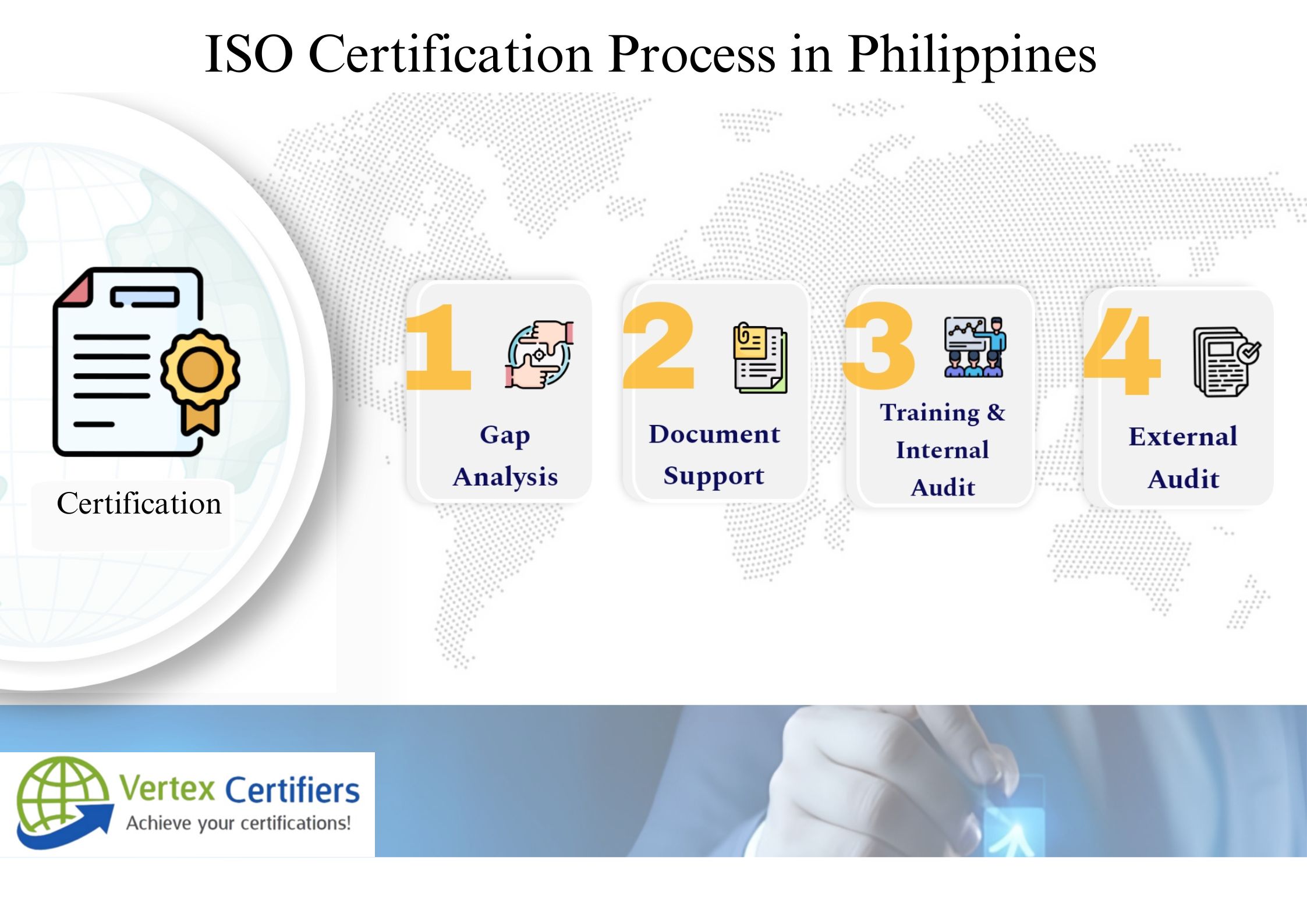
Next, documentation crafts policies and procedures compliant with Philippine laws.
Implementation rolls out changes, followed by internal audits to verify effectiveness.
A management review evaluates progress, leading to certification audits (Stage 1 and 2).
Finally, certificate issuance launches surveillance cycles.
Costing Factors of ISO Certification in Philippines
Key Factors Affecting ISO Certification in Philippines
3.1 Type of ISO Standard
The choice of ISO standard profoundly shapes certification efforts:
- ISO 9001: Focuses on quality management with strong documentation—ideal for BPO and manufacturing.
- ISO 14001: Requires environmental audits, perfect for export-oriented factories.
- ISO 27001: Involves risk assessments and security controls—critical for IT and BPO.
- ISO 22000: Focuses on food safety and hazard analysis.
3.2 Size of the Organization
- More employees = more training and documentation
- Multiple departments increase audit scope
- Larger operations require deeper audit sampling
3.3 Scope of Certification
- Single location vs multiple branches
- Limited vs full organizational coverage
- Broader scope increases audit complexity
3.4 Current Level of Compliance
- Existing systems aligned with ISO reduce effort
- Gap analysis identifies missing elements
- Poor readiness increases implementation time
3.5 Complexity of Business Operations
- Manufacturing requires supply chain audits
- Service industries focus on process control
- Regulatory requirements (DENR, DOH) add layers
- ERP and system integrations increase complexity
3.6 Number of Employees Involved
- Training sessions scale with workforce size
- Internal audit teams need formation
- Phased implementation ensures productivity
3.7 Certification Body Selection
- International bodies offer global recognition
- Local bodies provide regulatory familiarity
- Audit duration varies by methodology
3.8 Consultant Expertise and Approach
- Experienced consultants reduce timelines
- Onsite vs online support options
- End-to-end vs partial implementation services
3.9 Documentation Requirements
- Customized SOPs vs generic templates
- Industry-specific compliance requirements
- Digital documentation improves efficiency
3.10 Training and Awareness Programs
- Employee awareness sessions
- Internal auditor training
- Leadership workshops
- Continuous improvement programs
3.11 Audit Duration and Frequency
- Stage 1 (Readiness Audit)
- Stage 2 (Certification Audit)
- Annual surveillance audits
- Recertification every 3 years
3.12 Integration of Multiple ISO Standards
- Integrated Management System (IMS)
- Combines ISO 9001, 14001, 27001
- Reduces duplication and improves efficiency
4. Hidden Factors Businesses Often Overlook
- Internal resource allocation
- Employee time and productivity impact
- Process restructuring requirements
- Technology upgrades (e.g., security systems)
- Ongoing ISO maintenance and audits
5. How to Optimize ISO Certification Efforts
- Start with a professional gap analysis
- Define a clear and limited scope
- Adopt an Integrated Management System (IMS)
- Work with experienced ISO consultants
- Train internal teams for sustainability
Benefits That Justify the Investment
- Improved operational efficiency
- Enhanced customer trust and credibility
- Access to global markets
- Strong risk management (especially for ISO 27001)
- Competitive advantage in tenders and exports
Why Choose Vertex Certifiers in Philippines
- Local expertise with global standards knowledge
- Faster certification timelines
- Industry-specific solutions (BPO, IT, Food, Manufacturing)
- End-to-end support from gap analysis to certification
Conclusion
ISO certification in the Philippines is a strategic investment that drives business excellence. By understanding the influencing factors—standards, size, scope, and implementation approach— organizations can make informed decisions and achieve sustainable growth.
Get Started with ISO Certification Today
Ready to simplify your ISO certification journey?
- ✔ Free Gap Analysis
- ✔ Expert Consultation
- ✔ Tailored Solutions for Your Industry
📧 Email us: info@vertexcertifiers.com
🌐 Take the first step toward ISO certification today.
Get Free ConsultationOur Services
- Quality management system
- Improves customer satisfaction
- Required for tenders & exports
- Environmental management system
- Legal compliance & sustainability
- Suitable for manufacturing units
- Occupational health & safety
- Reduces workplace incidents
- Mandatory for high-risk sectors
- Information security management
- Protects customer & business data
- Essential for IT & BPO companies
- Food safety management system
- HACCP-based compliance
- For food processors & exporters
- Educational organizations standard
- Improves learning services
- For schools & training institutes
