GLP Certification in Japan:
GLP Certification in Japan, Vertex Certifiers provides end-to-end GLP certification and compliance services in Japan, supporting pharmaceutical laboratories, CROs, biotech companies, and research institutes in achieving OECD-aligned, PMDA-ready GLP compliance with full inspection confidence. Our GLP consulting covers the complete lifecycle—from gap assessment and risk mapping to documentation, QA setup, training, mock inspections, and regulatory audit support—tailored to Japan’s stringent regulatory environment. We serve organizations across all major Japanese research and industrial hubs, including Tokyo, Osaka, Yokohama, Nagoya, Kobe, Kyoto, Kawasaki, and Fukuoka, offering flexible onsite and remote implementation models. Vertex Certifiers focuses on practical, data-integrity-driven GLP systems that align with real laboratory operations, ensuring sustainable compliance, global data acceptance, and long-term regulatory readiness in Japan.
GLP certification ensures data integrity for non-clinical safety studies submitted to Japanese regulators. Laboratories and CROs in Japan must align with OECD GLP principles for PMDA acceptance
Introduction to GLP Certification
Good Laboratory Practice (GLP) establishes quality standards for non-clinical laboratory studies supporting safety assessments of pharmaceuticals, chemicals, and devices. In Japan, GLP compliance verifies the reliability of toxicology and safety data for regulatory submissions. These principles gained importance after Japan joined the OECD in 1964, enabling mutual acceptance of data (MAD) across member countries to avoid duplicative testing
How to get GLP Certification in Japan:
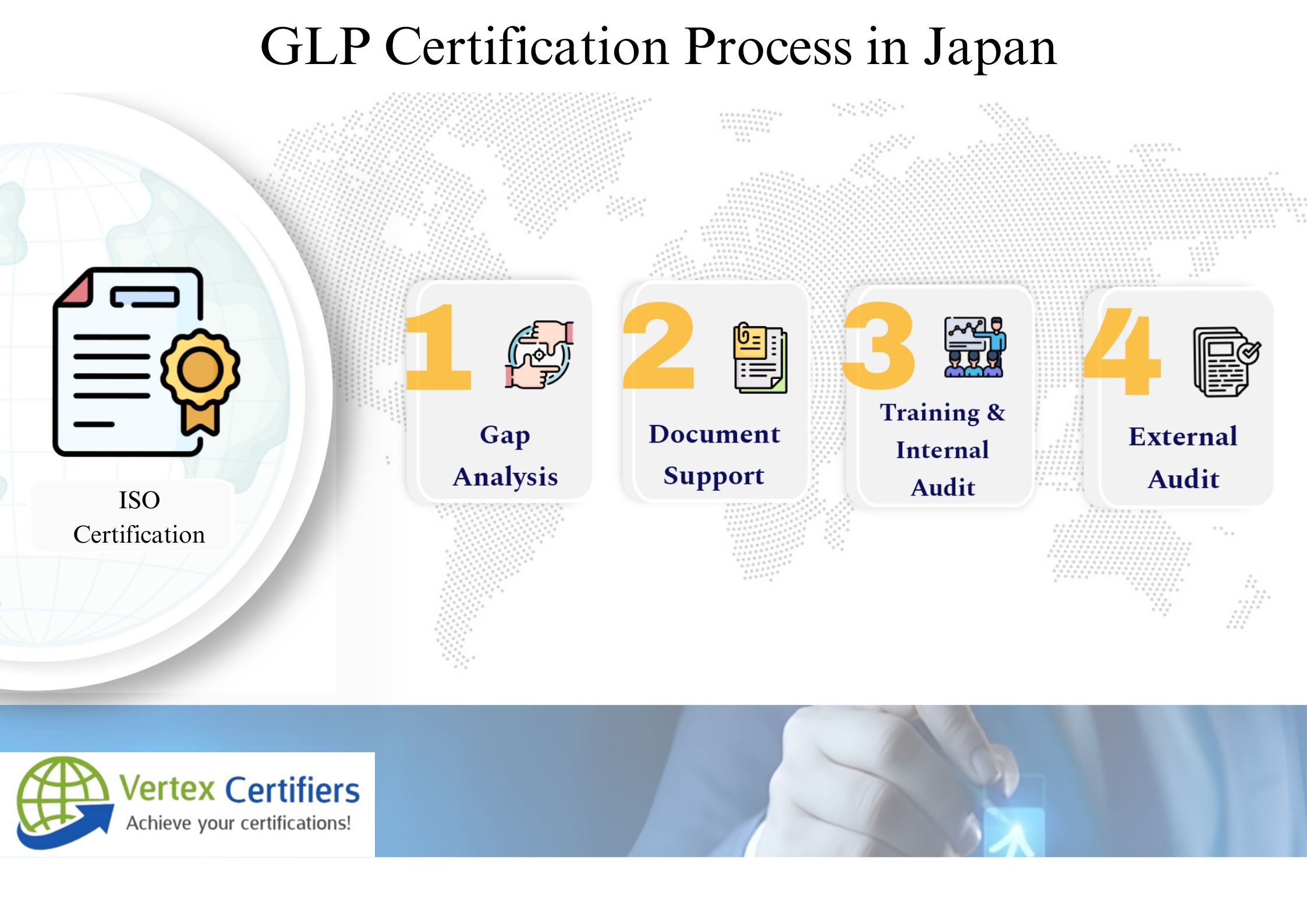
GLP Certification Process in Japan
The GLP implementation and certification process generally follows a systematic approach.
Initial Gap Analysis
A detailed assessment is conducted to identify compliance gaps and operational improvement areas within laboratory activities.
Documentation Development
Laboratory procedures, SOPs, protocols, testing procedures, equipment records, and quality assurance documents are prepared.
System Implementation
GLP controls are implemented across laboratory operations including sample handling, data recording, calibration, and quality monitoring.
Employee Training
Laboratory personnel receive training on GLP requirements, documentation practices, study conduct, and quality procedures.
Internal Audit
Internal audits are conducted to verify implementation effectiveness and identify corrective actions.
Certification or Compliance Assessment
An external assessment is conducted to evaluate laboratory compliance with GLP requirements.
Continuous Monitoring and Improvement
Organizations continuously monitor laboratory performance and maintain compliance through periodic reviews and audits.
Japan is globally recognized for its advanced pharmaceutical, biotechnology, chemical, healthcare, and research industries. Organizations involved in laboratory testing, clinical research, non-clinical studies, and product safety evaluations increasingly implement Good Laboratory Practice (GLP) systems to improve research reliability, regulatory compliance, and international acceptance of laboratory data.
GLP Certification helps laboratories establish structured procedures for conducting studies, managing test data, maintaining equipment calibration, documenting observations, and ensuring traceability throughout the testing process. Organizations implementing GLP systems demonstrate commitment toward scientific integrity, data accuracy, and quality assurance.
For Japanese laboratories and research organizations, GLP implementation supports:
- Regulatory compliance
- International research credibility
- Reliable test data generation
- Improved laboratory controls
- Better documentation practices
- Enhanced audit readiness
- Increased client confidence
- Reduced research errors and deviations
- Improved data traceability
- Better global market acceptance
GLP systems are especially important for organizations involved in pharmaceutical testing, toxicology studies, chemical analysis, biotechnology research, environmental testing, and medical product development.
GLP Implementation Process in Japan
GLP implementation in Japan follows a structured, inspection-driven approach aligned with OECD GLP Principles and PMDA expectations. The process begins with a detailed GLP gap assessment and risk analysis of existing laboratory practices.
Based on identified gaps, laboratories develop a GLP Quality Manual, SOPs, and study-specific templates, followed by the establishment of an independent Quality Assurance (QA) unit with appropriate training.
GLP systems are rolled out across ongoing and new studies, supported by internal audits and mock inspections. Corrective actions are implemented to achieve full inspection readiness. For domestic facilities, PMDA routine inspections are voluntary and result in GLP certification.
GLP Inspections and Audits in Japan
PMDA conducts three types of GLP inspections:
- Routine inspections – voluntary for domestic facilities, certificate issued
- Product-based inspections – mandatory for marketing authorization applications
- Special inspections – triggered by concerns or critical submissions
Inspections focus heavily on data integrity, QA independence, study conduct, and computerized systems. Reviews include facility audits and detailed study inspections.
Identified findings are addressed through CAPA; re-inspections may occur if required. Common issues include unvalidated systems and weak deviation handling.
GLP Certification Timeline in Japan
- Small laboratories: 6–12 months
- Medium CROs: 12–18 months
- Large or multi-site facilities: 18–24 months
Timelines depend on study volume, documentation maturity, and digital system readiness. Certification renewal occurs every three years.
Cost Considerations for GLP in Japan
GLP implementation costs vary based on:
- Laboratory size and operational complexity
- QA staffing requirements
- Documentation gaps
- Computerized system validation needs
While small labs incur moderate costs, multi-site operations require higher investment. Digital upgrades add expense but ensure long-term compliance and inspection success. A GLP gap assessment provides the most accurate cost estimate.
Common GLP Challenges in Japan
- Over-documentation misaligned with actual operations
- Limited QA authority and independence
- Unvalidated spreadsheets and LIMS
- Poor deviation and CAPA management
- Archiving and long-term data retention issues
- Conflicts between GLP, ISO 17025, and GMP systems
Increased competition from non-MAD countries such as China intensifies inspection pressure on Japanese facilities.
Regulatory Framework for GLP in Japan
Japan’s GLP regulations are governed under the Pharmaceuticals and Medical Devices Act, enforced by PMDA and overseen by MHLW.
Japan has been a participant in the OECD Mutual Acceptance of Data (MAD) system since 1964. GLP data from OECD member countries is automatically accepted, reducing barriers for multinational submissions.
Studies Covered Under GLP
GLP applies to non-clinical safety studies including:
- Toxicology and safety pharmacology
- Pharmacokinetics and ADME
- Genotoxicity and carcinogenicity
- Medical device biocompatibility
- Agrochemical and environmental safety studies (CSCL GLP)
Who Needs GLP Compliance in Japan?
- Pharmaceutical and biopharmaceutical laboratories
- Contract Research Organizations (CROs)
- Medical device testing facilities
- Agrochemical and environmental laboratories
- Academic and government research institutions
- Japanese subsidiaries of multinational companies
Benefits of GLP Certification
- PMDA submission readiness
- Global acceptance of data via OECD MAD
- Reduced re-testing and development costs
- Improved sponsor and regulator confidence
- Competitive advantage in Asia-Pacific CRO markets
Why Vertex Certifiers for GLP Certification in Japan
Vertex Certifiers delivers OECD-aligned, PMDA-focused GLP implementation with end-to-end support including gap assessment, documentation, QA setup, training, mock inspections, and inspection support.
Our remote and onsite consulting models across Asia-Pacific enable laboratories and CROs to achieve practical, inspection-ready GLP systems—not template-based compliance.
Get GLP Certified in Japan – Free Consultation
Achieve inspection-ready GLP compliance with expert guidance from Vertex Certifiers.
- ✔ Free GLP gap assessment
- ✔ Customized roadmap and timelines
- ✔ Mock inspections and PMDA support
📧 info@vertexcertifiers.com
🌐
Schedule Your Free Consultation
Our Services
- GMP Certification
- GLP Certification
- GDP Certification
- Halal Certificate
- Organic Certificate
- CE Marking Certification
- RoHS Certification
- FDA Certification
- CMMI Certification
- Cyber Security
- VAPT Testing
- Security Assessment
Industries in Japan Benefiting from GLP Certification
Several industries in Japan benefit significantly from implementing Good Laboratory Practice systems.
Pharmaceutical Industry
Japan has one of the world’s largest pharmaceutical and life sciences sectors. Pharmaceutical companies implement GLP systems to improve non-clinical laboratory studies, toxicology testing, drug development documentation, and regulatory compliance.
Biotechnology and Research Organizations
Biotechnology companies and research institutions use GLP standards to maintain study reliability, scientific accuracy, and proper laboratory documentation controls.
Contract Research Organizations (CROs)
CROs conducting laboratory studies and research services implement GLP systems to improve client trust, international project eligibility, and regulatory acceptance.
Chemical and Industrial Testing Laboratories
Chemical laboratories use GLP systems to improve testing consistency, sample traceability, equipment calibration, and analytical accuracy.
Environmental Testing Laboratories
Environmental laboratories implement GLP standards to improve monitoring reliability, testing accuracy, and compliance with environmental assessment requirements.
Medical Device and Healthcare Sector
Medical device testing laboratories and healthcare research facilities use GLP systems to strengthen quality assurance and laboratory process controls.
Frequently Asked Questions – GLP Certification in Japan
What is GLP Certification?
GLP Certification demonstrates that a laboratory follows Good Laboratory Practice systems to ensure reliable testing, proper documentation, and controlled laboratory operations.
Which industries require GLP systems in Japan?
Pharmaceutical, biotechnology, chemical, healthcare, environmental, and research laboratories commonly implement GLP systems.
Is GLP mandatory in Japan?
GLP requirements depend on regulatory expectations, laboratory activities, industry regulations, and client requirements.
What are the benefits of GLP implementation?
GLP improves laboratory reliability, data integrity, documentation quality, audit readiness, and international credibility.
How long does GLP implementation take?
The implementation timeline depends on laboratory size, operational complexity, and existing quality systems.
Can small laboratories implement GLP systems?
Yes. Small and medium-sized laboratories can also implement GLP systems according to their operational scope and testing activities.
