GMP Certification in Iran:
GMP Certification in Iran, Vertex Certifiers is a trusted GMP certification and consulting partner in Iran, delivering end-to-end Good Manufacturing Practices (GMP) certification support across major industrial and life-science hubs such as Tehran, Karaj, Isfahan, Tabriz, Mashhad, and Shiraz. We work closely with pharmaceutical manufacturers, food and beverage producers, cosmetics companies, medical device manufacturers, and herbal medicine units to implement GMP systems aligned with WHO GMP and Iran FDA (IFDA) regulatory requirements. Through practical gap analysis, customized GMP documentation, staff training, and audit readiness—offered via flexible onsite and remote models—Vertex Certifiers ensures a smooth, compliant, and internationally accepted GMP certification journey tailored to Iran’s manufacturing and export ecosystem.
What is GMP Certification?
GMP certification confirms a facility follows Good Manufacturing Practices—systematic protocols to prevent contamination, mix-ups, or errors during production. Objectives include ensuring product safety, purity, efficacy, and consistency. Scope spans facilities (cleanrooms, airflow), processes (validation), personnel (training, hygiene), and documentation (batch records). Guidelines like WHO GMP provide the framework, but certification delivers official validation from IFDA or accredited bodies. Unlike advisory guidelines, certification triggers regulatory approvals, making it essential for market entry.
Industries That Require GMP Certification in Iran
High-risk sectors demand GMP under IFDA:
- Pharmaceutical Manufacturing: Tablets, injectables, biotech drugs.
- Medical Devices: Syringes, diagnostics, surgical tools.
- Food & Beverage Processing: Dairy, juices, canned goods for halal exports.
- Cosmetics & Personal Care: Creams, shampoos, sanitizers.
- Herbal Medicines & Nutraceuticals: Traditional Iranian remedies, supplements.
- Packaging Materials: Pharma/food-contact plastics, glass.
Inspections enforce these, with WHO GMP for premium exports.
GMP Certification Process in Iran
Step-by-step path to GMP Certification:
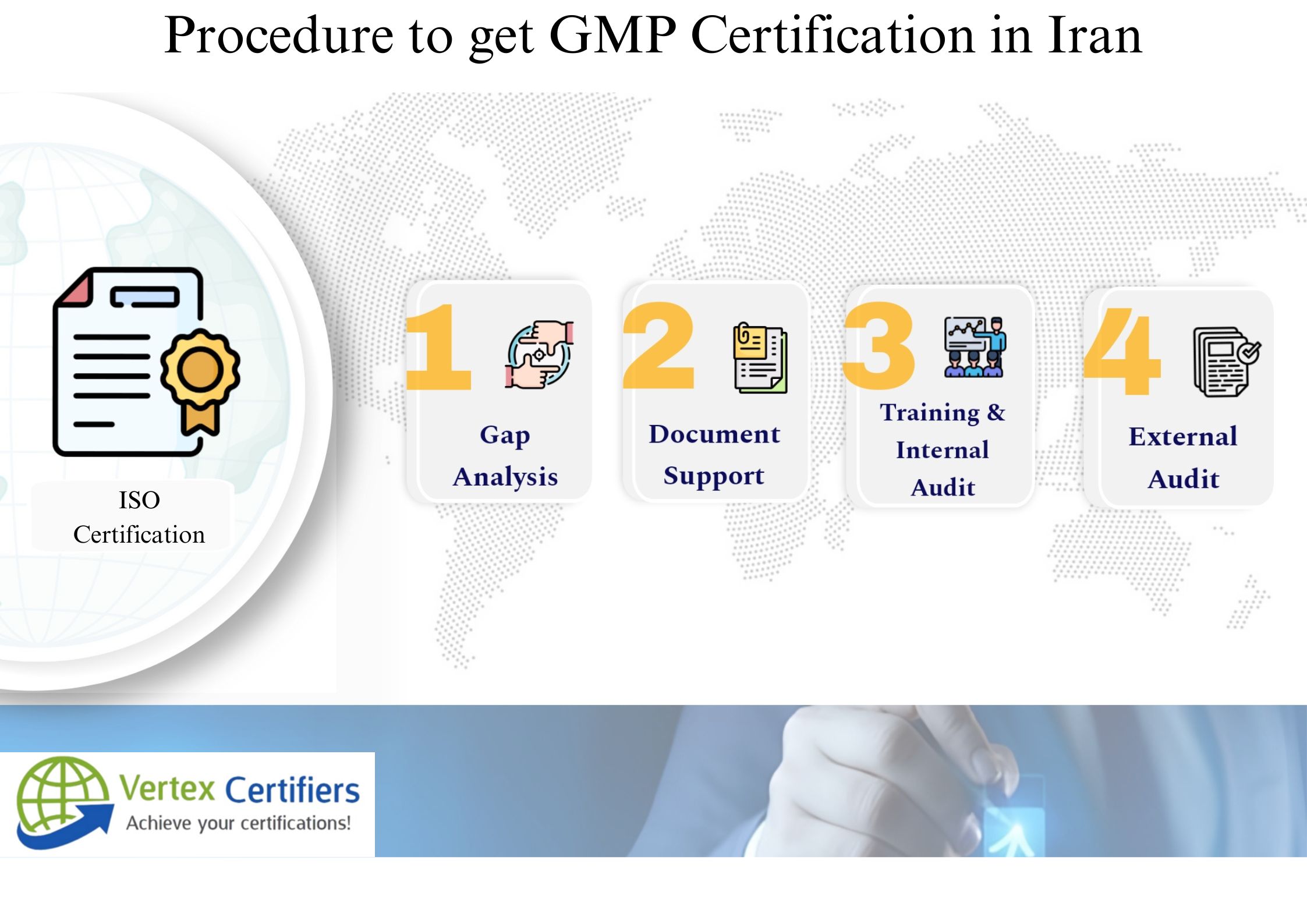
- GMP Gap Analysis: Identify deficiencies via expert review.
- Risk Assessment & Compliance Planning: Prioritize via FMEA.
- SOP & Documentation Development: Customized to operations.
- GMP Training for Employees: Competency-based programs.
- Implementation & Internal Audit: Trial runs, corrective actions.
- Certification/Regulatory Audit: IFDA inspection or WHO PQS.
- GMP Certificate Issuance: 2-3 year validity, surveillance follows.
Vertex Certifiers – GMP Consultants in Iran handles full cycles for Iranian firms.
Iran’s manufacturing and export sectors are rapidly focusing on international compliance standards to improve product quality, safety, and global acceptance. GMP Certification helps organizations establish structured manufacturing controls, reduce contamination risks, and ensure consistent product quality across production batches.
For pharmaceutical manufacturers, herbal product companies, cosmetics producers, food processing industries, and medical device suppliers in Iran, GMP implementation supports both domestic market credibility and international trade opportunities. Many importers and distributors in GCC countries, Europe, and Asia prefer suppliers operating under Good Manufacturing Practices because it demonstrates commitment to hygiene, traceability, and regulatory compliance.
GMP Certification also helps businesses in Iran:
- Improve production consistency
- Minimize product recalls and defects
- Strengthen customer trust
- Enhance export opportunities
- Maintain proper documentation and traceability
- Improve employee hygiene and operational discipline
- Reduce regulatory and operational risks
Organizations implementing GMP standards often experience better process control, improved audit readiness, and stronger market positioning in competitive industries.
Industries in Iran That Commonly Require GMP Certification
GMP Certification is highly beneficial for several industries operating in Iran where product safety, hygiene, and manufacturing consistency are critical.
Pharmaceutical Manufacturing
Pharmaceutical companies require GMP implementation to maintain controlled production environments, proper validation procedures, and quality assurance systems for medicines and healthcare products.
Food and Beverage Processing
Food manufacturers use GMP practices to improve hygiene management, contamination prevention, storage control, and safe production processes.
Herbal and Traditional Products
Iran has a growing herbal and natural products sector. GMP helps these businesses standardize production methods and improve consumer confidence.
Cosmetics and Personal Care Products
Cosmetics manufacturers implement GMP to ensure safe ingredient handling, production hygiene, and product consistency.
Medical Device Manufacturing
Medical equipment and device manufacturers use GMP systems to maintain strict quality controls and compliance with international buyer expectations.
Chemical and Packaging Industries
Packaging material manufacturers and industrial chemical companies also adopt GMP principles to improve operational control and product reliability.
Â
GMP Certification in Iran – City-Wise Demand
Iran’s expanding pharmaceutical, food, and life-science sectors are driving strong demand for GMP certification, especially across major industrial and Special Economic Zones (SEZs).
- Tehran: Pharmaceutical headquarters, biotech labs, and cosmetics exporters; over 50% of GMP-certified units operate here.
- Karaj: Contract manufacturing and large-scale pharmaceutical production facilities.
- Isfahan: Chemicals, nutraceuticals, and food processors supplying Middle East markets.
- Tabriz: Pharmaceutical, medical device, and agro-processing units within free trade zones.
- Mashhad: Herbal medicines, nutraceuticals, and food exports driven by pilgrimage demand.
- Shiraz: Medical devices, cosmetics manufacturing, and biotech R&D clusters.
SEZs in these cities provide GMP incentives and shared infrastructure, accelerating certification timelines.
Key GMP Requirements & Principles
GMP implementation in Iran follows Iran FDA (IFDA) guidelines aligned with WHO GMP, emphasizing strong risk management.
- Facility Layout & Hygienic Design: Unidirectional flow, HVAC systems, pest exclusion.
- Personnel Hygiene & Training: Certified GMP training, sterile barriers, gowning protocols.
- Equipment Qualification: DQ/IQ/OQ/PQ with traceable calibration records.
- Raw Material Control: Approved vendors, incoming inspections, quarantine & testing.
- Production Controls: Master batch formulas, in-process monitoring.
- Cleaning & Sanitation Validation: Microbiological swabbing and WHO-defined limits.
- Quality Control & Release: Finished product specifications and stability studies.
- Documentation & Records: SOPs and records retained for 5+ years.
- Deviation & Recall Systems: CAPA, root cause analysis, and mock recalls.
Tip: Start with a detailed gap analysis against IFDA inspection checklists.
Timeline for GMP Certification in Iran
- Small facilities: 3–4 weeks (startups and basic setups)
- Medium units: 4–6 weeks including SOPs and staff training
- Large or multi-site operations: 6–10 weeks for advanced validations
Pharmaceutical and herbal products often take longer due to stability testing, while food facilities certify faster. Early planning helps manage IFDA audit queues.
Cost Factors for GMP Certification in Iran
- Facility size and number of employees
- Industry type (pharma and devices require deeper audits)
- Production lines and cleanroom classifications
- Existing compliance maturity (retrofit vs greenfield)
- Single-site or multi-site scope
- Local IFDA audits vs international WHO scope
Ongoing surveillance should be budgeted separately. Experienced consultants like Vertex reduce costs through phased implementation.
Benefits of GMP Certification for Iranian Businesses
- Consistent product quality with minimal patient safety risks
- Up to 50% reduction in recalls and non-compliance issues
- Improved efficiency through validated, repeatable processes
- Export access to 20+ international markets
- Higher regulator and buyer trust—GMP firms win ~30% more contracts
GMP vs ISO Standards
- GMP vs ISO 9001: GMP validates manufacturing hygiene; ISO 9001 strengthens management systems.
- GMP vs ISO 22000: GMP provides hygiene foundation; ISO 22000 adds HACCP controls.
- GMP vs ISO 13485: GMP covers manufacturing; ISO 13485 governs full medical device lifecycle.
- Integrated Systems: Hybrid GMP + ISO models cut audit costs by up to 40%.
How Vertex Certifiers Helps with GMP Certification in Iran
Vertex Certifiers delivers turnkey GMP solutions across Iran—supporting manufacturers from initial assessment to certification.
- Comprehensive GMP gap analysis and IFDA readiness audits
- Customized SOPs, validation plans, and documentation
- Employee GMP training for pharma, food, cosmetics, and devices
- Remote support for Tehran & Karaj; onsite consulting in Isfahan & Tabriz
- Fast-track programs with WHO-aligned, globally accepted outcomes
Trusted by 500+ clients across 50+ countries, Vertex ensures smooth, audit-ready GMP compliance.
Frequently Asked Questions (FAQs)
- Is GMP mandatory in Iran? Yes for pharmaceuticals, medical devices, and cosmetics under IFDA.
- Which industries require GMP? Pharma, medical devices, food, cosmetics, herbals, packaging.
- Who issues GMP certificates? IFDA, WHO-listed bodies, and accredited certification agencies.
- How long is GMP valid? Usually 2–3 years with annual surveillance.
- Can GMP integrate with ISO standards? Yes, for audit efficiency and cost savings.
- Is GMP suitable for SMEs? Absolutely—requirements are scalable for small producers.
Get GMP Certified in Iran
Boost your business growth with GMP Certification in Iran. Vertex Certifiers offers a FREE GMP gap analysis customized for Tehran, Karaj, Isfahan, Tabriz, Mashhad, and Shiraz.
📧 Email: info@vertexcertifiers.com
Request Your Free GMP ConsultationOur Services
- GMP Certification
- GLP Certification
- GDP Certification
- Halal Certificate
- Organic Certificate
- CE Marking Certification
- RoHS Certification
- FDA Certification
- CMMI Certification
- Cyber Security
- VAPT Testing
- Security Assessment
Frequently Asked Questions – GMP Certification in Iran
What is GMP Certification?
GMP Certification demonstrates that an organization follows Good Manufacturing Practices to ensure product safety, quality consistency, and hygienic manufacturing operations.
Which industries need GMP Certification in Iran?
Pharmaceutical, food, cosmetics, herbal products, medical devices, packaging, and chemical industries commonly implement GMP systems.
Is GMP Certification mandatory in Iran?
Requirements depend on the industry, customer expectations, export obligations, and applicable regulatory frameworks.
How long does GMP Certification take?
The implementation timeline depends on company size, operational complexity, and existing compliance systems. Many organizations complete implementation within a few weeks to a few months.
What are the benefits of GMP Certification?
GMP Certification improves operational control, customer trust, product quality, export opportunities, and regulatory compliance readiness.
Can small businesses apply for GMP Certification?
Yes. Small and medium-sized enterprises can also implement GMP practices based on their operational scope and industry requirements.
