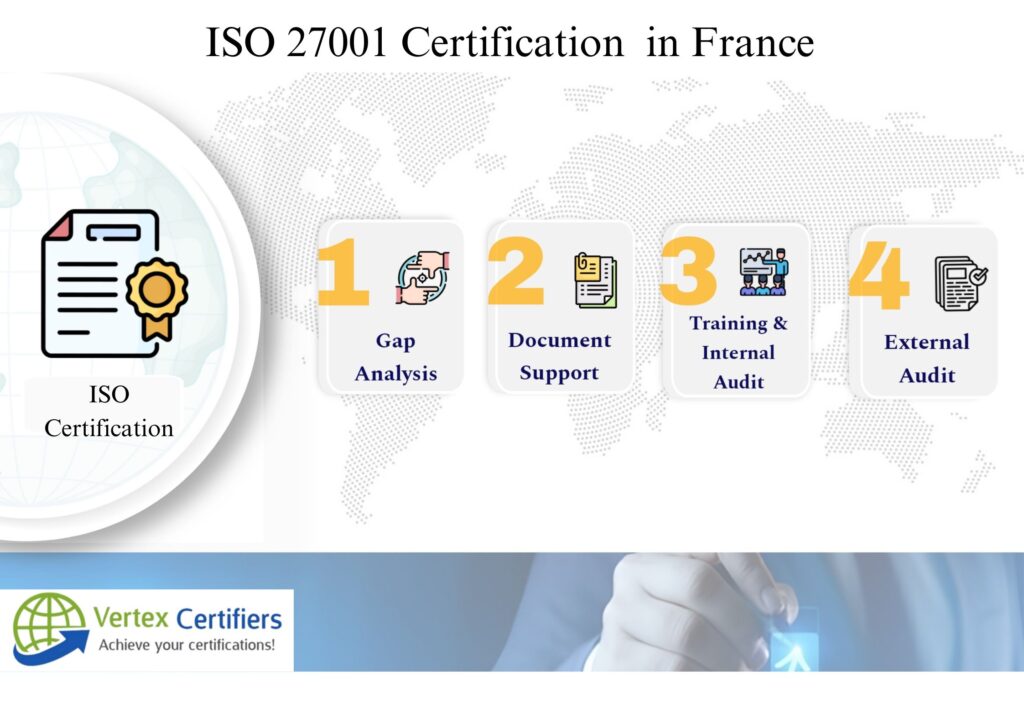
Need ISO 27001 Certification Support in France?
Vertex Certifiers helps businesses across France with documentation, risk assessment, implementation, internal audits, employee training, and certification assistance.
3. Why Do French Businesses Need ISO 27001 Certification?
French businesses increasingly depend on digital systems, cloud platforms, remote collaboration, outsourced vendors, and connected supply chains, which means information security is now a board-level business issue rather than only an IT concern. French organisations are also expected to apply appropriate technical and organisational measures for personal data protection under the GDPR and the French Data Protection Act, and CNIL guidance strongly emphasises governance, risk analysis, access management, incident readiness, logging, backups, cloud oversight, and supplier management.
[secureleap](https://www.secureleap.tech/blog/iso-27001-surveillance-audit)ISO 27001 gives organisations a structured Information Security Management System (ISMS) that helps them identify risks, define controls, assign responsibilities, document procedures, and improve security continuously. This is especially valuable in France, where customers, regulators, partners, and international buyers increasingly expect evidence that information is handled securely and consistently.
[scrut](https://www.scrut.io/hub/iso-27001/iso-27001-surveillance-audit)Rising cybersecurity challenges
French businesses face a broad range of cyber threats that can disrupt operations, expose confidential data, and damage trust. Common risks include phishing, ransomware, insider misuse, data breaches, supply chain compromise, and weaknesses in cloud environments, all of which require more than ad hoc technical fixes.
[secureleap](https://www.secureleap.tech/blog/iso-27001-surveillance-audit)- Phishing: Employees remain a frequent target of deceptive emails, fake login pages, and impersonation attacks. CNIL specifically highlights phishing, identity theft, and the need for user awareness and response procedures as part of good data security practice.
[secureleap](https://www.secureleap.tech/blog/iso-27001-surveillance-audit)- Ransomware: Malware can encrypt files, halt operations, and trigger recovery costs, legal exposure, and reputational harm. This is why backup processes, continuity planning, and incident management are essential controls within an ISMS.
[scrut](https://www.scrut.io/hub/iso-27001/iso-27001-surveillance-audit)- Insider threats: Risks do not only come from external hackers; they also come from excessive access rights, poor user behaviour, or deliberate misuse. CNIL recommends least-privilege access, role-based authorisations, annual access reviews, and clear user rules.
[secureleap](https://www.secureleap.tech/blog/iso-27001-surveillance-audit)- Data breaches: Loss, unauthorised disclosure, or improper processing of information can affect personal data, commercial secrets, contracts, and intellectual property. Article 32 GDPR requires security measures appropriate to the risk, which aligns closely with ISO 27001’s risk-based approach.
[secureleap](https://www.secureleap.tech/blog/iso-27001-surveillance-audit)- Supply chain attacks: Businesses often depend on software vendors, cloud providers, logistics systems, and third-party processors. CNIL’s guidance specifically includes managing data processors and cloud resources, showing why supplier security must be controlled rather than assumed.
[secureleap](https://www.secureleap.tech/blog/iso-27001-surveillance-audit)- Cloud security: SaaS, PaaS, and IaaS improve flexibility, but they also create shared-responsibility risks around access, configuration, data location, monitoring, and vendor oversight. CNIL explicitly includes cloud resources in its security framework and recommends structured control over such environments.
[secureleap](https://www.secureleap.tech/blog/iso-27001-surveillance-audit)
Customer expectations and trust
Customers increasingly want proof that their information will be handled securely, especially when they share personal data, financial records, source code, contracts, health information, or proprietary operational data. ISO 27001 certification reassures clients that security is managed systematically through policies, objectives, risk treatment, audits, and continual improvement rather than informal practices alone.
[scrut](https://www.scrut.io/hub/iso-27001/iso-27001-surveillance-audit)This matters even more in service-driven and data-intensive sectors. IT companies, SaaS providers, healthcare organisations, manufacturers, banks, financial services firms, insurers, telecom providers, government contractors, defence suppliers, logistics operators, and e-commerce companies all process sensitive information that customers expect to be protected throughout its lifecycle.
[secureleap](https://www.secureleap.tech/blog/iso-27001-surveillance-audit)Regulatory and contractual pressure
ISO 27001 is not the same as GDPR compliance, but it helps organisations create the governance, risk management, security controls, and documentation that support compliance efforts. CNIL notes that data protection requires formal objectives, management involvement, action plans, audits, security reviews, and ongoing improvement, which are all strongly aligned with an ISMS model.
[secureleap](https://www.secureleap.tech/blog/iso-27001-surveillance-audit)French businesses also face customer contractual requirements and international business expectations. Many enterprise clients, multinational groups, and public-sector buyers require suppliers to show documented security controls, structured incident response, vendor oversight, and audit readiness before contracts are awarded or renewed.
[scrut](https://www.scrut.io/hub/iso-27001/iso-27001-surveillance-audit)Why key industries need it
- IT Companies and SaaS Providers: Protect client data, application environments, and support systems while strengthening market trust.
- Healthcare: Safeguard sensitive health and patient-related information with stronger access control and incident response.
- Manufacturing: Protect production systems, supply chain data, designs, and operational continuity.
- Banking, Financial Services, and Insurance: Reduce fraud, improve data governance, and meet demanding client and regulator expectations.
- Telecommunications: Secure large data volumes, network operations, and customer records.
- Government Contractors and Defence Suppliers: Demonstrate structured protection of confidential information and controlled supplier relationships.
- Logistics and E-commerce: Secure customer data, order systems, vendor connections, and digital platforms.
In practice, French businesses need ISO 27001 because it turns information security into a managed business system that supports resilience, compliance, commercial credibility, and long-term trust. For organisations operating in competitive or regulated markets, certification is often both a defensive necessity and a strategic advantage.
[scrut](https://www.scrut.io/hub/iso-27001/iso-27001-surveillance-audit)5. ISO 27001 Documentation Required
ISO 27001 documentation forms the backbone of the Information Security Management System because it defines what the organisation intends to protect, how risks are evaluated, which controls apply, and how evidence is retained for internal management and external auditors. While ISO 27001:2022 requires certain documented information directly, many additional documents are commonly maintained because they make implementation practical, consistent, and audit-ready.
[scrut](https://www.scrut.io/hub/iso-27001/iso-27001-surveillance-audit)Without strong documentation, even good security practices become difficult to repeat, verify, or improve. Documentation ensures that responsibilities are clear, controls are consistently applied, incidents are handled correctly, and decisions can be demonstrated to customers, auditors, and other interested parties.
[scrut](https://www.scrut.io/hub/iso-27001/iso-27001-surveillance-audit)Core ISO 27001 documents
- Information Security Policy: This sets the organisation’s direction, leadership commitment, and overall security principles. It provides a formal foundation for the ISMS and communicates management intent across the business.
[scrut](https://www.scrut.io/hub/iso-27001/iso-27001-surveillance-audit)- ISMS Scope: The scope document defines the boundaries and applicability of the ISMS, including locations, departments, processes, systems, products, or services covered by certification.
[scrut](https://www.scrut.io/hub/iso-27001/iso-27001-surveillance-audit)- Risk Assessment Methodology: ISO 27001 requires documented risk assessment and treatment processes. This methodology explains how risks are identified, scored, evaluated, and prioritised.
[scrut](https://www.scrut.io/hub/iso-27001/iso-27001-surveillance-audit)- Risk Register: Often maintained as part of the risk assessment report, the risk register records assets, threats, vulnerabilities, likelihood, impact, existing controls, and treatment decisions.
[scrut](https://www.scrut.io/hub/iso-27001/iso-27001-surveillance-audit)- Statement of Applicability: The SoA is one of the most important ISO 27001 documents because it identifies which Annex A controls are applicable, whether they are implemented, and why they are included or excluded.
[scrut](https://www.scrut.io/hub/iso-27001/iso-27001-surveillance-audit)- Information Security Objectives: These translate policy into measurable goals, such as reducing incidents, improving awareness, strengthening supplier oversight, or increasing backup reliability.
[scrut](https://www.scrut.io/hub/iso-27001/iso-27001-surveillance-audit)
Operational and control documents
- Asset Inventory: A documented inventory helps identify information assets, systems, devices, software, cloud resources, and related ownership. Advisera lists asset inventory as commonly documented under Annex A control requirements, and CNIL also recommends identifying hardware, software, communication channels, cloud resources, and premises.
[secureleap](https://www.secureleap.tech/blog/iso-27001-surveillance-audit)- Access Control Policy: This explains user access rules, approval processes, role allocation, privilege restrictions, and periodic access review. CNIL specifically recommends documented access control measures and regular rights review.
[secureleap](https://www.secureleap.tech/blog/iso-27001-surveillance-audit)- Incident Response Procedure: This defines how the organisation detects, reports, escalates, investigates, responds to, and learns from security incidents.
[secureleap](https://www.secureleap.tech/blog/iso-27001-surveillance-audit)- Backup Procedures: Backup documentation explains what is backed up, how often, where copies are stored, how restoration is tested, and how continuity is supported.
[secureleap](https://www.secureleap.tech/blog/iso-27001-surveillance-audit)- Supplier Security Documentation: This covers due diligence, security expectations, contractual controls, monitoring, and risk treatment for third parties. Supplier security is particularly important because cloud use and outsourced processing create shared risks.
[scrut](https://www.scrut.io/hub/iso-27001/iso-27001-surveillance-audit)- HR Security Documentation: This includes confidentiality commitments, responsibilities, onboarding rules, role changes, exit controls, awareness expectations, and disciplinary principles where relevant. CNIL also highlights user rules, confidentiality obligations, and tailored awareness by role.
[secureleap](https://www.secureleap.tech/blog/iso-27001-surveillance-audit)
Mandatory records and evidence
ISO 27001 also requires retained evidence showing that the ISMS is operating. Advisera identifies mandatory records such as training, competence, monitoring and measurement results, internal audit program and results, management review results, and corrective action records.
[scrut](https://www.scrut.io/hub/iso-27001/iso-27001-surveillance-audit)- Internal Audit Reports: Evidence that the ISMS is periodically reviewed for conformity and effectiveness.
[secureleap](https://www.secureleap.tech/blog/iso-27001-surveillance-audit)- Management Review Records: Minutes or records showing top management reviews the ISMS, performance, risks, incidents, resources, and opportunities for improvement.
[scrut](https://www.scrut.io/hub/iso-27001/iso-27001-surveillance-audit)- Corrective Action Records: Documentation showing nonconformities are investigated, root causes are considered, and actions are tracked to closure.
[scrut](https://www.scrut.io/hub/iso-27001/iso-27001-surveillance-audit)- Training Records: These prove that employees have the skills, awareness, and competence needed to fulfil security responsibilities.
[secureleap](https://www.secureleap.tech/blog/iso-27001-surveillance-audit)- Monitoring Records: These include measurement results, logs, review outcomes, and other evidence used to assess performance and control effectiveness.
[secureleap](https://www.secureleap.tech/blog/iso-27001-surveillance-audit)
Why documentation is critical
Documentation is critical because ISO 27001 is a management system standard, not just a checklist of technical safeguards. Auditors need to see that the organisation has defined processes, implemented them in practice, reviewed results, and improved performance over time.
[scrut](https://www.scrut.io/hub/iso-27001/iso-27001-surveillance-audit)Good documentation also improves daily operations. It reduces confusion, supports onboarding, standardises decisions, strengthens accountability, and makes it easier to manage incidents, audits, suppliers, and compliance obligations in a controlled way. For French businesses working with demanding customers or regulated data, documentation is often the clearest evidence that information security is taken seriously and managed professionally.
[secureleap](https://www.secureleap.tech/blog/iso-27001-surveillance-audit)6. ISO 27001 Certification Cost in France
ISO 27001 certification cost in France varies significantly from one organisation to another because the total effort depends on scope, complexity, readiness, and audit requirements. There is no reliable one-size-fits-all price, and businesses should avoid fixed figures that ignore the practical realities of implementation, internal effort, and recurring audit obligations.
[startiso](https://www.startiso.com/course/iso-27001/lesson/9.1/)In most projects, the real cost includes far more than the certification audit alone. It typically combines preparation effort, internal resource time, documentation work, risk assessment, control implementation, training, consultancy support, and ongoing surveillance audits after certification.
[startiso](https://www.startiso.com/course/iso-27001/lesson/9.1/)Main cost factors
- Company size: Larger organisations usually have more assets, people, departments, records, and controls to assess, which increases implementation and audit effort.
[konfirmity](https://www.konfirmity.com/blog/iso-27001-audit-timeline)- Number of employees: More staff means more user access, awareness requirements, role-based controls, evidence collection, and training records.
[scrut](https://www.scrut.io/hub/iso-27001/iso-27001-surveillance-audit)- Multiple office locations: If a company operates from several sites, the scope becomes harder to coordinate and auditors may need to review location-specific processes and controls.
- Scope of certification: A narrow scope covering one service line or one entity generally costs less than a broad enterprise-wide scope involving all operations, cloud systems, development teams, and support functions.
[scrut](https://www.scrut.io/hub/iso-27001/iso-27001-surveillance-audit)- Existing ISMS maturity: Organisations that already maintain policies, risk processes, access control, logging, backup routines, supplier oversight, and audit discipline usually spend less on remediation than those starting from scratch.
[secureleap](https://www.secureleap.tech/blog/iso-27001-surveillance-audit)- Consultancy fees: External consultants may support gap analysis, policy development, risk workshops, implementation guidance, audit preparation, and staff training. Fees vary based on project depth and level of support.
- Certification body charges: These depend on audit duration, stage 1 and stage 2 activities, certification cycle requirements, and surveillance audits in later years.
[startiso](https://www.startiso.com/course/iso-27001/lesson/9.1/)- Internal resources: Time spent by management, IT, HR, compliance, operations, procurement, and process owners is a major hidden cost because implementation requires cross-functional involvement.
[secureleap](https://www.secureleap.tech/blog/iso-27001-surveillance-audit)- Employee training: Security awareness, role-based training, and internal auditor capability all require planned effort and evidence.
[scrut](https://www.scrut.io/hub/iso-27001/iso-27001-surveillance-audit)- Surveillance audits: ISO 27001 certification is maintained through a multi-year cycle, and surveillance audits typically occur in years 1 and 2 before recertification in year 3.
[startiso](https://www.startiso.com/course/iso-27001/lesson/9.1/)
Why costs differ so much
A small SaaS company with one office, mature cloud controls, and a focused scope may require less effort than a multi-site manufacturer or financial services group with broader operational complexity. Similarly, a business with undocumented processes often spends more time building governance foundations than one that already has structured controls in place.
[konfirmity](https://www.konfirmity.com/blog/iso-27001-audit-timeline)Organisations should also remember that weak planning can create indirect costs. Delays, repeated document revisions, poor evidence collection, unclear scope, and failed audit readiness checks can increase consultancy time, employee burden, and certification body effort.
Why professional consultants reduce implementation costs
Professional consultants help reduce total implementation cost not by making the project artificially cheap, but by making it efficient. They identify gaps early, prevent over-documentation, tailor controls to business reality, and keep the scope aligned with actual certification objectives.
[scrut](https://www.scrut.io/hub/iso-27001/iso-27001-surveillance-audit)This matters because many organisations waste time producing unnecessary documents, using generic templates poorly, or implementing controls that do not match their risks. Experienced ISO 27001 consultants can streamline risk assessment, prepare practical documentation, coordinate internal teams, support audit readiness, and reduce the chance of rework or nonconformities.
[konfirmity](https://www.konfirmity.com/blog/iso-27001-audit-timeline)Consultants are also useful when a business lacks internal ISO 27001 experience. Instead of forcing operational teams to learn everything through trial and error, external specialists can accelerate decision-making, clarify priorities, and help the organisation focus on the controls and evidence that auditors and customers actually expect.
How French businesses should budget
Rather than asking for a single fixed price, French companies should request a cost estimate based on their size, sites, industry, current maturity, certification scope, and desired support model. A realistic budget should include implementation, training, internal preparation, certification audit charges, and ongoing maintenance across the three-year certification cycle.
[konfirmity](https://www.konfirmity.com/blog/iso-27001-audit-timeline)When approached strategically, ISO 27001 is not only a compliance expense. It is an investment in stronger governance, fewer security disruptions, improved customer confidence, and more efficient control over information assets.
[secureleap](https://www.secureleap.tech/blog/iso-27001-surveillance-audit)7. ISO 27001 Certification Timeline
The ISO 27001 certification timeline in France depends on organisation size, complexity, scope, existing controls, and how quickly teams can implement and evidence the ISMS. In general, smaller and more focused organisations can move faster, while larger or multi-site businesses usually need a longer implementation period.
[startiso](https://www.startiso.com/course/iso-27001/lesson/9.1/)A typical project follows several defined phases: gap analysis, documentation, implementation, internal audit, management review, and certification audit. The certification audit itself usually includes Stage 1 for documentation and readiness review, followed by Stage 2 for operational implementation assessment.
[startiso](https://www.startiso.com/course/iso-27001/lesson/9.1/)Typical implementation stages
- Gap Analysis: The organisation reviews current practices against ISO 27001 requirements to identify missing policies, weak controls, undocumented processes, and governance gaps.
- Documentation: Core ISMS documents are prepared, including scope, policy, risk methodology, SoA, objectives, procedures, and records structure.
[scrut](https://www.scrut.io/hub/iso-27001/iso-27001-surveillance-audit)- Implementation: Policies and controls are put into practice across relevant teams, systems, suppliers, and locations. This includes awareness, access management, incident handling, backups, and monitoring.
[secureleap](https://www.secureleap.tech/blog/iso-27001-surveillance-audit)- Internal Audit: The organisation conducts internal audits to confirm whether the ISMS is implemented and effective.
[secureleap](https://www.secureleap.tech/blog/iso-27001-surveillance-audit)- Management Review: Top management reviews performance, risks, incidents, improvement needs, and readiness for external certification.
[scrut](https://www.scrut.io/hub/iso-27001/iso-27001-surveillance-audit)- Certification Audit: Stage 1 reviews documented information and readiness; Stage 2 checks real implementation, evidence, control effectiveness, and conformity.
[startiso](https://www.startiso.com/course/iso-27001/lesson/9.1/)
Typical duration ranges
For a small business with limited scope and strong existing controls, implementation may be completed in a few months. For medium-sized organisations, the project often takes several months, while larger, multi-site, or highly regulated businesses may require a longer period due to coordination, remediation, and evidence generation needs.
[konfirmity](https://www.konfirmity.com/blog/iso-27001-audit-timeline)The timeline is heavily influenced by the speed of internal decision-making. If management is engaged, responsibilities are assigned quickly, and process owners cooperate, the project moves smoothly. If documentation approvals stall or technical actions remain unresolved, certification can be delayed significantly.
After certification
ISO 27001 is not a one-time milestone. The certification cycle generally runs for three years, with surveillance audits commonly taking place in years 1 and 2, followed by recertification in year 3.
[startiso](https://www.startiso.com/course/iso-27001/lesson/9.1/)This means organisations should plan not only for initial implementation, but also for ongoing internal audits, management reviews, monitoring, corrective actions, and continual improvement. A realistic timeline therefore includes both the initial certification journey and the operating rhythm needed to maintain certification effectively.
[startiso](https://www.startiso.com/course/iso-27001/lesson/9.1/)8. Benefits of ISO 27001 Certification in France
ISO 27001 certification delivers both operational and commercial value for businesses in France. It helps organisations build a structured security framework, reduce exposure to incidents, strengthen compliance efforts, improve trust, and support long-term growth in domestic and international markets.
[secureleap](https://www.secureleap.tech/blog/iso-27001-surveillance-audit)Because French organisations face increasing regulatory expectations, customer scrutiny, supplier risks, and cyber threats, ISO 27001 offers a practical system for turning information security into an organised, measurable, and continuously improving business discipline.
[secureleap](https://www.secureleap.tech/blog/iso-27001-surveillance-audit)Security and risk benefits
- Strong cybersecurity: ISO 27001 drives a systematic approach to policies, responsibilities, controls, and monitoring instead of fragmented security activity.
[scrut](https://www.scrut.io/hub/iso-27001/iso-27001-surveillance-audit)- Reduced security incidents: Better awareness, access control, backup routines, incident handling, and supplier governance lower the likelihood and impact of common security failures.
[secureleap](https://www.secureleap.tech/blog/iso-27001-surveillance-audit)- Better risk management: The ISMS requires organisations to identify, assess, treat, and review security risks regularly, improving decision quality.
[scrut](https://www.scrut.io/hub/iso-27001/iso-27001-surveillance-audit)- Better incident response: Documented response procedures improve detection, escalation, containment, investigation, and recovery.
[scrut](https://www.scrut.io/hub/iso-27001/iso-27001-surveillance-audit)- Business continuity: Backup, continuity planning, and ICT readiness support resilience during disruption, including ransomware and system failure.
[secureleap](https://www.secureleap.tech/blog/iso-27001-surveillance-audit)- Reduced financial losses: Fewer incidents, better control, and faster recovery can reduce downtime, remediation costs, contractual issues, and reputational damage.
Compliance and commercial benefits
- Regulatory compliance support: ISO 27001 does not replace GDPR obligations, but it supports the governance and security discipline needed to apply appropriate measures under Article 32 and related French data protection expectations.
[secureleap](https://www.secureleap.tech/blog/iso-27001-surveillance-audit)- Improved customer confidence: Customers are more comfortable sharing sensitive information when they see recognised certification and mature security practices.
[scrut](https://www.scrut.io/hub/iso-27001/iso-27001-surveillance-audit)- International credibility: ISO 27001 is globally recognised, which helps French businesses work with overseas clients and group entities more confidently.
[cnil](https://www.cnil.fr/en/iso-27701-international-standard-addressing-personal-data-protection)- Competitive advantage: Certification can strengthen tenders, shorten security reviews, and differentiate a business from less mature competitors.
- Better supplier relationships: Clear expectations, due diligence, and documented controls improve collaboration with processors, cloud providers, and external partners.
[scrut](https://www.scrut.io/hub/iso-27001/iso-27001-surveillance-audit)- Supports global expansion: A recognised ISMS helps organisations enter new markets, respond to client security questionnaires, and meet international procurement expectations.
[cnil](https://www.cnil.fr/en/iso-27701-international-standard-addressing-personal-data-protection)
Operational benefits
- Secure digital transformation: As businesses adopt SaaS, cloud infrastructure, remote work, automation, and interconnected systems, ISO 27001 helps ensure those changes are governed securely.
[secureleap](https://www.secureleap.tech/blog/iso-27001-surveillance-audit)- Increased operational efficiency: Clear procedures, defined roles, and documented controls reduce confusion and improve consistency.
[scrut](https://www.scrut.io/hub/iso-27001/iso-27001-surveillance-audit)- Continuous improvement: Internal audits, management review, corrective actions, and monitoring create a cycle of regular review and refinement.
[secureleap](https://www.secureleap.tech/blog/iso-27001-surveillance-audit)
For French businesses, these benefits are especially important because information security now affects legal exposure, sales opportunities, supplier trust, and organisational resilience at the same time. ISO 27001 helps align all of these priorities within one structured management system.
[scrut](https://www.scrut.io/hub/iso-27001/iso-27001-surveillance-audit)9. Industries That Need ISO 27001 in France
IT & Software
IT and software companies manage source code, client environments, internal admin systems, and proprietary development assets. ISO 27001 helps them improve secure development governance, access management, incident response, and customer confidence.
[secureleap](https://www.secureleap.tech/blog/iso-27001-surveillance-audit)SaaS
SaaS providers host customer data in shared cloud environments and must demonstrate reliable operational security. ISO 27001 supports structured cloud oversight, supplier control, logging, backup, and contractual trust with enterprise clients.
[scrut](https://www.scrut.io/hub/iso-27001/iso-27001-surveillance-audit)Manufacturing
Manufacturers rely on production planning systems, supplier networks, quality records, technical drawings, and operational data. ISO 27001 helps reduce disruption, improve supply chain security, and protect commercially sensitive information.
Healthcare
Healthcare organisations handle highly sensitive personal and clinical information, making confidentiality, access control, and breach response essential. CNIL’s security expectations around personal data make structured governance especially important in this sector.
[secureleap](https://www.secureleap.tech/blog/iso-27001-surveillance-audit)Pharmaceutical
Pharmaceutical businesses manage research, formulations, regulatory records, trial-related data, and global supply chains. ISO 27001 helps protect valuable data assets while supporting risk management and partner confidence.
Banking
Banks need rigorous control over customer records, financial systems, third-party services, and incident management. ISO 27001 supports stronger governance and helps demonstrate security maturity to clients and stakeholders.
Financial Services
Financial services providers process confidential data, transactions, identification records, and advisory information. ISO 27001 improves trust, control effectiveness, and internal discipline around sensitive information handling.
Insurance
Insurers manage policyholder data, claims information, supporting documents, and third-party assessors. ISO 27001 helps improve data protection, vendor oversight, and incident preparedness.
Logistics
Logistics companies depend on transport systems, customer instructions, vendor interfaces, shipment data, and often international digital workflows. ISO 27001 helps secure data flows and improve continuity across connected partners.
E-commerce
E-commerce businesses process customer data, payment-related information, supplier records, and online platform activity. ISO 27001 supports secure handling, trust, and stronger response to digital threats.
Telecom
Telecommunications companies manage large-scale infrastructure, subscriber records, traffic-related systems, and critical operational data. ISO 27001 provides stronger control, monitoring, and resilience mechanisms.
Defence
Defence suppliers often handle confidential contracts, technical information, and sensitive communications. ISO 27001 helps demonstrate disciplined information protection and stronger third-party security practices.
Aerospace
Aerospace organisations manage engineering data, designs, supplier collaboration, and critical project documentation. ISO 27001 improves confidentiality, traceability, and risk control across complex operations.
Engineering
Engineering firms work with designs, project files, contractual records, client data, and increasingly cloud-based collaboration platforms. ISO 27001 helps manage access, protect intellectual property, and support client confidence.
Consulting
Consulting companies often access customer strategies, financial records, operational plans, and internal systems. ISO 27001 strengthens confidentiality controls and gives clients added assurance during procurement and onboarding.
Government Suppliers
Government suppliers must often prove secure handling of sensitive data and controlled operational processes. ISO 27001 supports a formal approach to governance, incident management, supplier oversight, and audit readiness.
[scrut](https://www.scrut.io/hub/iso-27001/iso-27001-surveillance-audit)10. Common Challenges During ISO 27001 Implementation
ISO 27001 implementation is highly achievable, but many organisations face practical challenges during the project. Most problems are not caused by the standard itself, but by weak planning, limited ownership, inconsistent documentation, and insufficient awareness across the business.
[secureleap](https://www.secureleap.tech/blog/iso-27001-surveillance-audit)Common challenges and practical solutions
- Lack of management commitment: Without leadership support, teams struggle to secure time, budget, and decisions. CNIL explicitly stresses management involvement, formal objectives, action plans, and annual review, so the solution is to appoint leadership owners early and define responsibilities clearly.
[secureleap](https://www.secureleap.tech/blog/iso-27001-surveillance-audit)- Poor documentation: Some businesses create too little documentation, while others produce excessive paperwork disconnected from reality. The best solution is practical, scope-based documentation aligned to actual processes and audit evidence needs.
[scrut](https://www.scrut.io/hub/iso-27001/iso-27001-surveillance-audit)- Risk assessment challenges: Teams often find it difficult to identify assets, threats, impacts, and treatment priorities consistently. A documented methodology and guided risk workshops help create a more reliable and repeatable process.
[scrut](https://www.scrut.io/hub/iso-27001/iso-27001-surveillance-audit)- Employee resistance: Staff may see ISO 27001 as extra admin work or an IT-only project. Awareness training, role-based explanation, and simple procedures help show how security supports everyday work.
[secureleap](https://www.secureleap.tech/blog/iso-27001-surveillance-audit)- Limited cybersecurity knowledge: Smaller companies may lack dedicated security specialists. External consultants, structured templates, and focused training can close knowledge gaps efficiently.
[scrut](https://www.scrut.io/hub/iso-27001/iso-27001-surveillance-audit)- Scope definition problems: If the scope is too broad, the project becomes slow and expensive; if it is unrealistic, it may not meet business objectives. The solution is to define a clear, logical scope linked to the services, sites, and information assets that matter most.
[scrut](https://www.scrut.io/hub/iso-27001/iso-27001-surveillance-audit)- Resource constraints: Internal teams already have operational workloads, so implementation can stall. Businesses should assign project owners, create a phased plan, and prioritise high-impact actions first.
- Vendor management: Many organisations underestimate supplier and cloud risks. Supplier reviews, contractual security requirements, and third-party evidence tracking should be built into the ISMS.
[secureleap](https://www.secureleap.tech/blog/iso-27001-surveillance-audit)- Maintaining continual improvement: Some companies focus only on passing the audit and neglect long-term operation. Internal audits, management reviews, monitoring, and corrective actions keep the ISMS alive after certification.
[startiso](https://www.startiso.com/course/iso-27001/lesson/9.1/)
The most effective implementation approach is practical rather than theoretical. When the ISMS is built around real business processes, supported by management, and documented clearly, organisations can overcome these challenges and move toward certification with much less friction.
[secureleap](https://www.secureleap.tech/blog/iso-27001-surveillance-audit)11. Why Choose Vertex Certifiers for ISO 27001 Certification in France?
Vertex Certifiers offers end-to-end ISO 27001 consulting support for businesses in France that want a practical, structured, and efficient route to certification. Instead of leaving organisations to manage a complex implementation alone, Vertex helps guide each stage from planning to audit readiness.
End-to-end support
- Gap Analysis: Identify missing controls, process weaknesses, and certification readiness gaps.
- Documentation Support: Prepare practical policies, procedures, records, and ISMS documents aligned to the organisation’s scope.
- Risk Assessment: Conduct structured risk identification, evaluation, and treatment planning.
- ISMS Implementation: Help translate documentation into operational practice across teams and functions.
- Employee Training: Build staff awareness and role-based security understanding.
- Internal Audits: Assess implementation status and identify corrective actions before the certification audit.
- Audit Support: Prepare teams, evidence, and responses for Stage 1 and Stage 2 audits.
- Certification Assistance: Support the organisation through the complete certification journey.
Why businesses value Vertex Certifiers
- Experienced ISO consultants with a practical implementation mindset.
- Affordable consulting focused on efficiency and reduced rework.
- Practical implementation approach tailored to business operations rather than generic templates.
- Remote and on-site support depending on project needs and team availability.
- Faster certification process through structured planning, expert guidance, and better audit readiness.
Support across France
Vertex Certifiers supports organisations across major French business locations including Paris, Lyon, Marseille, Toulouse, Nice, Nantes, Lille, Bordeaux, Strasbourg, and Rennes. Whether a company is a fast-growing SaaS provider, manufacturer, healthcare business, logistics operator, or consulting firm, Vertex can support a practical path to ISO 27001 certification.
Start Your ISO 27001 Project with Vertex Certifiers
Get complete implementation, documentation, audit, and certification support for your business in France.
12. Frequently Asked Questions (15 FAQs)
1. What is ISO 27001 Certification?
ISO 27001 certification confirms that an organisation has implemented an Information Security Management System that meets the requirements of the standard and is independently audited.
[scrut](https://www.scrut.io/hub/iso-27001/iso-27001-surveillance-audit)2. How do I get ISO 27001 Certification in France?
You typically start with gap analysis, prepare documentation, implement controls, conduct internal audit and management review, then undergo Stage 1 and Stage 2 certification audits.
[startiso](https://www.startiso.com/course/iso-27001/lesson/9.1/)3. How long does ISO 27001 implementation take?
The timeline depends on size, complexity, scope, and readiness. Smaller organisations may move faster, while larger businesses usually need a longer implementation period.
[konfirmity](https://www.konfirmity.com/blog/iso-27001-audit-timeline)4. What is the cost of ISO 27001 Certification in France?
Cost depends on company size, scope, number of locations, internal maturity, consultancy support, training, and certification body charges. Fixed pricing should generally be avoided because implementation effort varies widely.
[konfirmity](https://www.konfirmity.com/blog/iso-27001-audit-timeline)5. Is ISO 27001 mandatory?
ISO 27001 certification is generally not legally mandatory, but customers, regulators, and contracts may effectively make it commercially necessary in many sectors.
6. Which businesses need ISO 27001?
It is especially valuable for IT, SaaS, healthcare, finance, telecom, manufacturing, logistics, e-commerce, consulting, government suppliers, and defence-related organisations that handle sensitive information.
7. What documents are required?
Typical documents include the Information Security Policy, ISMS Scope, risk methodology, risk register, SoA, objectives, procedures, and records such as audits, reviews, corrective actions, training, and monitoring evidence.
[scrut](https://www.scrut.io/hub/iso-27001/iso-27001-surveillance-audit)8. What is the Stage 1 audit?
Stage 1 is the readiness and documentation review conducted before the main certification assessment.
[startiso](https://www.startiso.com/course/iso-27001/lesson/9.1/)9. What is the Stage 2 audit?
Stage 2 evaluates whether the ISMS is effectively implemented in practice, with evidence, interviews, and control verification.
[startiso](https://www.startiso.com/course/iso-27001/lesson/9.1/)10. How often are surveillance audits conducted?
Surveillance audits generally take place in years 1 and 2 after certification, followed by recertification in year 3.
[startiso](https://www.startiso.com/course/iso-27001/lesson/9.1/)11. Can small businesses get ISO 27001 certified?
Yes. Small businesses can achieve certification if they define a realistic scope and implement controls appropriate to their risks and operations.
12. Can implementation be done remotely?
Yes. Many activities such as documentation, workshops, training, and implementation guidance can be delivered remotely, depending on the organisation’s needs.
13. How long is the certificate valid?
ISO 27001 certification generally follows a three-year cycle with surveillance audits in between.
[startiso](https://www.startiso.com/course/iso-27001/lesson/9.1/)14. How can Vertex Certifiers help?
Vertex Certifiers can support gap analysis, documentation, risk assessment, implementation, training, internal audits, audit preparation, and certification assistance across France.
15. How do I get started?
Start with a discussion about your business scope, current controls, timelines, and certification goals, then build a practical implementation roadmap.
Conclusion
Protecting information assets is now essential for every modern business in France, especially as cyber threats, customer expectations, regulatory obligations, and third-party risks continue to grow. From phishing and ransomware to supplier vulnerabilities and cloud security concerns, organisations need a systematic way to identify risks, implement controls, and maintain trust over time.
[secureleap](https://www.secureleap.tech/blog/iso-27001-surveillance-audit)ISO 27001 certification gives businesses that structure. It helps strengthen cybersecurity, improve risk management, support GDPR-aligned security efforts, build customer confidence, and create long-term operational discipline through documented processes, audits, management review, and continual improvement.
[secureleap](https://www.secureleap.tech/blog/iso-27001-surveillance-audit)The certification journey is clear when approached step by step: begin with gap analysis, define the ISMS scope, prepare documentation, conduct risk assessment, implement controls, train employees, perform internal audits, complete management review, and then move into Stage 1 and Stage 2 certification audits. Over time, surveillance audits and continuous improvement ensure that certification continues to deliver value rather than becoming a one-time exercise.
[startiso](https://www.startiso.com/course/iso-27001/lesson/9.1/)For French businesses, the long-term value of ISO 27001 goes beyond audit success. It supports stronger compliance, higher customer trust, better resilience, more confident digital transformation, and improved credibility in both local and international markets. Whether you operate in IT, SaaS, healthcare, manufacturing, finance, telecom, logistics, consulting, or government supply chains, ISO 27001 can become a powerful foundation for secure and sustainable growth.
Contact Vertex Certifiers for Complete ISO 27001 Support Across France
Vertex Certifiers provides complete end-to-end ISO 27001 consulting and certification support across France, including documentation, implementation, employee training, internal audits, and certification assistance.