How to get ISO 9001 Certification in Mozambique ?
How to get ISO 9001 Certification in Mozambique, Vertex Certifiers is a leading ISO consulting and certification support company helping organizations across Mozambique achieve internationally recognized standards with ease. We actively support businesses in major cities such as Maputo, Matola, Beira, Nampula, Nacala, Tete, Chimoio, and Pemba, delivering practical and cost-effective ISO 9001 implementation solutions. With a strong focus on local business needs and global compliance, Vertex Certifiers provides end-to-end support—from gap analysis and documentation to audit coordination—ensuring a smooth and timely journey to ISO 9001 Certification in Mozambique.
In today’s competitive global market, ISO 9001 Certification in Mozambique stands out as a game-changer for businesses aiming to elevate their quality standards. As Mozambique’s economy grows—driven by mining, agriculture, construction, and exports—local companies face increasing pressure to meet international benchmarks. This certification proves your commitment to a robust Quality Management System (QMS), helping you stand out in tenders and partnerships.
ISO 9001, developed by the International Organization for Standardization (ISO), focuses on consistent quality delivery, customer satisfaction, and continual improvement. For Mozambican firms, especially those exporting to South Africa, the EU, or beyond, it’s no longer optional—it’s essential. Benefits include boosted operational efficiency, stronger customer trust, and eligibility for high-value international projects. Whether you’re a manufacturer in Maputo or a contractor in Beira, securing ISO 9001 in Mozambique unlocks doors to sustainable growth.
Who Needs ISO 9001 Certification in Mozambique?
Not every business requires ISO 9001, but in Mozambique’s dynamic sectors, it’s increasingly vital. Government regulations, donor-funded projects, and export demands make it a must for many. Here’s who benefits most:
- Manufacturing companies: Food processors, cement producers, steel fabricators, and packaging firms in industrial hubs like Matola. ISO 9001 ensures product consistency, reducing defects and recalls—critical for exports to SADC markets.
- Construction & infrastructure firms: Those bidding on public works, roads, or ports funded by the World Bank or African Development Bank. Certification demonstrates reliability, giving you an edge over uncertified competitors.
- Oil & gas support services, logistics, and ports: With Mozambique’s gas boom in Rovuma Basin, companies providing drilling support, shipping, or warehouse services need ISO 9001 to comply with multinational partners like TotalEnergies or ENI.
- IT, telecom, and professional service providers: Growing tech firms in Maputo or Nampula serving regional clients. It signals process maturity, attracting contracts from South African or EU enterprises.
- Export-oriented SMEs: Businesses targeting South Africa, EU markets, or global supply chains. ISO 9001 meets buyer requirements, simplifies customs, and enhances competitiveness.
If your operations span multiple sites or involve cross-border trade, ISO 9001 Certification in Mozambique positions you for long-term success amid economic diversification.
Step-by-Step Process on How to Get ISO 9001 Certification in Mozambique
Achieving ISO 9001 Certification in Mozambique follows a structured path aligned with ISO 9001:2015 standards. With expert guidance, it’s straightforward—even for small teams. Here’s the complete roadmap by ISO 9001 Consultants in Mozambique:
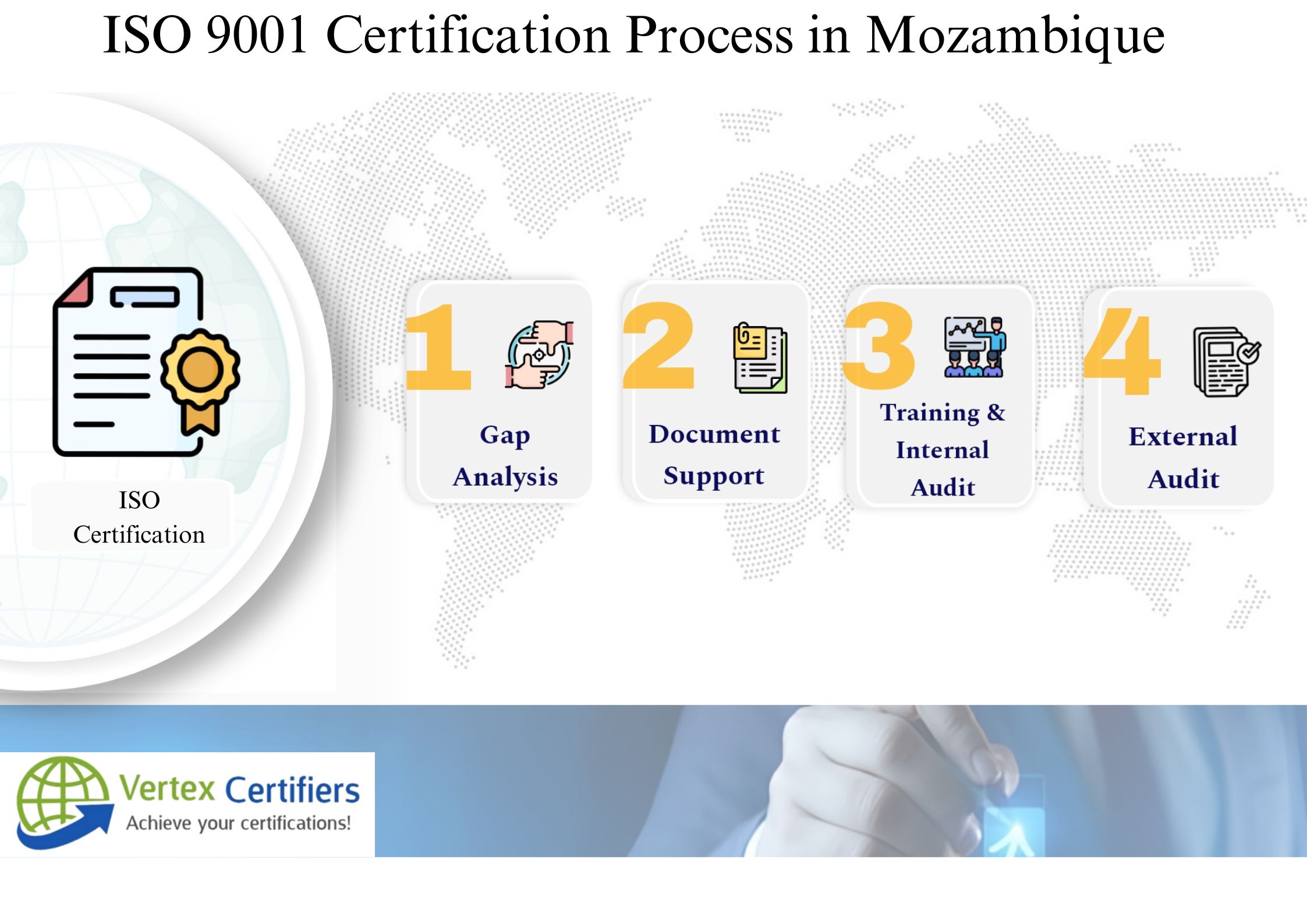
Step 1: Gap Analysis – Assess Current Processes
Start with a thorough audit. Compare your existing QMS against ISO 9001 clauses (e.g., leadership, planning, support). Hire a consultant to identify gaps in 1-2 weeks. Tools like process mapping reveal inefficiencies early.
Step 2: Documentation – Develop Key Materials
Create essential documents: quality policy, objectives, SOPs, and records. Tailor them to Mozambican contexts, like risk assessments for cyclone-prone areas. Use digital tools for easy updates—no need for a massive manual.
Step 3: Implementation – Apply Procedures and Train Staff
Roll out changes across operations. Train employees via workshops (1-2 days per group). Monitor via KPIs like defect rates. Full integration typically takes 4-6 weeks.
Step 4: Internal Audit & Management Review
Conduct an internal audit to verify effectiveness. Hold a management review meeting to address non-conformities. This builds evidence for the external audit.
Step 5: Certification Audit – Engage an Accredited Body
Select a body accredited by IAF or international equivalents. Stage 1 (document review) and Stage 2 (on-site audit & review) occur over 3-5 days. Address minor issues, and receive your certificate.
Our Services
- GMP Certification
- GLP Certification
- GDP Certification
- Halal Certificate
- Organic Certificate
- CE Marking Certification
- RoHS Certification
- FDA Certification
- CMMI Certification
- Cyber Security
- VAPT Testing
- Security Assessment
Benefits of ISO 9001 Certification for Mozambican Companies
Adopting ISO 9001 Certification in Mozambique is not just about documentation—it is a strategic business investment. Organizations across Mozambique report measurable improvements, from stronger operations to easier market access. Below are the key advantages explained simply and practically.
⚙️ Improves Operational Efficiency & Reduces Rework
ISO 9001 requires organizations to map, monitor, and improve their processes. This eliminates duplication, waste, and recurring errors.
Example: A food manufacturing company in Maputo reduced production errors by over 30% after implementing standardized quality controls.
🤝 Builds Customer Confidence & Brand Credibility
ISO 9001 is an internationally recognized mark of quality. Displaying certification on proposals, websites, and marketing materials builds instant trust.
Exporters supplying South Africa and regional markets report faster approvals and smoother negotiations due to ISO-certified credibility.
🏗️ Helps Win Government & International Projects
Many Mozambican public tenders and donor-funded projects prioritize ISO-compliant organizations. Certification strengthens eligibility for infrastructure, logistics, and PPP projects.
ISO 9001 is especially valuable for projects linked to the Nacala Development Corridor and international development agencies.
📋 Ensures Consistent Quality Across Departments & Sites
Standard Operating Procedures (SOPs) ensure that quality is maintained across all locations. This is critical for businesses operating in multiple regions.
Companies with sites in Pemba, Quelimane, and remote operational areas benefit from uniform service delivery and reduced variation.
🌍 Supports Business Growth & Global Expansion
ISO 9001-certified organizations gain easier access to regional and international markets. Certification supports trade under frameworks like AfCFTA and EU partnerships.
For Mozambican SMEs, ISO 9001 acts as a growth accelerator—opening doors to new clients, long-term contracts, and sustainable expansion.
In summary: ISO 9001 Certification in Mozambique helps businesses transform operational challenges into growth opportunities, strengthening resilience in a competitive, post-cyclone recovery economy.
Why Choose Vertex Certifiers?
Vertex Certifiers has supported organizations in 50+ countries, including Mozambique. We provide end-to-end assistance for ISO 9001 Certification in Mozambique— from gap analysis to successful audit completion.
Our experience has helped companies in Maputo and other key cities secure high-value contracts and improve operational excellence.
📧 Email us today: info@vertexcertifiers.com
Get started with ISO 9001 Certification in Mozambique—simple, compliant, and audit-ready.
How to Get ISO 9001 Certification in Mozambique: Step-by-Step Guide
Organizations in Mozambique are increasingly adopting internationally recognized management systems to improve operational performance, strengthen customer confidence, and enhance competitiveness in local and international markets. ISO 9001 Certification provides a structured framework for establishing an effective Quality Management System (QMS) that focuses on customer satisfaction, process efficiency, and continual improvement.
Whether your organization operates in construction, agriculture, mining, logistics, manufacturing, energy, healthcare, or professional services, understanding the certification process can help you achieve ISO 9001 efficiently and effectively.
Who Can Apply for ISO 9001 Certification?
ISO 9001 can be implemented by organizations of any size and sector operating in Mozambique.
- Small and medium-sized enterprises (SMEs)
- Manufacturing companies
- Construction organizations
- Mining and resource companies
- Agricultural businesses
- Healthcare providers
- Educational institutions
- Government agencies
- Service-based organizations
- Multinational corporations
Step 1: Understand ISO 9001 Requirements
The first step involves understanding the requirements of ISO 9001 and evaluating how they apply to your organization. Management commitment is critical for successful implementation.
Key areas include:
- Leadership and commitment
- Risk-based thinking
- Customer focus
- Process management
- Performance evaluation
- Continual improvement
Step 2: Conduct a Gap Analysis
A gap analysis helps identify differences between your current business practices and ISO 9001 requirements.
This assessment enables organizations to:
- Identify strengths and weaknesses
- Determine required improvements
- Establish an implementation plan
- Allocate resources effectively
Step 3: Develop Required Documentation
Organizations should establish documented information necessary for the effective operation of the Quality Management System.
Common ISO 9001 Documents Include:
- Quality Policy
- Quality Objectives
- Process Maps
- Risk and Opportunity Registers
- Operational Procedures
- Work Instructions
- Internal Audit Procedures
- Corrective Action Procedures
- Management Review Records
- Training Records
Step 4: Implement the Quality Management System
After developing the required documentation, organizations should implement the processes throughout the business.
- Communicate responsibilities clearly
- Train employees on relevant procedures
- Monitor process effectiveness
- Maintain records of implementation activities
- Encourage employee participation
Step 5: Conduct Internal Audits
Internal audits help verify whether the Quality Management System conforms to ISO 9001 requirements and organizational objectives.
Audits provide opportunities to:
- Identify nonconformities
- Evaluate process performance
- Recommend improvements
- Prepare for certification audits
Step 6: Perform Management Review
Top management should review the effectiveness of the QMS and ensure adequate resources are available to achieve quality objectives.
Management reviews commonly consider:
- Audit results
- Customer feedback
- Process performance indicators
- Corrective actions
- Opportunities for improvement
Step 7: Certification Audit
The certification body typically conducts the audit in two stages.
Stage 1 Audit
- Review of documented information
- Evaluation of implementation readiness
- Identification of potential concerns
Stage 2 Audit
- Assessment of operational effectiveness
- Verification of conformity with ISO 9001 requirements
- Review of objective evidence
- Identification of improvement opportunities
How Long Does ISO 9001 Certification Take in Mozambique?
The timeline depends on organizational size and complexity. Most organizations complete implementation and certification within:
- 30–45 days for small organizations
- 45–75 days for medium-sized organizations
- 60–120 days for larger or more complex organizations
Factors Affecting ISO 9001 Certification Cost
- Organization size
- Number of employees
- Operational complexity
- Number of sites
- Extent of consulting support required
- Certification body fees
Common Mistakes to Avoid
- Insufficient management involvement
- Overcomplicated documentation
- Inadequate employee training
- Failure to conduct internal audits
- Ignoring corrective actions
- Implementing generic templates without customization
Frequently Asked Questions (FAQs)
Is ISO 9001 Certification mandatory in Mozambique?
No. ISO 9001 certification is generally voluntary, although many customers and procurement processes may prefer certified organizations.
Can small businesses obtain ISO 9001 Certification?
Yes. ISO 9001 is designed to be applicable to organizations of all sizes and sectors.
How often are surveillance audits conducted?
Surveillance audits are generally conducted annually during the three-year certification cycle.
How long is ISO 9001 Certification valid?
ISO 9001 certification is typically valid for three years, subject to successful surveillance audits.
What are the key benefits of ISO 9001?
Improved customer satisfaction, enhanced efficiency, stronger process control, increased credibility, and continual improvement are among the primary benefits.
Need Assistance with ISO 9001 Certification in Mozambique?
Vertex Certifiers provides complete ISO 9001 consulting services including gap analysis, documentation support, implementation assistance, internal audits, employee training, and certification coordination.
Our consultants help organizations establish effective quality management systems aligned with ISO 9001 requirements while supporting efficient certification outcomes.
Email: info@vertexcertifiers.com
