Vertex Certifiers

ISO 19650-1 & ISO 19650-2 Certification for BIM Design Companies – Implementation, Consulting & Certification Services

The construction industry is undergoing a rapid digital transformation, with organizations increasingly adopting Building Information Modeling (BIM) to improve collaboration, enhance project efficiency, and deliver high-quality built assets. As construction projects become more complex and involve multiple stakeholders across different locations, the need for structured and standardized information management has become essential. BIM enables project teams to create, share, and manage intelligent digital models throughout the entire lifecycle of a building or infrastructure asset, helping reduce errors, improve coordination, and support informed decision-making.

The global adoption of BIM has accelerated due to government mandates, client expectations, and the growing demand for digital construction practices. However, implementing BIM effectively requires more than advanced software—it requires standardized processes for creating, managing, sharing, and controlling project information. This is where the ISO 19650 series of standards plays a crucial role by providing an internationally recognized framework for information management using BIM throughout the lifecycle of built assets, from initial planning and design to construction, operation, maintenance, and eventual decommissioning.

Vertex Certifiers is an international ISO consulting company providing end-to-end ISO 19650-1 and ISO 19650-2 consulting, implementation, training, documentation, internal audit, and certification support services for BIM design companies, architecture firms, engineering consultants, construction organizations, and infrastructure developers. Our experienced consultants help organizations establish efficient BIM information management systems that align with international best practices and support successful certification.

What is Building Information Modeling (BIM)?

Building Information Modeling (BIM) is a collaborative digital process that enables project stakeholders to create, manage, and exchange intelligent information about buildings and infrastructure throughout their entire lifecycle. Unlike traditional 2D drawings, BIM integrates graphical models with structured project data, allowing architects, engineers, contractors, and facility managers to work from a shared and coordinated source of information.

A BIM model contains much more than visual representations of a project. It includes technical specifications, material properties, dimensions, scheduling information, cost data, maintenance requirements, and operational details. Because all stakeholders work with the same information, BIM improves communication, minimizes design conflicts, reduces costly rework, and enhances overall project quality.

BIM supports every stage of the asset lifecycle, including planning, conceptual design, detailed engineering, procurement, construction, commissioning, operation, maintenance, renovation, and eventual asset disposal. The use of intelligent digital models enables organizations to make informed decisions, optimize project performance, and improve long-term asset management.

Today, BIM is widely adopted across numerous industries, including:

  • Architecture and architectural design firms
  • Civil, structural, and MEP engineering consultants
  • Construction companies and EPC contractors
  • Infrastructure and transportation projects
  • Oil & Gas facilities
  • Railway and metro projects
  • Airport development projects
  • Healthcare and hospital construction
  • Industrial and manufacturing facilities
  • Commercial and residential real estate developments
  • Facility management organizations

What is ISO 19650?

ISO 19650 is an internationally recognized series of standards that establishes best practices for managing information throughout the lifecycle of built assets using Building Information Modeling (BIM). The standard provides organizations with a structured framework for creating, organizing, sharing, storing, and controlling project information in a consistent and collaborative manner.

The primary objective of ISO 19650 is to ensure that the right information is available to the right people at the right time throughout a project’s lifecycle. By defining standardized processes, responsibilities, naming conventions, and information exchange requirements, ISO 19650 improves collaboration among project participants while reducing information loss, duplication, and project risks.

Based on internationally accepted BIM principles, ISO 19650 promotes effective information management through the use of a Common Data Environment (CDE), enabling all project stakeholders to work with accurate, up-to-date, and controlled information. This approach supports better coordination between designers, engineers, contractors, clients, and facility managers, resulting in improved project outcomes and more efficient asset management.

Procedure to get ISO 19650-1 & ISO 19650-2 Certification for BIM Design Companies

Implementing ISO 19650 requires organizations to establish structured information management processes that align with the requirements of the standard while integrating them into existing BIM workflows. A systematic implementation approach ensures consistent adoption across projects and supports successful certification.
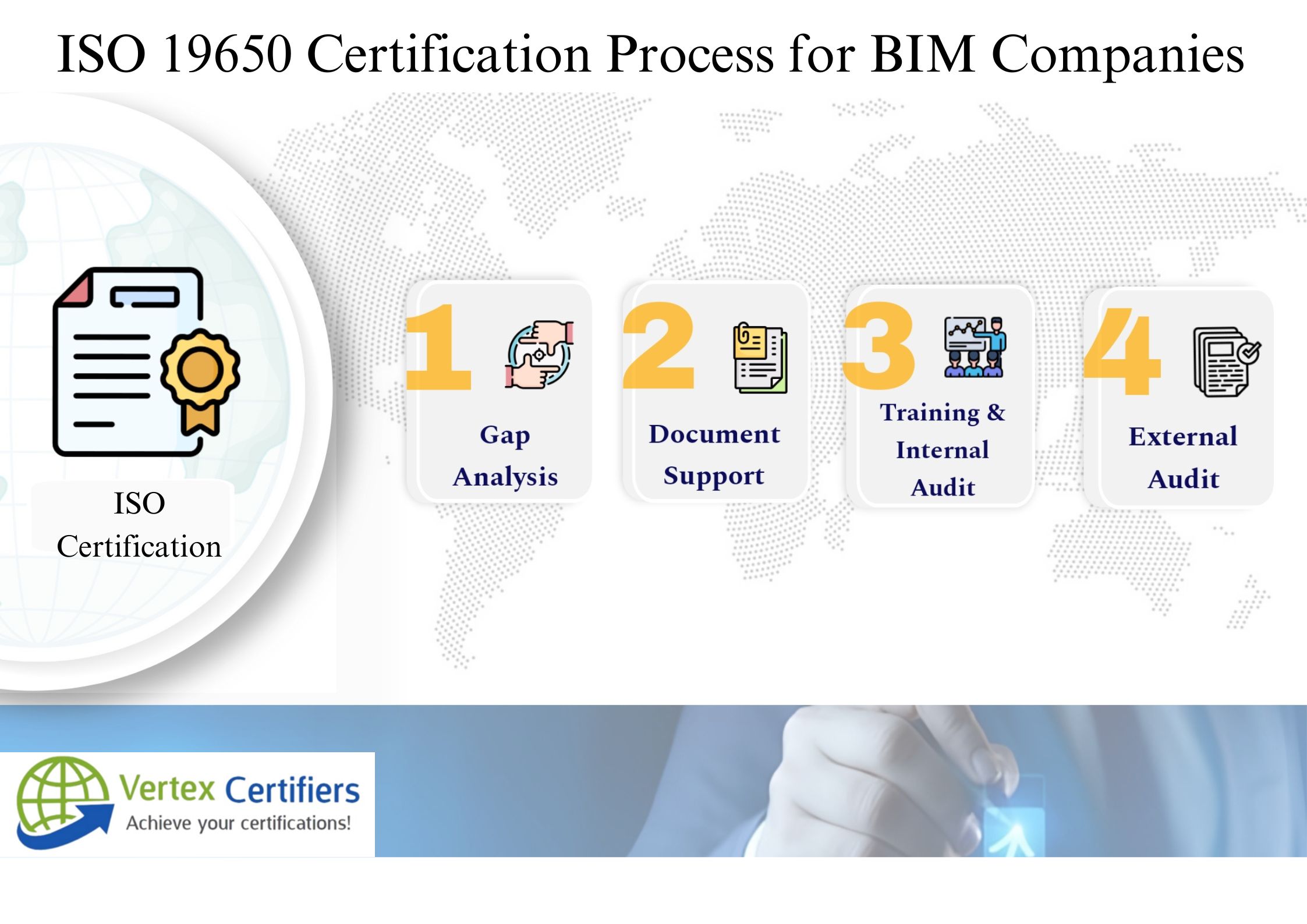
ISO 19650-1 & ISO 19650-2 Certification for BIM Design Companies

1. Gap Analysis

The implementation process begins with a comprehensive assessment of the organization’s existing BIM practices, information management procedures, documentation, and digital workflows. The gap analysis identifies areas that already comply with ISO 19650 requirements and highlights opportunities for improvement.

2. Awareness and Training

Management, BIM managers, project teams, architects, engineers, and other stakeholders receive training on ISO 19650 requirements, information management principles, roles and responsibilities, Common Data Environment (CDE), and best practices for BIM collaboration.

3. Information Assessment

The organization evaluates its current methods for creating, storing, exchanging, approving, and maintaining project information. Information requirements, project data structures, naming conventions, document controls, and workflow processes are reviewed to ensure alignment with ISO 19650.

4. Documentation Development

Required policies, procedures, templates, information management plans, document control procedures, naming conventions, and supporting documentation are developed or updated to comply with ISO 19650-1 and ISO 19650-2 requirements.

5. Process Development

Standardized workflows are established for information creation, review, approval, sharing, version control, issue management, collaboration, and information delivery throughout the project lifecycle. Clear roles and responsibilities are assigned to all project participants.

6. Common Data Environment (CDE) Setup

A structured Common Data Environment is established to enable secure information sharing, document control, version management, approval workflows, and collaborative access for authorized stakeholders. The CDE becomes the central source of project information throughout the asset lifecycle.

7. System Implementation

The documented information management processes are implemented across ongoing and future BIM projects. Project teams begin applying standardized procedures for information production, coordination, communication, and document management while monitoring effectiveness and identifying opportunities for continual improvement.

8. Internal Audit

Internal audits are conducted to verify that ISO 19650 processes are consistently implemented and effectively maintained. Any identified nonconformities are addressed through corrective actions before proceeding to certification.

9. Management Review

Top management evaluates the effectiveness of the information management system, reviews audit findings, assesses organizational performance, allocates necessary resources, and identifies opportunities for continual improvement.

10. Certification Audit Support

Vertex Certifiers provides complete support throughout the certification process by coordinating with the selected certification body, assisting with audit preparation, reviewing documentation, supporting audit interviews, and helping resolve any observations raised during the certification audit.

11. ISO 19650 Certification

After successfully completing the certification audit and demonstrating compliance with the requirements of ISO 19650, the organization receives certification, demonstrating its capability to manage BIM information effectively in accordance with internationally recognized best practices. Certification enhances credibility, improves client confidence, supports participation in international projects, and strengthens the organization’s competitive position in the digital construction industry.

    Get Free
    Consultation


    Our Services

    Understanding ISO 19650-1 and ISO 19650-2 | Vertex Certifiers

    Understanding ISO 19650-1 and ISO 19650-2

    ISO 19650 is an international series of standards for managing information over the whole life cycle of a built asset using Building Information Modelling (BIM). ISO 19650-1 and ISO 19650-2 provide a structured framework for how project and asset information should be defined, created, checked, approved, stored, and exchanged within a Common Data Environment (CDE).

    Understanding ISO 19650-1

    ISO 19650-1 sets out the concepts and principles for information management using BIM across the life cycle of built assets. It is high-level and foundational, explaining why structured information management is needed and how organizations should think about information requirements, responsibilities, and processes.

    Concepts and principles

    ISO 19650-1 defines the fundamental concepts of information management such as information containers, information requirements, information delivery milestones, and the use of a Common Data Environment. It explains how information should support decision-making during design, construction, handover, and operation and how standardized processes help reduce risk, ambiguity, and duplication.

    Information management

    The standard describes an overarching information management process that applies to both projects and assets. It emphasizes planning information needs, defining responsibilities for information production, and controlling information quality. It also clarifies the relationship between project information and asset information and how both must be coordinated.

    Common Data Environment (CDE)

    ISO 19650-1 introduces the Common Data Environment as the central digital space where all project and asset information is collected, managed, and shared. The CDE supports workflows for creating, reviewing, approving, and publishing information. It helps ensure that all stakeholders are working from the latest, verified information and reduces inconsistencies.

    Project information

    Project information refers to all data generated during the planning, design, construction, and delivery phases of a project. This includes models, drawings, schedules, reports, specifications, and documentation needed to build and commission the asset. ISO 19650-1 defines how this project information should be aligned with information requirements and structured for effective use.

    Asset information

    Asset information is the data needed to operate, maintain, and manage the built asset after handover. It includes operation manuals, maintenance schedules, performance data, and as-built models. ISO 19650-1 clarifies how asset information relates to project information and highlights the importance of planning asset information needs early in the project.

    Roles and responsibilities

    The standard identifies typical roles involved in information management, such as appointing party, lead appointed party, and task teams. Each role has specific responsibilities for defining information requirements, producing information, checking quality, and delivering information to the CDE. Clear roles help ensure accountability and avoid confusion during BIM workflows.

    Information requirements

    ISO 19650-1 explains different levels of information requirements, such as organizational information requirements, asset information requirements, and project information requirements. These requirements specify what information is needed, when it is needed, and for what purpose, enabling more efficient information production and reducing unnecessary data.

    Understanding ISO 19650-2

    ISO 19650-2 focuses on the delivery phase of assets. It describes how information should be managed during the planning, design, construction, and handover stages of projects and gives more detailed guidance on processes, activities, and responsibilities for information production and exchange.

    Delivery phase

    The delivery phase covers the period from project initiation to handover of the completed asset. ISO 19650-2 provides a step-by-step framework for managing information throughout this phase, aligned with project milestones, appointments, and contractual arrangements.

    Planning

    During planning, information management requirements are defined and documented. The appointing party sets out information requirements, assigns responsibilities, and defines the information management approach. ISO 19650-2 explains how to plan information delivery, specify information models, and establish procedures before design and construction activities begin.

    Design

    In the design stage, project participants produce coordinated information models, drawings, and documents in line with the agreed information requirements. ISO 19650-2 describes how design information should be structured, reviewed, and approved through the CDE, including design coordination, clash detection, and progressive detail development.

    Construction

    During construction, information models and documentation are updated to reflect actual site conditions and construction progress. The standard explains how construction information should be managed, including updates to models, records of changes, and documentation for quality control, commissioning, and handover.

    Tender and appointments

    ISO 19650-2 covers how information requirements should be included in tender documentation and how responsibilities for information management are allocated in contracts and appointments. It ensures that bidders understand information expectations and that appointed parties agree to follow defined information processes.

    Information production

    The standard sets out workflows for production, review, coordination, and approval of information. It clarifies how task teams create information, how lead appointed parties coordinate it, and how information is checked before publication. This improves consistency, reduces errors, and supports reliable project decision-making.

    Project delivery and information exchange

    ISO 19650-2 emphasizes structured information exchange at defined project milestones. Information must be delivered in agreed formats, levels of information need, and at the right times to enable client decisions, regulatory approvals, and smooth handover. The standard ensures that information exchange supports project delivery outcomes and future asset management.

    Difference between ISO 19650-1 and ISO 19650-2

    ISO 19650-1 and ISO 19650-2 are closely related, but they serve different purposes. ISO 19650-1 focuses on concepts and principles for information management, while ISO 19650-2 provides more detailed guidance for the delivery phase of projects.

    AspectISO 19650-1ISO 19650-2
    Main focusConcepts, principles, and overall framework for information management using BIM.Information management processes during the delivery phase of assets.
    Concepts vs. deliveryDefines core concepts such as information requirements, CDE, project and asset information.Describes how information is planned, produced, coordinated, and delivered in projects.
    Principles vs. implementationHigh-level principles for structured information management and roles.Implementation-oriented guidance for project execution activities and workflows.
    Framework vs. project executionProvides a general framework that applies to project and asset life cycles.Focuses on project execution, appointments, tender requirements, and delivery milestones.
    Information requirementsExplains organizational, asset, and project information requirements in concept.Translates information requirements into specific information deliverables and exchanges.
    Information deliverySets the context for why structured information delivery is needed.Specifies how information should be delivered, approved, and exchanged throughout the delivery phase.

    Why BIM design companies need ISO 19650 Certification

    ISO 19650 Certification helps BIM design companies demonstrate that they manage project and asset information in a controlled, standardized way. This certification becomes a key differentiator when working on complex, multi-stakeholder projects.

    • Competitive advantage – Companies with ISO 19650 Certification can stand out from competitors by proving mature information management and BIM practices.
    • International projects – ISO 19650 is recognized internationally, helping BIM firms qualify for global projects where standardized information processes are expected.
    • Government tenders – Many public sector clients and government projects increasingly require or prefer ISO-based information management frameworks.
    • Client confidence – Certification increases client trust that models, documents, and data will be managed consistently and securely.
    • Reduced project risk – Better information control reduces errors, miscommunication, and disputes arising from inconsistent or outdated information.
    • Better collaboration – Standardized workflows and a well-managed CDE enable smoother collaboration between architects, engineers, contractors, and clients.
    • Digital transformation – ISO 19650 supports a structured digital approach to design, documentation, and asset data, aligning with wider digital construction strategies.
    • Efficient documentation – Naming rules, version control, and approval workflows lead to more efficient document management and fewer errors.
    • Higher productivity – When information is well organized, teams spend less time searching, redoing, or clarifying documents and models.

    Which organizations should implement ISO 19650?

    ISO 19650 is applicable to a wide range of organizations involved in the design, construction, and operation of built assets, especially those using BIM and digital models.

    • Architecture firms
    • Structural consultants
    • MEP consultants
    • Interior designers
    • Infrastructure consultants
    • Construction companies
    • General contractors
    • Project management consultants
    • Real estate developers
    • Facility management companies
    • Government organizations
    • Engineering consultants
    • Railway projects
    • Airport projects
    • Industrial projects
    • Oil & Gas EPC companies

    Key requirements of ISO 19650

    ISO 19650 defines a set of requirements for information management that organizations must implement in their BIM and project workflows.

    • Information requirements – Clear definition of organizational, asset, and project information requirements, including what information is needed and at which milestones.
    • Project Information Model (PIM) – A structured project information model that captures design, construction, and commissioning data in line with agreed requirements.
    • Asset Information Model (AIM) – A model capturing all information required for operation and maintenance of the built asset after handover.
    • Common Data Environment (CDE) – A central platform where information is stored, managed, and shared, with defined states (work-in-progress, shared, published, and archived).
    • Naming conventions – Standard naming rules for files, models, drawings, and information containers so stakeholders can quickly identify content.
    • Version control – Clear versioning of documents and models to avoid confusion over which information is current.
    • Approval workflow – Controlled workflows for review, approval, and authorization before information is published to the CDE.
    • Information security – Measures to protect information integrity, confidentiality, and access rights within the CDE.
    • Collaboration – Processes for multi-disciplinary collaboration, coordination, clash resolution, and information sharing.
    • Document control – Defined procedures for issuing, revising, archiving, and retrieving documents and records.
    • Responsibilities – Clear allocation of responsibilities across appointing party, lead appointed parties, and task teams for information production and management.

    Benefits of ISO 19650 Certification

    Organizations that implement ISO 19650 and obtain certification gain tangible benefits in project performance, collaboration, and business development.

    • Better project coordination
    • Reduced rework and fewer information-related errors
    • Faster approvals due to structured information workflows
    • Improved document and model management
    • Enhanced collaboration between disciplines and stakeholders
    • Lower project risks caused by misaligned or missing information
    • Compliance with internationally recognized information management standards
    • Support for digital construction and BIM-based delivery methods
    • Higher customer confidence in information reliability
    • More business opportunities, especially for complex and international projects
    • Global recognition of information management capability

    Common challenges during ISO 19650 implementation

    Implementing ISO 19650 can be challenging if organizations are new to structured BIM processes and digital information management.

    • Resistance to change from teams used to informal document practices.
    • Lack of established BIM standards or guidelines within the organization.
    • Poor document control and scattered information storage.
    • Inconsistent naming conventions across projects and departments.
    • Limited training and awareness about ISO 19650 requirements and workflows.
    • Use of multiple software platforms without clear integration strategies.
    • Information duplication in different systems or folders.
    • Communication issues between disciplines and external stakeholders.

    Why choose Vertex Certifiers for ISO 19650?

    Vertex Certifiers helps organizations implement ISO 19650 in a practical, project-focused way, aligning information management with real BIM and construction workflows.

    • International consulting company with experience in BIM and ISO standards.
    • Experienced BIM consultants who understand design, engineering, and construction environments.
    • ISO Lead Auditors capable of conducting gap assessments and internal audits.
    • End-to-end implementation support from initial assessment to certification readiness.
    • Documentation support for information management procedures, naming rules, workflows, and CDE usage.
    • Training programs for management, BIM coordinators, engineers, and document controllers.
    • Internal audits to verify compliance and identify improvement areas.
    • Certification coordination with recognized certification bodies.
    • Support across multiple countries and regions for organizations with international operations.
    • Cost-effective consulting focused on practical implementation rather than excessive paperwork.

    Frequently asked questions (FAQ) – ISO 19650

    1. What is ISO 19650 Certification?

    ISO 19650 Certification is a formal recognition that an organization’s information management processes for BIM and construction projects comply with ISO 19650 requirements. It demonstrates that information is planned, produced, controlled, and exchanged using a consistent and standardized framework.

    2. Is ISO 19650 mandatory?

    ISO 19650 is generally not legally mandatory. However, many clients, government bodies, and international projects strongly prefer or require ISO 19650-based information management for BIM-enabled projects, especially where collaboration and complex assets are involved.

    3. Who should obtain ISO 19650 Certification?

    Architecture firms, engineering consultants, contractors, BIM design companies, project management consultants, developers, and facility management organizations involved in BIM and digital project delivery can benefit from ISO 19650 Certification.

    4. What is the difference between ISO 19650-1 and ISO 19650-2?

    ISO 19650-1 focuses on concepts and principles of information management using BIM across the asset life cycle. ISO 19650-2 focuses on processes and responsibilities for information management during the delivery phase of projects, including planning, design, construction, and handover.

    5. How long does ISO 19650 implementation take?

    Implementation time depends on the size of the organization, current level of BIM maturity, number of projects, and complexity of existing processes. Some organizations may implement ISO 19650 in a few months, while larger or multi-country operations may take longer.

    6. What documents are required for ISO 19650 Certification?

    Typical documents include information management procedures, CDE usage guidelines, naming conventions, version control rules, information delivery plans, role descriptions, responsibility matrices, and evidence of implementation on live projects.

    7. Does ISO 19650 apply to small BIM firms?

    Yes. ISO 19650 can be scaled for small BIM and design firms. The standard does not require large teams; it requires clear processes and responsibilities, which can be tailored for smaller organizations.

    8. Can engineering consultants get ISO 19650 certified?

    Yes. Structural, MEP, civil, and multi-disciplinary engineering consultants involved in BIM design and coordination can implement ISO 19650 and obtain certification.

    9. Is ISO 19650 applicable outside construction?

    ISO 19650 is focused on built assets and construction-related projects. However, the principles of structured information management and BIM-based modeling can be useful for other infrastructure and industrial sectors where assets are designed, built, and operated.

    10. What software is required for ISO 19650?

    ISO 19650 does not dictate specific software. Organizations typically use BIM authoring tools (e.g., for models), CDE platforms, and document management systems. The key requirement is that chosen tools support structured information workflows and CDE principles.

    11. What is a Common Data Environment (CDE)?

    A Common Data Environment is the central digital workspace where project and asset information is stored, managed, and shared. It includes controlled states for work-in-progress, shared, published, and archived information and supports workflows for review and approval.

    12. How much does ISO 19650 Certification cost?

    Cost depends on organization size, number of locations, project volume, current BIM maturity, and support required for implementation and audits. Consultancy and certification bodies provide quotations based on scope and complexity.

    13. How often is ISO 19650 Certification renewed?

    Certification is typically subject to periodic surveillance audits and renewal cycles (for example, every three years) depending on the certification body’s rules. Organizations must maintain and continually improve their information management processes.

    14. Can ISO 19650 be integrated with ISO 9001?

    Yes. ISO 19650 can be integrated with ISO 9001 Quality Management Systems, as both standards deal with process control, documentation, and continual improvement. Integration helps align information management with overall quality management.

    Ready to Implement ISO 19650 for Your BIM Design Company?

    Whether you're an architecture firm, engineering consultant, BIM service provider, or construction company, Vertex Certifiers can help you establish an effective ISO 19650 Information Management System. Our experts provide complete consulting support—from gap analysis and documentation to implementation, training, internal audits, and certification assistance—ensuring your organization meets international BIM best practices.

    ✔ Experienced ISO 19650 Consultants
    ✔ End-to-End Implementation Support
    ✔ Documentation & Internal Audits
    ✔ Global Certification Assistance
    Request a Free Consultation Get a Free Quote

    Vertex Certifiers has successfully assisted organizations across multiple countries with ISO implementation, training, internal audits, and certification support for internationally recognized management system standards.

      Company Logo

      Get ISO certification


      Fill the details below, one of our executives will contact you shortly


      This will close in 0 seconds

      Call Now Button