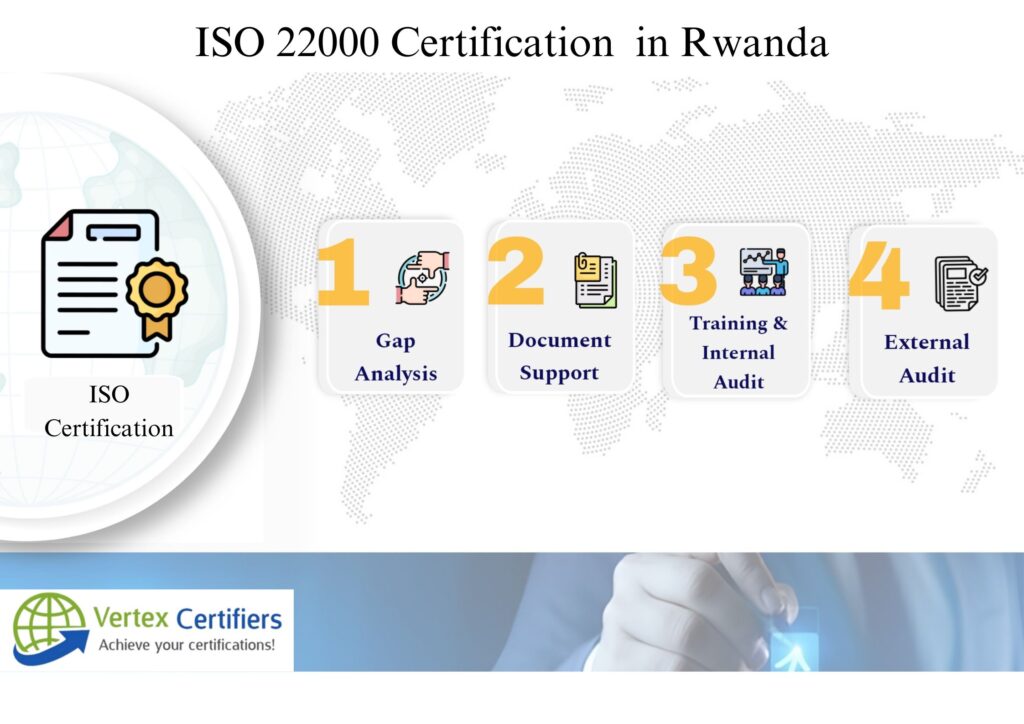
ISO 22000 Certification in Rwanda
ISO 22000 certification in Rwanda helps organizations establish, implement, maintain and continually improve a Food Safety Management System (FSMS). The standard provides a structured approach for identifying food-safety hazards, controlling risks and demonstrating the ability to supply safe food consistently.
ISO 22000:2018 is intended for organizations of different sizes and complexities throughout the food chain, including farms, manufacturers, food-service businesses, retailers, transport operators, packaging suppliers and animal-feed producers. Certification is voluntary unless a customer, contract, regulator or market-access requirement makes it necessary. ISO confirms that the standard applies to organizations across the food chain.
[iso](https://www.iso.org/standard/65464.html)
Who Can Get ISO 22000 Certification in Rwanda?
ISO 22000 can be implemented by small, medium-sized and large organizations involved directly or indirectly in the food chain. Its requirements can be adapted to an organization’s products, processes, locations, risks and operational complexity.
- Farms and agricultural producers: Farms can use ISO 22000 to control food-safety risks associated with soil, water, fertilizers, pesticides, harvesting, animal health and post-harvest handling.
- Food manufacturers: Manufacturers can establish controls for raw materials, production processes, equipment, personnel hygiene, storage and finished products.
- Food processors: Processing companies can identify hazards introduced during washing, cutting, cooking, drying, freezing, fermentation or other production activities.
- Beverage manufacturers: Beverage producers can control risks related to water quality, ingredients, processing, filling, packaging and storage.
- Dairy businesses: Dairy farms, milk collection centres and dairy processors can manage risks associated with raw milk, pasteurization, contamination and cold-chain control.
- Meat and poultry processors: Meat and poultry businesses can control biological, chemical and physical hazards during slaughtering, cutting, processing, chilling, freezing and distribution.
- Fish and seafood businesses: Fishers, seafood processors and distributors can address contamination, temperature control, handling, packaging and traceability risks.
- Coffee and tea processors: Coffee and tea businesses can apply controls to harvesting, drying, sorting, processing, storage, packaging and export preparation.
- Bakeries: Bakeries can manage allergens, microbiological hazards, foreign materials, ingredient control, hygiene and baking processes.
- Catering companies: Caterers can control purchasing, food preparation, cooking, transportation, service and temperature management.
- Hotels and restaurants: Hotels and restaurants can use an FSMS to control food handling, kitchen hygiene, supplier management, storage and customer service operations.
- Food retailers: Supermarkets, grocery stores and other retailers can manage receiving, storage, display, temperature control and product withdrawal.
- Food warehouses: Storage facilities can control segregation, pest management, stock rotation, temperature, hygiene and traceability.
- Transportation and distribution companies: Logistics providers can manage vehicle hygiene, temperature control, loading, unloading, delivery conditions and product information.
- Packaging suppliers: Food-packaging manufacturers can control materials, hygiene, product conformity, contamination risks and communication with food businesses.
- Animal-feed businesses: Feed manufacturers and suppliers can manage hazards that may affect animal health, food-producing animals and the wider food chain.
ISO 22000 is therefore suitable for organizations operating at primary production, processing, packaging, storage, transport, distribution, food service, retail and feed-production stages.
Why Is ISO 22000 Certification Important in Rwanda?
Improve Food Safety
ISO 22000 helps organizations identify and control biological, chemical and physical food-safety hazards. Controls may address microorganisms, allergens, chemical residues, cleaning agents, pesticides, glass, metal, stones and other foreign materials.
The FSMS connects preventive controls, operational procedures, monitoring and corrective action so that food-safety risks are addressed before unsafe products reach consumers.
Reduce Food Safety Risks
Organizations use ISO 22000 to systematically identify hazards, assess their significance and establish appropriate control measures throughout food-related processes. This includes raw-material purchasing, production, storage, transportation, preparation and delivery.
Rather than relying only on final-product inspection, the organization controls risks at the points where they may arise. This preventive approach can reduce contamination, process failures, product complaints and costly withdrawals.
Meet Customer and Regulatory Requirements
An FSMS helps a business demonstrate that food-safety requirements are being identified, implemented, monitored and reviewed. Documented procedures and records provide evidence that the organization is systematically addressing its responsibilities.
ISO 22000 does not replace applicable Rwandan laws, regulations or customer specifications. Instead, it provides a management framework for incorporating those requirements into business processes.
Improve Customer Confidence
Certification can demonstrate an organization’s commitment to consistent food safety and responsible operations. Customers, distributors, retailers and business partners may view a certified FSMS as evidence that food-safety responsibilities are managed through a structured and independently assessed system.
Support Market Expansion and Exports
An internationally recognized food-safety system can support organizations supplying regional, continental and international markets. RSB notes that food standards and certification can contribute to access to local, regional, continental and international markets.
Certification cannot guarantee export approval because each destination market has its own legal and contractual requirements. However, an ISO 22000-based FSMS can make it easier to demonstrate process control, traceability and food-safety capability to prospective buyers.
Improve Operational Control
ISO 22000 can help Rwandan businesses achieve:
- Better process control.
- Improved traceability.
- Reduced contamination risks.
- Better documentation and recordkeeping.
- Clearer responsibilities and communication.
- More effective supplier control.
- Continual improvement based on monitoring and audit results.
Key Requirements of ISO 22000 in Rwanda
ISO 22000:2018 follows a management-system approach. The practical requirements below summarize the main areas organizations should address without reproducing every clause of the standard.
Context of the Organization
- Understand internal and external issues that may affect food safety.
- Identify interested parties such as regulators, customers, suppliers, employees and consumers.
- Determine relevant food-safety requirements.
- Define the scope of the FSMS, including products, processes, locations and activities.
Leadership and Food Safety Policy
- Demonstrate management commitment to food safety.
- Establish and communicate a suitable food-safety policy.
- Assign roles, responsibilities and authorities.
- Appoint a food-safety team and team leader where appropriate.
- Ensure food safety is integrated into business operations.
Planning and Risk Management
- Identify food-safety hazards associated with products and processes.
- Assess the significance of identified hazards.
- Establish food-safety objectives.
- Plan actions to address risks and opportunities.
- Control planned changes that may affect food safety.
Support and Resources
- Provide competent employees and suitable staffing.
- Conduct training and maintain awareness of food-safety responsibilities.
- Establish internal and external communication processes.
- Control documented information and records.
- Maintain appropriate infrastructure, equipment and working conditions.
- Provide resources for monitoring, measurement and verification.
Operational Control
Operational controls may include:
- Good hygiene practices.
- Prerequisite programmes (PRPs).
- Product and process descriptions.
- Process-flow diagrams.
- Hazard analysis.
- Operational control measures.
- Critical control points and critical limits.
- Monitoring and verification activities.
- Calibration and control of monitoring equipment.
- Traceability from incoming materials to delivery.
- Emergency preparedness and response.
- Control of nonconforming products.
- Product withdrawal and recall procedures.
Performance Evaluation and Improvement
- Monitor and measure relevant food-safety processes.
- Conduct internal audits.
- Review FSMS performance during management review meetings.
- Investigate nonconformities and implement corrective actions.
- Update the FSMS when products, processes, hazards or requirements change.
- Continually improve the suitability and effectiveness of the system.
ISO 22000 Certification Process in Rwanda
Implementation and certification are related but separate activities. An organization first establishes and operates its FSMS; an independent certification body then evaluates whether the system conforms to ISO 22000 requirements.
- Select an appropriate certification body: Choose a competent and suitably accredited certification body whose scope covers the organization’s activities.
- Submit an application: Provide information about the organization, products, processes, locations, employees and proposed certification scope.
- Conduct a Stage 1 audit: The auditor reviews the FSMS documentation, scope, readiness, site conditions and preparedness for the main audit.
- Conduct a Stage 2 audit: The certification body assesses whether the FSMS has been implemented effectively and whether operational controls work in practice.
- Address nonconformities: The organization investigates findings, identifies root causes and submits corrective-action evidence within the required timeframe.
- Certification decision: The certification body reviews the audit results and corrective actions before making an independent certification decision.
- Receive the certificate: If certification is approved, the organization receives an ISO 22000 certificate covering the agreed scope.
- Maintain the system: Surveillance audits, internal audits, management reviews, monitoring and continual improvement help maintain certification.
Rwanda has an established food-safety certification framework. RSB identifies ISO 22000:2018 as a system-certification standard for organizations implementing an FSMS, and its certification activities include food-safety management system certification. Learn more about RSB system certification schemes.
[rsb.gov](https://www.rsb.gov.rw/certifications/system-certification/system-certification-schemes)
Documents Required for ISO 22000 Certification
The exact documentation depends on the organization’s size, activities, products, processes, risks and number of locations. A practical ISO 22000 documentation set may include:
- FSMS scope.
- Food-safety policy.
- Food-safety objectives.
- Organizational chart and responsibilities.
- Process information and process-flow diagrams.
- Product descriptions and intended use.
- Hazard analysis.
- HACCP plan.
- Prerequisite programme documentation.
- Operational prerequisite programme controls.
- Critical control point monitoring records.
- Traceability records.
- Training and competence records.
- Supplier evaluation and approval records.
- Cleaning, sanitation and pest-control records.
- Internal audit reports.
- Management review records.
- Corrective-action records.
- Emergency preparedness and response records.
- Nonconforming-product records.
- Product withdrawal and recall records.
- Verification and validation records.
Documentation should be proportionate to actual risks. Creating unnecessary procedures can make the system difficult to operate, while inadequate documentation may make it difficult to demonstrate effective control.
ISO 22000 and HACCP in Rwanda – What Is the Difference?
| ISO 22000 | HACCP |
|---|
| Complete Food Safety Management System. | Food-safety hazard-control methodology. |
| Includes management-system requirements. | Primarily focuses on hazard analysis and critical control points. |
| Covers leadership, planning, communication, resources, evaluation and improvement. | Focuses mainly on food-safety hazards and control measures. |
| Suitable for organizations throughout the food chain. | Can be implemented as a food-safety control system. |
| Can be assessed and certified by an independent certification body. | Can form part of a broader FSMS. |
HACCP is an important part of food-safety control, but ISO 22000 adds broader management-system elements such as leadership, communication, documented information, internal audits, management review and continual improvement.
Rwanda also has RS 184:2023, which specifies requirements for a food-safety system based on HACCP. The Rwandan standard applies to food-handling organizations regardless of size, including feed producers, farmers, ingredient producers and food manufacturers. View the RSB HACCP standard document.
[rsb.gov](https://www.rsb.gov.rw/fileadmin/Standard_Publications/Standards_for_public_review/DRS_184_2023.pdf)
ISO 22000 Certification Cost in Rwanda
There is no single fixed ISO 22000 certification cost in Rwanda. The final cost depends on the work required to implement the FSMS and the audit time determined by the certification body.
Factors Affecting ISO 22000 Cost
- Organization size.
- Number of employees.
- Number of locations and sites.
- Complexity of food processes.
- Number and diversity of products.
- Scope of certification.
- Existing food-safety systems and procedures.
- Level of documentation required.
- Training and competence requirements.
- Certification-body audit days.
- Laboratory testing, technical resources or infrastructure improvements where required.
- Need for consultancy or implementation support.
How to Reduce ISO 22000 Implementation Costs
- Conduct a proper gap analysis before beginning implementation.
- Use existing processes and records where they already meet requirements.
- Avoid unnecessary documentation and focus on effective controls.
- Train internal employees to manage routine FSMS activities.
- Implement controls according to actual food-safety risks.
- Prepare thoroughly before the certification audit to reduce avoidable findings.
How Long Does ISO 22000 Certification Take in Rwanda?
ISO 22000 implementation time varies from one organization to another. Smaller organizations with established hygiene, HACCP and traceability practices may complete implementation faster than complex manufacturers or multi-site businesses.
The timeline is influenced by:
- Organization size.
- Existing food-safety practices.
- Complexity of operations.
- Number of employees.
- Number of sites.
- Documentation requirements.
- Availability of management and employee resources.
- Time needed to operate the system and generate objective records.
- Availability of the selected certification body.
A practical project may take several weeks or several months. A reliable timeline should be prepared after a gap assessment rather than promised as a fixed period.
ISO 22000 Certification for Different Industries in Rwanda
ISO 22000 for Food Manufacturing
Food manufacturers can use ISO 22000 to control raw materials, production lines, sanitation, allergens, foreign materials, process parameters, packaging and finished-product release.
ISO 22000 for Agriculture and Farming
Farms and agricultural producers can manage risks related to water, soil, fertilizers, pesticides, animal health, harvesting, worker hygiene and post-harvest handling.
ISO 22000 for Dairy and Meat Processing
Dairy and meat businesses can establish controls for raw-material reception, temperature, microbiological hazards, cleaning, processing, cold storage, traceability and product withdrawal.
ISO 22000 for Coffee and Tea Businesses
Coffee and tea processors can apply an FSMS to harvesting, drying, sorting, processing, moisture control, storage, packaging and shipment to domestic or export customers.
ISO 22000 for Food and Beverage Companies
Food and beverage companies can integrate supplier approval, water control, production hygiene, hazard analysis, process monitoring, packaging and customer communication into one FSMS.
ISO 22000 for Hotels, Restaurants and Catering
Hotels, restaurants and catering companies can manage food purchasing, receiving, preparation, cooking, holding, serving, cleaning, employee hygiene and customer-related food-safety risks.
ISO 22000 for Food Storage and Distribution
Warehouses, transport companies and distributors can control temperature, hygiene, stock rotation, segregation, loading, unloading, product information and traceability.
ISO 22000 for Animal Feed Businesses
Animal-feed producers and suppliers can use ISO 22000 to control ingredients, contamination, formulation, processing, storage, transport and communication across the feed and food chain.
RSB specifically identifies ISO 22000 among the applicable standards for agriculture, agro-processing and animal-feed value chains.
[rsb.gov](https://www.rsb.gov.rw/updates/news-detail/18-hotels-and-enterprises-have-been-certified-in-rwanda-food-safety-consultants-and-young-professionals-trained-to-boost-food-trade-1)
ISO 22000 Certification in Kigali and Other Cities in Rwanda
Organizations across Rwanda can implement ISO 22000 regardless of whether they operate in Kigali or another commercial, industrial or agricultural centre. Certification support may be relevant to businesses in:
- Kigali.
- Huye.
- Musanze.
- Rubavu.
- Muhanga.
- Rusizi.
- Nyagatare.
- Rwamagana.
- Karongi.
The FSMS scope should identify the actual locations and activities covered. A business operating outside Kigali can establish the same structured food-safety controls while adapting implementation to its products, infrastructure, suppliers and local operating conditions.
ISO 22000 Certification with Vertex Certifiers
Vertex Certifiers helps organizations in Rwanda understand ISO 22000 requirements and establish a practical FSMS suited to their operations. Support may include gap analysis, documentation development, food-safety risk assessment, HACCP and FSMS implementation, employee training, internal audits, management review support, certification-audit preparation and assistance during the certification process. The focus is on developing controls that employees can operate consistently, rather than creating documentation disconnected from day-to-day food-safety activities.
Email Vertex Certifiers
Contact Us for ISO 22000 Support
Benefits of ISO 22000 Certification for Rwandan Businesses
- Improved food safety.
- Better identification and control of hazards.
- Stronger process consistency.
- Improved traceability.
- Better employee awareness and competence.
- Increased customer confidence.
- Improved supplier control.
- Support for regulatory and customer requirements.
- Greater readiness for regional and international market expansion.
- More effective corrective action.
- Continual improvement of food-safety performance.
Frequently Asked Questions About ISO 22000 Certification in Rwanda
What is ISO 22000 certification in Rwanda?
ISO 22000 certification is an independent assessment confirming that an organization’s Food Safety Management System conforms to the applicable requirements of ISO 22000. The certification scope identifies the products, processes, locations and activities covered.
Is ISO 22000 applicable to small businesses in Rwanda?
Yes. ISO 22000 can be applied to small businesses as well as large organizations. The system should be proportionate to the organization’s size, activities, products, processes and food-safety risks.
Who can obtain ISO 22000 certification?
Farms, food manufacturers, processors, beverage producers, dairy and meat businesses, coffee and tea processors, bakeries, caterers, hotels, restaurants, retailers, warehouses, transport companies, packaging suppliers and animal-feed businesses may obtain certification if they establish and effectively operate a conforming FSMS.
Is ISO 22000 mandatory in Rwanda?
ISO 22000 certification is not automatically mandatory for every organization. It may become necessary because of a customer contract, tender, supply-chain requirement, export arrangement, regulatory expectation or organizational policy. Businesses should confirm the requirements applicable to their specific sector and market.
What is the difference between ISO 22000 and HACCP?
HACCP is a hazard-control methodology focused on identifying hazards and controlling critical points. ISO 22000 is a complete FSMS that incorporates hazard control while also addressing leadership, planning, communication, documentation, audits, management review and continual improvement.
How much does ISO 22000 certification cost?
There is no standard fixed price. Cost depends on the organization’s size, number of employees and sites, process complexity, certification scope, existing controls, audit time, training needs and consultancy requirements.
How long does ISO 22000 certification take?
Implementation may take several weeks or several months depending on the organization’s readiness and complexity. A gap analysis can provide a more realistic project schedule.
What documents are required for ISO 22000?
Typical documents include the FSMS scope, food-safety policy, objectives, responsibilities, process information, hazard analysis, HACCP plan, PRPs, monitoring records, traceability records, training records, supplier evaluations, internal-audit reports, management-review records, corrective-action records and emergency or recall records.
Can farms and agricultural businesses obtain ISO 22000 certification?
Yes. ISO 22000 applies to primary producers and other organizations in the food chain. Farms can establish controls for water, soil, agricultural inputs, worker hygiene, animal health, harvesting and post-harvest handling.
Can restaurants and catering companies implement ISO 22000?
Yes. Restaurants, hotels and catering companies can implement ISO 22000 for food purchasing, receiving, storage, preparation, cooking, serving, hygiene, cleaning, temperature control and traceability.
Does ISO 22000 help businesses export food products?
ISO 22000 can help demonstrate systematic food-safety management to international customers and supply-chain partners. It does not replace the legal, labelling, inspection and import requirements of the destination country.
How can a company prepare for an ISO 22000 certification audit?
Define the scope, complete a gap analysis, conduct hazard analysis, establish PRPs and HACCP controls, train employees, generate operating records, conduct an internal audit, hold a management review and close identified nonconformities before the certification audit.
Conclusion
Food safety is important across Rwanda’s growing agricultural, manufacturing, hospitality, retail and distribution value chains. ISO 22000 provides a structured way to identify hazards, control food-safety risks, demonstrate consistent processes and continually improve performance.
The standard can be applied throughout the food chain, from farming and food processing to packaging, storage, transportation, catering and retail. Organizations seeking ISO 22000 certification, consultancy, implementation assistance or audit preparation in Rwanda can contact Vertex Certifiers for practical support.
Email Us for ISO 22000 Certification Support
Contact Vertex Certifiers