ISO 22000 Certification in Sri Lanka for food industry:
ISO 22000 Certification in Sri Lanka for food industry, Vertex Certifiers is an international ISO consulting company providing end-to-end ISO 22000 consulting, implementation, training, internal audits, and certification support for organizations across Sri Lanka. Our experienced consultants assist food businesses through every stage of the certification journey, including gap analysis, documentation development, HACCP integration, employee training, implementation support, internal audits, management review, and certification audit coordination. We serve organizations throughout Colombo, Gampaha, Kandy, Galle, Kurunegala, Negombo, Matara, Ratnapura, Anuradhapura, Jaffna, and other cities across Sri Lanka, helping businesses achieve internationally recognized food safety certification with practical and cost-effective solutions.
Sri Lanka’s food industry continues to expand with strong growth in tea manufacturing, spice processing, coconut products, seafood processing, fish exports, dairy processing, beverage manufacturing, fruit and vegetable processing, rice mills, bakery and confectionery production, food packaging, ready-to-eat foods, frozen food manufacturing, meat processing, and poultry processing. As both domestic consumption and international exports increase, organizations are expected to implement effective Food Safety Management Systems that ensure product quality, regulatory compliance, and consistent food safety practices throughout the supply chain. ISO 22000 certification helps Sri Lankan food businesses strengthen operational controls, reduce food safety incidents, improve traceability, and build long-term consumer confidence.
For businesses engaged in exporting tea, seafood, spices, coconut products, processed foods, beverages, and agricultural products, ISO 22000 certification demonstrates commitment to internationally recognized food safety requirements. The standard promotes proactive hazard identification, risk-based thinking, effective communication throughout the food supply chain, and continual improvement of food safety processes. By implementing ISO 22000:2018, organizations can reduce product recalls, improve supplier management, increase customer trust, and gain easier access to global markets while supporting sustainable business growth.
What is ISO 22000 Certification?
ISO 22000:2018 is an internationally recognized standard developed by the International Organization for Standardization (ISO) that specifies the requirements for establishing, implementing, maintaining, and continually improving a Food Safety Management System (FSMS). It is applicable to all organizations involved in the food chain, including food manufacturers, processors, exporters, distributors, storage facilities, logistics providers, catering companies, retailers, packaging manufacturers, and ingredient suppliers. The primary objective of ISO 22000 is to ensure that food products remain safe for consumers by systematically identifying, evaluating, and controlling food safety hazards throughout the entire supply chain.
The standard combines internationally accepted food safety principles with a structured management system based on the Plan-Do-Check-Act (PDCA) methodology. Through the PDCA cycle, organizations establish food safety objectives, implement operational controls, monitor performance, evaluate results, and continually improve their Food Safety Management System. This systematic approach enables businesses to consistently deliver safe food products while adapting to changing regulations, customer expectations, technological advancements, and emerging food safety risks.
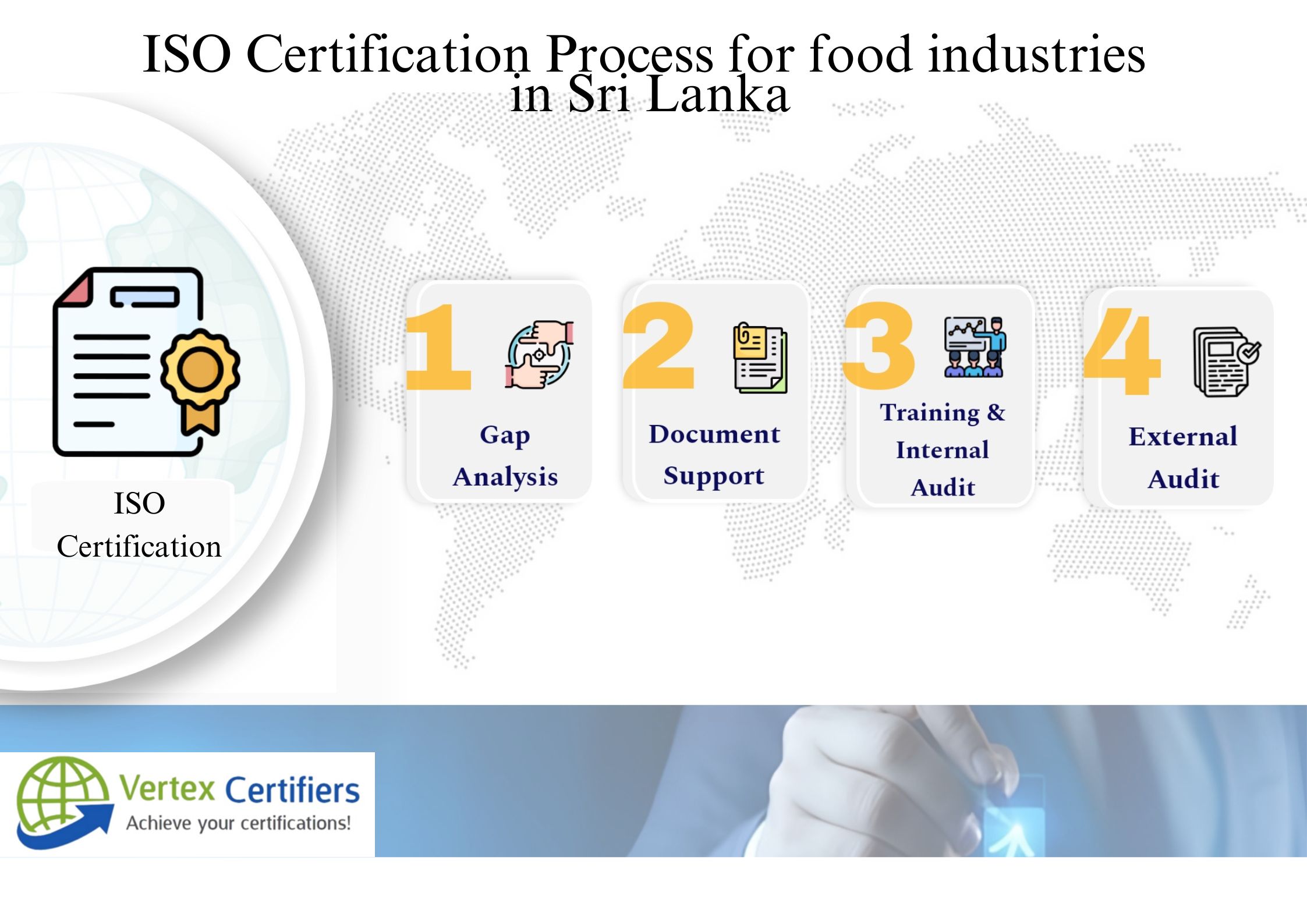
Process to get ISO 22000 Certification in Sri Lanka for food industry
Obtaining ISO 22000 Certification in Sri Lanka involves a structured implementation process that enables organizations to establish an effective Food Safety Management System aligned with international requirements.
1. Initial Consultation
The certification journey begins with understanding the organization’s operations, products, regulatory requirements, business objectives, and current food safety practices. Consultants define the project scope, implementation plan, timeline, and certification objectives.
2. Gap Analysis
A comprehensive gap analysis is conducted to compare the organization’s existing food safety management practices with the requirements of ISO 22000:2018. Areas requiring improvement are identified, and an implementation roadmap is prepared.
3. Documentation Development
The required Food Safety Management System documentation is developed, including food safety policies, objectives, procedures, process maps, hazard analysis records, operational controls, work instructions, monitoring forms, and documented information required by ISO 22000.
4. HACCP Study
A detailed Hazard Analysis and Critical Control Point (HACCP) study is performed to identify biological, chemical, physical, and allergen hazards. Critical Control Points (CCPs), Operational Prerequisite Programs (OPRPs), monitoring methods, corrective actions, and verification activities are established to control identified risks.
5. FSMS Implementation
The documented Food Safety Management System is implemented across the organization. Operational controls, prerequisite programs, traceability systems, sanitation practices, supplier controls, and food safety procedures are integrated into daily operations to ensure consistent compliance.
6. Employee Training
Employees at all levels receive awareness and competency training on ISO 22000 requirements, food safety responsibilities, hygiene practices, HACCP principles, operational controls, emergency preparedness, and documented procedures to ensure effective implementation.
7. Internal Audit
Internal audits are conducted to evaluate the effectiveness of the implemented Food Safety Management System. Nonconformities, process weaknesses, and opportunities for improvement are identified and corrective actions are initiated before the certification audit.
8. Management Review
Top management reviews the overall performance of the Food Safety Management System, including audit findings, customer feedback, process performance, food safety objectives, regulatory compliance, and continual improvement opportunities to ensure the system remains effective.
9. Certification Audit
An independent accredited certification body conducts the Stage 1 and Stage 2 certification audits to verify compliance with ISO 22000:2018 requirements. The auditors evaluate documentation, implementation effectiveness, operational controls, and overall system performance.
10. ISO 22000 Certification
Upon successful completion of the certification audit and closure of any identified nonconformities, the organization is awarded ISO 22000 Certification. The certificate demonstrates compliance with internationally recognized food safety standards and enhances customer confidence, export opportunities, and business credibility. Regular surveillance audits are conducted to ensure the Food Safety Management System continues to meet ISO 22000 requirements and supports continual improvement.
ISO 22000 Certification in Sri Lanka | Vertex Certifiers
Vertex Certifiers
ISO 22000 Certification in Sri Lanka
Build safer food operations with practical ISO 22000 consulting support across Sri Lanka
Vertex Certifiers helps food businesses in Sri Lanka implement ISO 22000 through consulting, documentation, training, internal audits, and certification support. Sri Lanka’s food hygiene regulations apply to establishments involved in processing, transport, distribution, handling, storage, and sale of food, making structured food safety systems highly relevant for manufacturers, exporters, logistics providers, retailers, and hospitality businesses [page:2].
Implementation support for all food chain sectors
Training, internal audits, and documentation
Remote and onsite consulting across Sri Lanka
Export-focused food safety system approach
3) Why ISO 22000 Certification is Important in Sri Lanka
ISO 22000 is important for Sri Lankan businesses because it helps turn food safety obligations into a repeatable management system that supports compliance, market growth, and stronger customer confidence. The national food hygiene regulations cover the full chain from processing and storage to transport and sale, so businesses need documented controls rather than informal practices [page:2].
Export competitiveness
For tea, spices, coconut products, seafood, dairy, beverages, and other export-oriented sectors, ISO 22000 shows buyers that food safety is managed in a systematic and internationally recognized way. This improves competitiveness when dealing with global importers, private labels, and supply chains that expect verified controls.
Customer trust
Certification strengthens customer trust by showing that the company identifies hazards, controls contamination risks, and monitors food safety throughout operations. When businesses can demonstrate a formal system, customers, distributors, and retailers feel more confident about product consistency.
Regulatory compliance
Sri Lanka’s Food Act and Food (Hygiene) Regulations require sanitary facilities, potable water, temperature control, pest control, hygienic handling, trained staff, and recall readiness [page:2]. ISO 22000 helps organizations align these legal duties with documented procedures, records, responsibilities, and audits.
Food safety culture
ISO 22000 encourages management involvement, staff awareness, and day-to-day discipline in hygiene and hazard control. This helps organizations build a food safety culture where employees understand why controls matter, not just what tasks they need to perform.
Operational efficiency
Clear procedures, defined responsibilities, better monitoring, and controlled workflows reduce confusion and rework. A well-implemented system improves coordination across procurement, production, packing, storage, dispatch, and customer communication.
Reduced recalls
By identifying hazards earlier and controlling critical processes, businesses can reduce the risk of unsafe products reaching the market. Sri Lankan regulations also expect managers to have procedures for rapid recall of implicated lots, which makes preventive systems especially valuable [page:2].
Better supplier management
ISO 22000 improves supplier management by requiring businesses to define input specifications, approval methods, and monitoring criteria. This is especially useful when raw materials come from multiple farms, processors, fishing sources, or packaging vendors.
Market access
Certification can support access to supermarkets, institutional buyers, hospitality chains, exporters, and international procurement programs that prefer certified suppliers. It also helps businesses respond more confidently to tender, customer, and buyer qualification requirements.
International recognition
ISO 22000 is widely known across global food supply chains, so it gives Sri Lankan businesses a recognized framework for demonstrating food safety commitment. This is useful when expanding into new geographies or working with multinational customers.
4) Food Industries that Need ISO 22000 Certification in Sri Lanka
Any organization involved in the food chain can benefit from ISO 22000 because Sri Lankan hygiene rules apply broadly to establishments dealing with processing, transport, distribution, handling, storage, or sale of food [page:2]. The following sectors are among the most relevant industries for certification in Sri Lanka.
Tea manufacturers
Tea exporters
Spice exporters
Coconut processing companies
Coconut oil manufacturers
Seafood processors
Fish exporters
Shrimp processing plants
Dairy companies
Milk processing plants
Beverage manufacturers
Bottled water companies
Juice manufacturers
Bakery manufacturers
Food packaging companies
Frozen food manufacturers
Rice mills
Flour mills
Poultry processors
Meat processors
Food ingredient suppliers
Warehouses
Cold storage facilities
Logistics companies
Catering companies
Hotels
Restaurants
Food retailers
Supermarket food processing units
5) Benefits of ISO 22000 Certification
ISO 22000 gives food businesses a structured framework for identifying hazards, controlling food safety risks, monitoring operations, and improving performance over time. It is especially useful in Sri Lanka because hygiene, storage, transport, staff practices, and recall preparedness are already regulated areas that need consistent control [page:2].
Improved food safety
The system brings food safety into everyday operations through documented controls, monitoring, training, corrective actions, and review. This reduces dependence on ad hoc decisions and improves product safety consistency.
Better hazard control
Organizations systematically identify biological, chemical, and physical hazards and define how to prevent, eliminate, or reduce them to acceptable levels. This improves control across receiving, processing, packing, storage, and delivery stages.
HACCP integration
ISO 22000 integrates HACCP principles into a broader management system, connecting hazard analysis with leadership, support functions, verification, documentation, and continual improvement. That makes food safety more practical and more sustainable.
Strong customer confidence
Customers and buyers gain assurance when the company can show formal food safety controls, traceability, internal checks, and system review. This often strengthens long-term relationships and reduces approval delays.
Better export opportunities
Certification helps businesses present themselves as reliable suppliers for global trade, private-label partnerships, and institutional procurement. It can strengthen prequalification for export-focused contracts and overseas buyer assessments.
Reduced operational risks
Clear control points, corrective action methods, staff responsibilities, and review mechanisms reduce the chance of contamination, process deviation, product mix-ups, and nonconforming output. This lowers both safety and business risk.
Better traceability
Documented batch controls, supplier records, production records, and dispatch details make it easier to trace products and ingredients. Faster traceability improves issue response and supports more controlled withdrawals or recalls when needed.
Increased efficiency
Organizations benefit from standardized work methods, fewer process gaps, improved coordination, and reduced waste. Better process discipline often leads to smoother audits and more predictable production performance.
Regulatory compliance
Businesses can align their internal system with Sri Lankan legal expectations for food hygiene, premises, water, temperature control, cleaning, transport, food handler hygiene, and food recall readiness [page:2]. This makes compliance easier to manage and demonstrate.
Reduced product recalls
Preventive controls and stronger monitoring help identify issues before products move widely into the market. When a problem does occur, traceability and documented response procedures support faster containment.
Better supplier control
Supplier approval, material specifications, purchase controls, and periodic evaluation improve confidence in raw materials, ingredients, packaging, and outsourced processes. This is critical for food businesses working with multiple upstream sources.
Continuous improvement
ISO 22000 promotes ongoing review through audits, data analysis, corrective action, and management review. Instead of treating food safety as a one-time project, businesses keep improving performance over time.
6) ISO 22000 Requirements
ISO 22000 combines food safety controls with management system requirements so organizations can plan, operate, evaluate, and improve their food safety management system. Below is a brief explanation of the key requirements commonly addressed during implementation.
Context of the organization
The business identifies internal and external issues, interested parties, legal obligations, and the scope of its food safety management system.
Leadership
Top management must show commitment, assign responsibilities, provide resources, and ensure food safety objectives align with business direction.
Food safety policy
The organization defines a clear food safety policy that reflects its commitment to safe products, compliance, and continual improvement.
Planning
The company plans actions to address risks and opportunities, defines objectives, and determines how changes will be controlled.
Support
This includes competence, awareness, communication, documented information, infrastructure, and resources needed to operate the system effectively.
Operational planning
The organization plans and controls the processes needed to meet food safety requirements from incoming materials to final delivery.
HACCP principles
ISO 22000 uses HACCP thinking to identify hazards, assess significance, and establish controls for food safety risks.
Prerequisite Programs (PRPs)
PRPs are the basic conditions and activities needed to maintain a hygienic environment, such as cleaning, pest control, sanitation, personal hygiene, and facility maintenance.
Operational PRPs (OPRPs)
OPRPs are control measures identified through hazard analysis that need active management but may not be classified as CCPs.
Hazard Analysis
The organization identifies potential biological, chemical, and physical hazards and evaluates which controls are necessary.
Critical Control Points (CCPs)
CCPs are stages where control is essential to prevent or reduce a significant food safety hazard to an acceptable level.
Performance evaluation
The company measures system performance through monitoring, verification, analysis, and review of objectives and food safety outcomes.
Internal audit
Internal audits verify whether the food safety management system is implemented effectively and follows planned arrangements.
Management review
Top management reviews audit results, performance trends, complaints, nonconformities, risks, and improvement actions to keep the system effective.
Continual improvement
The organization improves its system using corrective actions, verification results, audit findings, lessons learned, and performance data.
Why Choose Vertex Certifiers?
International experience: Support aligned with global food safety expectations and export market needs.
Experienced ISO consultants: Guidance from consultants who understand ISO implementation and audit preparation.
Practical implementation: Systems designed for actual operations, not just paperwork.
Affordable consulting: Cost-effective support for startups, SMEs, and established food businesses.
Fast project completion: Structured timelines to move from gap analysis to certification efficiently.
More reasons to work with us
Industry-specific approach: Sector-focused support for tea, spices, seafood, dairy, beverages, logistics, hospitality, and more.
Remote + onsite support: Flexible project delivery across Sri Lanka.
High certification success rate: Strong focus on readiness, training, and audit confidence.
End-to-end assistance: Gap assessment, documentation, training, implementation, internal audits, and certification coordination.
Long-term compliance support: Continued help for surveillance audits, updates, and ongoing system improvement.
10) Industries Served
Vertex Certifiers serves a wide range of food-related sectors in Sri Lanka with ISO 22000 consulting, implementation, training, internal audits, and certification support.
Tea industry
Spice industry
Coconut products
Seafood
Fisheries
Dairy
Beverage
Bakery
Confectionery
Rice processing
Flour mills
Poultry
Meat processing
Food packaging
Agriculture
Cold chain logistics
Warehousing
Hotels
Restaurants
Catering
Retail food chains
11) Cities We Serve in Sri Lanka
Vertex provides ISO 22000 consulting, implementation, training, internal audits, and certification support throughout Sri Lanka. Our services are available for manufacturers, exporters, processors, warehouses, hospitality businesses, and food supply chain organizations across major cities and surrounding industrial regions.
Colombo
Vertex Certifiers offers ISO 22000 consulting in Colombo for food manufacturers, importers, distributors, hotels, restaurants, and exporters. We support gap analysis, implementation, staff training, internal audits, documentation, and certification coordination.
Gampaha
We provide ISO 22000 services in Gampaha for processing units, beverage companies, storage facilities, and food supply businesses. Our team helps establish practical food safety systems that support compliance and certification readiness.
Kandy
Vertex supports businesses in Kandy with ISO 22000 consulting, implementation, training, and audit support. We help food producers and hospitality businesses strengthen food safety controls and improve customer confidence.
Galle
Our ISO 22000 consulting in Galle is ideal for seafood-related businesses, hotels, restaurants, food retailers, and processors. We assist with system design, hazard control planning, internal audits, and certification preparation.
Kurunegala
Vertex helps food and agro-processing companies in Kurunegala implement ISO 22000 efficiently. Our services cover documentation, employee training, compliance guidance, and full certification assistance.
Negombo
In Negombo, we support seafood processors, exporters, cold storage providers, and hospitality businesses with ISO 22000 consulting and certification support. We focus on practical hazard controls, hygiene systems, and traceability.
Matara
Vertex provides ISO 22000 implementation and training services in Matara for food businesses seeking better food safety performance and stronger market credibility. We assist from initial assessment to certification audit support.
Ratnapura
Our team serves Ratnapura with ISO 22000 consulting for manufacturers, processors, packaging-related companies, and food service providers. We help businesses improve process control, compliance, and operational discipline.
Anuradhapura
Vertex supports food businesses in Anuradhapura with implementation planning, staff training, internal audits, and certification guidance. We help organizations develop a reliable food safety management system suited to their operations.
Jaffna
We provide ISO 22000 consulting in Jaffna for processors, exporters, retailers, and hospitality organizations. Our remote and onsite support helps businesses across Northern Sri Lanka move toward successful certification.
12) Frequently Asked Questions (FAQs)
These FAQs answer common questions from Sri Lankan food businesses exploring ISO 22000 certification.
What is ISO 22000 Certification?
ISO 22000 Certification confirms that a business has implemented a food safety management system designed to identify hazards, control risks, monitor operations, and continually improve food safety performance.
Who needs ISO 22000 Certification in Sri Lanka?
It is suitable for food manufacturers, exporters, processors, warehouses, cold storage facilities, logistics companies, hotels, restaurants, caterers, retailers, and ingredient suppliers involved anywhere in the food chain.
How long does certification take?
The timeline depends on company size, process complexity, current controls, and resource availability. Small businesses may complete implementation faster, while larger or multi-site operations may need more time for system development and readiness.
How much does ISO 22000 Certification cost in Sri Lanka?
Costs vary based on scope, number of employees, number of locations, process risk, and the level of consulting support needed. Certification body charges and internal preparation effort also affect the total project cost.
Is HACCP required for ISO 22000?
Yes, HACCP principles are an important part of ISO 22000. The standard integrates HACCP into a broader management system framework with documentation, verification, audits, and continual improvement.
Can small food businesses get ISO 22000 certified?
Yes, small and medium-sized food businesses can achieve certification when they implement controls appropriate to their size, process complexity, and food safety risks.
What are PRPs and CCPs?
PRPs are the foundational hygiene and operational conditions needed for safe production, while CCPs are specific points where control is essential to prevent or reduce significant hazards to acceptable levels.
Is ISO 22000 mandatory?
ISO 22000 itself is generally a voluntary certification, but many customers, buyers, exporters, and organized supply chains treat it as a strong commercial requirement. Businesses still must comply with Sri Lankan food laws and hygiene regulations regardless of certification status [page:1][page:2].
How long is the certificate valid?
ISO certificates are typically issued for a defined cycle with periodic surveillance audits by the certification body. The business must maintain the system and continue meeting certification requirements.
What is the difference between HACCP and ISO 22000?
HACCP focuses mainly on hazard analysis and control points, while ISO 22000 includes HACCP within a full management system that also covers leadership, planning, support, evaluation, auditing, and continual improvement.
Can exporters benefit from ISO 22000 Certification?
Yes, exporters can benefit through stronger buyer confidence, improved qualification for supply chains, better documentation, and easier communication of food safety controls to international customers.
How can Vertex Certifiers help with ISO 22000 Certification?
Vertex Certifiers provides end-to-end support including gap assessment, implementation consulting, documentation, employee training, internal audits, corrective action guidance, and certification support throughout Sri Lanka.
Looking for ISO 22000 Certification in Sri Lanka?
Vertex Certifiers provides end-to-end ISO 22000:2018 Food Safety Management System (FSMS)
consulting, HACCP implementation, documentation, employee training, internal audits, and certification
support for food manufacturers, processors, exporters, restaurants, warehouses, and food businesses
across Sri Lanka.
Contact our ISO experts today for a free consultation and receive a customized certification roadmap
tailored to your organization's food safety requirements.