Vertex Certifiers

Vertex Certifiers is a trusted international ISO consulting company providing end-to-end ISO certification services for organizations across Greece. Our experienced consultants assist businesses of all sizes with every stage of the certification journey, including gap analysis, documentation, implementation, employee training, internal audits, and certification audit support. Whether you are seeking ISO 22301 or other internationally recognized ISO standards, we deliver practical, customized solutions that simplify compliance, strengthen business performance, and ensure successful certification. With a commitment to quality, timely project completion, and affordable consulting services, Vertex Certifiers helps organizations achieve globally recognized ISO certifications at a competitive and cost-effective price.

ISO 22301 Certification in Greece – Business Continuity Management System (BCMS) Consultants & Certification Services

Introduction

In today’s unpredictable business environment, organizations must be prepared to continue their operations even when faced with unexpected disruptions. Natural disasters, cyberattacks, supply chain interruptions, equipment failures, pandemics, power outages, and other unforeseen incidents can significantly impact productivity, customer service, financial performance, and organizational reputation. ISO 22301:2019 Business Continuity Management System (BCMS) is the internationally recognized standard that helps organizations establish a systematic framework to prepare for, respond to, recover from, and adapt to disruptive events. By implementing ISO 22301, businesses can strengthen operational resilience, safeguard critical processes, minimize downtime, and ensure business continuity under all circumstances. Achieving ISO 22301 Certification in Greece demonstrates an organization’s commitment to resilience, risk management, and uninterrupted service delivery while enhancing stakeholder confidence and long-term business sustainability.

ISO 22301 provides organizations with a structured approach to identifying potential threats, conducting Business Impact Analysis (BIA), assessing operational risks, developing business continuity strategies, and implementing effective disaster recovery and incident response plans.By integrating risk assessment, business continuity planning, crisis management, and continual improvement into everyday operations, organizations can reduce financial losses, protect customers, maintain regulatory compliance, preserve their reputation, and recover more efficiently from disruptions.

What is ISO 22301 Certification?

ISO 22301:2019 is the internationally recognized standard for establishing, implementing, maintaining, and continually improving a Business Continuity Management System (BCMS). Published by the International Organization for Standardization (ISO), the standard provides organizations with a comprehensive framework to prepare for unexpected disruptions, respond effectively to incidents, maintain essential operations, and recover quickly while minimizing the impact on customers, employees, and business performance. ISO 22301 is applicable to organizations of every size and industry, making it one of the most important international standards for building operational resilience and ensuring long-term business continuity.

The primary objective of ISO 22301 Certification is to enhance organizational resilience.Resilient organizations are better equipped to withstand crises such as natural disasters, cyberattacks, supply chain failures, equipment breakdowns, utility interruptions, labor shortages, pandemics, and other unexpected events.

When disruptions do occur, ISO 22301 enables organizations to respond effectively to incidents through well-defined emergency response procedures, incident management structures, communication plans, and clearly assigned responsibilities. During emergencies, confusion and delays can significantly increase operational losses. A properly implemented Business Continuity Management System ensures that employees understand their roles, decision-makers receive accurate information, stakeholders remain informed, and recovery activities begin immediately. This coordinated response minimizes operational disruption while helping organizations maintain essential services during critical situations.

Another important objective of ISO 22301 is enabling organizations to recover critical operations quickly after an incident. Business continuity planning includes identifying recovery priorities, establishing Recovery Time Objectives (RTOs), determining Recovery Point Objectives (RPOs) for information systems where applicable, developing alternative operating arrangements, and preparing disaster recovery plans for facilities, technology, and infrastructure.

ISO 22301 also promotes risk-based thinking, encouraging organizations to integrate business continuity considerations into strategic planning, operational management, supplier selection, digital transformation initiatives, infrastructure development, and organizational change.Leadership teams continuously assess evolving risks, evaluate emerging threats, monitor business performance, and adjust continuity strategies to reflect changing operational environments.

  • Plan: Establish the BCMS scope, identify business continuity objectives, conduct Business Impact Analysis and risk assessments, and develop business continuity strategies and documented plans.
  • Do: Implement business continuity controls, provide employee training, allocate necessary resources, establish communication procedures, and integrate continuity measures into daily operations.
  • Check: Monitor the effectiveness of the Business Continuity Management System through internal audits, performance measurement, testing exercises, incident evaluations, and management reviews.
  • Act: Implement corrective actions, address identified gaps, update business continuity plans, improve operational resilience, and continually enhance the effectiveness of the Business Continuity Management System.

ISO 22301 Certification also supports compliance with applicable legal, regulatory, contractual, and customer requirements.Certification demonstrates that an organization follows globally recognized best practices for managing operational disruptions, strengthening credibility and improving opportunities to secure contracts, partnerships, and international business.

It represents an organization’s commitment to protecting its people, customers, operations, and reputation while ensuring continuity under even the most challenging circumstances.

Why ISO 22301 Certification is Important in Greece

As Greece continues to strengthen its position as a leading European hub for maritime trade, tourism, logistics, manufacturing, renewable energy, pharmaceuticals, and technology, organizations are becoming increasingly dependent on uninterrupted operations to meet customer expectations and maintain business performance. Today’s businesses operate in a highly interconnected environment where even a minor disruption can affect production schedules, supply chains, customer service, regulatory compliance, and financial stability. Implementing ISO 22301 Certification in Greece enables organizations to establish a proactive Business Continuity Management System (BCMS) that prepares them to anticipate potential risks, respond effectively during emergencies, and recover critical operations with minimal downtime.

The standard helps businesses identify vulnerabilities, assess operational risks, develop recovery strategies, and continually improve their ability to withstand unexpected events.

Protecting Businesses Against Earthquakes and Natural Disasters

Greece is one of the most seismically active countries in Europe, making earthquakes an important consideration for organizations across every industry. Manufacturing facilities, logistics centers, hospitals, hotels, office buildings, shipping terminals, warehouses, and public infrastructure may all experience operational disruptions following significant seismic activity.

Organizations that proactively prepare for natural disasters are far better positioned to maintain customer confidence and recover faster than businesses without structured continuity planning.

Managing the Growing Risk of Wildfires

ISO 22301 encourages organizations to identify wildfire-related risks, establish alternative operating arrangements, protect critical assets, and prepare relocation or remote working strategies where appropriate. Organizations can also develop communication procedures to keep employees, suppliers, customers, and emergency authorities informed during rapidly changing situations.

Preparing for Flooding and Extreme Weather Events

Flooding can interrupt manufacturing operations, damage inventory, affect distribution networks, delay customer deliveries, and temporarily close offices or production facilities.

ISO 22301 enables organizations to identify flood-related vulnerabilities, develop preventive measures, establish backup facilities where necessary, and prepare recovery procedures that reduce operational downtime. These proactive measures strengthen business resilience while supporting faster restoration of normal operations following severe weather events.

Strengthening Supply Chain Resilience

Modern businesses depend on complex domestic and international supply chains. Organizations operating in Greece frequently rely on international shipping routes, imported raw materials, overseas suppliers, logistics providers, and transportation networks to maintain production and deliver products to customers worldwide.

ISO 22301 requires organizations to identify critical suppliers, evaluate supply chain dependencies, assess associated risks, and develop contingency plans.

For exporters and internationally connected organizations, supply chain resilience has become one of the most valuable outcomes of implementing ISO 22301.

Enhancing Cybersecurity Incident Preparedness

Digital transformation has created enormous opportunities for businesses across Greece, but it has also increased exposure to cybersecurity threats. Organizations today rely heavily on cloud computing, enterprise software, digital payment systems, remote working technologies, customer databases, and interconnected IT infrastructure.

Although ISO 22301 is not a cybersecurity standard, it plays a vital role in business continuity by ensuring organizations have documented incident response procedures, backup strategies, disaster recovery plans, communication protocols, and recovery objectives for technology systems.

Minimizing the Impact of Power Failures and Utility Interruptions

Many industries rely on continuous electricity, water supply, internet connectivity, and communication infrastructure. Manufacturing plants, hospitals, banks, logistics facilities, telecommunications providers, and data centers may experience significant operational disruption if these essential services become unavailable.

ISO 22301 helps organizations establish contingency measures such as backup power systems, alternative communication methods, redundant infrastructure, and emergency operating procedures to maintain critical operations until normal services are restored.

Managing IT Outages and Digital Business Disruptions

Businesses increasingly depend on enterprise resource planning (ERP) systems, cloud platforms, digital communication tools, online customer portals, financial software, and data management systems.

ISO 22301 encourages organizations to define Recovery Time Objectives (RTOs), establish disaster recovery procedures, regularly back up critical information, test restoration processes, and maintain documented recovery plans for business-critical technology systems.

Addressing Labor Shortages and Workforce Disruptions

Organizations may also experience disruptions caused by workforce shortages resulting from health emergencies, industrial actions, transportation issues, seasonal demand fluctuations, or unexpected employee absences.

ISO 22301 encourages workforce continuity planning through succession planning, cross-training employees, documenting critical procedures, identifying essential roles, and preparing flexible staffing arrangements.

Preparing for Economic Uncertainty

Global economic conditions continue to influence organizations across every sector. Inflation, currency fluctuations, changing customer demand, geopolitical developments, financial market instability, and international trade disruptions may all affect business performance.

Business continuity planning enables organizations to remain agile while protecting long-term sustainability.

Supporting Legal, Regulatory, and Contractual Compliance

Government agencies, financial institutions, healthcare organizations, pharmaceutical manufacturers, telecommunications providers, logistics companies, and critical infrastructure operators often need robust continuity arrangements to demonstrate operational preparedness.

Certification also demonstrates accountability and responsible management practices to regulators, auditors, investors, and business partners.

Building Customer Confidence and Market Reputation

Organizations capable of maintaining operations during emergencies are viewed as more reliable, trustworthy, and professionally managed.

In competitive industries, resilience has become a significant differentiator when customers evaluate suppliers and service providers.

Meeting International Business Expectations

Many international organizations evaluate suppliers not only on quality and price but also on operational resilience and business continuity capabilities.

For organizations seeking global expansion, certification demonstrates professionalism and readiness to support international business relationships.

ISO 22301 Certification Process in Greece
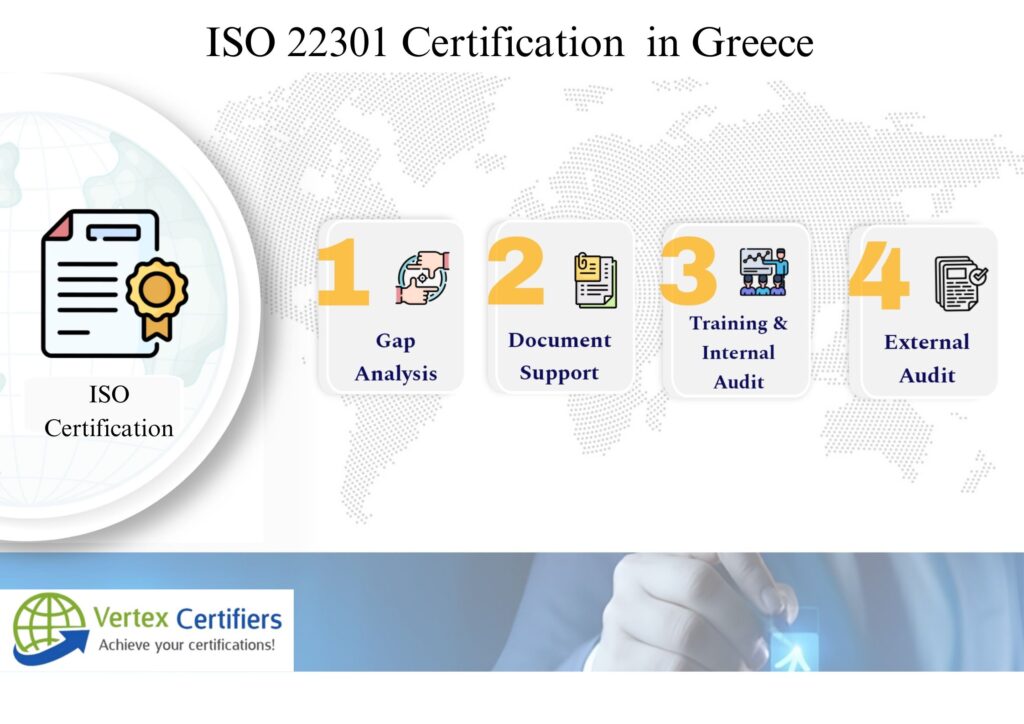
Achieving ISO 22301 Certification in Greece is a strategic process that enables organizations to establish, implement, maintain, and continually improve a Business Continuity Management System (BCMS) aligned with the requirements of ISO 22301:2019.

At Vertex Certifiers, we provide end-to-end consulting services that simplify the implementation process, helping organizations build a practical and effective Business Continuity Management System that aligns with international best practices.

Step 1: Initial Consultation

The certification journey begins with an initial consultation to understand the organization’s business activities, operational structure, existing management systems, and business continuity objectives.

During this stage, consultants evaluate:

  • Nature of business operations
  • Organizational structure
  • Critical products and services
  • Existing continuity arrangements
  • Business risks and challenges
  • Certification objectives
  • Applicable legal and regulatory requirements

This consultation establishes the foundation for the implementation project and defines the overall certification roadmap.


Step 2: Gap Analysis

A detailed Gap Analysis is conducted to compare the organization’s existing practices against the requirements of ISO 22301:2019.

The assessment identifies:

  • Existing strengths
  • Areas requiring improvement
  • Missing documentation
  • Process gaps
  • Operational risks
  • Compliance requirements

The Gap Analysis provides a clear action plan for achieving full compliance with ISO 22301.


Step 3: Project Planning

After identifying improvement opportunities, a structured implementation plan is developed.

The project plan includes:

  • Scope of the Business Continuity Management System
  • Roles and responsibilities
  • Project milestones
  • Resource allocation
  • Documentation schedule
  • Implementation timeline
  • Internal communication plan

Proper planning ensures that implementation activities remain organized and aligned with business priorities.


Step 4: Business Impact Analysis (BIA)

Business Impact Analysis (BIA) is one of the most important requirements of ISO 22301.

The BIA helps organizations identify:

  • Critical business functions
  • Key operational processes
  • Dependencies between departments
  • Maximum acceptable downtime
  • Recovery priorities
  • Financial and operational impacts of disruptions

By understanding which activities are essential for business continuity, organizations can prioritize recovery efforts during emergencies.


Step 5: Risk Assessment

ISO 22301 requires organizations to systematically identify, analyze, and evaluate risks that could disrupt business operations.

Risk assessments typically consider:

  • Natural disasters
  • Cybersecurity threats
  • Supply chain failures
  • IT outages
  • Utility interruptions
  • Equipment failures
  • Human resource risks
  • Regulatory risks
  • Infrastructure failures

Based on the findings, organizations establish appropriate preventive controls and mitigation strategies.


Step 6: BCMS Documentation

Documentation forms the backbone of an effective Business Continuity Management System.

Organizations develop documentation including:

  • BCMS Manual
  • Scope statement
  • Document control procedures
  • Roles and responsibilities
  • Risk assessment records
  • Business Impact Analysis reports
  • Operational procedures
  • Business continuity plans
  • Recovery procedures

Well-structured documentation ensures consistency and supports effective implementation.


Step 7: Business Continuity Policy

Top management establishes a formal Business Continuity Policy that reflects the organization’s commitment to resilience and continual improvement.

The policy generally includes:

  • Commitment to business continuity
  • Business continuity objectives
  • Leadership responsibilities
  • Compliance commitment
  • Continuous improvement approach

The policy provides strategic direction for the entire BCMS.


Step 8: Business Continuity Objectives

Organizations establish measurable business continuity objectives that support operational resilience.

Objectives may include:

  • Reducing operational downtime
  • Improving emergency response
  • Protecting critical services
  • Enhancing customer confidence
  • Strengthening supply chain resilience
  • Improving crisis communication
  • Meeting regulatory obligations

Objectives are monitored regularly to measure BCMS effectiveness.


Step 9: Emergency Response Procedures

Organizations develop documented procedures for responding to emergency situations.

These procedures define:

  • Emergency response teams
  • Evacuation procedures
  • Incident reporting
  • Emergency communication
  • Employee safety measures
  • Coordination with emergency authorities

Clearly documented procedures help organizations respond quickly during emergencies.


Step 10: Incident Management Plan

An Incident Management Plan establishes how the organization will manage disruptive events.

The plan identifies:

  • Incident response structure
  • Escalation procedures
  • Decision-making authority
  • Communication responsibilities
  • Resource mobilization
  • Stakeholder notifications

A structured incident management process minimizes confusion during crisis situations.


Step 11: Disaster Recovery Planning

Disaster Recovery Planning focuses on restoring business operations after significant disruptions.

Recovery planning includes:

  • IT system recovery
  • Data backup and restoration
  • Alternative work locations
  • Infrastructure recovery
  • Supplier recovery coordination
  • Business service restoration

Organizations regularly review and update disaster recovery plans to reflect changing business requirements.


Step 12: BCMS Implementation

Once documentation has been completed, the Business Continuity Management System is implemented across the organization.

Implementation activities include:

  • Deploying documented procedures
  • Integrating continuity practices into daily operations
  • Assigning responsibilities
  • Conducting awareness programs
  • Implementing continuity controls

Management support plays a critical role in successful implementation.


Step 13: Employee Training

Employees are the foundation of an effective Business Continuity Management System.

Training programs help employees understand:

  • Business continuity principles
  • Individual responsibilities
  • Emergency response procedures
  • Crisis communication
  • Incident reporting
  • Recovery activities

Regular awareness programs ensure employees remain prepared for unexpected events.


Step 14: Internal Audit

Before certification, organizations perform an internal audit to verify BCMS effectiveness.

Internal auditors evaluate:

  • Compliance with ISO 22301
  • Documentation effectiveness
  • Process implementation
  • Employee awareness
  • Operational controls
  • Areas for improvement

Internal audits help identify nonconformities before the external certification audit.


Step 15: Management Review

Senior management conducts a formal review of the Business Continuity Management System.

Management reviews evaluate:

  • Audit findings
  • Business continuity performance
  • Risk assessment updates
  • Achievement of objectives
  • Resource requirements
  • Improvement opportunities

Leadership involvement ensures the BCMS remains aligned with organizational goals.


Step 16: Corrective Actions

Any issues identified during audits or reviews are addressed through corrective actions.

Organizations:

  • Identify root causes
  • Implement corrective measures
  • Verify effectiveness
  • Update documentation
  • Prevent recurrence

Corrective actions support continual improvement and strengthen overall resilience.


Step 17: Stage 1 Certification Audit

An accredited certification body conducts the Stage 1 Audit.

The auditor reviews:

  • BCMS documentation
  • Scope of certification
  • Organizational readiness
  • ISO 22301 compliance
  • Documentation completeness

Any identified gaps are addressed before Stage 2.


Step 18: Stage 2 Certification Audit

The Stage 2 Audit evaluates the actual implementation of the Business Continuity Management System.

Auditors verify:

  • Practical implementation
  • Employee awareness
  • Business continuity plans
  • Risk management activities
  • Internal audit process
  • Management review
  • Operational effectiveness

Successful completion demonstrates conformity with ISO 22301 requirements.


Step 19: Certification Decision

Following successful completion of the certification audit, the certification body reviews the audit findings.

If all ISO 22301 requirements are satisfied, the organization is awarded ISO 22301 Certification, demonstrating that its Business Continuity Management System meets internationally recognized standards and best practices.

Certification enhances credibility with customers, regulators, business partners, and other stakeholders.


Step 20: Surveillance Audits

ISO 22301 certification is maintained through periodic surveillance audits.

These audits verify that the organization continues to:

  • Maintain the BCMS
  • Follow documented procedures
  • Manage business continuity risks
  • Improve operational resilience
  • Meet ISO 22301 requirements

Surveillance audits encourage organizations to sustain high levels of preparedness and continual improvement.


Step 21: Continual Improvement

Business continuity is an ongoing process rather than a one-time project.

Organizations continually improve their BCMS by:

  • Updating risk assessments
  • Reviewing Business Impact Analysis
  • Testing continuity plans
  • Learning from incidents
  • Monitoring performance
  • Improving documentation
  • Adapting to changing business environments

Continual improvement ensures the Business Continuity Management System remains effective and relevant as organizational risks evolve.

    Get Free
    Consultation


    Our Services

    Our Clients

    client
    client
    client
    client
    client

    About Vertex Certifiers

    Vertex Certifiers is an international ISO consulting company specializing in end-to-end Business Continuity Management System (BCMS) implementation and certification support. Our team of experienced ISO 22301 consultants helps organizations across Greece build resilient operations capable of withstanding disruptions ranging from natural disasters to cyber incidents. [web:1][web:7]

    We provide comprehensive BCMS consulting services including Gap Analysis, Business Impact Analysis (BIA), Risk Assessment, Business Continuity Planning, Disaster Recovery Planning, Employee Training, Internal Audits, Certification Audit Support, and Surveillance Audit Support. Our practical, tailored approach ensures organizations not only achieve certification but also develop genuine operational resilience. [web:1][web:5]

    With years of experience serving organizations across Greece—from Athens-based financial institutions to Thessaloniki manufacturing firms and island tourism enterprises—Vertex Certifiers understands the unique challenges Greek businesses face. We deliver cost-effective, customized BCMS solutions through both remote and on-site consulting across all Greek regions. [web:12][web:19]

    Benefits of ISO 22301 Certification in Greece

    ISO 22301 certification delivers transformative benefits for Greek organizations seeking operational resilience and stakeholder confidence:

    • Business continuity assurance: Maintain critical operations during disruptions through structured BCMS frameworks. [web:12][web:19]
    • Reduced operational downtime: Minimize interruption duration with predefined recovery procedures and tested plans. [web:1][web:14]
    • Improved crisis management: Establish clear incident response structures and decision-making protocols. [web:2][web:6]
    • Faster recovery after disruptions: Achieve defined Recovery Time Objectives (RTOs) through strategic planning. [web:1][web:14]
    • Better risk management: Identify, assess, and treat risks systematically before they materialize. [web:3][web:10]
    • Improved stakeholder confidence: Demonstrate commitment to resilience to investors, regulators, and partners. [web:12][web:19]
    • Increased customer trust: Assure clients of uninterrupted service delivery even under adverse conditions. [web:12][web:15]
    • Compliance with legal requirements: Meet regulatory obligations in sectors like banking, healthcare, and critical infrastructure. [web:11][web:16]
    • Enhanced reputation: Gain international recognition as a resilient, reliable organization. [web:12][web:14]
    • Competitive advantage: Differentiate from competitors through certified business continuity capabilities. [web:15][web:19]
    • Protection of critical business functions: Prioritize and safeguard activities essential to organizational survival. [web:1][web:5]
    • Reduced financial losses: Dramatically decrease costs from disruptions through proactive planning. [web:12][web:14]
    • Improved employee awareness: Train staff on their roles during incidents, boosting organizational readiness. [web:6][web:10]
    • Supply chain resilience: Strengthen supplier and partner continuity through coordinated planning. [web:1][web:16]
    • Better decision making: Make informed choices during crises using established protocols and data. [web:14][web:19]
    • Continuous improvement: Embed a culture of learning and enhancement through regular audits and reviews. [web:5][web:10]

    Who Needs ISO 22301 Certification in Greece?

    ISO 22301 applies to organizations of all sizes and sectors across Greece. Industries with critical operations or high disruption exposure benefit most:

    • Shipping & Maritime: Shipping Companies, Maritime Services, Ports
    • Logistics & Supply Chain: Logistics Companies, Warehousing, E-commerce Companies
    • Tourism & Hospitality: Tourism Businesses, Hotels & Resorts, Airlines, Travel Agencies
    • Manufacturing: Manufacturing Industries, Automotive Suppliers, Pharmaceutical Companies, Food Processing Companies
    • Healthcare: Hospitals, Laboratories
    • Financial Services: Banks, Financial Institutions, Insurance Companies
    • Technology: IT Companies, Data Centers, Software Companies, Telecom Companies
    • Public Sector: Government Organizations, Universities
    • Construction & Engineering: Construction Companies, Engineering Firms
    • Energy: Energy Companies, Renewable Energy Projects
    • Retail: Retail Chains

    ISO 22301's flexibility makes it suitable for large enterprises, SMEs, and public sector entities alike. [web:12][web:16][web:19]

    ISO 22301 Requirements

    ISO 22301:2019 follows a Plan-Do-Check-Act structure across 10 major clauses:

    Clause 4: Context of the Organization

    • Understand internal and external issues affecting business continuity
    • Identify interested parties and their requirements
    • Define BCMS scope

    Clause 5: Leadership

    • Business Continuity Policy: Establish top-level commitment and direction
    • Organizational Roles: Assign responsibilities and authorities for BCMS

    Clause 6: Planning

    • Risk Assessment: Identify threats, vulnerabilities, and impacts to critical activities
    • Business Impact Analysis (BIA): Determine critical activities, dependencies, and recovery objectives (RTO/RPO)
    • Business Continuity Objectives: Set measurable goals aligned with policy

    Clause 7: Support

    • Resources: Allocate people, infrastructure, technology, and funding
    • Competence: Ensure staff have necessary skills and training
    • Awareness: Communicate BCMS importance to all employees
    • Communication: Establish internal and external communication protocols
    • Documented Information: Maintain controlled documents and records

    Clause 8: Operation

    • Business Continuity Strategies: Select approaches to meet RTOs/RPOs
    • Business Continuity Plans: Document procedures for responding to disruptions
    • Incident Response Structure: Define roles, escalation paths, and command structures
    • Exercising and Testing: Conduct regular drills to validate plans

    Clause 9: Performance Evaluation

    • Internal Audits: Assess BCMS conformity and effectiveness
    • Management Review: Evaluate BCMS performance and adequacy at planned intervals

    Clause 10: Improvement

    • Corrective Actions: Address nonconformities and prevent recurrence
    • Continual Improvement: Enhance BCMS suitability, adequacy, and effectiveness

    Implementation typically takes 6–9 months depending on organizational complexity. [web:1][web:10]

    Required Documents for ISO 22301 Certification

    ISO 22301 requires documented information to demonstrate BCMS implementation and effectiveness:

    • Business Continuity Policy
    • BCMS Scope
    • Business Continuity Objectives
    • Risk Assessment Records
    • Business Impact Analysis (BIA) Reports
    • Continuity Strategies Documentation
    • Business Continuity Plans (per critical activity/department)
    • Emergency Response Procedures
    • Disaster Recovery Plans
    • Communication Plans
    • Training Records
    • Incident Logs
    • Internal Audit Reports
    • Management Review Minutes
    • Corrective Action Reports
    • Document Control Records

    Vertex Certifiers provides complete documentation templates and support throughout the implementation journey. [web:2][web:6]

    Cost of ISO 22301 Certification in Greece

    ISO 22301 certification costs in Greece vary based on several factors:

    • Organization size: Larger enterprises require more extensive BCMS coverage
    • Number of employees: More staff means broader training and awareness programs
    • Number of business locations: Multiple sites increase complexity and audit scope
    • Operational complexity: Diverse processes require more detailed BIA and planning
    • Existing management systems: Organizations with ISO 9001/27001 may leverage existing frameworks
    • Scope of certification: Broader BCMS scope increases implementation effort
    • Consultancy requirements: Extent of external support needed
    • Certification body fees: Varies by accredited registrar (typically €700–€3,000+ annually for audits) [web:17][web:18]
    • Internal resource availability: Dedicated BCMS staff reduces external dependency
    • Training requirements: Staff competencies and awareness programs

    Vertex Certifiers provides cost-effective ISO 22301 consulting solutions tailored to organizations in Greece, optimizing resources while ensuring certification success. [web:7][web:15]

    Why Choose Vertex Certifiers for ISO 22301 Certification in Greece?

    Vertex Certifiers stands out as your trusted partner for ISO 22301 implementation in Greece:

    • International ISO consulting company: Global expertise with local Greek market knowledge [web:7]
    • Experienced ISO consultants: Seasoned BCMS professionals with proven track records
    • Practical implementation approach: Real-world, actionable plans—not just paperwork [web:2][web:6]
    • Complete documentation support: Templates, policies, and records ready for audit
    • Business continuity expertise: Deep understanding of BCMS principles and practices [web:1][web:5]
    • Risk assessment specialists: Expert identification and treatment of organizational risks [web:3][web:10]
    • BIA facilitation: Structured workshops to identify critical activities and recovery objectives
    • Internal auditor training: Build in-house capability for ongoing BCMS monitoring
    • High certification success rate: Proven methodology ensures first-time audit success
    • Affordable consulting services: Competitive pricing without compromising quality [web:15]
    • Timely project completion: Structured 6–9 month implementation roadmaps [web:1]
    • Ongoing post-certification support: Surveillance audit preparation and continuous improvement guidance
    • Customized BCMS solutions: Tailored to your industry, size, and risk profile
    • Services across Greece: Remote and on-site consulting in Athens, Thessaloniki, and beyond [web:13][web:19]

    ISO 22301 Certification Services Across Greece

    Vertex Certifiers supports organizations across all regions of Greece through flexible remote and on-site consulting. Our services cover major cities including:

    • Athens
    • Thessaloniki
    • Patras
    • Heraklion
    • Larissa
    • Volos
    • Rhodes
    • Ioannina
    • Chania
    • Kavala
    • Kalamata
    • Alexandroupoli

    Whether you're a shipping company in Piraeus, a hotel chain in Crete, or a manufacturing plant in Northern Greece, our team delivers tailored BCMS consulting to meet your unique needs. [web:12][web:13][web:19]

    Get Started with ISO 22301 Certification Today

    Build a resilient organization capable of withstanding any disruption. Contact Vertex Certifiers for end-to-end ISO 22301 implementation and certification support across Greece.

    Frequently Asked Questions (FAQs)

    What is ISO 22301 certification?

    ISO 22301 is the international standard for Business Continuity Management Systems (BCMS). It provides a framework for organizations to prepare for, respond to, and recover from disruptions while maintaining critical operations. [web:4][web:11][web:16]

    Who needs ISO 22301 certification in Greece?

    Any organization seeking operational resilience can benefit, especially those in critical sectors like shipping, finance, healthcare, manufacturing, tourism, IT, and government. ISO 22301 applies to all sizes and types of organizations. [web:12][web:16][web:19]

    How long does ISO 22301 implementation take?

    Typical implementation takes 6–9 months depending on organizational size, complexity, existing management systems, and resource availability. Structured roadmaps with clear phases ensure timely completion. [web:1][web:10]

    What is Business Impact Analysis (BIA)?

    BIA identifies critical business activities, assesses the impact of disruptions over time, and defines Recovery Time Objectives (RTOs) and Recovery Point Objectives (RPOs). It's foundational to effective business continuity planning. [web:1][web:3]

    What is the difference between ISO 22301 and disaster recovery?

    ISO 22301 covers the entire BCMS including governance, risk assessment, BIA, strategies, plans, training, and continuous improvement. Disaster recovery focuses specifically on restoring IT systems and data after incidents. ISO 22301 encompasses disaster recovery as one component. [web:2][web:16]

    Is ISO 22301 mandatory?

    ISO 22301 is voluntary but may be required by customers, regulators, or contracts in certain sectors (e.g., banking, critical infrastructure). Many Greek organizations pursue it to demonstrate resilience and gain competitive advantage. [web:11][web:15]

    How much does ISO 22301 certification cost in Greece?

    Costs vary by organization size, complexity, locations, and certification body. Annual certification audit fees typically range from €700 to €3,000+. Consulting costs depend on implementation scope and support level. [web:17][web:18]

    What documents are required?

    Required documents include Business Continuity Policy, BCMS Scope, Risk Assessment, BIA, Business Continuity Plans, Emergency Procedures, Training Records, Internal Audit Reports, Management Review Minutes, and Corrective Action Reports. [web:2][web:6]

    Can small businesses achieve ISO 22301 certification?

    Yes. ISO 22301 is designed for all organization types and sizes. SMEs can implement scaled BCMS appropriate to their risk profile and resources, often achieving certification faster than large enterprises. [web:12][web:16]

    How long is the certificate valid?

    ISO 22301 certificates are valid for 3 years, subject to annual surveillance audits. Organizations must maintain and continually improve their BCMS to retain certification. [web:19][web:20]

    What are surveillance audits?

    Surveillance audits are annual assessments conducted by the certification body to verify ongoing BCMS conformity and effectiveness. They ensure the system remains operational and continues to improve. [web:1][web:19]

    How can Vertex Certifiers help with ISO 22301 certification?

    Vertex Certifiers provides end-to-end consulting: Gap Analysis, BIA, Risk Assessment, BCMS documentation, training, internal audits, and certification audit support. Our experienced team ensures practical implementation and high success rates across Greece. [web:7][web:15]

    Conclusion

    ISO 22301 certification is essential for Greek organizations seeking to build resilience, manage risks effectively, and ensure operational continuity in an increasingly volatile business environment. By implementing a robust Business Continuity Management System, organizations protect critical functions, reduce financial losses, and enhance stakeholder confidence. [web:12][web:14][web:19]

    Vertex Certifiers offers comprehensive, cost-effective ISO 22301 consulting services tailored to organizations across Greece—from Athens to Thessaloniki and beyond. Our experienced team guides you through every step, from initial gap analysis to certification and ongoing surveillance support, ensuring sustainable business growth and enhanced customer trust.

    Ready to build organizational resilience?

    ✉️ Email Us: info@vertex.com
    📞 Contact Us

      Company Logo

      Get ISO certification


      Fill the details below, one of our executives will contact you shortly


      This will close in 0 seconds

      Call Now Button