Why is ISO 27001 Certification Important in Erbil?
Businesses in Erbil are increasingly dependent on information technology, digital platforms, cloud systems, business applications, networks, and electronic records. As organizations become more connected, protecting business and customer information has become an important part of maintaining secure and reliable operations. ISO 27001 Certification in Erbil provides a structured framework for identifying information-security risks, implementing suitable controls, defining responsibilities, and continually improving an Information Security Management System (ISMS).
Increasing Cybersecurity Risks
Organizations can face a wide range of information-security threats, whether their systems are hosted internally, in the cloud, or across multiple locations. Common risks include:
- Malware and malicious software
- Phishing and fraudulent emails
- Ransomware attacks
- Unauthorized access
- Data theft and information leakage
- Insider threats
- Weak or compromised passwords
- System and software vulnerabilities
- Social engineering attacks
An ISO 27001-based ISMS helps organizations address these risks systematically. Instead of reacting to individual security incidents, businesses can identify information assets, assess risks, determine appropriate controls, assign responsibilities, monitor performance, and review the effectiveness of their security measures.
Protecting Sensitive Business Information
Businesses in Erbil may handle large amounts of confidential and commercially important information. ISO 27001 helps organizations establish appropriate processes and controls for protecting information throughout its lifecycle.
This may include:
- Customer information and personal data
- Employee records
- Financial information
- Contracts and agreements
- Business plans and strategic information
- Intellectual property
- Supplier information
- Digital records and business documents
By identifying how information is created, stored, accessed, shared, and disposed of, organizations can establish more consistent information-security practices.
Building Customer and Business Partner Trust
Customers and business partners increasingly want assurance that organizations have appropriate processes for protecting sensitive information. ISO 27001 certification demonstrates that an organization has established an independently assessed information-security management system based on an internationally recognized standard.
For businesses working with enterprise customers, international partners, technology providers, financial organizations, or other security-conscious clients, demonstrating a structured approach to information security can strengthen confidence and support business relationships.
Supporting Business Continuity
Information security is closely connected with business continuity. Loss of access to critical systems, databases, applications, or information can interrupt business operations.
An effective ISMS can help organizations consider:
- Backup and recovery arrangements
- Incident management
- Disaster recovery
- Availability of critical systems
- Business continuity requirements
- Recovery of important information and services
This helps organizations prepare for disruptions and establish a more structured approach to restoring important operations.
Supporting Digital Transformation
As organizations in Erbil adopt modern technologies, information-security requirements become increasingly important. Businesses using the following technologies need appropriate controls to protect systems and information:
- Cloud computing
- ERP systems
- CRM platforms
- Online services
- Remote working systems
- Digital payment platforms
- SaaS applications
ISO 27001 helps organizations consider security risks associated with these technologies and establish controls appropriate to their business environment.
Which Organizations in Erbil Can Obtain ISO 27001 Certification?
ISO 27001 is applicable to organizations of different sizes and sectors. Any organization that creates, processes, stores, or manages information can establish an ISMS according to its business activities, risks, and certification scope.
IT and Software Companies
Software development companies, cloud service providers, hosting companies, managed IT service providers, SaaS businesses, and technology companies can use ISO 27001 to strengthen controls around applications, systems, source code, customer information, infrastructure, and cloud environments.
Banking and Financial Organizations
Financial organizations handle sensitive customer, transaction, financial, and operational information. ISO 27001 can support structured controls for protecting financial information, access to systems, customer data, and critical IT infrastructure.
Healthcare Organizations
Hospitals, clinics, healthcare providers, laboratories, and healthcare technology organizations manage confidential patient and medical information. An ISMS can help establish appropriate controls for patient records, healthcare systems, access permissions, and sensitive information.
Telecommunications Companies
Telecommunication organizations manage networks, subscriber information, communication infrastructure, and technical systems. ISO 27001 can help them systematically identify and manage information-security risks associated with these environments.
Construction and Engineering Companies
Construction and engineering organizations handle project drawings, contracts, procurement information, BIM information, technical documents, client data, and commercial records. ISO 27001 can help protect this information throughout project activities and collaboration with clients and suppliers.
Oil and Gas Support Organizations
Oil and gas support companies may manage operational, engineering, commercial, supplier, project, and contractual information. An ISMS can provide a structured approach to protecting sensitive business and project information.
Trading, Logistics and Professional Services
Trading companies, logistics providers, consultants, and professional service organizations handle customer, supplier, financial, shipment, contractual, and operational information. ISO 27001 can help these organizations establish consistent controls for managing information securely.
ISO 27001 Requirements for Organizations in Erbil
Establishing an ISO 27001-compliant ISMS requires organizations to understand their business environment, identify information-security risks, implement appropriate controls, evaluate performance, and continually improve the system.
Understanding the Organization and Its Context
The organization first needs to understand the factors that can affect its information-security objectives and ISMS. This can include:
- Internal issues
- External issues
- Interested parties
- Business requirements
- Information-security requirements
- ISMS scope
Defining the scope clearly helps the organization determine which departments, locations, systems, services, and processes are covered by the ISMS.
Information Security Risk Assessment
Risk assessment is a central part of ISO 27001. Organizations identify their information assets and evaluate potential threats and vulnerabilities.
The assessment may consider:
- Information assets
- Threats
- Vulnerabilities
- Existing controls
- Likelihood
- Potential impact
- Overall risk levels
The results help the organization prioritize risks and determine where additional controls are required.
Risk Treatment
After assessing risks, organizations determine how those risks should be treated. Depending on the circumstances, an organization may choose to:
- Reduce the risk by implementing appropriate controls
- Avoid the activity creating unacceptable risk
- Transfer the risk through appropriate contractual or third-party arrangements
- Accept the risk where it falls within the organization's defined criteria
Information Security Policies
Organizations need appropriate policies that define information-security responsibilities, expectations, and rules. These policies provide direction to employees and help establish consistent security practices across the organization.
Operational Controls
Depending on the organization's risks and requirements, operational controls can address areas such as:
- Access control
- Asset management
- Supplier security
- Incident management
- Backup
- Business continuity
- Physical security
- Secure development
- Cryptography
- Security monitoring
Performance Evaluation
An ISMS needs to be monitored and evaluated. Organizations can use measurement, internal audits, management reviews, and other performance-evaluation activities to determine whether the system is achieving its intended results.
Continual Improvement
ISO 27001 encourages organizations to address nonconformities and corrective actions and continually improve the effectiveness of their ISMS. This allows information-security practices to evolve as business activities, technologies, threats, and risks change.
ISO 27001 Annex A Controls
The ISO/IEC 27001:2022 Annex A control framework provides a reference set of information-security controls. Organizations should determine which controls are applicable based on their risk assessment, business requirements, and ISMS scope rather than automatically implementing every control without considering its relevance.
Organizational Controls
Organizational controls address how information security is managed across the business.
- Information-security policies
- Roles and responsibilities
- Asset management
- Supplier relationships
- Information-security incident management
- Business continuity
People Controls
People-related controls help organizations address information-security responsibilities throughout the employee lifecycle.
- Screening
- Employment responsibilities
- Security awareness and training
- Disciplinary processes
- Remote working
Physical Controls
Physical controls help protect facilities, equipment, and information from unauthorized physical access or damage.
- Physical entry controls
- Secure areas
- Equipment protection
- Clear desk and clear screen
- Physical monitoring
Technological Controls
Technological controls address security requirements within IT systems and infrastructure.
- Access control
- Malware protection
- Backup
- Logging
- Network security
- Vulnerability management
- Secure authentication
- Data leakage prevention
ISO 27001 Documentation Required in Erbil
ISO 27001 documentation depends on the organization's size, ISMS scope, business activities, risks, processes, and applicable controls. Typical documentation and records may include:
- ISMS scope
- Information-security policy
- Information-security objectives
- Risk assessment methodology
- Risk assessment report
- Risk treatment plan
- Statement of Applicability (SoA)
- Asset inventory
- Access control policy
- Password policy
- Backup policy
- Incident management procedure
- Business continuity procedures
- Supplier security procedures
- Data classification policy
- Acceptable use policy
- Internal audit procedure and records
- Management review records
- Corrective action records
- Training and awareness records
- Security incident records
Professional ISO 27001 consultants can help organizations identify which documentation is relevant to their scope and avoid creating unnecessary paperwork that does not support the actual ISMS.
How Does ISO 27001 Implementation Work in Erbil?
ISO 27001 implementation should be practical and connected to the organization's real business operations. Instead of treating certification as a documentation exercise, the organization needs to understand its information, risks, people, systems, and processes and then establish appropriate controls.
Understand the Existing System
The implementation starts by reviewing how the organization currently creates, stores, accesses, transfers, and protects information. Existing policies, systems, processes, responsibilities, and controls can then be assessed.
Identify Information Assets
Organizations can create an inventory of important information assets, including:
- Computers
- Servers
- Applications
- Databases
- Cloud platforms
- Documents
- Networks
- Mobile devices
Identify Security Risks
The organization evaluates what could go wrong, why it could happen, which assets could be affected, and what the potential business impact could be.
Build the Required Controls
Based on the identified risks, the organization implements appropriate technical, organizational, physical, and people-related controls.
Train Employees
Employees are made aware of their information-security responsibilities and the policies and procedures relevant to their work.
Test the System
Internal audits, monitoring, management reviews, and corrective actions help determine whether the ISMS and its controls are operating as intended.
Prepare for Certification
Before the certification audit, the organization closes identified gaps, ensures required records are available, prepares employees, and verifies that the ISMS has been implemented effectively.
How Long Does ISO 27001 Certification Take in Erbil?
The time required to achieve ISO 27001 certification varies according to the organization's existing systems, ISMS scope, size, risk complexity, documentation readiness, and implementation progress.
Important factors include:
- Existing ISMS maturity
- Number of employees
- Number of locations
- Certification scope
- Risk complexity
- Documentation readiness
- Implementation speed
- Internal audit completion
- Corrective actions
A proper gap analysis at the beginning of the project can help establish a realistic implementation roadmap and identify the activities that need to be completed before the certification audit.
Benefits of ISO 27001 Certification in Erbil
Improved Information Security
An ISMS establishes a structured approach to identifying and managing information-security risks.
Better Risk Management
Organizations can identify, assess, prioritize, and treat information-security risks using a defined process.
Reduced Likelihood of Data Breaches
Appropriate controls and employee awareness can help reduce exposure to common information-security weaknesses and threats.
Improved Customer Confidence
Certification can provide customers and business partners with greater confidence in the organization's approach to information security.
Better Supplier and Third-Party Management
Organizations can establish more consistent processes for assessing and managing information-security risks associated with suppliers and external service providers.
Stronger Business Continuity
Information-security planning can support backup, incident response, recovery, and continued availability of critical business information.
Improved Employee Awareness
Training helps employees understand their role in protecting information and responding appropriately to security incidents.
Support for International Business
ISO 27001 certification can help demonstrate a structured information-security management approach to customers and partners operating in international markets.
Competitive Advantage
Organizations that can demonstrate mature information-security practices may have an advantage when responding to customer security requirements, tenders, partnerships, and business opportunities.
Continual Improvement of Information Security
Internal audits, management reviews, corrective actions, monitoring, and risk assessments encourage organizations to continually improve their ISMS.
Important: ISO 27001 certification does not guarantee that an organization will never experience a cyberattack or data breach. It provides a systematic framework for managing information-security risks and improving security practices.
ISO 27001 Certification vs ISO 27001 Implementation
ISO 27001 implementation and certification are related but different activities. Implementation involves establishing and operating the ISMS, while certification involves an independent certification body assessing whether the organization meets the applicable requirements.
| ISO 27001 Implementation | ISO 27001 Certification |
|---|
| Establishing the ISMS | Independent assessment of the ISMS |
| Conducting risk assessment | Certification audit |
| Implementing controls | Stage 1 and Stage 2 audit |
| Developing documentation | Review of audit evidence |
| Employee training | Certification decision |
| Internal audit | Certificate issuance after successful assessment |
A consultant can support the organization with implementation and certification preparation, while the certification decision is made by an independent certification body.
How to Choose an ISO 27001 Consultant in Erbil
Selecting the right consultant can make the implementation process more organized and practical. Organizations should consider:
- Experience with ISO 27001
- Qualified and experienced consultants
- Understanding of information-security risks
- Risk assessment capability
- Documentation support
- Employee awareness training
- Internal audit support
- Certification audit preparation
- Experience with organizations of similar size and complexity
- Clear and transparent engagement terms
- Post-certification support
Businesses should also ensure that the consultant provides genuine implementation support rather than simply preparing documents for certification. The certification itself should be conducted by an independent certification body.
Why Choose Vertex Certifiers for ISO 27001 Certification in Erbil?
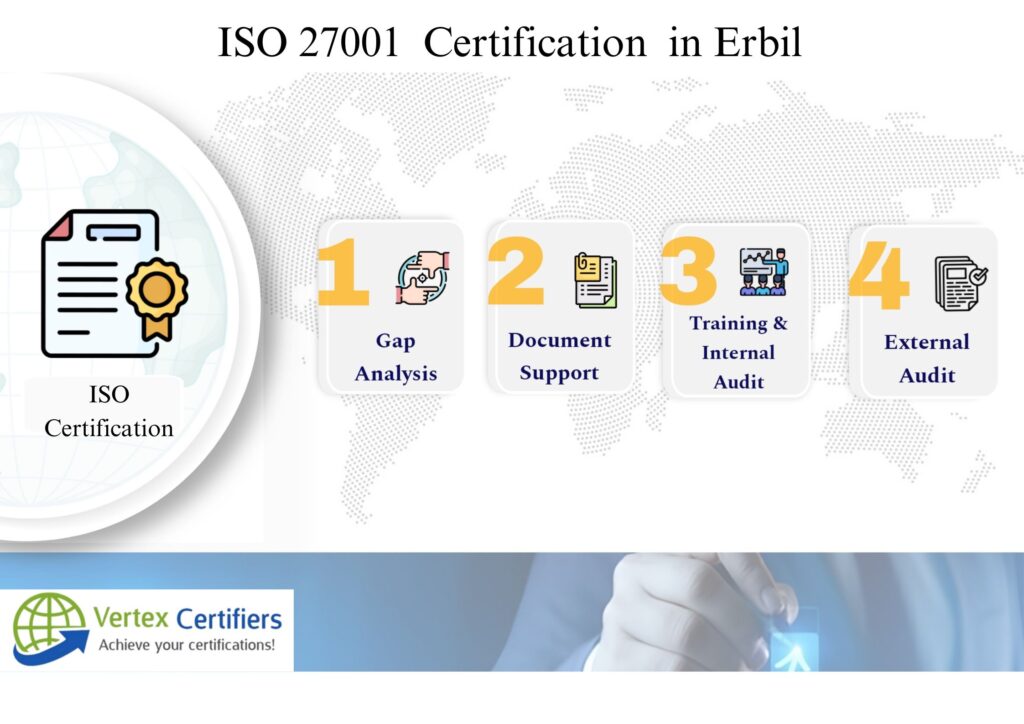
Vertex Certifiers provides end-to-end ISO consulting and certification support for organizations seeking ISO 27001 certification in Erbil. Our approach covers the complete certification journey, from understanding your current system and identifying gaps to implementing the ISMS and preparing your organization for the external certification audit.
Our ISO 27001 services can include:
- ISO 27001 Gap Analysis
- ISMS Documentation
- Information-Security Risk Assessment Support
- Risk Treatment Planning
- ISO 27001 Implementation
- Employee Awareness Training
- Internal Audit
- Management Review Support
- Corrective Action Support
- Certification Audit Preparation
- Certification Support
We focus on a practical, business-oriented implementation approach, helping organizations establish processes and controls that are relevant to their actual operations. Our team can support businesses through the preparation and implementation stages while helping them become ready for an independent certification assessment.
Vertex Certifiers also provides consulting support for a wide range of standards, including ISO 9001, ISO 14001, ISO 45001, ISO 22000, ISO 27001, ISO 22301, ISO 50001, ISO 13485, ISO 20000-1, ISO 41001, ISO 19650, ISO 27701, ISO 37001, and ISO 10002.
Start Your ISO 27001 Certification Journey in Erbil
Let our consultants help you identify your current gaps, establish an effective ISMS, and prepare your organization for certification.
📧 info@vertexcertifiers.com
Contact Our Experts
ISO 27001 Certification Services in Major Areas of Erbil and Kurdistan Region
Vertex Certifiers can support organizations seeking ISO 27001 consulting, implementation, and certification preparation across Erbil and surrounding areas. Our local SEO focus includes the following locations without compromising the usefulness or readability of the content.
ISO 27001 Certification in Erbil
Support for organizations across Erbil seeking to establish and certify an Information Security Management System.
ISO 27001 Certification in Ankawa
ISO 27001 consulting and implementation support for businesses operating in Ankawa and nearby commercial areas.
ISO 27001 Certification in Shaqlawa
Professional support for organizations in Shaqlawa that need a structured approach to information-security management.
ISO 27001 Certification in Koya
ISO 27001 implementation and certification preparation support for organizations operating in Koya.
ISO 27001 Certification in Soran
Consulting support for businesses in Soran seeking to strengthen information-security practices and prepare for ISO 27001 certification.
Frequently Asked Questions About ISO 27001 Certification in Erbil
What is ISO 27001 Certification in Erbil?
ISO 27001 Certification in Erbil is the independent assessment of an organization's Information Security Management System against the requirements of ISO/IEC 27001. It demonstrates that the organization has established and implemented a structured approach to managing information-security risks.
Is ISO 27001 applicable to small businesses in Erbil?
Yes. ISO 27001 can be implemented by organizations of different sizes and sectors. The ISMS should be appropriately scoped according to the organization's business activities, information assets, risks, processes, and requirements.
How much does ISO 27001 certification cost in Erbil?
ISO 27001 project requirements vary between organizations because scope, size, systems, risks, implementation requirements, and audit arrangements differ. Organizations can contact Vertex Certifiers to discuss their specific requirements and receive guidance based on their certification scope.
How long does ISO 27001 certification take?
The timeline depends on the organization's existing information-security practices, ISMS scope, documentation readiness, risk complexity, implementation progress, internal audit, and corrective actions. A gap analysis can help establish a practical certification roadmap.
Is ISO 27001 mandatory in Iraq?
ISO 27001 is generally a voluntary international management-system standard. However, specific customer, contractual, sector, regulatory, or business requirements may make information-security controls or certification important for particular organizations.
What documents are required for ISO 27001?
Depending on the ISMS scope and applicable requirements, documentation can include the ISMS scope, information-security policy, objectives, risk assessment, risk treatment plan, Statement of Applicability, asset inventory, access-control procedures, backup procedures, incident-management procedures, business continuity arrangements, internal audit records, management review records, training records, and corrective action records.
Can a small IT company obtain ISO 27001 certification?
Yes. A small IT company can establish an ISMS appropriate to its size, activities, systems, information assets, and risks and undergo the certification process once the system has been effectively implemented.
Does ISO 27001 certification guarantee protection from cyberattacks?
No. ISO 27001 certification does not eliminate all cybersecurity threats. It provides a systematic framework for identifying, managing, monitoring, and continually improving information-security risks and controls.
Can Vertex Certifiers help with ISO 27001 implementation?
Yes. Vertex Certifiers provides end-to-end ISO 27001 consulting support, including gap analysis, ISMS documentation, risk assessment, risk treatment planning, implementation support, employee awareness training, internal audit, management review support, corrective actions, and certification audit preparation.
Conclusion
Organizations in Erbil are increasingly dependent on digital information, business applications, cloud platforms, networks, and electronic records. As this dependence grows, having a structured approach to information security becomes increasingly important. ISO 27001 Certification in Erbil provides organizations with a recognized framework for identifying information-security risks, protecting sensitive information, implementing appropriate controls, improving employee awareness, preparing for incidents, and continually improving their ISMS.
Successful certification requires more than preparing policies and documentation. Organizations need to implement controls, train employees, conduct internal audits, perform management reviews, address corrective actions, and demonstrate evidence that the ISMS is working effectively.
If your organization is planning ISO 27001 certification in Erbil, Vertex Certifiers can support you from the initial gap assessment through implementation and certification audit preparation. Contact our team today to discuss your requirements and take the next step toward a stronger information-security management system.