Protection against cyber threats
Organizations need a systematic approach to prevent phishing, malware, unauthorized access, ransomware, and insider risks. ISO 27001 helps define controls that reduce exposure and improve detection and response.
ISO 27001 Certification in Greece – ISO 27001 Consultants, Implementation & Certification Services
Vertex Certifiers is an international ISO consulting company providing end-to-end ISO 27001 consulting, implementation, training, internal audits, and certification support for organizations across Greece. Our experienced ISO consultants assist businesses throughout every stage of the certification journey, including gap analysis, information security risk assessment, ISMS documentation, employee awareness training, implementation support, internal audits, management review, and certification audit coordination. We provide practical and cost-effective ISO 27001 consulting services to organizations across Athens, Thessaloniki, Patras, Heraklion, Larissa, Volos, Ioannina, Chania, Kalamata, Rhodes, and other cities throughout Greece.
Greece has a diverse and rapidly evolving economy driven by Information Technology (IT), software development, cloud service providers, FinTech, banking and financial services, shipping and maritime, logistics and supply chain, tourism and hospitality, healthcare, pharmaceuticals, manufacturing, food and beverage, telecommunications, energy and utilities, e-commerce, and Business Process Outsourcing (BPO). As organizations increasingly adopt digital technologies, cloud platforms, and interconnected business systems, protecting sensitive information and ensuring cyber resilience have become essential for sustainable business growth. ISO/IEC 27001:2022 helps organizations establish robust information security controls, effectively manage cyber risks, and comply with evolving customer, contractual, and regulatory expectations.
Organizations operating in Greece must safeguard valuable business assets, including customer information, financial records, intellectual property, employee data, operational systems, and digital infrastructure. ISO 27001 promotes a risk-based approach to information security by identifying vulnerabilities, implementing appropriate security controls, monitoring risks, and continually improving the effectiveness of the Information Security Management System. This enables businesses to reduce security incidents, improve resilience against cyber threats, maintain business continuity, strengthen supplier confidence, and create new opportunities in both domestic and international markets.
ISO/IEC 27001:2022 is the internationally recognized standard for establishing, implementing, maintaining, and continually improving an Information Security Management System (ISMS). Published by the International Organization for Standardization (ISO) and the International Electrotechnical Commission (IEC), the standard provides organizations with a structured framework to identify information security risks, implement effective controls, and protect information assets against evolving cyber threats. ISO 27001 is applicable to organizations of all sizes and industries, including IT companies, financial institutions, healthcare providers, manufacturers, logistics companies, government contractors, and service organizations.
An Information Security Management System (ISMS) is a comprehensive management framework that integrates policies, procedures, processes, technology, and people to protect organizational information. The objective of an ISMS is to ensure the confidentiality, integrity, and availability (CIA) of information assets. Confidentiality ensures that sensitive information is accessible only to authorized individuals, integrity protects data from unauthorized modification or corruption, and availability ensures that critical information and systems remain accessible whenever required for business operations.
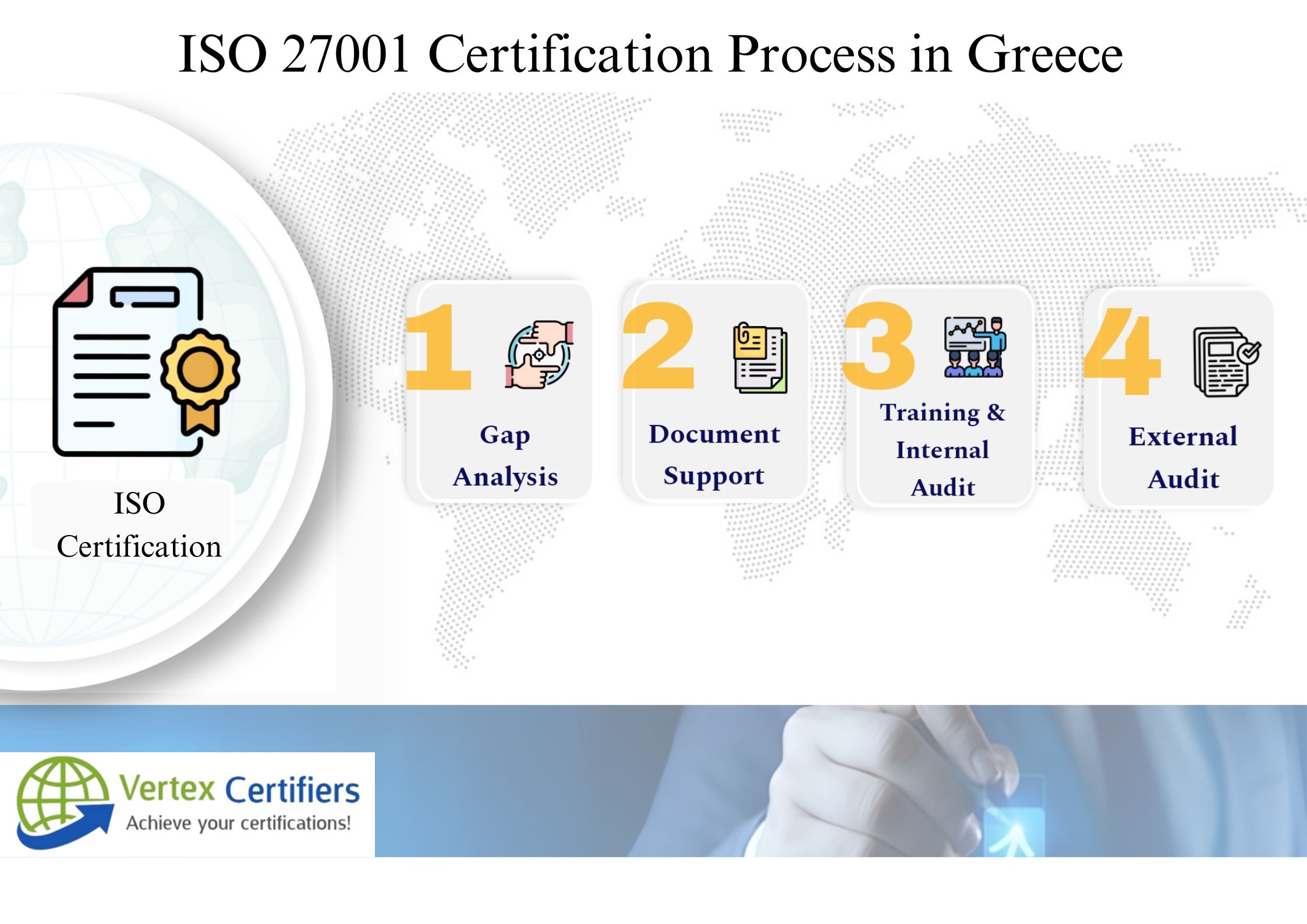
Obtaining ISO/IEC 27001 Certification in Greece involves a systematic implementation process designed to establish an effective Information Security Management System that complies with international best practices.
The certification journey begins with understanding the organization’s business operations, information assets, regulatory obligations, existing security practices, and certification objectives. A project scope, implementation plan, and certification timeline are established.
A comprehensive gap analysis is conducted to compare the organization’s current information security practices with the requirements of ISO/IEC 27001:2022. Areas requiring improvement are identified, and a detailed implementation roadmap is developed.
Information assets, business processes, vulnerabilities, and potential threats are identified and evaluated. The organization performs a formal risk assessment to determine security risks and develops appropriate risk treatment plans to reduce identified risks.
The required Information Security Management System documentation is developed, including information security policies, objectives, procedures, risk assessment reports, Statement of Applicability (SoA), asset inventories, incident management procedures, access control policies, business continuity procedures, and other documented information required by ISO 27001.
The documented Information Security Management System is implemented throughout the organization. Security controls, operational procedures, technical safeguards, monitoring mechanisms, and risk treatment measures are integrated into daily business operations to protect information assets effectively.
Employees receive information security awareness training covering ISO 27001 requirements, cybersecurity best practices, password management, phishing awareness, data protection responsibilities, incident reporting, and organizational security policies to ensure successful implementation.
An internal audit is conducted to evaluate the effectiveness of the implemented ISMS, verify compliance with ISO/IEC 27001 requirements, identify nonconformities, and recommend corrective actions before the certification audit.
Top management reviews the performance of the Information Security Management System, including audit results, information security objectives, risk treatment effectiveness, security incidents, compliance status, resource requirements, and continual improvement opportunities.
An accredited certification body conducts the certification audit in two stages. Stage 1 evaluates the organization’s documented Information Security Management System, while Stage 2 verifies the practical implementation and effectiveness of the ISMS across the organization.
After successfully completing the certification audit and addressing any identified nonconformities, the organization is awarded ISO/IEC 27001 Certification. The certification demonstrates that the organization has implemented an internationally recognized Information Security Management System capable of protecting sensitive information, managing cybersecurity risks, supporting business continuity, and maintaining continual improvement through regular surveillance audits.


Vertex Certifiers supports Greek organizations with ISO 27001 consulting, implementation, employee awareness, internal audits, risk assessment, and certification support. Greece’s National Cybersecurity Authority has responsibility for monitoring compliance with cybersecurity legislation and implementing the NIS2 framework, making structured security governance especially important [page:1].
ISO 27001 is important for Greek organizations because it creates a structured way to protect sensitive information, respond to cyber threats, and demonstrate responsible governance. It is especially valuable in a country where cybersecurity oversight, mandatory requirements for essential and important entities, and EU-aligned compliance expectations are actively enforced by the National Cybersecurity Authority [page:1].
Organizations need a systematic approach to prevent phishing, malware, unauthorized access, ransomware, and insider risks. ISO 27001 helps define controls that reduce exposure and improve detection and response.
ISO 27001 supports GDPR-aligned handling of personal and sensitive data while also helping organizations meet information security requirements expected by customers and regulators. It provides a practical structure for policies, controls, records, and accountability [page:2].
Clients and partners trust organizations more when they can show a certified security management system. Certification signals that information is handled carefully and that security is taken seriously.
The standard requires structured risk assessment and treatment, which helps organizations prioritize what matters most. This reduces guesswork and supports smarter security investments.
ISO 27001 helps organizations prepare for incidents, limit disruption, and restore operations faster. This is valuable for businesses that depend on digital systems, third-party platforms, or time-sensitive services.
Companies can better protect customer data, financial records, employee records, trade secrets, and operational documents. Strong access controls and clear procedures reduce the chance of misuse or leakage.
Certification helps Greek organizations stand out in procurement, vendor assessments, and sector comparisons. It often improves credibility during tenders and supplier evaluations.
ISO 27001 is widely recognized in global markets, so certification can support cross-border sales, partnerships, and outsourcing relationships. It is particularly useful for digitally delivered services and export-oriented sectors [page:2].
The standard strengthens accountability, leadership oversight, documented policies, and review cycles. This improves internal discipline and security ownership at management level.
When controls, training, and monitoring are in place, organizations are less likely to face frequent incidents. Fewer incidents usually means lower downtime, lower cost, and less reputational damage.
Any organization that stores, processes, transmits, or relies on sensitive data can benefit from ISO 27001. The following sectors in Greece are especially relevant for certification because they handle critical information, customer records, financial data, or digitally dependent operations.
ISO 27001 gives organizations a complete framework for managing information security risk, improving day-to-day control, and strengthening trust with customers and stakeholders. It also aligns well with modern expectations for cybersecurity governance and regulated data handling [page:1][page:2].
The ISMS helps organizations protect systems, users, endpoints, cloud resources, records, and networks with defined controls and responsibilities. This reduces weak spots created by informal practices.
Security controls, awareness, monitoring, and incident response reduce the likelihood and impact of cyberattacks. This is essential for organizations exposed to external and internal threats.
By managing access, encryption, asset handling, supplier access, and security events, the organization lowers the chance of unauthorized disclosure. Strong processes also support faster containment if an issue occurs.
ISO 27001 supports compliance with GDPR, contractual security obligations, and broader cybersecurity requirements. It gives organizations a documented way to prove they manage security responsibly [page:1][page:2].
Certified organizations often appear more trustworthy to clients, vendors, and regulators because they can demonstrate a mature security posture. This is especially important in outsourcing and digital service markets.
The standard helps organizations prepare for incidents and continue operating under pressure. Clear controls, backups, and recovery expectations support resilience during outages or attacks.
Risk-based thinking helps leaders focus on the most important threats and protect the most valuable assets first. This makes security spending and action plans more effective.
Vendor controls help businesses assess third-party risk, define expectations, and monitor outsourced service providers. This reduces exposure created by weak suppliers or partners.
Clear procedures, responsibilities, and documentation reduce confusion and repetitive rework. Security becomes part of normal operations instead of an emergency response activity.
ISO 27001 is recognized internationally and can help open doors to new customers, partnerships, and tenders. It is often used as a prequalification requirement in B2B deals [page:2].
Certification enhances the image of the organization by showing professionalism, discipline, and concern for data protection. This can improve relationships with customers, investors, and employees.
The standard requires monitoring, audits, management review, and corrective action so the ISMS keeps improving over time. That makes security a living program, not a one-time project.
ISO 27001 uses a management system structure that combines leadership, planning, controls, and performance review. Below is a brief explanation of the major requirements organizations typically implement.
The organization identifies internal and external issues, interested parties, scope, and security needs that affect the ISMS.
Top management sets direction, provides resources, assigns responsibility, and demonstrates commitment to information security.
The organization defines a policy that states its security objectives, commitments, and governance principles.
Information security risks are identified, analyzed, and prioritized so the organization knows which threats require treatment first.
The organization selects actions and controls to reduce, transfer, avoid, or accept risks according to its risk criteria.
This includes awareness, competence, communication, documented information, and the resources required to run the ISMS.
The organization applies and maintains controls to manage information security risks in day-to-day operations.
The business monitors, measures, analyzes, and evaluates ISMS performance to confirm controls are effective.
Internal audits check whether the ISMS is implemented correctly and follows both ISO requirements and company procedures.
Top management reviews risks, audit results, incidents, performance data, and improvement opportunities.
The organization acts on nonconformities, lessons learned, and performance trends to strengthen the ISMS.
The SoA lists applicable Annex A controls, explains why each control is included or excluded, and shows how controls are managed.
Annex A contains the control set used to address security risks, including organizational, people, physical, and technological controls.
Vertex Certifiers supports organizations throughout Greece with implementation planning, security documentation, internal audits, training, and certification readiness support.
Vertex Certifiers serves a wide range of sectors in Greece with ISO 27001 consulting and certification support.
Vertex Certifiers provides ISO 27001 consulting, implementation, employee training, internal audits, risk assessment, and certification support across Greece.
We support Athens-based organizations with ISO 27001 consulting, ISMS implementation, training, internal audits, and certification coordination for digital and service-driven businesses.
Our ISO 27001 services in Thessaloniki help companies strengthen cybersecurity governance, improve risk control, and prepare for certification success.
Vertex assists organizations in Patras with information security documentation, risk assessment, employee awareness, and practical ISO 27001 implementation.
We provide ISO 27001 support in Heraklion for businesses seeking better data protection, compliance, and stronger customer confidence.
Vertex Certifiers delivers ISO 27001 consulting in Larissa for companies that want a structured ISMS and better control over information security risk.
Our Volos services include ISO 27001 gap assessment, policy development, internal audit support, and certification readiness assistance.
We help Ioannina organizations implement ISO 27001 efficiently with remote and onsite support tailored to the business environment.
Vertex supports Chania-based organizations with ISMS documentation, training, risk treatment, and ongoing compliance support.
Our ISO 27001 consulting in Kalamata is designed for businesses that need practical cybersecurity controls and audit-ready processes.
We provide ISO 27001 implementation and certification support in Rhodes for organizations across tourism, services, and digitally dependent sectors.
ISO 27001 Certification confirms that an organization has established and implemented an Information Security Management System designed to protect information assets, manage risk, and improve security over time [page:2].
It is relevant for organizations that store, process, or rely on sensitive data, especially IT, software, cloud, finance, healthcare, telecom, logistics, government contractors, and digital businesses.
The timeline depends on the scope, number of locations, maturity of current controls, available resources, and how quickly documentation and risk treatment can be completed.
Costs vary based on company size, system scope, consulting support required, and certification body fees. Smaller organizations usually need less implementation effort than larger multi-site operations.
ISO 27001 certification is generally voluntary, but many clients, tenders, and regulated environments expect strong information security controls. Greek organizations may also need to satisfy legal and regulatory cybersecurity expectations [page:1].
An ISMS is the management framework used to protect information by combining policy, risk management, controls, responsibilities, monitoring, and continual improvement.
The SoA is a document that lists Annex A controls, identifies which ones are applied, and explains why they are included or excluded.
It supports structured control of personal data, access management, incident handling, documentation, and accountability, which helps organizations meet GDPR-aligned security obligations [page:2].
Certificates are typically issued for a fixed cycle and maintained through surveillance audits and ongoing compliance with the ISMS requirements.
Annex A controls are the information security controls used to manage and reduce risk across organizational, people, physical, and technological areas.
Yes, small businesses can obtain certification if they implement controls proportionate to their risks, size, and operations.
Vertex Certifiers supports the full process with gap assessment, documentation, risk treatment, asset identification, awareness training, audits, corrective action support, certification audit coordination, and post-certification support across Greece.
Vertex Certifiers provides end-to-end ISO/IEC 27001:2022 Information Security Management System (ISMS) consulting, risk assessment, ISMS documentation, implementation, employee awareness training, internal audits, and certification support for organizations across Greece.
Whether you operate in IT, software development, cloud services, banking, healthcare, logistics, manufacturing, telecommunications, shipping & maritime, or other industries, our experienced ISO consultants will help you achieve ISO 27001 certification efficiently with practical, cost-effective solutions.
WhatsApp us