Why is ISO 27001 Certification Important in Ivory Coast?
As businesses in Côte d’Ivoire continue to adopt digital technologies, information security has become an important part of business management. Organizations increasingly depend on cloud services, databases, enterprise applications, digital platforms, online transactions, and interconnected IT infrastructure. ISO 27001 certification in Ivory Coast provides a systematic approach for identifying information-security risks and implementing appropriate controls to protect critical information and systems.
Increasing Digitalization of Ivorian Businesses
Organizations across Ivory Coast are increasingly using digital infrastructure to deliver services, communicate with customers, manage operations, and store business information. Cloud platforms, enterprise applications, databases, online services, digital payments, and remote-access technologies have improved business efficiency but have also created additional information-security risks.
ISO 27001 helps organizations establish a structured Information Security Management System (ISMS) that considers technology, people, processes, and organizational responsibilities. Instead of relying only on individual cybersecurity tools, businesses can develop a coordinated approach to managing information-security risks.
Protecting Sensitive Business Information
Organizations handle different types of information that require appropriate protection. An ISO 27001-based ISMS helps businesses identify critical information assets and establish controls according to their security requirements.
- Customer information
- Employee records
- Financial information
- Intellectual property
- Contracts and business documents
- Business strategies and confidential information
- Passwords and access credentials
- Digital and operational records
By applying appropriate access controls, information classification, security procedures, monitoring, backup practices, and employee responsibilities, organizations can reduce the likelihood and impact of information-security incidents.
Addressing Cybersecurity Risks
Cybersecurity threats can affect organizations of every size and across different industries. Common risks include phishing attacks, malware, ransomware, unauthorized access, insider threats, data breaches, social engineering, and system failures.
ISO 27001 requires organizations to take a risk-based approach to information security. This means identifying relevant threats and vulnerabilities, evaluating their potential impact, and determining appropriate measures to manage identified risks. The result is a more structured and proactive approach to cybersecurity rather than responding to incidents only after they occur.
Supporting Côte d’Ivoire's Data-Protection Requirements
Côte d’Ivoire's Law No. 2013-450 of 19 June 2013 relating to the protection of personal data establishes requirements concerning the processing and protection of personal information. The law addresses principles including lawful and fair processing, transparency, confidentiality, and protection of personal data. :contentReference[oaicite:1]{index=1}
ISO 27001 can support organizations in managing information-security and privacy-related risks through controls and processes covering access management, information handling, risk assessment, incident management, supplier security, employee awareness, and information-security governance.
However, ISO 27001 certification does not replace compliance with Côte d’Ivoire's data-protection laws or other applicable legal requirements. Organizations should identify their specific regulatory and contractual obligations and ensure that their ISMS supports those requirements.
Supporting National Information-Security Expectations
Côte d’Ivoire has established the Référentiel Général de Sécurité des Systèmes d’Information (RGSSI) as a national information-security framework. According to Côte d’Ivoire's ANSSI, the RGSSI defines organizational and technical security rules applicable to public administrations, private organizations, and critical infrastructure, and is inspired by ISO 27001 and ISO 27002. :contentReference[oaicite:2]{index=2}
The RGSSI was adopted through Decree No. 2021-916 of 22 December 2021, alongside the Plan de Protection des Infrastructures Critiques. :contentReference[oaicite:3]{index=3}
For organizations operating in Ivory Coast, ISO 27001 can therefore provide a structured international management-system approach while businesses separately assess their obligations under applicable Ivorian cybersecurity and data-protection requirements.
Key Requirements of ISO 27001:2022
ISO/IEC 27001:2022 establishes requirements for creating, implementing, maintaining, and continually improving an Information Security Management System. The requirements cover organizational context, leadership, risk management, supporting processes, operational controls, performance evaluation, and continual improvement.
Context of the Organization
The organization must understand the internal and external factors that can affect its information-security objectives. It must also identify relevant interested parties and determine the appropriate scope of the ISMS.
- Internal and external issues
- Interested parties
- ISMS scope
- Information-security objectives
Defining the context and scope helps ensure that the ISMS is aligned with the organization's actual operations, risks, information assets, and business objectives.
Leadership and Commitment
Top management plays an important role in the successful implementation of ISO 27001. Management must demonstrate commitment to information security, establish appropriate policies, assign responsibilities, and ensure that necessary resources are available.
- Top-management involvement
- Information-security policy
- Roles and responsibilities
- Accountability
Information Security Risk Assessment
Risk assessment is one of the central elements of ISO 27001. Organizations need to establish a systematic process for identifying and evaluating information-security risks.
The assessment may consider:
- Information assets
- Threats
- Vulnerabilities
- Potential business impacts
- Likelihood of occurrence
- Overall information-security risks
This process allows organizations to prioritize significant risks and determine appropriate treatment measures.
Risk Treatment
After information-security risks have been identified and evaluated, the organization determines how those risks should be treated. Depending on the circumstances, treatment may involve reducing, avoiding, transferring, or accepting a risk.
- Risk-treatment plans
- Selection of security controls
- Risk acceptance
- Risk mitigation
- Risk avoidance
- Risk transfer
Annex A Controls
ISO 27001:2022 includes Annex A controls that organizations can consider when determining appropriate information-security measures. The controls are organized into four themes:
- Organizational controls
- People controls
- Physical controls
- Technological controls
The selection of applicable controls should be based on the organization's information-security risks, requirements, and risk-treatment decisions. The Statement of Applicability records these decisions and provides an important link between the organization's risk assessment and its selected controls.
Performance Evaluation and Continual Improvement
ISO 27001 requires organizations to monitor and evaluate the performance of their ISMS. This helps management determine whether information-security processes and controls are achieving their intended results.
- Monitoring
- Measurement
- Internal audits
- Management reviews
- Corrective actions
- Continual improvement
Continual improvement ensures that the ISMS remains effective as the organization's technology, business environment, regulatory obligations, and cybersecurity risks evolve.
Benefits of ISO 27001 Certification in Ivory Coast
ISO 27001 certification can provide both security and business benefits for organizations operating in Ivory Coast. By establishing a formal ISMS, organizations can move toward a structured and risk-based approach to information security.
Improved Information Security
ISO 27001 helps organizations establish policies, processes, responsibilities, and controls for protecting important information and information-processing systems.
Better Cybersecurity Risk Management
A risk-based ISMS enables organizations to identify significant information-security risks, prioritize them, implement appropriate treatment measures, and monitor their effectiveness.
Protection of Customer and Personal Data
Appropriate information-security controls can help organizations protect customer and employee information from unauthorized access, accidental loss, disclosure, alteration, or other security incidents.
Increased Customer Trust
Independent ISO 27001 certification demonstrates that an organization has established a formal information-security management system assessed by an external certification body. This can strengthen confidence among customers, suppliers, partners, and other stakeholders.
Competitive Advantage
ISO 27001 certification can help businesses demonstrate their commitment to internationally recognized information-security practices and differentiate themselves when responding to customer requirements or business opportunities.
Improved Business Continuity
Information-security risk management can support organizational resilience by addressing risks associated with system failures, loss of information, cybersecurity incidents, and disruption of critical services.
Stronger Supplier and Third-Party Management
Organizations can establish processes for evaluating and managing information-security risks associated with suppliers, contractors, cloud-service providers, and other external parties.
Support for Regulatory and Contractual Requirements
An effective ISMS can help organizations systematically identify legal, regulatory, contractual, and customer information-security requirements and incorporate relevant obligations into their security processes.
Improved International Business Opportunities
For Ivorian organizations working with multinational companies and international customers, ISO 27001 certification can provide independent evidence of a structured approach to information security. This can support customer due diligence, supplier evaluations, contractual requirements, and international business relationships.
Who Needs ISO 27001 Certification in Ivory Coast?
ISO 27001 can be implemented by organizations of different sizes and across a wide range of industries. It is particularly relevant to businesses that collect, process, store, transmit, or manage sensitive information.
- IT companies
- Software companies
- Fintech organizations
- Banks and financial institutions
- Insurance companies
- Telecommunications companies
- E-commerce businesses
- Healthcare organizations
- Logistics companies
- Manufacturing companies
- Professional-service organizations
- Government contractors
- Cloud-service providers
- Data-processing organizations
- Organizations handling sensitive customer information
Whether an organization operates in Abidjan or elsewhere in Côte d’Ivoire, the ISMS can be appropriately scoped according to its business activities, information assets, technology environment, and security risks.
ISO 27001 Certification Requirements for Businesses in Ivory Coast
Organizations preparing for ISO 27001 certification should establish and maintain the key components of an effective ISMS. A practical readiness checklist includes:
- Defined ISMS scope
- Information-security policy
- Information-security risk assessment
- Risk treatment process
- Statement of Applicability
- Applicable information-security controls
- Documented policies and procedures
- Employee competence and awareness
- Internal audit
- Management review
- Corrective actions
- Continual improvement
Certification readiness is not limited to having documents in place. Organizations should also be able to demonstrate that relevant processes and controls are implemented, maintained, monitored, and supported by appropriate evidence.
How Long Does ISO 27001 Certification Take in Ivory Coast?
There is no universal implementation period for ISO 27001 certification. The timeline depends on the organization's size, ISMS scope, existing security controls, IT infrastructure, number of locations, regulatory environment, and overall information-security maturity.
For planning purposes, organizations may consider the following indicative implementation ranges:
- Small organization: approximately 2–4 months
- Medium organization: approximately 4–6 months
- Large or complex organization: approximately 6–12+ months
These are planning estimates rather than guaranteed certification timelines. Organizations with mature security practices and well-defined processes may progress more quickly, while complex environments may require additional time for implementation, testing, internal audits, and corrective actions.
ISO 27001 Certification vs RGSSI in Côte d’Ivoire
ISO 27001 and RGSSI are related but are not the same framework. ISO 27001 is an internationally recognized standard for establishing and continually improving an Information Security Management System. The RGSSI is Côte d’Ivoire's national information-security framework. ANSSI states that the RGSSI is inspired by ISO 27001 and ISO 27002. :contentReference[oaicite:4]{index=4}
| ISO 27001 | RGSSI |
|---|
| International information-security standard | Côte d’Ivoire's national information-security framework |
| Focused on establishing and improving an ISMS | Defines national organizational and technical security requirements |
| Certification is conducted through independent certification bodies | Forms part of Côte d’Ivoire's national cybersecurity framework |
| Can support international customer and contractual requirements | Particularly relevant to applicable organizations and systems operating in Côte d’Ivoire |
| Uses a risk-based management-system approach | Provides organizational and technical security requirements |
Organizations should not automatically treat ISO 27001 certification as a substitute for RGSSI or other applicable Ivorian obligations. Depending on the organization's activities and regulatory position, ISO 27001 and the RGSSI may need to be considered together as part of a broader information-security strategy.
ISO 27001 and Côte d’Ivoire Data Protection Law
Côte d’Ivoire's data-protection framework is an important consideration for organizations processing personal information. Law No. 2013-450 addresses the protection of personal data and establishes principles relating to the lawful and fair processing, transparency, confidentiality, and protection of personal information. :contentReference[oaicite:5]{index=5}
ISO 27001 can support organizations in establishing systematic processes for:
- Personal-data protection
- Data confidentiality
- Security of information processing
- Access controls
- Data handling
- Information-security incident management
- Employee awareness
- Risk management
- Third-party and supplier management
Organizations should assess their individual obligations under applicable Ivorian data-protection requirements. ISO 27001 should be viewed as a management-system framework that can support information-security governance, rather than as a replacement for applicable laws and regulatory requirements.
Common Challenges in Implementing ISO 27001 in Ivory Coast
Lack of Information-Security Awareness
Employees may not fully understand their responsibilities for protecting organizational information. Awareness programs can help establish stronger security practices across the workforce.
Limited Cybersecurity Expertise
Some organizations may lack dedicated information-security resources. Professional ISO 27001 consultants can provide structured guidance and implementation support.
Identifying and Assessing Information Risks
Organizations may find it difficult to identify all relevant information assets, threats, vulnerabilities, and business impacts. A structured risk-assessment methodology can help address this challenge.
Documentation and Evidence Requirements
Creating appropriate documentation and maintaining objective evidence can be challenging. Documentation should support actual processes rather than exist only for certification purposes.
Employee Resistance to New Security Procedures
New access controls, policies, approval processes, and security responsibilities can create resistance. Training, communication, and management involvement can help employees understand the purpose of these requirements.
Managing Third-Party and Cloud-Service Risks
Organizations increasingly depend on external providers. Supplier evaluation and appropriate contractual and security controls can help manage risks associated with third-party services and cloud environments.
Maintaining the ISMS After Certification
ISO 27001 certification is not the end of information-security management. Organizations need to continue monitoring risks, conducting internal audits, reviewing performance, addressing incidents, and improving their ISMS.
How to Choose an ISO 27001 Certification Consultant in Ivory Coast
Choosing the right ISO 27001 consultant can make the implementation process more structured and efficient. Businesses should evaluate a consultant based on practical experience, technical understanding, implementation methodology, and ability to support the organization throughout the certification journey.
Important factors include:
- ISO 27001 expertise
- Qualified Lead Auditor or Lead Implementer competence
- Experience across different industries
- Understanding of relevant local regulatory requirements
- Practical implementation methodology
- ISMS documentation support
- Employee training and awareness
- Internal audit support
- Certification-body coordination
- Clear and transparent service scope
- Post-certification support
A good consultant should focus on helping the organization build a practical ISMS that works within its existing business environment rather than simply preparing documents for an audit.
Why Choose Vertex Certifiers for ISO 27001 Certification in Ivory Coast?
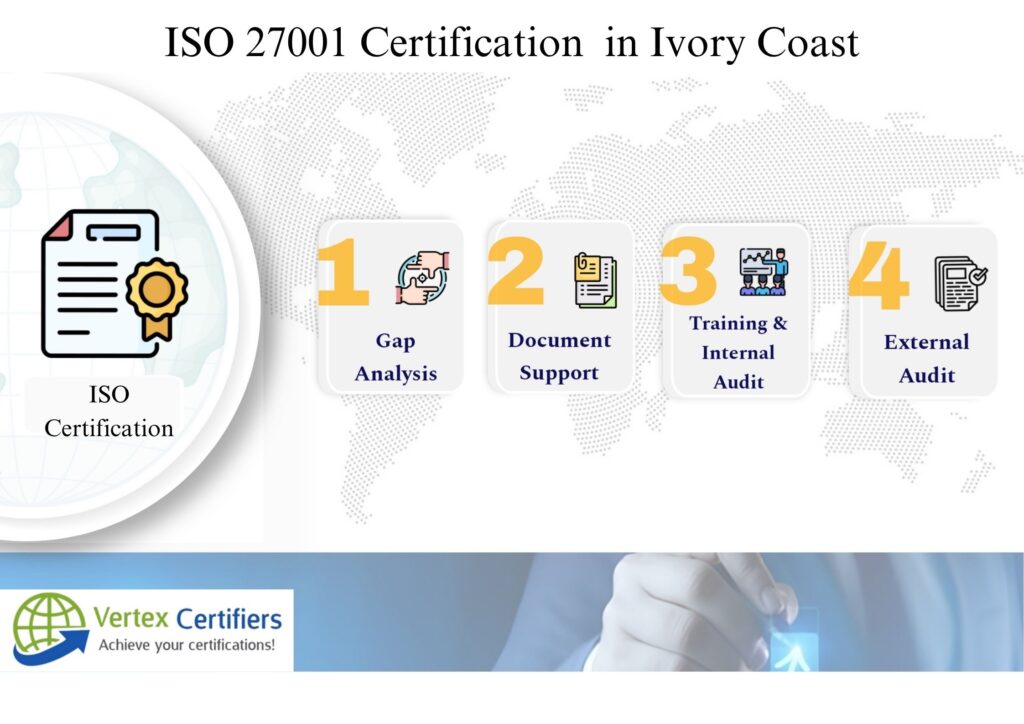
Vertex Certifiers provides end-to-end ISO 27001 certification consulting services for organizations in Ivory Coast. Our experienced consultants help businesses understand ISO 27001 requirements, identify information-security gaps, implement appropriate processes and controls, and prepare effectively for independent certification.
Our ISO 27001 support can cover the complete certification journey, including:
- Gap Analysis
- ISMS Documentation
- Information-Security Risk Assessment
- Risk Treatment
- ISO 27001 Training
- Implementation Support
- Internal Audit
- Management Review Support
- Certification Audit Preparation
- Certification Body Coordination
- Corrective Action Support
- Continual Improvement
We focus on practical implementation, experienced consulting support, efficient certification preparation, and solutions aligned with each organization's requirements. Whether you are implementing ISO 27001 for the first time or improving an existing information-security system, Vertex Certifiers can support your organization from initial assessment through certification readiness.
Ready to Start ISO 27001 Certification in Ivory Coast?
Speak with Vertex Certifiers for professional, end-to-end ISO 27001 certification support tailored to your organization's information-security requirements.
Email Us
Contact Us
Frequently Asked Questions About ISO 27001 Certification in Ivory Coast
What is ISO 27001 certification in Ivory Coast?
ISO 27001 certification confirms that an organization's Information Security Management System has been independently assessed against the requirements of ISO/IEC 27001 by a competent certification body.
Is ISO 27001 mandatory in Ivory Coast?
ISO 27001 is not universally mandatory for every organization. However, specific organizations may have applicable legal, regulatory, contractual, customer, or industry-specific information-security requirements. Businesses should assess the obligations applicable to their activities.
How long does ISO 27001 certification take?
The timeline depends on the organization's size, ISMS scope, existing security controls, IT environment, number of locations, and implementation readiness. Smaller organizations with mature processes may generally progress faster than large or complex organizations.
Can a small business in Ivory Coast get ISO 27001 certification?
Yes. ISO 27001 can be implemented by organizations of different sizes. The ISMS should be appropriately scoped according to the organization's activities, information assets, risks, and business requirements.
What documents are required for ISO 27001 certification?
Typical ISMS documentation can include the information-security policy, ISMS scope, risk-assessment methodology, risk register, risk-treatment plan, Statement of Applicability, relevant policies and procedures, internal-audit records, management-review records, and evidence of implemented controls.
Is ISO 27001 certification applicable to IT companies in Abidjan?
Yes. ISO 27001 can be particularly relevant to IT and software companies in Abidjan that manage customer information, applications, cloud infrastructure, databases, intellectual property, credentials, or other sensitive information.
What is the difference between ISO 27001 and RGSSI in Côte d’Ivoire?
ISO 27001 is an international standard for establishing and continually improving an Information Security Management System, while RGSSI is Côte d’Ivoire's national information-security framework. ANSSI states that the RGSSI is inspired by ISO 27001 and ISO 27002. :contentReference[oaicite:6]{index=6}
Does ISO 27001 help with Côte d’Ivoire's data-protection requirements?
ISO 27001 can help organizations systematically manage information-security and privacy-related risks through policies, risk assessment, access controls, incident management, supplier controls, employee awareness, and other security measures. However, ISO 27001 certification does not replace compliance with applicable Côte d’Ivoire data-protection laws.
Who issues ISO 27001 certificates?
ISO 27001 certificates are issued by independent certification bodies following an assessment of the organization's ISMS. ISO itself does not directly issue individual organization certificates.
Is ISO 27001:2022 the current version?
Yes. Organizations pursuing new ISO 27001 certification should implement the applicable requirements of ISO/IEC 27001:2022.
Conclusion
As digital transformation continues across Côte d’Ivoire, organizations need a systematic approach to protecting information, managing cybersecurity risks, and maintaining the availability and integrity of critical systems. ISO 27001 certification in Ivory Coast provides an internationally recognized framework for establishing an effective Information Security Management System and strengthening information-security governance.
From risk assessment and access control to employee awareness, incident management, supplier security, internal audits, and continual improvement, ISO 27001 helps organizations establish information-security practices that are integrated into everyday business operations. It can also support customer confidence, business resilience, international opportunities, and the systematic management of applicable security requirements.
For organizations operating in Côte d’Ivoire, ISO 27001 should be considered alongside applicable national requirements, including the RGSSI and data-protection framework. A properly implemented ISMS can provide a strong foundation for managing information-security risks while supporting the organization's wider business objectives.
Vertex Certifiers provides end-to-end ISO 27001 consulting and certification support in Ivory Coast, from gap analysis and risk assessment to documentation, implementation, training, internal audit, and certification audit preparation. Contact our team today to discuss your ISO 27001 certification requirements and start building a stronger information-security management system.
Start Your ISO 27001 Certification Journey Today
Get professional guidance from Vertex Certifiers for ISO 27001 certification in Ivory Coast.
Email Us
Contact Us