
ISO 37001 Certification in Philippines:
ISO 37001 Certification in Philippines, Vertex Certifiers provides comprehensive end-to-end ISO certification and consulting services across the Philippines, supporting organizations from initial gap analysis and documentation to implementation, internal audits, training, and final certification audits. In addition to ISO 37001 Anti-Bribery Management Systems, Vertex Certifiers delivers expert consulting for ISO 9001 (Quality Management), ISO 14001 (Environmental Management), ISO 45001 (Occupational Health & Safety), ISO 27001 (Information Security), ISO 22000 (Food Safety), ISO 20000 (IT Service Management), and ISO 22301 (Business Continuity), tailored to diverse industries. Our services are available to businesses in major commercial hubs including Manila, Makati, Quezon City, Cebu City, Davao City, Taguig, and Pasig, helping organizations achieve compliance, strengthen governance, and build globally trusted management systems with minimal disruption.
Businesses in Philippines are increasingly focusing on transparency, ethical governance, and anti-bribery compliance due to growing international trade, foreign investments, and stricter regulatory expectations. ISO 37001 certification helps organizations establish an effective Anti-Bribery Management System (ABMS) that prevents, detects, and addresses bribery risks across operations.
Companies working with multinational clients, government agencies, infrastructure projects, and international supply chains often require strong compliance systems to maintain credibility and reduce corruption-related risks. ISO 37001 certification demonstrates a company’s commitment to ethical business practices and regulatory compliance.
Organizations in Metro Manila, Cebu, Davao, and other major business hubs are adopting ISO 37001 to improve corporate governance and strengthen stakeholder confidence.
Major business hubs like Manila, Makati, Quezon City, Cebu, Davao, Taguig, and Pasig host thriving sectors such as construction, manufacturing, and BPOs. Here, ISO 37001 Certification in Manila, ISO 37001 Certification in Makati, and similar pursuits in Cebu and Davao signal a commitment to ethical operations. As the Philippines strengthens its regulatory framework, adopting ISO 37001 helps organizations navigate compliance challenges while enhancing their market position.
What is ISO 37001?
ISO 37001 is an internationally recognized standard that outlines requirements for establishing, implementing, maintaining, and improving an Anti-Bribery Management System. Published by the International Organization for Standardization (ISO), it provides a framework to prevent, detect, and address bribery across all forms—whether involving public or private entities.
The standard’s purpose centers on promoting a culture of integrity. Key components include leadership commitment, risk-based controls, and ongoing evaluation. It applies to organizations of any size or sector, helping them prevent bribery, corruption, and unethical practices. By integrating ISO 37001, businesses in the Philippines can demonstrate proactive measures against illicit activities, aligning with global best practices.
For instance, a construction firm in Quezon City might use ISO 37001 to standardize due diligence processes, ensuring fair dealings in project bids. This not only mitigates risks but also builds trust with partners.
Why ISO 37001 is Important in the Philippines
The Philippines grapples with anti-corruption initiatives, making ISO 37001 particularly relevant. Government regulations emphasize transparency, especially in public procurement and infrastructure projects. Compliance with laws like the Anti-Graft and Corrupt Practices Act aligns seamlessly with ISO 37001 principles.
Foreign investors often require certified ethical standards, boosting appeal for multinational partnerships. Sectors like construction, procurement, and public projects demand high integrity due to their scale and public scrutiny. In bustling areas like Taguig and Pasig, where business activity surges, ISO 37001 Certification in Taguig or Pasig positions companies as reliable players.
Moreover, as the economy grows, stakeholders prioritize ethical governance. ISO 37001 addresses this by fostering accountability, reducing exposure to legal penalties, and supporting sustainable development in cities like Cebu and Davao.
Step by Step Process to get ISO 37001 Certification in Philippines
Obtaining ISO 37001 Certification in the Philippines involves a systematic process. Accredited bodies oversee audits, ensuring adherence to the standard:
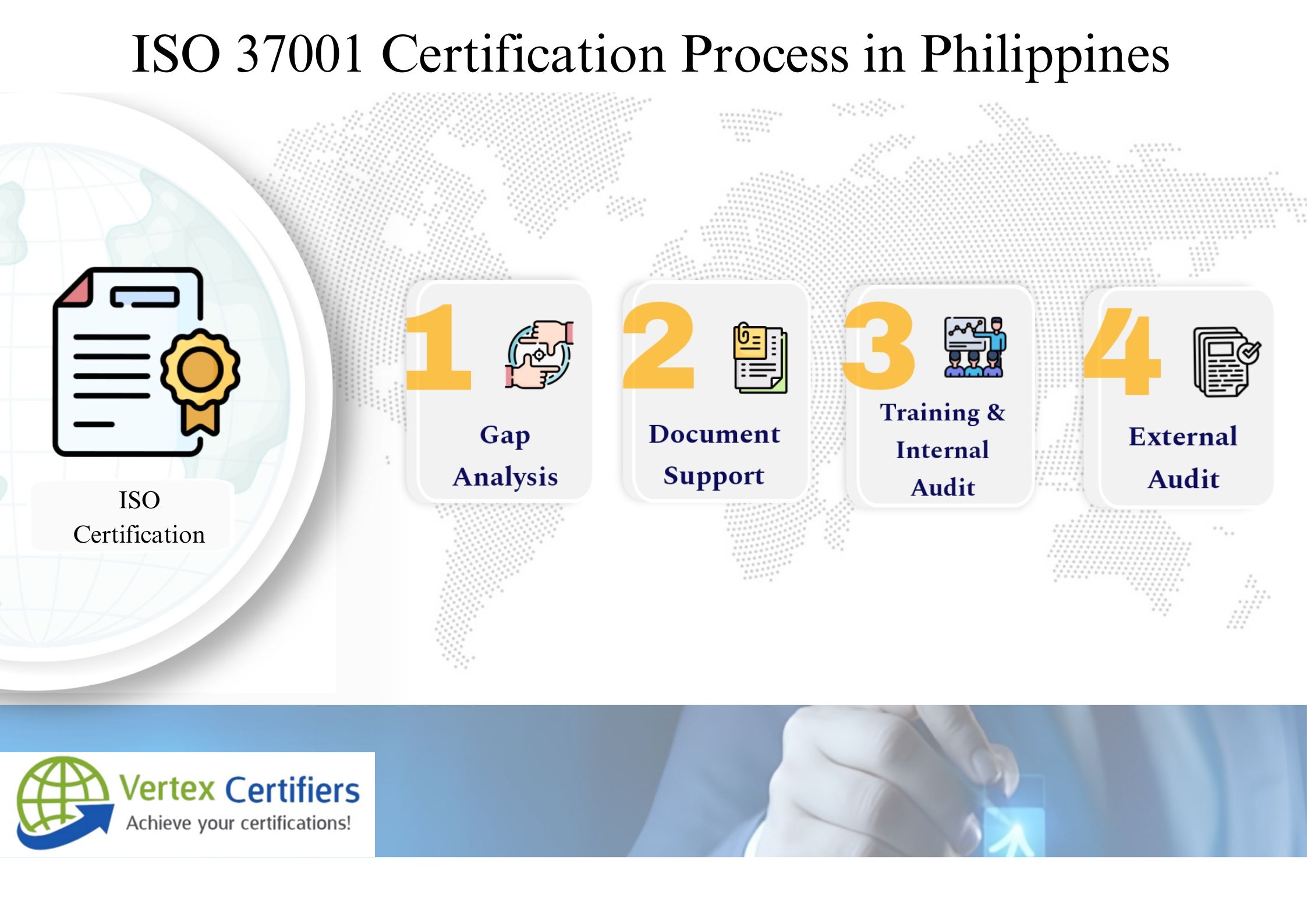
- Gap Analysis: Assess current practices against ISO 37001 requirements.
- Documentation and Policy Development: Create necessary policies and procedures.
- Implementation: Roll out controls across operations.
- Internal Audit: Conduct self-review to identify improvements.
- Management Review: Leadership evaluates effectiveness.
- Certification Audit: External auditors verify compliance in two stages—documentation review and on-site assessment.
This process promotes continuous improvement, benefiting firms in major cities.
Industries in Philippines That Benefit from ISO 37001
ISO 37001 certification is suitable for organizations of all sizes and industries, including:
- Construction Companies
- Government Contractors
- Manufacturing Industries
- Oil and Gas Companies
- Financial Institutions
- Healthcare Organizations
- Educational Institutions
- Logistics and Supply Chain Companies
- Information Technology Companies
- Import and Export Businesses
Industries involved in public procurement, infrastructure projects, and international business transactions particularly benefit from ISO 37001 implementation.