Vertex Certifiers

Vertex Certifiers is a trusted international ISO consulting company providing comprehensive end-to-end ISO certification services for organizations across Greece. We help businesses of all sizes achieve internationally recognized ISO certifications through a practical and cost-effective approach, covering gap analysis, documentation development, system implementation, employee training, internal audits, management review, and certification audit support. Our experienced consultants work closely with clients to simplify the certification process, ensure compliance with international standards, and improve overall business performance. With affordable consulting services, industry-specific expertise, and a commitment to timely project delivery, Vertex Certifiers enables organizations in Greece to achieve ISO certification efficiently while minimizing costs and maximizing long-term business value.

ISO 45001 Certification in Greece

ISO 45001 Certification in Greece: Build a Safer Workplace with Internationally Recognized Occupational Health & Safety Standards

Employee health and safety have become a strategic priority for organizations operating in today’s competitive and highly regulated business environment. Whether managing a construction site, manufacturing facility, shipping operation, hotel, healthcare institution, logistics center, or industrial plant, organizations are expected to provide a safe working environment while complying with occupational health and safety regulations. ISO 45001:2018, the internationally recognized Occupational Health & Safety Management System (OHSMS) standard, provides organizations with a structured framework to identify workplace hazards, assess occupational risks, reduce incidents, and continually improve health and safety performance.

Across Greece, businesses are experiencing significant growth in industries such as shipping and maritime services, tourism and hospitality, construction, manufacturing, food processing, pharmaceuticals, renewable energy, logistics and transportation, oil and gas, and healthcare.Workplace accidents, injuries, equipment failures, unsafe working conditions, and regulatory non-compliance can result in operational disruptions, financial losses, legal consequences, and reputational damage.

ISO 45001 adopts a risk-based approach to occupational health and safety by focusing on hazard identification, risk assessment, legal compliance, employee participation, operational controls, emergency preparedness, and continual improvement. Rather than reacting to workplace incidents after they occur, organizations establish preventive measures that minimize risks before they lead to accidents or occupational illnesses. This proactive approach not only protects employees but also improves operational efficiency, business continuity, employee morale, and stakeholder confidence.

Vertex Certifiers is an international ISO consulting company providing comprehensive ISO 45001 consulting, implementation, documentation, employee training, internal audits, management review support, and certification audit assistance for organizations across Greece.From initial gap analysis through successful certification and continual improvement, Vertex Certifiers offers end-to-end support that helps organizations achieve ISO 45001 certification efficiently while strengthening workplace safety, regulatory compliance, and long-term business performance.

What is ISO 45001 Certification?

ISO 45001:2018 is the internationally recognized standard for Occupational Health & Safety Management Systems (OHSMS), published by the International Organization for Standardization (ISO). It provides organizations with a systematic framework for managing occupational health and safety risks, preventing workplace injuries and illnesses, improving employee wellbeing, and ensuring compliance with applicable legal and regulatory requirements.

Organizations identify workplace hazards, evaluate associated risks, implement effective operational controls, monitor safety performance, investigate incidents, and continually improve their health and safety management processes.

A key strength of ISO 45001 is its emphasis on leadership commitment and worker participation. Top management is responsible for establishing occupational health and safety objectives, allocating resources, promoting employee involvement, and integrating health and safety into overall business strategy. Employees actively participate in hazard identification, risk assessments, reporting unsafe conditions, and recommending improvements, resulting in stronger organizational engagement and improved safety outcomes.

ISO 45001 follows the internationally recognized Plan-Do-Check-Act (PDCA) methodology, enabling organizations to continually improve their Occupational Health & Safety Management System.Organizations implementing multiple ISO standards benefit from streamlined documentation, integrated audits, improved operational efficiency, and simplified management processes.

ISO 45001 Certification Process
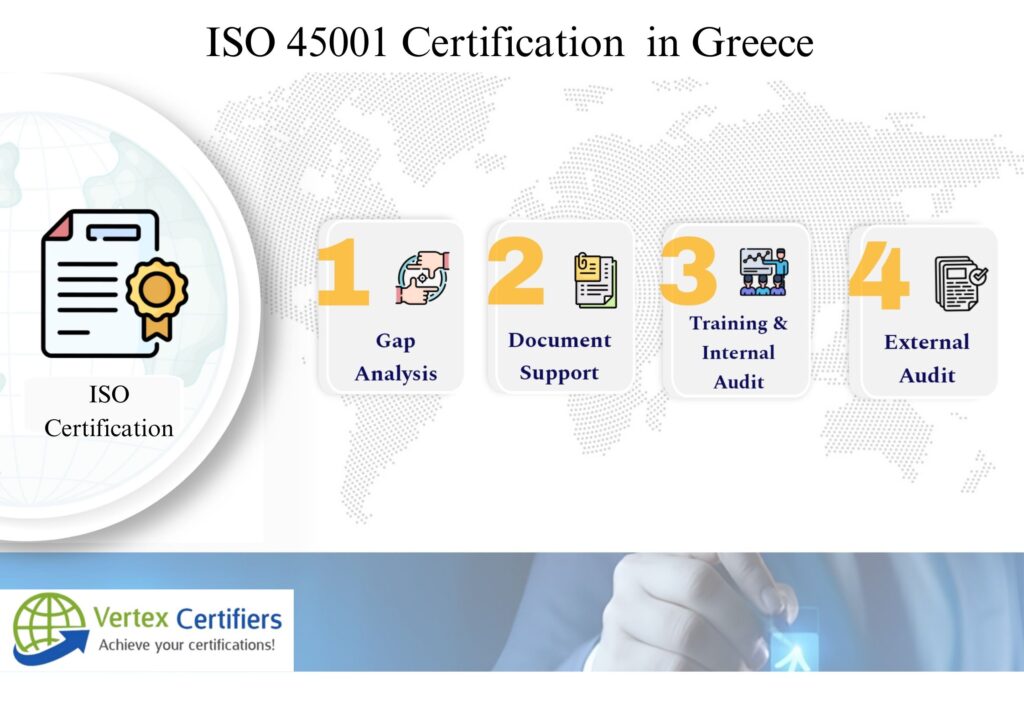
Achieving ISO 45001 Certification in Greece follows a structured implementation approach that enables organizations to establish an effective Occupational Health & Safety Management System while ensuring readiness for certification audits.

1. Initial Consultation

The certification journey begins with understanding the organization’s business activities, operational processes, workforce, legal obligations, existing safety practices, and certification objectives. Consultants evaluate organizational requirements and define the implementation roadmap.

2. Gap Analysis

A detailed assessment compares current occupational health and safety practices against ISO 45001 requirements. Existing strengths, compliance gaps, documentation needs, operational weaknesses, and improvement opportunities are identified, forming the foundation for implementation planning.

3. Project Planning

A comprehensive implementation plan is developed, defining project scope, responsibilities, timelines, resources, objectives, milestones, and communication strategies. Effective planning ensures smooth execution throughout the certification process.

4. Documentation Development

The Occupational Health & Safety Management System documentation is developed according to ISO 45001 requirements. Documentation typically includes:

  • Occupational Health & Safety Policy
  • Objectives
  • Procedures
  • Risk assessment methodology
  • Hazard registers
  • Emergency preparedness procedures
  • Operational controls
  • Incident reporting procedures
  • Monitoring records
  • Legal compliance documentation

Proper documentation provides consistency, accountability, and evidence of effective system implementation.

5. OH&S Policy Creation

Top management establishes an Occupational Health & Safety Policy that reflects the organization’s commitment to preventing injuries, protecting workers, complying with legal requirements, consulting employees, and continually improving workplace safety performance.

6. Hazard Identification

Organizations systematically identify workplace hazards associated with routine and non-routine activities. Hazards may include:

  • Physical hazards
  • Mechanical hazards
  • Electrical hazards
  • Chemical exposure
  • Biological hazards
  • Ergonomic risks
  • Fire hazards
  • Working at height
  • Noise exposure
  • Vehicle movements
  • Manual handling activities

Comprehensive hazard identification forms the basis for effective risk management.

7. Risk Assessment

Each identified hazard is evaluated according to its likelihood and potential consequences. Organizations prioritize significant risks and establish appropriate operational controls to eliminate or minimize occupational health and safety risks.

8. Legal Register Preparation

Applicable occupational health and safety legislation, regulatory requirements, permits, customer requirements, and industry obligations are identified and documented. Maintaining an up-to-date legal register helps organizations demonstrate ongoing regulatory compliance.

9. System Implementation

Policies, procedures, operational controls, inspection programs, maintenance activities, contractor management processes, emergency preparedness plans, and monitoring systems are implemented throughout the organization. Employees begin following documented procedures during day-to-day operations.

10. Employee Awareness Training

Employee competence plays a critical role in ISO 45001 implementation. Awareness training ensures personnel understand:

  • Workplace hazards
  • Safety responsibilities
  • Emergency procedures
  • Incident reporting
  • Personal protective equipment (PPE)
  • Safe work practices
  • Risk awareness
  • Legal responsibilities

Training promotes a proactive safety culture across all organizational levels.

11. Emergency Preparedness Planning

Organizations establish documented procedures for responding to emergencies such as fires, chemical spills, equipment failures, medical emergencies, natural disasters, and evacuation scenarios. Regular emergency drills verify preparedness and identify improvement opportunities.

12. Internal Audit

Internal auditors evaluate the effectiveness of the Occupational Health & Safety Management System before certification. Audits verify compliance with ISO 45001 requirements, organizational procedures, legal obligations, and operational controls while identifying opportunities for continual improvement.

13. Management Review

Top management reviews audit findings, safety performance indicators, legal compliance status, incident reports, employee feedback, organizational risks, corrective actions, and improvement opportunities to ensure continued effectiveness of the management system.

14. Corrective Actions

Nonconformities identified during implementation or internal audits are investigated to determine root causes. Corrective actions eliminate underlying issues and strengthen organizational processes before certification.

15. Stage 1 Certification Audit

An accredited certification body reviews documented information, evaluates implementation readiness, verifies organizational scope, and confirms preparedness for the final certification assessment.

16. Stage 2 Certification Audit

Auditors evaluate actual implementation of the Occupational Health & Safety Management System by observing workplace practices, interviewing employees, reviewing records, verifying operational controls, and confirming compliance with ISO 45001 requirements.

17. Certification Decision

Following successful completion of the certification audit and closure of any identified findings, the certification body issues the ISO 45001 certificate, demonstrating the organization’s conformity with the international Occupational Health & Safety Management System standard.

18. Surveillance Audits

Periodic surveillance audits verify that the management system remains effective, continues to comply with ISO requirements, and supports continual improvement.

19. Continual Improvement

ISO 45001 is not a one-time achievement but an ongoing commitment. Organizations continually review risks, evaluate performance, update procedures, engage employees, improve operational controls, and enhance workplace safety to maintain long-term compliance and business excellence.


    Get Free
    Consultation


    Our Services

    Our Clients

    client
    client
    client
    client
    client
    ISO 45001 Certification in Greece – Vertex Certifiers

    ISO 45001 Certification in Greece

    Build a safer, more compliant, and more competitive business with an internationally recognized Occupational Health & Safety Management System (OH&SMS). Vertex Certifiers supports organizations across Greece—from Athens to Thessaloniki and beyond—to implement, audit, and certify ISO 45001 efficiently.

    Ready to start your ISO 45001 journey in Greece?

    ✉️ Email us: info@vertex.com 📞 Contact Us (opens in new tab)

    3. Why ISO 45001 Certification is Important in Greece

    Greece’s occupational health and safety (OHS) framework—aligned with EU Directive 89/391/EEC and national laws such as Law 3850/2010 and the new Labour Law Code (P.D. 62/2025)—requires employers to systematically manage workplace risks, provide training, and ensure safe working conditions. [web:12][web:18][web:19] ISO 45001 helps organizations meet and exceed these obligations through a structured, risk‑based management system. [web:1][web:2]

    Core Business Benefits

    • Compliance with OHS regulations: Aligns with Greek legal duties (risk assessment, safety technician/occupational physician cooperation, training, and monitoring). [web:12][web:18]
    • Reduced workplace accidents: Proactive hazard control lowers incident rates and work‑related ill health.
    • Improved employee morale: Visible commitment to safety boosts engagement and retention.
    • Safer workplaces: Standardized controls, emergency readiness, and contractor management.
    • Better risk management: Systematic identification and treatment of OH&S risks and opportunities. [web:1]
    • Lower insurance & accident costs: Fewer claims and reduced downtime.
    • Improved productivity: Safer processes mean fewer disruptions and rework.
    • Stronger corporate reputation: Demonstrates responsible operations to regulators, clients, and communities.

    Commercial & Strategic Advantages

    • Qualification for government tenders: Many public and private tenders favor or require certified OHS systems.
    • Better customer confidence: Clients and partners trust certified organizations.
    • International business opportunities: ISO 45001 is globally recognized, easing cross‑border projects. [web:2]
    • ESG & sustainability initiatives: Strong OHS performance supports ESG reporting and responsible business goals.
    • Supply chain requirements: Meets contractor and supplier pre‑qualification criteria.
    • Continuous improvement culture: PDCA cycle embeds learning and ongoing performance gains. [web:1]

    Industry‑Specific Importance in Greece

    Shipping Companies

    Manages complex maritime risks (cargo operations, vessel‑shore interfaces, fatigue) and aligns with international safety expectations for Greek shipping. [web:17]

    Ports & Shipyards

    Controls high‑risk activities (lifting, confined spaces, hot work) and coordinates multiple contractors safely. [web:12]

    Construction Firms

    Addresses site hazards, temporary works, and legal duties under Greek construction OHS rules (PD 1073/1981, PD 305/1996). [web:12]

    Hotels & Resorts

    Protects staff and guests across housekeeping, kitchens, pools, and maintenance; strengthens brand trust.

    Manufacturing Companies

    Reduces machine‑related incidents, chemical exposures, and ergonomics risks while improving uptime.

    Food Processing Units

    Integrates OHS with hygiene/food safety controls, reducing cross‑contamination and worker injuries.

    Pharmaceutical Companies

    Ensures safe handling of APIs, solvents, and cleanroom operations alongside GMP environments.

    Logistics & Warehousing

    Manages forklift traffic, racking safety, manual handling, and yard operations efficiently.

    Renewable Energy Companies

    Controls high‑risk activities in wind/solar installations, working at height, and electrical safety.

    4. Benefits of ISO 45001 Certification

    Implementing ISO 45001 delivers measurable operational and cultural improvements aligned with the standard’s intended outcomes: better OH&S performance, legal compliance, and achievement of OH&S objectives. [web:1]

    Safety & Compliance

    • Improved workplace safety: Clear roles, controls, and worker participation.
    • Reduced workplace injuries: Data‑driven prevention and corrective actions.
    • Better hazard identification: Systematic methods and risk criteria. [web:24][web:25]
    • Improved legal compliance: Legal register, compliance evaluation, and documented evidence. [web:12][web:25]
    • Employee engagement: Consultation and participation mechanisms required by the standard.

    Performance & Reputation

    • Increased productivity: Fewer incidents and smoother operations.
    • Reduced downtime: Better emergency preparedness and operational controls. [web:25]
    • Lower compensation claims: Reduced accident frequency/severity.
    • Better business reputation: Recognized certification signals maturity.
    • Customer confidence: Stronger pre‑qualification in tenders and supply chains.
    • Competitive advantage: Differentiator in Greek and international markets. [web:2]
    • International recognition: ISO 45001 is accepted worldwide. [web:2]
    • Improved operational efficiency: Streamlined processes and clearer responsibilities.
    • Stronger organizational culture: Safety as a core value, not just compliance.
    • Continual improvement: PDCA cycle drives ongoing gains. [web:1]
    • Easier integration with other ISO standards: Aligned structure with ISO 9001/14001. [web:2]

    5. Who Needs ISO 45001 Certification in Greece?

    ISO 45001 is suitable for organizations of all sizes and sectors, from single‑site SMEs to multinationals with complex operations. [web:1] In Greece, the following sectors particularly benefit:

    Shipping & Maritime

    Ship owners, managers, and marine service providers.

    Shipbuilding

    Yards managing heavy lifts, welding, and confined spaces.

    Ports

    Terminal operators and logistics hubs with multi‑contractor activities.

    Construction & Civil Engineering

    Contractors, infrastructure developers, and EPC firms. [web:12]

    Manufacturing & Automotive Suppliers

    Production lines with machinery, chemicals, and ergonomics risks.

    Food Manufacturers

    Processing plants combining OHS with food safety controls.

    Pharmaceutical Companies

    GMP facilities with additional chemical and biological hazards.

    Hospitals, Clinics, Laboratories

    Healthcare workers, sharps, biohazards, and ergonomic risks.

    Hotels & Resorts, Restaurants

    Front‑of‑house and back‑of‑house safety across multiple sites.

    Logistics Companies & Warehouses

    Transport, storage, and material handling operations.

    Energy (Oil & Gas, Renewables)

    High‑risk energy assets and field operations.

    Mining

    Extraction, processing, and heavy equipment operations.

    Educational Institutions

    Campuses, labs, workshops, and maintenance teams.

    Government Organizations

    Public sector bodies seeking structured OHS governance. [web:4]

    IT Companies & Facilities Management

    Office ergonomics, field service safety, and contractor control.

    Engineering Consultants

    Project sites, client premises, and remote work risk management.

    Note: While ISO 45001 certification is not legally mandatory in Greece, it is widely adopted to enhance safety performance, meet client expectations, and improve compliance with national OHS laws. [web:9][web:12]

    6. ISO 45001 Certification Requirements

    ISO 45001 follows the High‑Level Structure (HLS). Key clauses organizations must address include:

    Context, Leadership & Planning

    • Context of the Organization: Internal/external issues and interested parties.
    • Leadership & Commitment: Top management accountability and worker participation.
    • OH&S Policy: Clear, communicated safety commitments. [web:25]
    • Planning: Risks/opportunities, legal requirements, and OH&S objectives. [web:1][web:25]
    • Risk Assessment & Hazard Identification: Defined methodology and criteria. [web:24][web:25]
    • Legal Compliance: Legal register and compliance evaluation. [web:12][web:25]

    Support, Operation & Performance

    • Support: Resources, competence, awareness, communication, documented information. [web:25]
    • Operation: Operational controls, emergency preparedness, contractor management. [web:25]
    • Performance Evaluation: Monitoring, measurement, internal audit, management review. [web:21][web:25][web:29]
    • Improvement: Nonconformity handling, corrective actions, continual improvement. [web:1][web:25]
    Management review must consider OH&S performance, audit results, compliance status, incidents, worker consultation, resource adequacy, and opportunities for improvement, producing decisions on system changes and improvements. [web:21][web:26]

    8. Documents Required for ISO 45001 Certification

    ISO 45001 specifies mandatory documented information and records; additional documents are commonly used to implement the system effectively. [web:23][web:24][web:25]

    Mandatory Documents & Records (typical)

    • Scope of the OH&S management system
    • Occupational Health & Safety Policy
    • Responsibilities and authorities within OH&SMS
    • OH&S process for addressing risks and opportunities
    • Methodology and criteria for OH&S risk assessment
    • OH&S objectives and plans for achieving them
    • Emergency preparedness and response process
    • Risk & opportunity register and actions taken
    • Legal and other requirements register
    • Evidence of competence and training records
    • Evidence of communications
    • Emergency response plans
    • Monitoring, measurement, analysis, and performance evaluation results
    • Calibration/maintenance records of monitoring equipment
    • Compliance evaluation results
    • Internal audit program and reports
    • Management review minutes/results
    • Incident/nonconformity reports and corrective actions
    • Evidence of continual improvement

    Common Supporting Documents

    • OH&S Manual (if applicable)
    • Hazard identification register
    • Inspection records
    • Equipment maintenance records
    • Incident investigation reports
    • Operational procedures (e.g., permits to work, LOTO, working at height)
    • Contractor management procedures
    • Monitoring & measurement records

    9. Why Choose Vertex Certifiers for ISO 45001 Certification in Greece?

    Vertex Certifiers is a global ISO consulting firm offering comprehensive certification solutions to businesses across Greece—from gap analysis and documentation to employee training, implementation, internal audits, and certification support. [web:3]

    Expertise & Delivery Model

    • Experienced ISO consultants with international presence
    • Industry‑specific expertise (maritime, construction, manufacturing, hospitality, energy)
    • Practical implementation approach aligned to Greek legal context
    • Documentation support tailored to your operations
    • Employee training and awareness programs
    • Internal audits and certification audit support

    Value & Speed

    • Affordable consulting services
    • Faster certification process with clear milestones
    • Customized solutions for SMEs and multinationals
    • End‑to‑end project management
    • High certification success rate
    • Remote and on‑site consulting across Greece

    Service Coverage Across Major Greek Cities

    Athens Thessaloniki Patras Heraklion Larissa Volos Ioannina Chania Kavala Rhodes

    Start your ISO 45001 project with Vertex Certifiers today.

    ✉️ Email us: info@vertex.com 📞 Contact Us (opens in new tab)

    10. Why Businesses in Greece Trust Vertex Certifiers

    • International consulting experience
    • Certified consultants
    • Proven implementation methodology
    • Customer‑focused approach
    • Competitive pricing
    • Quick turnaround
    • Practical documentation
    • Long‑term compliance support
    • Industry expertise
    • Excellent customer satisfaction
    • Global best practices
    • End‑to‑end implementation assistance

    11. Frequently Asked Questions (FAQs)

    What is ISO 45001 Certification?

    ISO 45001 is the international standard for Occupational Health & Safety Management Systems. It specifies requirements and guidance to help organizations provide safe and healthy workplaces by preventing work‑related injury and ill health and improving OH&S performance. [web:1][web:2]

    Why is ISO 45001 important in Greece?

    It helps Greek organizations meet OHS legal duties (risk assessment, training, monitoring, cooperation with safety technicians/occupational physicians) while reducing accidents and improving compliance and reputation. [web:12][web:18][web:9]

    Who needs ISO 45001 certification?

    Any organization that wants to systematically manage OH&S risks—regardless of size or sector. It’s especially valuable for high‑risk industries like construction, maritime, manufacturing, energy, logistics, and healthcare. [web:1]

    How much does ISO 45001 certification cost in Greece?

    Costs depend on company size, number of employees, industry risk, and number of sites. There are consulting costs (implementation, training, internal audit) and certification body fees (initial audit and annual surveillance). [web:8][web:9]

    How long does ISO 45001 certification take?

    Typical implementation time is around 1–3 months with active management involvement, followed by certification audit scheduling with an accredited body. Timelines vary by scope and readiness. [web:8]

    Is ISO 45001 mandatory?

    No, it’s not legally required in Greece, but many organizations adopt it to enhance safety performance, meet client/tender requirements, and strengthen compliance. [web:9]

    Can small businesses obtain ISO 45001 certification?

    Yes. ISO 45001 is designed for organizations of all sizes; requirements are scalable to the organization’s context and risks. [web:1]

    What documents are required?

    Core items include OH&S policy, objectives, risk and legal registers, competence/training records, emergency plans, monitoring results, internal audit reports, management review records, and corrective action reports—plus supporting procedures as needed. [web:23][web:24][web:25]

    How long is ISO 45001 certification valid?

    Certificates are typically valid for three years, with annual surveillance audits to maintain certification.

    How does Vertex Certifiers help organizations achieve ISO 45001 certification?

    Vertex provides end‑to‑end support: gap analysis, documentation, training, implementation, internal audits, and certification audit preparation—delivered by experienced consultants with industry‑specific knowledge across Greece. [web:3]

    12. Conclusion

    ISO 45001 certification is a strategic investment for organizations in Greece seeking stronger legal compliance, safer workplaces, and improved operational efficiency. By implementing an Occupational Health & Safety Management System, businesses reduce accidents, lower costs, and build a culture of continuous improvement—directly supporting sustainable growth and international competitiveness. [web:1][web:2]

    Vertex Certifiers delivers comprehensive ISO 45001 consulting, implementation, training, internal audits, and certification support for organizations across Greece—from Athens and Thessaloniki to Patras, Heraklion, Larissa, Volos, Ioannina, Chania, Kavala, and Rhodes. [web:3] Contact us today to begin your ISO 45001 certification journey and build a safer, more resilient business.

      Company Logo

      Get ISO certification


      Fill the details below, one of our executives will contact you shortly


      This will close in 0 seconds

      Call Now Button