Why is ISO 45001 Certification Important in Ivory Coast?
ISO 45001 certification is important for organizations in Ivory Coast because it provides a structured and internationally recognized approach to managing occupational health and safety (OH&S). As businesses expand their operations across manufacturing, construction, mining, agriculture, logistics, energy, infrastructure, and services, they need effective processes for identifying workplace hazards, controlling risks, protecting workers, and improving safety performance. ISO 45001 helps organizations move from reactive safety management to a systematic approach based on risk prevention, worker participation, leadership, monitoring, and continual improvement.
Strengthening Workplace Health and Safety
One of the primary purposes of ISO 45001 is to help organizations create safer and healthier workplaces. The standard provides a systematic framework for identifying hazards associated with workplace activities and determining appropriate measures to eliminate or reduce OH&S risks.
Organizations can use the ISO 45001 framework to address risks associated with machinery, electrical systems, chemicals, working at height, manual handling, transportation, construction activities, workplace equipment, emergency situations, and other operational hazards.
By implementing preventive controls and monitoring their effectiveness, businesses can work toward reducing workplace incidents, injuries, and work-related ill health. ISO 45001 also encourages organizations to involve workers in health and safety processes, helping employees contribute their practical knowledge and experience to workplace risk management.
Supporting Compliance with Ivorian OH&S Requirements
Organizations operating in Ivory Coast must consider the occupational health and safety requirements applicable to their activities. Côte d’Ivoire's Labour Code includes provisions relating to health and safety at work, health and safety committees, occupational health services, and worker protection. The International Labour Organization's NATLEX database identifies a dedicated section of the Labour Code covering occupational health and safety and occupational health organizations. :contentReference[oaicite:1]{index=1}
ISO 45001 can help organizations establish a structured process for identifying applicable legal and regulatory requirements, evaluating compliance obligations, maintaining relevant information, and incorporating those requirements into their OH&S management system.
However, ISO 45001 certification does not replace legal compliance. Certification demonstrates conformity with the ISO management-system requirements; organizations remain responsible for complying with applicable laws, regulations, permits, and other statutory obligations in Ivory Coast.
Improving Risk Management
Effective risk management is at the heart of ISO 45001. Organizations are expected to establish processes for identifying hazards, assessing OH&S risks and opportunities, implementing controls, monitoring performance, and taking corrective action when problems occur.
A structured risk-management approach can help organizations:
- Identify hazards before they result in incidents.
- Assess the significance of workplace OH&S risks.
- Establish appropriate risk-control measures.
- Monitor the effectiveness of implemented controls.
- Investigate incidents and nonconformities.
- Implement corrective actions.
- Continually improve workplace safety performance.
This proactive approach is particularly valuable for organizations operating in higher-risk environments such as construction sites, mines, manufacturing facilities, ports, industrial plants, and energy operations.
Building Customer and Stakeholder Confidence
ISO 45001 certification can provide customers, employees, contractors, suppliers, investors, and other stakeholders with independent evidence that an organization has established a structured approach to occupational health and safety management.
For businesses working with major customers or contractors, certification can also support supplier evaluation and qualification processes where recognized management-system certifications are requested. It can demonstrate that workplace safety is integrated into the organization's management processes rather than being treated as an isolated operational activity.
Supporting Business Growth and Market Opportunities
For organizations seeking to participate in major projects, tenders, supply chains, infrastructure contracts, or international business opportunities, ISO 45001 certification can strengthen their management-system credentials.
A recognized OH&S management system can be particularly valuable for higher-risk industries where customers and project owners place significant emphasis on contractor safety, workforce protection, risk management, and responsible business practices.
Which Industries in Ivory Coast Can Benefit from ISO 45001?
ISO 45001 can be implemented by organizations of different sizes and sectors. ISO states that the standard applies to organizations of all sizes and provides a framework for managing OH&S risks and improving OH&S performance. :contentReference[oaicite:2]{index=2}
In Ivory Coast, ISO 45001 can be particularly relevant to organizations operating in sectors where employees, contractors, equipment, materials, transportation, or industrial processes create occupational health and safety risks.
- Manufacturing: Manage risks related to machinery, production lines, electrical systems, maintenance, chemicals, and material handling.
- Construction and infrastructure: Address risks associated with working at height, excavation, heavy equipment, temporary works, electrical activities, and construction-site operations.
- Mining and quarrying: Support systematic management of risks involving heavy machinery, blasting-related activities, excavation, dust, noise, and vehicle movement.
- Oil and gas: Strengthen controls for fire, hazardous substances, pressure systems, confined spaces, maintenance, and emergency response.
- Agriculture and agro-processing: Manage risks associated with agricultural machinery, chemicals, manual work, transportation, processing equipment, and workplace conditions.
- Food and beverage: Address employee safety risks involving production equipment, cleaning chemicals, material handling, slips, trips, and operational processes.
- Logistics and transportation: Manage driver safety, vehicle movement, loading and unloading, fatigue, road risks, and warehouse activities.
- Warehousing: Control risks associated with forklifts, storage systems, manual handling, loading areas, and workplace movement.
- Energy and utilities: Address electrical hazards, maintenance activities, equipment operation, working at height, and emergency situations.
- Telecommunications: Manage risks associated with tower work, electrical systems, field operations, driving, and working at height.
- Chemicals: Strengthen controls for hazardous substances, chemical exposure, storage, handling, fire, and emergency response.
- Pharmaceuticals: Manage occupational risks involving chemicals, laboratory activities, equipment, biological hazards, and workplace processes.
- Healthcare: Address risks related to biological exposure, sharps, chemicals, ergonomics, workplace violence, and emergency situations.
- Hospitality: Manage employee risks associated with kitchens, housekeeping, cleaning chemicals, slips and falls, equipment, and emergency situations.
- Engineering and maintenance: Establish controls for machinery, electrical work, confined spaces, working at height, tools, and maintenance activities.
- Ports and maritime operations: Address risks related to cargo handling, heavy equipment, vehicles, loading operations, marine activities, and contractor safety.
Key Requirements of ISO 45001
ISO 45001 is structured around ten main clauses, with Clauses 4 to 10 containing the core management-system requirements. The standard covers leadership, worker participation, hazard identification, risk management, legal and regulatory requirements, emergency planning, auditing, incident investigation, and continual improvement. :contentReference[oaicite:3]{index=3}
Clause 4 – Context of the Organization
Organizations need to understand the internal and external factors that can affect their OH&S management system. This includes identifying relevant interested parties and understanding their needs and expectations.
The organization must also define the scope of its OHSMS. The scope establishes which locations, activities, departments, workers, processes, and operations are covered by the management system.
Clause 5 – Leadership and Worker Participation
Top management plays a central role in ISO 45001 implementation. Leadership must demonstrate commitment to OH&S and establish an appropriate OH&S policy.
This clause also addresses:
- Roles and responsibilities.
- Accountability for OH&S performance.
- Worker consultation.
- Worker participation.
- Promotion of a positive OH&S culture.
Worker participation is especially important because employees often have direct knowledge of workplace hazards and practical opportunities for improving safety.
Clause 6 – Planning
Planning involves identifying hazards, assessing OH&S risks and opportunities, determining applicable legal and regulatory requirements, and establishing OH&S objectives.
Organizations should establish suitable processes for identifying hazards arising from routine and non-routine activities and determining appropriate controls. Objectives should be relevant to the organization's OH&S priorities and supported by appropriate plans.
Clause 7 – Support
An effective OHSMS requires appropriate resources and competent personnel. Clause 7 covers resources, competence, awareness, communication, and documented information.
Organizations should ensure that employees understand relevant OH&S risks, responsibilities, procedures, and the importance of following established controls.
Clause 8 – Operation
Operational planning and control ensure that OH&S requirements are incorporated into day-to-day activities. Organizations need to establish appropriate controls for processes and activities that can affect workplace health and safety.
This includes considerations such as:
- Elimination of hazards and reduction of OH&S risks.
- Management of change.
- Procurement.
- Contractor management.
- Outsourced processes.
- Emergency preparedness and response.
Operational controls should reflect the organization's actual activities, risks, workforce, and working environment.
Clause 9 – Performance Evaluation
Organizations need to monitor and evaluate whether their OHSMS is achieving its intended outcomes. This involves establishing suitable monitoring and measurement processes, evaluating performance, conducting internal audits, and carrying out management reviews.
Performance evaluation helps management understand whether OH&S controls are working effectively and where improvement is required.
Clause 10 – Improvement
Continual improvement is an essential component of ISO 45001. Organizations need processes for responding to incidents and nonconformities, determining corrective actions, and continually improving the suitability, adequacy, and effectiveness of the OHSMS.
ISO specifically identifies incident investigation, continual improvement, legal and regulatory compliance, emergency planning, hazard identification, and risk assessment among the key elements of its OH&S management framework. :contentReference[oaicite:4]{index=4}
Documents Required for ISO 45001 Certification
ISO 45001 requires organizations to maintain documented information necessary for the effectiveness of the OHSMS. The exact documentation and records required will depend on the organization's size, activities, risks, number of locations, workforce, and operational complexity.
Typical ISO 45001 documentation and records may include:
- OH&S policy
- OH&S objectives
- OHSMS scope
- Hazard identification and risk assessment records
- Legal and regulatory compliance information
- Risk-control procedures
- Emergency preparedness and response procedures
- Training and competency records
- Worker consultation and participation records
- Incident and accident records
- Internal audit reports
- Management review records
- Corrective action records
- Operational control records
Vertex Certifiers can assist organizations in developing documentation that is relevant to their actual operations rather than creating unnecessary paperwork. Our consultants work with your team to establish practical processes that can be implemented and maintained effectively.
Benefits of ISO 45001 Certification in Ivory Coast
ISO 45001 provides organizations with a structured framework for improving occupational health and safety management. ISO highlights benefits including systematic management of OH&S risks, reduction of workplace incidents, demonstration of commitment to worker health and safety, fulfilment of applicable requirements, and continual improvement. :contentReference[oaicite:5]{index=5}
Key benefits for businesses in Ivory Coast include:
- Reduced workplace incidents: A proactive risk-management approach can help organizations identify and control hazards before incidents occur.
- Better hazard and risk management: Organizations establish systematic processes for identifying hazards and implementing controls.
- Improved employee safety awareness: Training, communication, consultation, and participation can strengthen employee understanding of workplace safety.
- Stronger OH&S culture: Leadership involvement and worker participation help integrate safety into organizational decision-making.
- Better emergency preparedness: Organizations establish processes for preparing for and responding to potential emergency situations.
- Improved regulatory compliance management: Organizations can systematically identify and monitor applicable OH&S requirements.
- Greater stakeholder confidence: Certification can demonstrate an externally assessed commitment to occupational health and safety.
- Improved operational control: Safety requirements can be incorporated into everyday processes and activities.
- Support for tender and contract requirements: ISO 45001 certification may support supplier, contractor, tender, and customer qualification requirements where applicable.
- Enhanced international business credibility: An internationally recognized management-system certification can strengthen an organization's credentials when working with international customers and supply chains.
- Continual improvement: Monitoring, auditing, corrective action, and management review provide mechanisms for ongoing improvement.
How Long Does ISO 45001 Certification Take in Ivory Coast?
The time required to implement and certify ISO 45001 varies from one organization to another. There is no single timeline that applies to every business because implementation depends on the organization's size, complexity, existing OH&S practices, number of locations, workforce, operational risks, and available resources.
Factors that can influence the implementation timeline include:
- Existing management-system maturity.
- Organization size and operational complexity.
- Number of locations and activities.
- Availability of internal resources.
- Existing OH&S documentation.
- Hazard identification and risk assessment status.
- Employee training and awareness requirements.
- Completion of internal audits.
- Management review completion.
- Corrective actions identified during implementation or audits.
A practical implementation plan should therefore be developed after reviewing the organization's current OH&S management practices. Vertex Certifiers can assess your current position and help establish a structured roadmap toward certification.
ISO 45001 Certification Audit in Ivory Coast
The ISO 45001 certification audit is conducted by an independent certification body. The audit evaluates whether the organization's Occupational Health and Safety Management System conforms to the applicable requirements and has been effectively implemented.
Stage 1 Audit
Stage 1 is primarily a readiness and documentation review. The certification auditor reviews areas such as the organization's OHSMS scope, documented information, organizational context, processes, and preparedness for the Stage 2 assessment.
The objective is to determine whether the organization is sufficiently prepared to proceed to the full certification audit.
Stage 2 Audit
Stage 2 focuses on the implementation and effectiveness of the OHSMS. Auditors may review records, interview employees and management, evaluate operational controls, examine risk assessments, review internal audits, and assess how the organization manages OH&S processes in practice.
The certification body evaluates whether the management system is effectively implemented and meets the applicable ISO 45001 requirements.
Corrective Actions
If nonconformities are identified during the audit, the organization must address them through an appropriate corrective-action process. This normally involves determining the cause, implementing corrective action, and providing appropriate evidence to the certification body.
Depending on the nature of the findings, the certification body may require verification of corrective actions before completing the certification decision.
ISO 45001 Certification vs ISO 9001 and ISO 14001
ISO 45001, ISO 9001, and ISO 14001 are management-system standards that address different areas of organizational performance.
| Standard | Main Focus |
|---|
| ISO 9001 | Quality Management |
| ISO 14001 | Environmental Management |
| ISO 45001 | Occupational Health and Safety Management |
Organizations can implement these standards individually or integrate them into a broader management-system framework. ISO confirms that ISO 45001 can be integrated with other ISO management-system standards. :contentReference[oaicite:6]{index=6}
Can ISO 45001 Be Integrated with Other ISO Standards?
Yes. ISO 45001 can be integrated with standards such as ISO 9001 and ISO 14001 because they use a compatible management-system structure.
An integrated management system can provide opportunities to combine common processes such as:
- Document control.
- Internal audits.
- Management reviews.
- Corrective action.
- Objectives and performance monitoring.
- Training and awareness.
- Risk and opportunity management.
For organizations already certified to ISO 9001 or ISO 14001, integrating ISO 45001 can provide a more coordinated approach to quality, environmental, and occupational health and safety management.
Why Choose Vertex Certifiers for ISO 45001 Certification in Ivory Coast?
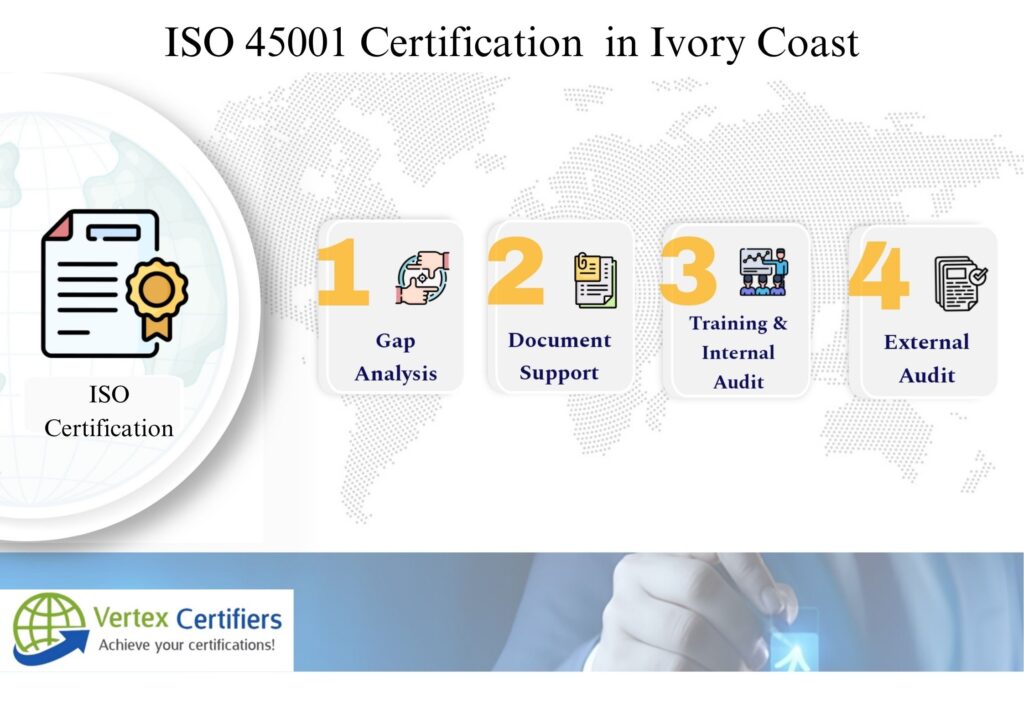
Vertex Certifiers provides end-to-end ISO 45001 consulting and certification support for organizations in Ivory Coast. Our approach is designed to make the certification journey structured, practical, and easier for your organization to manage.
Our consultants can support your organization through:
- Initial ISO 45001 consultation.
- Gap analysis.
- OHSMS scope definition.
- Hazard identification and risk assessment support.
- Documentation development.
- ISO 45001 implementation assistance.
- Employee awareness and training.
- Internal audit support.
- Management review guidance.
- Corrective-action support.
- Certification audit preparation.
- Certification coordination.
Our objective is to help organizations establish a management system that reflects their actual operations, risks, workforce, and business objectives. Whether you are preparing for certification for the first time or strengthening an existing OH&S system, our team can provide practical guidance throughout the process.
Start Your ISO 45001 Certification Journey
Ready to strengthen occupational health and safety management in your organization? Speak with Vertex Certifiers for professional ISO 45001 consultation and certification support in Ivory Coast.
Email Us: info@vertexcertifiers.com
Contact UsISO 45001 Certification in Major Cities of Ivory Coast
Vertex Certifiers supports organizations seeking ISO 45001 consulting and certification assistance across major business and industrial locations in Ivory Coast.
ISO 45001 Certification in Abidjan
Abidjan is a major commercial and industrial center, making occupational health and safety particularly relevant to manufacturing companies, construction businesses, logistics providers, port-related organizations, engineering companies, and corporate service organizations.
ISO 45001 can help organizations in Abidjan establish systematic processes for workplace risk management, employee safety, contractor management, emergency preparedness, and continual improvement.
ISO 45001 Certification in Bouaké
Bouaké has important activities associated with agriculture, manufacturing, trading, distribution, and logistics. Organizations operating in these sectors can use ISO 45001 to establish structured processes for managing operational hazards, worker safety, equipment risks, transportation, and workplace conditions.
ISO 45001 Certification in San-Pédro
San-Pédro is an important location for port, logistics, agricultural, agro-processing, and industrial activities. Businesses operating in these environments may face risks associated with cargo handling, heavy equipment, transportation, industrial operations, and contractor activities.
ISO 45001 provides a structured framework for identifying and controlling these risks while strengthening workplace safety management.
ISO 45001 Certification in Yamoussoukro
Yamoussoukro has activities related to infrastructure, construction, public services, agriculture, and other business operations. Organizations in these sectors can benefit from systematic OH&S processes covering hazard identification, risk assessment, operational controls, emergency preparedness, employee competence, and continual improvement.
Frequently Asked Questions About ISO 45001 Certification in Ivory Coast
What is ISO 45001 certification in Ivory Coast?
ISO 45001 certification in Ivory Coast is independent third-party confirmation that an organization's Occupational Health and Safety Management System conforms to the applicable requirements of ISO 45001:2018. The standard provides a framework for managing OH&S risks and improving occupational health and safety performance. :contentReference[oaicite:7]{index=7}
Is ISO 45001 mandatory in Ivory Coast?
ISO 45001 certification is a voluntary management-system certification unless a specific contract, customer, tender, or other applicable requirement makes it a condition of doing business. However, organizations must comply with the occupational health and safety laws and regulations applicable to their activities in Ivory Coast. ISO 45001 can help establish a structured process for managing those requirements, but it does not replace them.
Who needs ISO 45001 certification?
ISO 45001 can benefit organizations of different sizes and industries, particularly businesses with significant workplace hazards or organizations that want to demonstrate a systematic commitment to occupational health and safety.
How much does ISO 45001 certification cost in Ivory Coast?
The overall investment required for ISO 45001 implementation and certification varies according to factors such as organization size, scope, locations, operational complexity, existing OH&S practices, and audit requirements. A detailed assessment is recommended to determine the specific requirements for your organization.
How long does ISO 45001 certification take?
The certification timeline depends on the organization's size, complexity, existing OH&S management system, documentation, employee competence, number of locations, and implementation readiness. A practical timeline can be established after an initial gap assessment.
What documents are required for ISO 45001?
Typical documented information may include the OH&S policy, objectives, OHSMS scope, hazard and risk assessments, applicable legal requirements, operational controls, emergency procedures, training records, worker consultation records, incident records, internal audit reports, management review records, and corrective-action records.
Is ISO 45001 certification recognized internationally?
Yes. ISO 45001 is an internationally recognized occupational health and safety management-system standard. Certification can help organizations demonstrate a structured approach to OH&S management to customers, suppliers, contractors, employees, and other stakeholders.
Can small businesses in Ivory Coast obtain ISO 45001 certification?
Yes. ISO 45001 applies to organizations of different sizes and sectors. The implementation approach should be appropriate to the organization's activities, risks, workforce, and operational complexity. :contentReference[oaicite:8]{index=8}
Can ISO 45001 be integrated with ISO 9001 and ISO 14001?
Yes. ISO 45001 can be integrated with ISO 9001 and ISO 14001 because the standards share compatible management-system principles and structures. This can allow organizations to coordinate processes such as internal audits, management reviews, corrective actions, documentation, objectives, and continual improvement.
Who issues ISO 45001 certificates?
ISO itself does not issue ISO 45001 certificates. Certification is conducted by independent certification bodies that assess an organization's management system against the applicable requirements.
What is the difference between ISO 45001 implementation and certification?
ISO 45001 implementation means establishing and operating an OH&S management system that meets the standard's requirements. Certification is the independent third-party assessment that confirms conformity with those requirements.
Does ISO 45001 replace Côte d’Ivoire's occupational health and safety laws?
No. ISO 45001 does not replace national laws or regulations. Organizations must continue to comply with applicable occupational health and safety requirements in Côte d’Ivoire. ISO 45001 provides a management-system framework that can help organizations identify, manage, and monitor their applicable OH&S obligations. Côte d’Ivoire's Labour Code includes dedicated provisions concerning health and safety at work and occupational health organizations. :contentReference[oaicite:9]{index=9}
Conclusion
ISO 45001 certification provides businesses in Ivory Coast with a structured approach to managing occupational health and safety. By systematically identifying hazards, assessing risks, implementing operational controls, involving workers, monitoring performance, and taking corrective action, organizations can establish a stronger and more proactive safety management system.
For businesses operating in manufacturing, construction, mining, agriculture, logistics, energy, infrastructure, healthcare, engineering, ports, and other sectors, ISO 45001 can support better workplace risk management while demonstrating a commitment to employee health and safety. The standard can also strengthen organizational credibility when working with customers, contractors, suppliers, project owners, and international business partners.
Vertex Certifiers provides end-to-end ISO 45001 consulting and certification support in Ivory Coast, covering gap analysis, documentation, implementation assistance, employee training, internal audits, management review guidance, and certification audit preparation.
If your organization is planning ISO 45001 certification in Ivory Coast, our team can help you understand the requirements, identify gaps, implement an effective OHSMS, and prepare for the independent certification audit.
Get Started with ISO 45001 Certification
Contact Vertex Certifiers today for professional ISO 45001 consultation, implementation, internal audit, and certification support in Ivory Coast.
📧 Email Us: info@vertexcertifiers.com
Contact Us