

ISO 9001 Certification in Bangkok | ISO 9001 Consultants in Bangkok
ISO 9001 certification in Bangkok represents a global benchmark for quality management systems and operational excellence. In Bangkok, a bustling economic center of Thailand, obtaining this certification can significantly elevate a company’s reputation and competitive edge. This certification is not industry-specific, which makes it applicable to any organization, regardless of its size or the sector it operates in. The primary aim of this standard is to improve efficiency and enhance customer satisfaction by standardizing the processes that business adhere to for quality management. Achieving ISO 9001 certification in Bangkok allows businesses to demonstrate their commitment to quality and continuous improvement to both existing and potential customers.
What is ISO 9001?
The internationally acclaimed ISO 9001 standard describes the conditions that must be met by a quality management system (QMS). Using this standard, businesses may show that they can reliably deliver goods and services that satisfy both client and legal criteria. It is founded on several quality management tenets, such as a significant emphasis on the needs of the customer, senior management’s involvement and incentive, the process method, and continuous improvement.
Importance of ISO 9001 certification :
Obtaining ISO 9001 certification is crucial for businesses seeking to improve their operation and credibility. It helps in establishing a systematic approach to managing the organization’s processes and ensuring a consistent product or service. This certification is not just about establishment of procedures that adhere to international standards, but it’s about making these procedures effective and efficient. ISO 9001 certification often serves as a benchmark for quality management and plays a critical role in securing international business, as it is a symbol of trust and quality assurance.
Benefits of ISO 9001 Certification in Bangkok
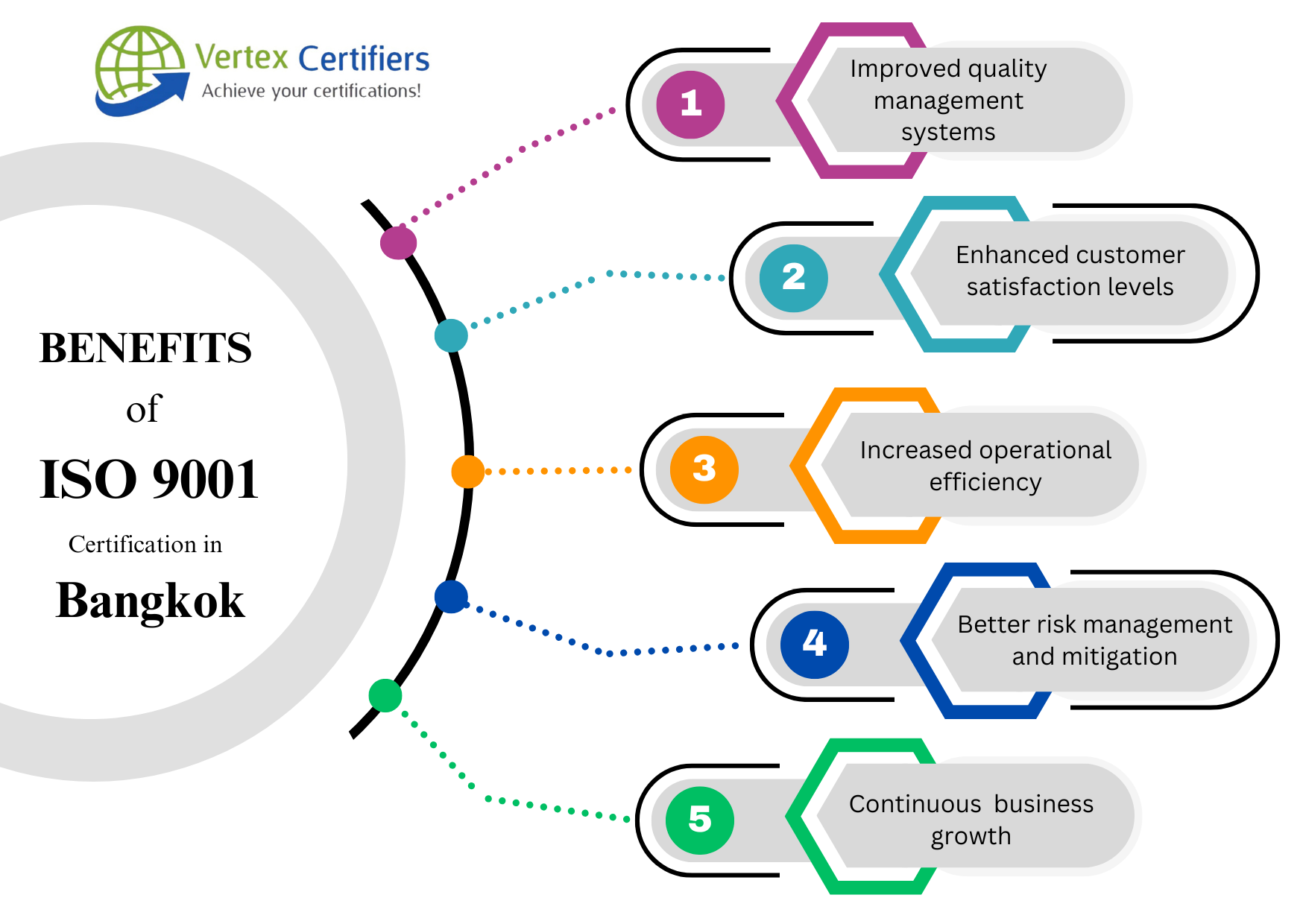
- Improved credibility and reputation : ISO 9001 certification is recognized globally across all industries which includes potential clients who might be specifically looking for suppliers that are certified. For businesses in Bangkok, achieving this certification not only boosts their credibility but also gives them a competitive edge in both local and international markets. Being ISO 9001 certified also makes a strong statement about the organization’s commitment to quality and customer satisfaction.
- Increased efficiency and productivity : Implementing the standards required for ISO 9001 certification necessitates streamlining processes and ensuring that everyone in the organization is aligned with these efficiency goals. This can lead to significant improvements in productivity, as the optimized processes reduce wasted time and resources. For businesses in Bangkok, where the economic landscape is fiercely competitive, these improvements can translate into cost savings and higher profitability.
- Enhanced customer satisfaction : One of the key principles of ISO 9001 is the focus on meeting customer requirements and enhancing customer satisfaction. By adopting ISO 9001 standards, businesses in Bangkok can improve the quality of their products and services, which in turn can increase customer satisfaction. Happy customers are likely to return and also provide referrals, which is an invaluable form of marketing. Ensuring customer satisfaction with consistent quality standards leads to better client retention and loyalty.
Steps to Achieve ISO 9001 Certification :

- Conducting a gap analysis : Achieving ISO 9001 certification begins with a thorough gap analysis. This initial step involves evaluating your current management system against the ISO 9001 requirements. Businesses in Bangkok should focus on identifying areas where their practices don’t meet the standard’s criteria. The gap analysis should be comprehensive, covering all processes, policies, and controls used within the organization. It serves as the foundation for all subsequent improvements and is crucial for setting a clear path toward compliance.
- Implementing necessary changes : Once the gap analysis is complete, the next step is to implement necessary changes to align your business processes with ISO 9001 standards. This typically involves revising current procedures, training employees, and possibly introducing new quality controls. For Bangkok-based companies, it’s important to consider both the local business environment and international best practices during this phase. Implementing these changes may require time and resources, but they are essential for building a robust quality management system that not only complies with ISO 9001 but also enhances overall operational efficiency.
- Documentation and audit process : An essential part of ISO 9001 certification is documentation. This phase involves documenting all processes, changes made, and the results of those changes in accordance with ISO standards. Proper documentation ensures that procedures are repeatable and auditable. Following documentation, an internal audit is conducted to ensure all documented procedures are being correctly followed and that they meet the ISO 9001 standards’ requirements. The results from this audit are used to make any needed adjustments before a final certification audit is conducted by an external body.
ISO 9001 Certification in Bangkok for Growing, Competitive Businesses
Bangkok is the commercial center of Thailand, and companies here operate in an environment shaped by manufacturing, tourism, healthcare, logistics, construction, and export-driven trade. In such a market, ISO 9001 helps businesses create consistent processes, improve customer satisfaction, and meet the expectations of local buyers as well as international customers.
1. Why ISO 9001 is Important for Businesses in Bangkok
Bangkok is the commercial heart of Thailand, where local enterprises, multinational branches, traders, service providers, factories, and project-based companies compete in a fast-moving market. Because businesses in the city serve both domestic and international customers, they need reliable systems that help them control quality, manage growth, and maintain trust. ISO 9001 is important in this context because it provides a practical framework for standardizing operations, reducing variation, and improving the customer experience across departments and locations.
For manufacturing companies, ISO 9001 supports process discipline, incoming material control, production monitoring, inspection routines, and corrective action. Thailand has long been recognized as a manufacturing hub in Southeast Asia, so businesses that supply components, finished goods, packaging, engineering items, or industrial services need a quality management system that proves consistency. In Bangkok, where many factories, trading offices, and corporate purchasing teams coordinate regional production and delivery, ISO 9001 helps improve traceability and supplier performance while reducing rework and late-stage defects.
Tourism and hospitality are also highly relevant. Hotels, resorts, restaurants, travel operators, and service brands in Bangkok depend on reputation, guest satisfaction, response time, and service consistency. A structured quality system helps them manage guest complaints, standard operating procedures, training, hygiene controls, and service recovery. The same applies to healthcare providers, including hospitals, clinics, laboratories, and medical support services, where process reliability, documentation, and patient-focused service are essential.
Bangkok is also a major base for logistics, warehousing, distribution, construction management, and export businesses. In these sectors, poor coordination can quickly lead to delays, cost overruns, damaged shipments, supplier disputes, and customer dissatisfaction. ISO 9001 encourages defined responsibilities, risk-based thinking, KPI review, and continual improvement, which helps businesses perform more predictably. This matters even more when serving international buyers, who often evaluate suppliers not only on price but also on documentation, consistency, audit readiness, and quality assurance capability.
Customer expectations in Bangkok are rising as markets become more competitive and transparent. Buyers want dependable service, fewer errors, quicker response, and confidence that problems will be handled professionally. ISO 9001 supports these expectations by making quality part of daily operations rather than a reactive activity. For businesses looking to strengthen brand credibility, improve internal control, and win better opportunities in Thailand and abroad, ISO 9001 is not just a certificate. It is a business improvement system that helps create sustainable growth.
2. Challenges Businesses Face Without ISO 9001
Businesses that operate without ISO 9001 often struggle with inconsistent quality because processes depend too much on individual employees instead of a controlled system. One team may follow a method correctly while another uses a different approach, leading to variable output, delays, and customer complaints. Over time, this inconsistency damages brand reputation and makes it harder to scale operations with confidence.
Another major problem is rework. When requirements are not clearly documented, checks are weak, and responsibilities are unclear, mistakes are discovered late. This results in scrap, repeated work, extra labor, replacement costs, and missed delivery schedules. The business ends up spending more money to fix avoidable issues instead of improving efficiency and profit margins.
Supplier issues are also common when there is no structured quality management approach. Incoming materials may not be evaluated properly, supplier performance may not be monitored, and purchase specifications may be vague. This creates defects, delays, disputes, and unstable production or service quality. Poor documentation makes the situation worse because root causes cannot be traced easily.
Without ISO 9001, internal audits are often irregular or absent, corrective actions are weak, and management review becomes informal. That can lead to audit failures during customer assessments, tender reviews, or regulatory inspections. Even when the business has capable staff, the lack of a formal system creates a perception of risk for buyers and decision-makers.
The final challenge is missed business opportunity. Many customers, especially larger companies and international buyers, prefer suppliers that can demonstrate process control and continuous improvement. When a company cannot show a recognized quality management system, it may lose tenders, fail supplier qualification, or be excluded from higher-value contracts. That is why the problem-to-solution path is clear: without ISO 9001, quality issues remain expensive and recurring; with ISO 9001, businesses gain structure, control, and stronger commercial credibility.
3. Industries Using ISO 9001 in Bangkok
Manufacturing companies use ISO 9001 to manage production controls, calibration, inspection, traceability, supplier quality, and nonconforming output. In Bangkok and the wider Thailand supply chain, this is especially useful for firms serving automotive, electronics, packaging, engineering, plastics, and industrial product markets.
Construction businesses apply ISO 9001 to improve planning, subcontractor control, material management, design coordination, site documentation, and handover quality. The standard helps reduce rework, delays, and communication gaps between project teams, consultants, and clients.
Hospitality and hotels use ISO 9001 to standardize guest services, housekeeping controls, complaint handling, food safety-linked procedures, training, and service recovery. In a tourism-driven market like Bangkok, quality consistency strongly influences online reviews, repeat business, and brand perception.
Healthcare organizations, including hospitals, clinics, diagnostic centers, and support services, benefit from stronger process discipline, documentation, appointment management, service quality measurement, and corrective action follow-up. ISO 9001 helps healthcare providers improve reliability while keeping patient focus at the center.
Food processing companies use ISO 9001 to control raw materials, recipes, batch records, process monitoring, packaging accuracy, complaint management, and continual improvement. It complements food-sector expectations by strengthening general quality management and operational consistency.
Logistics companies use ISO 9001 to improve dispatch planning, warehouse operations, handling controls, shipment tracking, customer communication, and incident resolution. In Bangkok’s busy trade environment, these controls help reduce delays, errors, and customer dissatisfaction.
Retail businesses apply ISO 9001 to standardize procurement, inventory control, customer service, store operations, returns handling, and vendor evaluation. This is useful for chains and growing brands that want a more consistent customer experience across outlets.
Educational institutions can use ISO 9001 to manage admissions, academic support services, training delivery, learner feedback, record control, and continuous improvement. It is particularly valuable for institutions that want stronger administrative consistency and measurable service performance.
IT companies use ISO 9001 to improve requirement management, project delivery, change control, issue tracking, testing discipline, service support, and customer communication. For software firms and technology service providers, the standard brings more predictability to delivery and client satisfaction.
4. ISO 9001 Certification Process
Gap Analysis
Gap analysis is the starting point of the ISO 9001 journey. It compares the company’s current practices with the requirements of the standard and identifies what is already in place, what is weak, and what is missing. This step usually reviews process controls, documentation, responsibilities, records, risk practices, customer handling, and monitoring methods. The purpose is to create a realistic action plan instead of making assumptions. A strong gap analysis saves time because it helps the organization prioritize the most important compliance and improvement areas first.
Documentation
Documentation converts business activities into a controlled management system. This usually includes the quality policy, quality objectives, process descriptions, standard operating procedures, formats, registers, and records needed to support consistency. Good documentation should reflect how the business actually works rather than copying generic templates. When documentation is practical and easy to use, employees can follow it with confidence. This step also improves clarity because people understand what must be done, who is responsible, what records are required, and how performance or issues should be tracked.
Implementation
Implementation means putting documented processes into practice across departments and daily operations. This is where ISO 9001 becomes a working system rather than a set of files. Teams start using defined procedures, recording evidence, applying controls, reviewing risks, managing nonconformities, and following corrective action processes. During this stage, businesses often discover operational gaps that were not visible earlier, such as inconsistent approvals, unclear ownership, or weak monitoring points. Effective implementation needs regular follow-up so that employees adopt the system naturally and management can see whether the new controls are improving performance.
Training
Training is essential because employees cannot support a quality management system they do not understand. ISO 9001 training usually explains the standard, the organization’s own processes, documentation practices, risk-based thinking, customer focus, and role-specific responsibilities. Management teams may need strategic training, while functional teams may need process-level instruction. The goal is not only awareness but also practical competence. When staff know how to use forms, follow procedures, report issues, and contribute to improvement, the system becomes more effective and sustainable. Training also increases involvement, which is a key success factor during implementation.
Internal Audit
Internal audit checks whether the quality management system is being followed and whether it is effective. Trained internal auditors review processes, records, controls, and actual practices to confirm conformity with both ISO 9001 requirements and the organization’s own procedures. Internal audits are not meant to blame teams. They help identify weaknesses early, before a certification body or customer audit finds them. A useful internal audit highlights nonconformities, observations, and improvement opportunities, then supports follow-up action. This step gives management a clearer picture of system performance and implementation maturity.
Management Review
Management review is the formal evaluation of the quality management system by top leadership. In this step, management reviews audit findings, customer feedback, process performance, risks, objectives, corrective actions, resource needs, and opportunities for improvement. This is important because ISO 9001 requires leadership involvement, not just operational compliance. A meaningful management review helps decision-makers understand whether the system supports business goals and where attention is needed. It also shows auditors that the quality system is actively managed at the leadership level and aligned with the company’s direction.
Stage 1 Audit
Stage 1 audit is the first certification audit conducted by the certification body. The auditor usually reviews the organization’s documented system, scope, readiness status, site conditions, and understanding of ISO 9001 requirements. The purpose is to confirm whether the company is prepared for the full certification assessment. If there are documentation gaps or major readiness issues, they are usually highlighted at this stage so the organization can correct them before Stage 2. A well-prepared Stage 1 audit reduces surprises and gives the business confidence for the final certification assessment.
Stage 2 Audit
Stage 2 audit is the main certification audit. Here, the auditor evaluates how effectively the quality management system is implemented in actual operations. This includes interviews, record review, process observation, and verification of controls, objectives, internal audits, management review, and corrective action. If nonconformities are identified, the company must address them within the required timeframe. Once the certification body is satisfied, ISO 9001 certification is issued. This step confirms that the organization not only documented its system properly but also applies it consistently in real business activities.
5. Documents Required for ISO 9001
ISO 9001 documentation should support effective quality management, not create unnecessary paperwork. The exact documents can vary by company size and complexity, but some core items are commonly required to build a reliable system.
- Quality Policy: A formal statement showing commitment to quality, customer satisfaction, and continual improvement.
- Quality Objectives: Measurable goals such as complaint reduction, on-time delivery, or rejection control.
- SOPs: Standard operating procedures for important business activities.
- Process Maps: Visual flow of processes, interactions, inputs, and outputs.
- Risk Register: A record of risks, opportunities, controls, and ownership.
- NCR: Nonconformity reports for deviations, failures, or defects.
- Corrective Actions: Root cause analysis and action tracking records.
- Internal Audit Reports: Evidence of planned internal review and follow-up.
- Management Review Minutes: Leadership review records covering performance, risks, and improvement.
6. Why International Customers Prefer ISO 9001 Certified Suppliers
International customers often prefer ISO 9001 certified suppliers because certification gives them confidence that the supplier has a structured quality management system. When buyers are sourcing across borders, they want reduced risk, predictable output, proper documentation, and a supplier that can consistently meet agreed requirements. ISO 9001 does not guarantee perfection, but it shows that the supplier manages quality through defined processes, monitoring, corrective action, and continual improvement.
For export businesses, this matters during supplier approval. Many overseas buyers, importers, contractors, and OEMs assess vendors before placing orders. They may review process controls, complaint history, inspection methods, traceability, and internal audit discipline. ISO 9001 helps suppliers answer these questions more confidently because the system already requires documented controls and management oversight.
Certification can also improve tender eligibility. In many sectors, buyers and project owners prefer or require suppliers that hold recognized certifications because it simplifies prequalification. This is especially important when the customer is comparing multiple vendors with similar technical capability and price. ISO 9001 becomes a commercial advantage because it signals maturity, reliability, and commitment to quality.
Another reason international customers prefer certified suppliers is reduced audit burden. If a supplier can demonstrate an established management system, the buyer may not need to perform as many repeated checks or deep corrective follow-ups. This can shorten onboarding time and strengthen business trust. In practical terms, ISO 9001 supports customer confidence, lowers perceived supplier risk, and improves the chance of long-term business relationships in export and international supply chains.
7. Common Mistakes During ISO 9001 Implementation
One of the most common mistakes is copy-paste documentation. Many businesses use generic manuals and procedures that do not reflect actual operations. This creates confusion for employees and problems during audits because the documented system and the real process do not match. ISO 9001 works best when documentation is practical, relevant, and built around the organization’s real workflow.
Another mistake is weak employee involvement. If implementation is handled only by one coordinator or consultant, the system usually becomes superficial. Process owners and frontline teams need to understand their role in quality, records, customer requirements, and improvement actions. Without participation from the people who actually run the work, implementation remains fragile.
Lack of management commitment is also a major risk. When top management treats ISO 9001 as a certificate-only exercise, resources are delayed, issues stay unresolved, and teams lose motivation. Leadership must actively review performance, support accountability, and ensure that quality objectives are aligned with business goals.
Poor risk assessment is another frequent issue. Some organizations create a risk register only for audit purposes but do not connect risks to real process controls, supplier dependencies, customer complaints, or service failures. The same happens with internal audits that are rushed or symbolic. Weak corrective actions are the final common mistake: companies close nonconformities quickly without real root cause analysis. As a result, the same problems return. Good implementation requires realistic documents, involved teams, committed leadership, practical risk thinking, meaningful internal audits, and corrective actions that solve problems permanently.
8. Maintaining ISO 9001 Certification
Maintaining ISO 9001 certification requires consistent effort after the initial certificate is issued. Certification bodies conduct surveillance audits at planned intervals to verify that the quality management system is still operating effectively. Businesses need to be ready with records, evidence of implementation, corrective actions, and management review outputs.
Continuous improvement is at the center of maintenance. This means the company should not keep the system static. It should analyze complaints, monitor process performance, review risks, evaluate supplier issues, and identify opportunities to improve quality, delivery, service, and efficiency. KPI monitoring helps management see whether objectives are being achieved and where action is required.
Internal audits remain a core activity because they detect weaknesses before external audits do. Management review meetings should continue at planned intervals so leadership remains involved in system performance and resource decisions. Employee training is equally important, especially when there are process changes, staff turnover, new customer requirements, or recurring errors. A business maintains ISO 9001 successfully when quality management stays integrated into everyday operations rather than being treated as a once-a-year audit event.
9. Why Choose Vertex
Gap Analysis
Vertex begins with a practical gap analysis that looks at your existing processes, records, risks, and system maturity. Instead of using a checklist in isolation, the review focuses on how your business actually operates so that implementation priorities are realistic. This helps you avoid wasted effort and identifies the most important actions needed for certification readiness and operational improvement.
Documentation
Vertex develops documentation that is aligned to your real processes, team structure, and business scope. The focus is on usability, not document quantity. Clear procedures, formats, process maps, and supporting records help employees follow the system with less confusion, while also making audits smoother and more credible.
Training
Vertex supports employee and management training so that ISO 9001 is understood in practical business terms. Teams learn how the standard applies to their daily work, what records matter, how to handle nonconformities, and how to contribute to continual improvement. This improves system adoption and reduces dependency on a single coordinator.
Internal Audit
Vertex helps organizations conduct meaningful internal audits that go beyond formality. Audit support focuses on process effectiveness, evidence review, root cause thinking, and follow-up actions. This gives management clear visibility into implementation gaps and helps prevent certification-stage surprises.
Certification Support
Vertex provides end-to-end support during the certification journey, including readiness review, audit coordination, closure guidance, and communication support. The goal is to make certification structured and manageable while improving confidence at each stage, from preparation through successful audit completion.
10. Without ISO 9001 vs With ISO 9001
| Without ISO 9001 | With ISO 9001 |
|---|---|
| Inconsistent processes | Standardized processes |
| Customer complaints | Higher customer satisfaction |
| Frequent rework | Reduced errors |
| Higher operational costs | Improved efficiency |
| Difficult supplier management | Better supplier control |
| Limited business opportunities | Greater market access |
FAQs
Is ISO 9001 mandatory in Thailand?
No. ISO 9001 is generally voluntary, but many customers and tenders strongly prefer it.
Can SMEs obtain ISO 9001 Certification?
Yes. ISO 9001 can be implemented by small, medium, and large businesses.
How long is ISO 9001 valid?
It is typically valid for three years, subject to surveillance audits.
Can ISO 9001 be integrated with ISO 14001 and ISO 45001?
Yes. Many organizations run integrated management systems.
What is the difference between ISO 9001 and Total Quality Management (TQM)?
ISO 9001 is a certifiable management system standard, while TQM is a broader quality philosophy.
Does ISO 9001 improve customer satisfaction?
Yes, when implemented properly, it supports consistency and stronger customer focus.
Can service companies obtain ISO 9001?
Yes. ISO 9001 applies to both service and manufacturing organizations.
Who issues ISO 9001 certificates?
Accredited certification bodies issue ISO 9001 certificates after successful audits.
What happens if surveillance audits fail?
The organization must address nonconformities, and serious unresolved issues can affect certification status.
How often should internal audits be conducted?
They should be conducted at planned intervals based on risk, process importance, and previous performance.
Ready to Achieve ISO 9001 Certification in Bangkok?
Partner with Vertex Certifiers for professional, end-to-end ISO 9001 Certification consulting services in Bangkok. We provide comprehensive support, including gap analysis, quality management system (QMS) documentation, implementation, employee training, internal audits, management review guidance, and certification audit assistance. Our experienced consultants help organizations streamline processes, improve customer satisfaction, enhance operational efficiency, and achieve internationally recognized ISO 9001 certification with confidence.
Get In Touch With Us
Our Services