
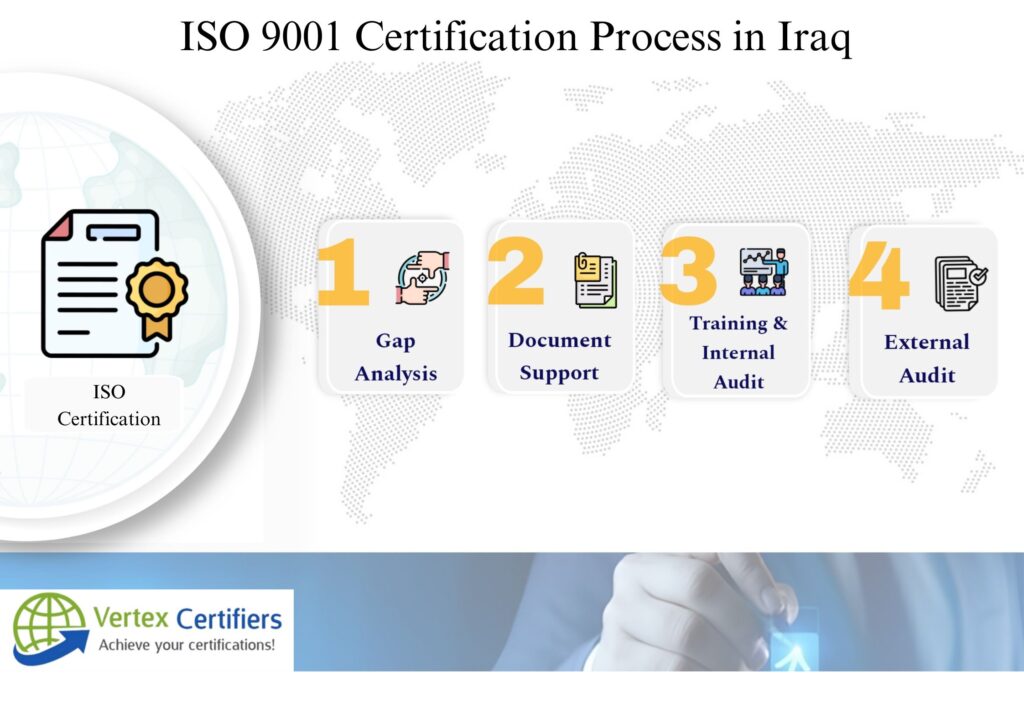
ISO 9001 certification helps manufacturing companies in Iraq establish a reliable Quality Management System (QMS) that controls production activities, improves product consistency, reduces waste, and increases customer confidence. It provides a structured framework for managing processes from raw material purchasing through production, inspection, storage, and final delivery.
For Iraqi manufacturers serving local customers, government projects, international buyers, and export markets, ISO 9001 can become an important strategic investment for improving operational control and supporting sustainable business growth.
3. Why Manufacturing Industries in Iraq Need ISO 9001 Certification
Manufacturing organizations operate through interconnected activities involving people, machinery, materials, suppliers, production methods, inspections, and distribution. Without a structured quality system, inconsistent processes can lead to defects, rework, customer complaints, delayed deliveries, and unnecessary operating costs. ISO 9001 helps manufacturers identify, control, measure, and continually improve these processes.
Improving Product Quality
ISO 9001 requires manufacturers to define product requirements, establish controlled production processes, conduct inspections, and address nonconforming outputs. This supports more consistent product quality across different batches, production shifts, and manufacturing lines.
Reducing Manufacturing Defects
A QMS helps organizations identify the causes of recurring defects instead of only correcting defective products after production. Root cause analysis, corrective action, process monitoring, and employee training can significantly reduce repeated manufacturing errors.
Standardizing Production
Standard operating procedures, work instructions, process parameters, and inspection criteria help employees perform activities consistently. Production standardization is particularly valuable when multiple shifts, operators, or facilities are involved.
Better Process Control
ISO 9001 encourages manufacturers to define process inputs, outputs, responsibilities, controls, performance indicators, and acceptance criteria. Better process control helps reduce variation and improves the predictability of production results.
Supplier Quality Management
Manufacturers can evaluate suppliers according to quality, delivery performance, technical capability, and compliance with purchase requirements. Supplier monitoring helps prevent poor-quality raw materials and components from entering the production process.
Customer Satisfaction
ISO 9001 places strong emphasis on understanding customer requirements, fulfilling agreed specifications, managing complaints, and measuring customer feedback. These activities help manufacturers build stronger, long-term customer relationships.
Export Opportunities
International buyers often prefer working with suppliers that follow a recognized quality management framework. ISO 9001 certification can support supplier qualification, prequalification, export discussions, and entry into markets where documented quality controls are expected.
Tender Eligibility
Some public-sector, infrastructure, construction, energy, and industrial tenders may request ISO 9001 certification or evidence of a documented quality management system. Certification can help Iraqi manufacturers meet buyer and tender qualification requirements where applicable.
Regulatory Compliance
ISO 9001 does not replace Iraqi laws, technical regulations, product approvals, or sector-specific requirements. However, its documentation, monitoring, and corrective action framework can help companies demonstrate better control over applicable legal and customer obligations.
Cost Reduction
Defects, rework, rejected materials, product returns, production delays, and emergency purchases can increase manufacturing costs. By controlling processes and preventing recurring problems, ISO 9001 can help reduce avoidable expenses.
Productivity Improvement
Clear responsibilities, documented processes, effective planning, preventive maintenance, and performance measurement allow employees to work more efficiently. Manufacturers can identify bottlenecks and improve the use of available equipment, labor, and materials.
Waste Reduction
Process monitoring and nonconformity analysis help manufacturers reduce scrap, excess consumption, rejected batches, damaged goods, and unnecessary movement of materials. Waste reduction can also support environmental and cost-control objectives.
Better Inventory Management
Defined purchasing controls, stock identification, storage requirements, and inventory records help manufacturers manage raw materials, work-in-progress, finished goods, and obsolete items more effectively.
Operational Excellence
ISO 9001 promotes a process-based management approach. Manufacturing leaders can use process performance data, audit results, customer feedback, and improvement actions to create a culture of operational excellence.
Improved Traceability
Product identification, batch records, inspection reports, supplier details, and dispatch information make it easier to trace products through the manufacturing and delivery process. Traceability supports faster investigation and controlled action when a quality issue occurs.
Data-Driven Decision Making
ISO 9001 encourages organizations to monitor key indicators such as defect rates, customer complaints, on-time delivery, supplier performance, machine downtime, and audit findings. Management can use this information to make more effective decisions.
Business Growth
A structured QMS can make it easier to scale production, onboard new employees, add product lines, qualify suppliers, and serve larger customers. Stronger process control supports sustainable growth rather than growth based only on individual experience.
International Recognition
ISO 9001 is an internationally recognized quality management standard. Certification demonstrates that the organization has implemented a systematic approach to managing quality and continually improving its processes.
Ready to Improve Manufacturing Quality in Iraq?
Vertex Certifiers can support your organization with ISO 9001 consulting, implementation, training, documentation, internal audits, and certification coordination.
Email: info@vertexcertifiers.com Contact Us4. Key Requirements of ISO 9001 for Manufacturing Industries
ISO 9001:2015 is organized around clauses that help an organization understand its business environment, establish leadership responsibility, plan its QMS, provide resources, control operations, evaluate performance, and improve results. The following clauses explain how the standard can be applied in a manufacturing environment.
Clause 4 – Context of the Organization
The organization must identify internal and external issues that can affect its ability to achieve quality results. A manufacturer may consider customer expectations, raw material availability, supplier reliability, equipment capacity, workforce skills, infrastructure, market conditions, applicable regulations, and competition.
The company must identify relevant interested parties, understand their requirements, define the QMS scope, and determine the processes needed to operate the quality management system. The scope may include activities such as design, procurement, production, inspection, warehousing, and dispatch.
Clause 5 – Leadership
Top management must demonstrate leadership and commitment to the QMS. Quality cannot be treated as the responsibility of the quality department alone. Directors, plant managers, production managers, and department heads should provide resources, establish accountability, promote customer focus, and ensure that quality objectives support the organization’s business direction.
The organization must establish and communicate a quality policy. Roles, responsibilities, and authorities should be clearly assigned for production, inspection, purchasing, maintenance, stores, engineering, and other relevant functions.
Clause 6 – Planning
Manufacturers must identify risks and opportunities that could affect product conformity and customer satisfaction. Examples include unreliable suppliers, machine breakdowns, power interruptions, inadequate inspection equipment, incorrect specifications, operator shortages, and production capacity limits.
The company must establish measurable quality objectives and plan how to achieve them. Objectives may include reducing defects, improving on-time delivery, lowering customer complaints, improving supplier performance, or reducing rework.
Clause 7 – Support
Clause 7 covers the resources required to operate the QMS effectively. This includes competent employees, suitable infrastructure, production equipment, monitoring and measuring resources, organizational knowledge, communication, and controlled documented information.
Employees should receive appropriate induction, technical training, quality awareness, and job-specific instruction. Records should demonstrate employee competence where required.
Clause 8 – Operation
Clause 8 is particularly important for manufacturing organizations because it addresses operational planning, customer requirements, design where applicable, purchasing, production controls, release of products, and control of nonconforming outputs.
Production activities should be planned and performed under controlled conditions using approved specifications, suitable equipment, competent personnel, appropriate monitoring, and documented information.
Clause 9 – Performance Evaluation
The organization must monitor, measure, analyze, and evaluate the performance of its QMS. Manufacturing indicators may include defect percentages, scrap levels, rework costs, customer complaints, delivery performance, machine downtime, supplier quality, and audit results.
Clause 9 also requires internal audits and management reviews. These activities help management determine whether the QMS is suitable, effective, and aligned with business objectives.
Clause 10 – Improvement
Manufacturers must identify improvement opportunities and take action when nonconformities occur. Corrective action should address the root cause of a problem and should be evaluated for effectiveness.
Continual improvement may involve upgrading equipment, revising work instructions, improving supplier controls, redesigning inspection methods, automating records, or introducing more effective production planning techniques.
Manufacturing Examples of ISO 9001 Controls
| Manufacturing Activity | Example of ISO 9001 Application |
|---|---|
| Production planning | Prepare production schedules based on customer orders, capacity, material availability, personnel, equipment, and delivery requirements. |
| Incoming inspection | Inspect received materials and components against purchase specifications before approval for production use. |
| Raw material verification | Verify certificates, grades, dimensions, quantities, batch numbers, and other defined acceptance requirements. |
| Process validation | Validate processes where the output cannot be fully verified by later inspection, such as special welding, heat treatment, sterilization, or chemical processing. |
| Machine maintenance | Maintain production equipment according to preventive maintenance schedules and retain maintenance records. |
| Calibration | Calibrate measuring and testing equipment at planned intervals and control equipment that is damaged, overdue, or found inaccurate. |
| Work instructions | Provide clear and current instructions for operating machinery, setting process parameters, conducting inspections, and handling products. |
| Product identification | Identify raw materials, work-in-progress, finished products, inspection status, and rejected items to prevent mix-ups. |
| Traceability | Maintain batch, lot, serial number, supplier, production, inspection, and dispatch information where traceability is required. |
| Packaging | Use approved packaging methods, labels, specifications, and handling instructions to protect products from damage. |
| Storage | Control storage conditions, stock rotation, material segregation, preservation, and protection against damage or deterioration. |
| Dispatch | Verify product release, quantity, documentation, customer requirements, and delivery details before shipment. |
5. Benefits of ISO 9001 Certification for Manufacturing Companies
Better Product Consistency
Controlled processes and documented specifications help ensure that products meet defined requirements from one batch to another.
Increased Customer Confidence
Certification provides customers with evidence that the company follows a systematic approach to quality management and customer satisfaction.
Reduced Product Returns
Improved inspection, process control, packaging, and complaint analysis can reduce the number of products returned because of quality problems.
Lower Rework Costs
Root cause analysis and preventive controls help reduce repeated rework, repair, sorting, and product rectification activities.
Fewer Production Errors
Clear work instructions, employee competence, approved documents, and effective supervision help prevent avoidable production mistakes.
Better Employee Accountability
Defined responsibilities and measurable objectives make it easier for employees and managers to understand their roles in achieving quality results.
Increased Productivity
Efficient workflows, reduced downtime, better planning, and fewer interruptions help employees and equipment deliver more productive output.
Efficient Resource Utilization
Manufacturers can improve the use of materials, machinery, labor, energy, storage space, and production capacity.
Higher Profitability
Lower waste, fewer defects, reduced complaints, and improved customer retention can contribute to stronger financial performance.
Improved Documentation
Controlled procedures and records create reliable evidence of what was planned, what was performed, what was inspected, and what was improved.
Better Supplier Performance
Supplier evaluation, incoming inspection, performance monitoring, and corrective action improve the quality and reliability of purchased materials.
Improved Operational Control
Process ownership, defined controls, performance indicators, and risk-based planning provide management with greater visibility over daily operations.
Easier Compliance
A documented QMS supports the organization in identifying and monitoring applicable customer, statutory, regulatory, and contractual requirements.
Enhanced Brand Image
Certification can strengthen the company’s reputation among customers, distributors, contractors, government buyers, and international partners.
Global Market Access
ISO 9001 certification can support supplier approval and market-entry discussions where customers expect recognized quality management practices.
Strong Competitive Advantage
Companies that consistently deliver conforming products and reliable service can differentiate themselves in competitive manufacturing markets.
6. Which Manufacturing Industries Need ISO 9001?
ISO 9001 can be applied to almost any manufacturing organization, regardless of company size, product type, production method, or ownership structure. The QMS should be designed according to the organization’s risks, processes, customers, products, and operational complexity.
- Food processing: Controlling raw materials, production hygiene, processing parameters, inspection, packaging, and product release.
- Beverage manufacturing: Managing ingredients, filling processes, packaging materials, product testing, and batch traceability.
- Pharmaceutical manufacturing: Controlling materials, manufacturing processes, documentation, equipment, testing, and customer requirements.
- Medical devices: Establishing product controls, traceability, inspection, risk management, complaint handling, and regulatory support processes.
- Chemical industries: Controlling formulations, material verification, process parameters, laboratory testing, storage, and safety-related requirements.
- Petrochemical manufacturing: Managing production processes, equipment reliability, inspection, supplier quality, maintenance, and product specifications.
- Plastic industries: Controlling resin, molding, extrusion, production parameters, dimensional inspection, and finished product conformity.
- Packaging industries: Managing printing, cutting, forming, labeling, material selection, inspection, and customer-specific specifications.
- Steel industries: Controlling raw materials, melting, rolling, treatment, testing, dimensions, grades, and product identification.
- Metal fabrication: Managing drawings, cutting, forming, welding, finishing, inspection, and project-specific requirements.
- Cement manufacturing: Monitoring raw materials, kiln processes, laboratory testing, packaging, storage, and delivery controls.
- Construction materials: Controlling concrete products, blocks, tiles, pipes, aggregates, testing, dimensional requirements, and product release.
- Electrical equipment: Managing component verification, assembly, wiring, testing, inspection, labeling, and technical documentation.
- Electronics manufacturing: Controlling components, assembly, soldering, programming, testing, product identification, and handling of electrostatic-sensitive items.
- Textile industries: Managing fibers, yarns, dyeing, weaving, stitching, finishing, inspection, and customer specifications.
- Leather products: Controlling hides, tanning, cutting, stitching, finishing, color consistency, inspection, and packaging.
- Furniture manufacturing: Managing wood, metal, fittings, design specifications, assembly, finishing, inspection, and delivery.
- Automotive components: Controlling materials, machining, assembly, inspection, traceability, supplier performance, and customer-specific requirements.
- Machinery manufacturing: Managing drawings, purchased parts, machining, assembly, testing, commissioning, and after-sales support.
- Engineering industries: Controlling technical design, procurement, fabrication, installation, testing, inspection, and project documentation.
7. ISO 9001 Documentation Requirements
ISO 9001 requires organizations to maintain documented information necessary to support process operation and retain evidence that processes are being performed as planned. The exact documents and records depend on the size, products, processes, risks, and regulatory obligations of the manufacturer.
Quality policy
A documented statement of the organization’s commitment to quality, customer satisfaction, compliance, and continual improvement.
Quality objectives
Measurable targets related to defects, customer complaints, delivery, supplier performance, productivity, or other important quality indicators.
QMS scope
A clear description of the sites, products, services, processes, and activities covered by the Quality Management System.
Process maps
Visual or documented descriptions showing how management, production, support, purchasing, inspection, and improvement processes interact.
Risk register
A record of significant risks and opportunities, their potential effects, responsible owners, controls, and planned actions.
SOPs
Standard operating procedures that define how important processes are planned, performed, monitored, and controlled.
Work instructions
Detailed instructions for specific tasks such as machine operation, inspection, assembly, cleaning, packaging, or material handling.
Inspection procedures
Methods defining inspection stages, sampling, acceptance criteria, testing equipment, responsibilities, and records.
Calibration records
Evidence of calibration, verification, equipment status, due dates, results, and actions taken when equipment is found inaccurate.
Maintenance records
Records of planned and corrective maintenance performed on production machinery, utilities, tools, and critical infrastructure.
Supplier evaluation
Approved supplier lists, supplier selection criteria, performance reviews, incoming inspection results, and supplier corrective actions.
Production records
Batch records, job cards, production reports, operator details, material information, process parameters, and inspection results.
Internal audit reports
Audit plans, checklists, evidence, findings, conclusions, responsible persons, and follow-up results.
NCR reports
Nonconformity records describing defective materials, products, processes, documentation, or service outputs.
Corrective actions
Records showing containment, root cause analysis, action planning, implementation, and verification of corrective action effectiveness.
Management review minutes
Evidence that top management has reviewed QMS performance, risks, objectives, audit results, customer feedback, resources, and improvement needs.
Important: ISO 9001 does not require unnecessary paperwork. The documentation should be practical, understandable, controlled, and useful to employees and managers. Digital forms, ERP records, approved checklists, and electronic workflows may be used where they are properly controlled.
9. ISO 9001 Internal Audits for Manufacturing Industries
Internal audits help manufacturing companies determine whether their processes conform to planned arrangements, ISO 9001 requirements, customer specifications, and internal procedures. Audits also reveal opportunities to improve efficiency, reduce risks, and prevent quality problems.
Important Internal Audit Activities
- Audit planning: Prepare an annual or periodic audit program based on process importance, risks, previous findings, changes, and performance.
- Process audits: Evaluate whether defined processes are operating as planned and achieving their intended results.
- Shop floor audits: Check work instructions, operator competence, machine settings, housekeeping, product identification, and inspection practices.
- Warehouse audits: Review receiving, storage, stock identification, preservation, segregation, stock rotation, and dispatch controls.
- Supplier audits: Assess supplier controls when supplier performance or product criticality creates a significant risk.
- Production audits: Verify production planning, process parameters, records, inspection stages, product release, and nonconforming product controls.
- Maintenance audits: Review preventive maintenance schedules, breakdown records, spare parts, machine condition, and maintenance effectiveness.
- Calibration audits: Confirm that measuring equipment is identified, calibrated, protected, within validity, and suitable for its intended use.
- Audit findings: Record objective evidence, nonconformities, observations, risks, and opportunities for improvement.
- Root cause analysis: Investigate why a problem occurred using methods such as the five whys, fishbone analysis, or process analysis.
- Corrective actions: Assign responsibility, establish deadlines, implement actions, and verify whether the actions effectively prevented recurrence.
- Continual improvement: Use audit trends and recurring findings to improve processes, training, equipment, controls, and documentation.
10. Common Challenges During ISO 9001 Implementation
| Common Challenge | Practical Solution |
|---|---|
| Resistance to change | Explain the business benefits, involve employees in process development, provide practical training, and introduce changes gradually with clear responsibilities. |
| Poor documentation | Develop simple, process-based documents using language employees understand. Remove duplicate forms and control document versions. |
| Lack of leadership support | Involve top management from the beginning, establish measurable objectives, assign resources, and review QMS performance during management meetings. |
| Employee awareness issues | Provide role-specific training and explain how each employee’s work affects product quality, customer satisfaction, safety, and business performance. |
| Weak process monitoring | Define useful KPIs such as defect rates, downtime, rework, delivery performance, complaints, and supplier quality, then review trends regularly. |
| Poor supplier control | Establish supplier approval criteria, conduct incoming inspections, monitor supplier performance, communicate specifications, and issue corrective actions where necessary. |
| Calibration problems | Maintain an equipment register, identify calibration intervals, use authorized calibration providers, label equipment status, and control overdue instruments. |
| Inadequate risk assessment | Conduct risk reviews with production, quality, maintenance, purchasing, engineering, and management personnel who understand the actual processes. |
| Limited resources | Prioritize high-risk and customer-critical processes, use existing systems where effective, and implement the QMS in manageable stages. |
| Inconsistent production records | Use standardized forms, clear completion instructions, supervisor verification, routine record reviews, and electronic controls where practical. |
11. Cost of ISO 9001 Certification in Iraq
The cost of ISO 9001 certification in Iraq varies from one manufacturing organization to another. A small facility with a single production line and an established QMS will generally require a different level of effort than a large manufacturer with multiple sites, complex processes, and extensive documentation.
Factors Affecting ISO 9001 Certification Cost
- Organization size: The number of departments, employees, shifts, and operational activities affects implementation and audit time.
- Number of employees: More employees may require additional awareness, competence, and role-specific training.
- Number of production lines: Multiple lines may require separate process reviews, work instructions, inspection controls, and audit coverage.
- Business complexity: Design, special processes, testing, traceability, regulated products, and customer-specific requirements can increase project effort.
- Multiple manufacturing sites: Additional sites require broader implementation, coordination, documentation, and certification audit coverage.
- Existing documentation: Companies with effective procedures and records may need less documentation development than organizations starting from the beginning.
- Scope of certification: A broader scope covering design, manufacturing, installation, servicing, or multiple products may affect the overall cost.
- Certification body: Certification fees depend on audit duration, auditor requirements, location, accreditation arrangements, and certification body charges.
- Consultancy support: The level of support required for gap assessment, documentation, implementation, training, internal audits, and corrective action affects the consulting fee.
- Employee training: Awareness programs, internal auditor training, process-specific training, and management workshops may be included separately.
A reliable quotation should be prepared after understanding the organization’s products, sites, employees, production processes, existing QMS, certification scope, and target timeline. Contact Vertex Certifiers for a project-specific assessment and quotation.
12. Why Choose Vertex Certifiers for ISO 9001 Certification in Iraq?
Vertex Certifiers supports manufacturing organizations that want to establish a practical, effective, and audit-ready ISO 9001 Quality Management System. Our approach focuses on integrating quality controls into daily manufacturing activities instead of creating documentation that employees do not use.
Experienced ISO Consultants
Our consultants help organizations understand ISO 9001 requirements and apply them to real operational processes.
Manufacturing Industry Expertise
We focus on production planning, inspection, supplier control, equipment, maintenance, calibration, traceability, and process improvement.
Practical Implementation Approach
We develop processes and controls that are suitable for the organization’s size, products, workforce, risks, and production environment.
Complete Documentation Support
Our support can include quality manuals where appropriate, procedures, SOPs, work instructions, forms, registers, and required records.
Employee Training Programs
We provide awareness, internal auditor, process-owner, and role-specific training to improve employee participation and competence.
Internal Audit Services
We help conduct process, production, warehouse, supplier, maintenance, calibration, and system audits before the certification audit.
Certification Body Coordination
We assist with certification body communication, audit planning, document submission, audit preparation, and response to audit findings.
Affordable Consulting Solutions
Our services can be structured according to the organization’s size, complexity, scope, resources, and implementation requirements.
Fast Project Completion
A focused implementation plan helps organizations complete important activities efficiently without compromising the effectiveness of the QMS.
End-to-End Assistance
We can support gap assessment, implementation, documentation, training, internal audits, management review, certification preparation, and follow-up.
Support Across Major Iraqi Industrial Cities
Vertex Certifiers can support manufacturing organizations across major industrial locations in Iraq through suitable on-site and remote arrangements.
Global Project Experience
Our international project experience helps organizations align their QMS with customer expectations and globally recognized management practices.
Start Your ISO 9001 Project with Vertex Certifiers
Get professional support for ISO 9001 implementation, documentation, training, internal audits, and certification readiness across Iraq.
info@vertex.com Contact Vertex Certifiers13. Frequently Asked Questions About ISO 9001 Certification in Iraq
What is ISO 9001 certification?
ISO 9001 certification confirms that an organization has established and maintains a Quality Management System that meets the requirements of ISO 9001. It focuses on customer requirements, process control, risk-based thinking, performance evaluation, and continual improvement.
Why do manufacturing companies need ISO 9001?
Manufacturing companies use ISO 9001 to improve product consistency, reduce defects and rework, control suppliers, standardize production, improve traceability, increase customer confidence, and support business growth.
Is ISO 9001 mandatory in Iraq?
ISO 9001 is not automatically mandatory for every manufacturing company in Iraq. However, specific customers, tenders, contracts, regulators, export partners, or industry requirements may request certification or equivalent evidence of quality management.
How long does ISO 9001 certification take?
The timeline depends on organization size, process complexity, employee involvement, existing documentation, number of sites, and audit readiness. A small manufacturer with an established system may complete the project faster than a complex multi-site organization starting from the beginning.
How much does ISO 9001 certification cost in Iraq?
The cost depends on employees, production lines, sites, business complexity, certification scope, certification body fees, consultancy support, and training requirements. A customized quotation should be prepared after a gap assessment or project discussion.
What documents are required for ISO 9001 certification?
Typical documented information may include the QMS scope, quality policy, objectives, process information, risk records, procedures, work instructions, inspection records, calibration records, maintenance records, supplier records, production records, audit reports, NCRs, corrective actions, and management review minutes.
Can small manufacturers obtain ISO 9001 certification?
Yes. ISO 9001 can be implemented by small manufacturers. The system should be scaled according to the company’s activities, risks, products, workforce, and customer requirements rather than copied from a large organization.
How long is ISO 9001 certification valid?
ISO 9001 certificates are generally issued for a three-year certification cycle, subject to successful surveillance audits and continued conformity with the certification requirements.
What is the difference between implementation and certification?
Implementation is the process of establishing, documenting, operating, and improving the QMS. Certification is the independent assessment conducted by an eligible certification body to determine whether the QMS conforms to ISO 9001.
What happens during the certification audit?
Auditors review documented information, interview employees, observe manufacturing activities, examine records, evaluate process controls, and determine whether the QMS meets ISO 9001 requirements and the organization’s own procedures.
What are surveillance audits?
Surveillance audits are periodic audits performed during the certification cycle to confirm that the QMS remains implemented and effective. Auditors may review selected processes, records, objectives, internal audits, corrective actions, and management review outputs.
Can ISO 9001 help increase exports?
ISO 9001 can support export readiness by demonstrating a recognized approach to quality management. It may help during customer qualification and supplier approval, although export success also depends on product compliance, pricing, logistics, market requirements, and commercial capability.
Does ISO 9001 reduce manufacturing defects?
ISO 9001 provides tools that can help reduce defects, including process controls, inspection, employee competence, equipment maintenance, supplier evaluation, nonconformity management, root cause analysis, and corrective action. Results depend on how effectively the system is implemented and used.
Can ISO 9001 be integrated with ISO 14001 and ISO 45001?
Yes. ISO 9001 can be integrated with ISO 14001 for environmental management and ISO 45001 for occupational health and safety management. An integrated management system can use common processes for documentation, audits, objectives, risk management, training, and management review.
Does ISO 9001 certification guarantee defect-free products?
No. ISO 9001 does not guarantee that every product will be defect-free. It establishes a systematic framework for controlling processes, identifying problems, reducing risks, investigating causes, and continually improving product and process performance.
Is internal auditing required for ISO 9001?
Yes. Organizations must plan and conduct internal audits at suitable intervals to determine whether the QMS conforms to ISO 9001 requirements and the organization’s own requirements.
Do manufacturers need a quality manual?
ISO 9001 does not specifically require a traditional quality manual. However, the organization must maintain documented information needed to support its QMS, including its scope, processes, policies, objectives, procedures, and records where necessary.
Can Vertex Certifiers help prepare for the certification audit?
Yes. Vertex Certifiers can support gap assessment, QMS implementation, documentation, employee training, internal audits, management review preparation, corrective action, and coordination with the certification body.
Why choose Vertex Certifiers for ISO 9001 certification in Iraq?
Vertex Certifiers combines ISO consulting knowledge, manufacturing process understanding, documentation support, training, internal audit assistance, and certification coordination to provide practical end-to-end support for organizations across Iraq.
14. Conclusion: ISO 9001 Certification for Manufacturing Industries in Iraq
Iraq’s manufacturing sector has an important role to play in supporting economic development, local supply chains, infrastructure projects, construction activity, energy-related industries, consumer markets, and international trade. As competition increases, manufacturers must do more than produce goods. They must demonstrate that their products are consistent, reliable, traceable, and suitable for customer and contractual requirements. A structured Quality Management System based on ISO 9001 can help Iraqi manufacturing companies achieve these objectives through organized processes, documented controls, employee involvement, and continual improvement.
ISO 9001 certification helps manufacturers improve the way they plan, purchase, produce, inspect, store, and deliver products. Production planning becomes more systematic because customer requirements, resources, equipment, materials, and delivery commitments are considered before work begins. Incoming inspection and supplier evaluation help prevent unsuitable raw materials from entering the production process. Work instructions, process monitoring, machine maintenance, calibration, and employee training create more reliable production conditions. Product identification and traceability make it easier to investigate quality issues and take controlled action when necessary.
The benefits extend beyond product quality. By reducing defects, rework, scrap, returns, production delays, and unnecessary material consumption, ISO 9001 can support better cost control and higher productivity. Performance indicators help managers understand whether processes are achieving their intended results. Internal audits provide an organized method for identifying weaknesses, while corrective action ensures that recurring problems are investigated rather than repeatedly treated as isolated incidents. Management reviews give leadership a structured opportunity to evaluate risks, resources, customer feedback, audit findings, objectives, and improvement priorities.
For customers, ISO 9001 certification demonstrates that the manufacturer follows a recognized framework for managing quality. This can increase confidence among local buyers, contractors, distributors, government organizations, and international partners. Certification may also support tender eligibility, supplier prequalification, export discussions, and access to customers that expect documented quality management practices. Although ISO 9001 does not replace product-specific regulations, technical approvals, or sector requirements, it can provide a strong management foundation for controlling those obligations.
Implementing ISO 9001 successfully requires more than preparing documents for an audit. The system must be understood by employees and integrated into daily manufacturing activities. Leaders must provide support, process owners must accept responsibility, employees must follow controlled procedures, and managers must use performance data to make decisions. The most effective QMS is practical, risk-based, and connected to the organization’s business objectives. It should help employees perform their work better while giving management greater visibility and control.
For small manufacturers, ISO 9001 can establish a strong foundation for controlled growth. For larger companies, it can improve consistency across departments, production lines, shifts, suppliers, and manufacturing sites. It can also serve as a foundation for integrating other management systems, including environmental management and occupational health and safety. Over time, a mature QMS can help organizations build a culture in which quality is considered during planning, purchasing, production, maintenance, inspection, delivery, and improvement.
Choosing ISO 9001 certification is therefore not merely an administrative decision. It is a strategic investment in operational efficiency, customer satisfaction, employee accountability, regulatory preparedness, export readiness, and long-term competitiveness. Iraqi manufacturers that establish effective quality controls today can improve their ability to respond to customer expectations, reduce avoidable losses, qualify for new opportunities, and grow with greater confidence.
Vertex Certifiers can help your manufacturing organization move from initial assessment to certification readiness through professional ISO 9001 consulting, implementation, documentation development, employee training, internal audits, corrective action support, and certification body coordination. Whether your company is located in Baghdad, Basra, Erbil, Mosul, Najaf, Karbala, Kirkuk, or another industrial location in Iraq, our team can develop a practical approach suited to your products, processes, workforce, and business goals.
Contact Vertex Certifiers today to discuss your ISO 9001 requirements and receive professional guidance for building a reliable Quality Management System that supports sustainable manufacturing growth.
Begin Your ISO 9001 Certification Journey
Speak with Vertex Certifiers for consulting, implementation, documentation, training, internal audits, and certification support across Iraq.
Email: info@vertexcertifiers.com Contact Us