Why Is ISO 9001 Certification Important in Surabaya?
Surabaya is a major business, manufacturing, trade, logistics, and maritime centre in Indonesia. The city’s industrial and commercial ecosystem includes manufacturing companies, food processors, engineering firms, distributors, technology businesses, and port-related organizations. Tanjung Perak Port also supports trade and logistics activities across East Java and eastern Indonesia, increasing the need for reliable processes and consistent service delivery.
[pthms](https://pthms.com/news/the-evolution-of-tanjung-perak-from-a-transit-terminal-to-a-global-trade-hub)
ISO 9001 certification helps Surabaya organizations establish a structured Quality Management System (QMS). It enables businesses to control their processes, understand customer requirements, manage operational risks, and continually improve performance.
Improving Product and Service Quality
ISO 9001 encourages organizations to control and improve the processes that influence product and service quality. Businesses can:
- Establish consistent processes for production and service delivery.
- Reduce variations, defects, and process errors.
- Improve the reliability and consistency of products and services.
- Define clear quality requirements and acceptance criteria.
- Use documented information and performance data to support decisions.
Increasing Customer Satisfaction
A QMS helps organizations understand what customers expect and evaluate whether those expectations are being met. ISO 9001 supports businesses in:
- Identifying customer requirements before accepting orders or contracts.
- Monitoring customer feedback and satisfaction levels.
- Addressing complaints through a systematic process.
- Improving response times and communication.
- Delivering a more consistent customer experience.
Improving Operational Efficiency
Structured quality management allows companies to examine how work is performed and identify areas that cause delays, duplication, or unnecessary costs. Organizations can:
- Identify inefficient or duplicated processes.
- Reduce rework, waste, delays, and avoidable expenses.
- Clearly define responsibilities and authorities.
- Improve coordination between departments.
- Monitor key processes using suitable performance indicators.
Supporting Business Growth
ISO 9001 can help Surabaya businesses create organized processes that are easier to manage as the organization expands. A structured QMS may also improve credibility with customers, contractors, suppliers, and business partners.
For companies supplying larger organizations or participating in national and international supply chains, a recognized quality management system can support supplier evaluations, tender participation, and market expansion. Certification does not guarantee a contract, but it can demonstrate that the organization has established a systematic approach to managing quality.
Reducing Operational Risks
ISO 9001 promotes risk-based thinking throughout the QMS. Businesses can use the standard to:
- Identify quality-related risks and opportunities.
- Establish controls for important operational activities.
- Monitor process performance and potential failures.
- Record nonconformities and corrective actions.
- Prevent recurring quality problems.
Who Can Get ISO 9001 Certification in Surabaya?
ISO 9001 is suitable for organizations of different sizes and sectors. The standard is not limited to manufacturers. Its requirements can be applied to any organization that needs to consistently provide products or services that meet customer and applicable statutory requirements.
Organizations in Surabaya that may pursue ISO 9001 certification include:
- Manufacturing companies.
- Food processing companies.
- Construction companies.
- Engineering firms.
- Automotive businesses.
- Logistics and transportation companies.
- Shipping and port-related businesses.
- Trading and distribution companies.
- Information technology companies.
- Software and technology companies.
- Healthcare organizations.
- Educational institutions.
- Professional service providers.
- Small and medium-sized enterprises.
The QMS should be designed according to the organization’s size, operational complexity, customer expectations, risks, and certification scope.
Key Requirements of ISO 9001:2015
ISO 9001:2015 requires organizations to establish, implement, maintain, and continually improve a QMS. The major requirements are addressed through Clauses 4 to 10 of the standard.
Context of the Organization
The organization must understand the circumstances that influence its ability to achieve intended quality results. This includes:
- Understanding internal and external issues.
- Identifying relevant interested parties and their requirements.
- Defining the scope of the Quality Management System.
- Determining the processes required for the QMS and their interactions.
Leadership
Top management must demonstrate commitment to the QMS and make quality part of the organization’s business direction. This includes:
- Demonstrating management commitment.
- Establishing and communicating a quality policy.
- Assigning appropriate roles, responsibilities, and authorities.
- Promoting customer focus throughout the organization.
- Ensuring that the QMS supports business processes.
Planning
Organizations must plan actions that address risks and opportunities and establish measurable quality objectives. Planning may include:
- Identifying risks and opportunities.
- Establishing quality objectives for relevant functions and processes.
- Defining plans to achieve quality objectives.
- Planning changes to the QMS in a controlled manner.
Support
The organization must provide the resources and support necessary to operate the QMS effectively. This includes:
- Providing appropriate infrastructure and process environments.
- Ensuring employee competence and training.
- Creating awareness of the quality policy and relevant objectives.
- Establishing suitable internal and external communication methods.
- Maintaining and controlling documented information.
Operation
Operational controls help ensure that products and services are delivered according to specified requirements. Key areas include:
- Operational planning and control.
- Reviewing customer requirements.
- Design and development controls, where applicable.
- Product and service delivery.
- Identification and traceability, where relevant.
- Control of nonconforming outputs.
- Control of suppliers and external providers.
Performance Evaluation
Organizations must evaluate whether the QMS is effective and achieving its intended results. This generally involves:
- Monitoring, measurement, analysis, and evaluation.
- Monitoring customer satisfaction.
- Conducting internal audits.
- Performing management reviews.
- Reviewing process and QMS performance.
Improvement
ISO 9001 requires organizations to respond to problems and improve the suitability, adequacy, and effectiveness of the QMS. Improvement activities include:
- Managing nonconformities.
- Implementing corrective actions.
- Investigating the causes of problems.
- Evaluating whether corrective actions are effective.
- Driving continual improvement.
Documents Required for ISO 9001 Certification
ISO 9001:2015 does not require every organization to use identical documents. The extent of documented information depends on the organization’s size, number of employees, process complexity, operational risks, customer requirements, and existing management system.
Examples of documents and records that may be required or useful include:
- Quality policy.
- Quality objectives and action plans.
- QMS scope.
- Process maps, procedures, work instructions, or process information.
- Risk and opportunity records.
- Supplier evaluation and monitoring records.
- Training, competence, and awareness records.
- Customer enquiry, order, contract, and feedback records.
- Operational and production records.
- Inspection, testing, and release records, where applicable.
- Internal audit records.
- Management review records.
- Nonconformity and corrective action records.
- Monitoring and measurement results.
Documentation should support effective process control rather than create unnecessary administrative work. It should be practical, accessible, current, and relevant to actual operations.
Benefits of ISO 9001 Certification for Surabaya Businesses
Implementing ISO 9001 can provide practical benefits for businesses operating in Surabaya’s competitive commercial and industrial environment. Potential benefits include:
- Improved quality consistency.
- Higher customer satisfaction.
- Better process control.
- Reduced errors, defects, and rework.
- Clearer employee responsibilities.
- Improved supplier selection and management.
- Stronger business credibility.
- Improved operational efficiency.
- Better risk management.
- Greater readiness for new markets and supply chains.
- More reliable performance monitoring.
- Continual improvement of products, services, and processes.
For example, a Surabaya-based logistics company may use ISO 9001 to standardize order handling, shipment documentation, delivery monitoring, complaint management, and supplier evaluation. This can help reduce service variations and provide clearer evidence of process performance.
How Much Does ISO 9001 Certification Cost in Surabaya?
There is no single fixed ISO 9001 certification cost in Surabaya. The total investment depends on the organization’s requirements and the amount of work needed to establish and assess the QMS.
Important cost factors may include:
- Organization size.
- Number of employees.
- Number of locations.
- Scope of certification.
- Complexity and number of processes.
- Existing QMS and level of readiness.
- Level of documentation required.
- Consultant involvement.
- Certification body fees.
- Audit duration and audit days.
- Travel and accommodation requirements, where applicable.
- Additional training or internal audit support.
Organizations with established processes and records may require less preparation than businesses starting from scratch. A detailed estimate should be prepared after reviewing the certification scope, employee count, locations, activities, and current management practices.
Request an ISO 9001 Certification Cost Estimate
How Long Does ISO 9001 Certification Take in Surabaya?
The time required for ISO 9001 certification varies from one organization to another. The timeline depends on the organization’s size, existing management system, process complexity, employee involvement, documentation requirements, and readiness for the certification audit.
Organizations with an existing structured QMS, established records, trained employees, and active internal audits may require less preparation time. Organizations starting from scratch may need additional time to develop processes, implement controls, train employees, generate records, complete internal audits, and conduct management review.
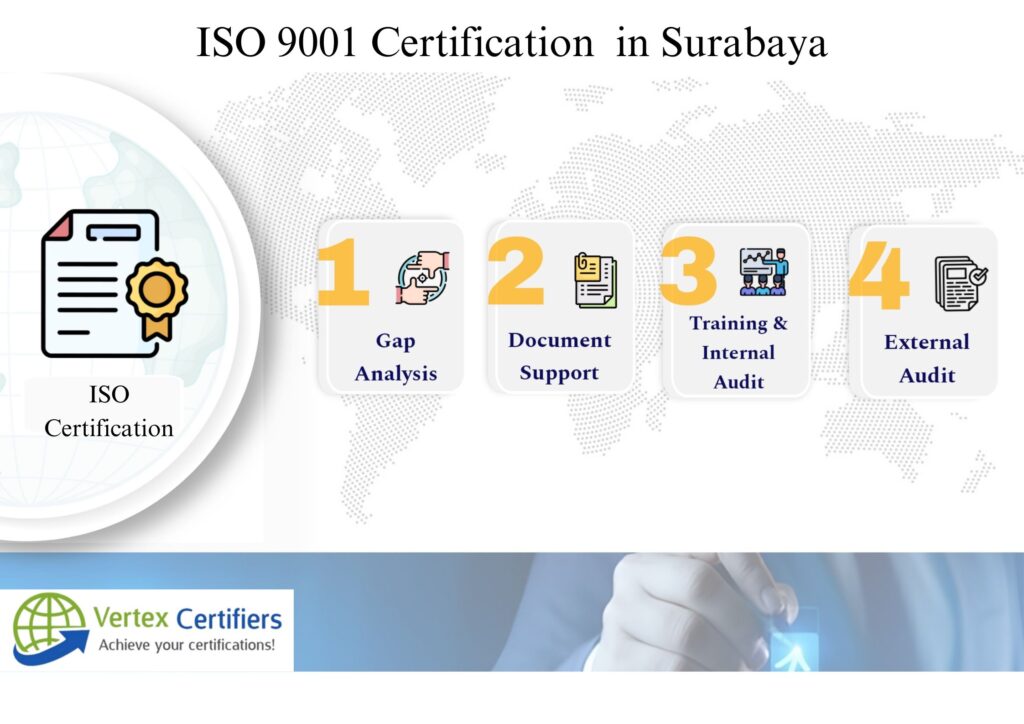
The typical certification route includes preparation, QMS implementation, internal audit, management review, and an independent certification audit. The initial certification audit is commonly conducted in two stages: Stage 1 assesses readiness and documented information, while Stage 2 evaluates implementation and effectiveness across the certification scope.
[factocert](https://factocert.com/how-to-get-iso-certification-in-indonesia-complete-step-by-step-guide-for-businesses/)
After certification, organizations normally undergo surveillance audits during the certification cycle, followed by recertification at the end of the cycle. Certificates are typically issued for a three-year cycle, subject to satisfactory surveillance results and the certification body’s applicable rules.
[factocert](https://factocert.com/how-to-get-iso-certification-in-indonesia-complete-step-by-step-guide-for-businesses/)
ISO 9001 Certification vs ISO 9001 Implementation
| ISO 9001 Implementation | ISO 9001 Certification |
|---|
| Establishing the QMS. | Independent assessment of the QMS. |
| Developing processes and documented information. | Certification audit. |
| Employee training and awareness. | Certification decision by the certification body. |
| Internal audit. | External certification. |
| Corrective actions and system improvement. | Ongoing surveillance audits. |
Implementation is the process of building and operating the QMS. Certification is the independent conformity assessment performed by a certification body. An organization may implement ISO 9001 without becoming certified, but certification requires an audit by an independent certification body.
Why Choose Vertex Certifiers for ISO 9001 Certification in Surabaya?
Vertex Certifiers supports organizations in Surabaya with practical ISO 9001 preparation and implementation activities. The support can be adapted to the organization’s sector, size, operational risks, and certification objectives.
Services may include:
- ISO 9001 gap analysis.
- ISO 9001 documentation support.
- Quality policy and objective development.
- QMS implementation guidance.
- Employee training and awareness programs.
- Process and risk assessment support.
- Internal audit support.
- Management review preparation.
- Corrective action guidance.
- Certification audit preparation and support.
Vertex Certifiers can help your organization understand the standard, identify gaps, organize documented information, involve employees, and prepare objective evidence before the independent certification audit. Certification decisions remain the responsibility of the selected certification body.
ISO Certification Services Offered by Vertex Certifiers in Indonesia
Vertex Certifiers provides support for a range of ISO management system standards across Indonesia. Depending on the organization’s sector and objectives, services may include:
- ISO 9001 – Quality Management System.
- ISO 14001 – Environmental Management System.
- ISO 45001 – Occupational Health and Safety Management System.
- ISO 22000 – Food Safety Management System.
- ISO 27001 – Information Security Management System.
- ISO 22301 – Business Continuity Management System.
- ISO 13485 – Quality Management System for Medical Devices.
- ISO 50001 – Energy Management System.
- ISO 37001 – Anti-Bribery Management System.
- Other industry-specific ISO standards.
Support is available for organizations in Jakarta, Surabaya, Bandung, Medan, Semarang, Makassar, Palembang, Denpasar, Yogyakarta, Balikpapan, and other cities across Indonesia.
Frequently Asked Questions About ISO 9001 Certification in Surabaya
What Is ISO 9001 Certification?
ISO 9001 certification is an independent confirmation that an organization’s Quality Management System has been assessed against the applicable requirements of ISO 9001:2015. The certification audit evaluates whether the organization has established and implemented suitable processes within its defined scope.
Is ISO 9001 Suitable for Small Businesses in Surabaya?
Yes. ISO 9001 can be applied by small and medium-sized businesses as well as large organizations. The QMS should be scaled according to the company’s size, risks, activities, customer requirements, and process complexity. Small businesses do not need to copy the documentation structure of a large corporation.
How Long Does ISO 9001 Certification Take?
The timeline depends on the organization’s size, existing QMS, process complexity, employee involvement, documentation needs, and audit readiness. A company with established processes and records may complete preparation faster than an organization developing its QMS for the first time.
How Much Does ISO 9001 Certification Cost in Surabaya?
There is no universal price. Cost is influenced by employee numbers, locations, certification scope, process complexity, existing QMS maturity, consulting requirements, certification body fees, and audit duration. Contact Vertex Certifiers for an organization-specific estimate.
Is ISO 9001 Mandatory in Indonesia?
ISO 9001 certification is generally voluntary unless a particular law, government requirement, tender condition, customer contract, or industry requirement makes a certified QMS necessary. Organizations should verify the requirements that apply to their specific sector, products, services, and contracts.
What Documents Are Required for ISO 9001 Certification?
Documents and records may include the quality policy, quality objectives, QMS scope, process information, risk and opportunity records, supplier evaluation records, training records, customer-related records, operational records, internal audit records, management review records, and nonconformity and corrective action records.
Can a Company Implement ISO 9001 Without a Consultant?
Yes. An organization can implement ISO 9001 using its internal resources, provided it understands the standard and has sufficient time, competence, and personnel. A consultant may help accelerate the process, provide implementation structure, train employees, identify gaps, and prepare the organization for an independent audit.
Who Conducts the ISO 9001 Certification Audit?
An independent third-party certification body conducts the certification audit. Consultants may assist with implementation and preparation, but they should not make the independent certification decision for the organization they supported.
How Long Is an ISO 9001 Certificate Valid?
An ISO 9001 certificate is typically issued for a three-year certification cycle, subject to successful surveillance audits and the conditions established by the certification body. A recertification audit is generally required at the end of the cycle.
[factocert](https://factocert.com/how-to-get-iso-certification-in-indonesia-complete-step-by-step-guide-for-businesses/)
What Happens After ISO 9001 Certification?
After certification, the organization must continue operating and improving its QMS. It should monitor processes, review customer satisfaction, conduct internal audits, perform management reviews, manage nonconformities, implement corrective actions, and participate in surveillance audits arranged by the certification body.
Get ISO 9001 Certification in Surabaya
ISO 9001 certification can help Surabaya organizations establish a more consistent, controlled, and customer-focused approach to business operations. A structured QMS supports better process performance, clearer responsibilities, improved customer satisfaction, reduced errors, and continual improvement.
Start by assessing your current quality management practices and identifying the processes that require improvement. Vertex Certifiers can support your organization with ISO 9001 gap analysis, documentation, implementation, employee training, internal audit preparation, corrective action guidance, and certification audit support.
Contact Vertex Certifiers to discuss your organization’s ISO 9001 requirements and obtain a practical certification support plan.
Email Us: info@vertexcertifiers.com
Contact Us
Request Your ISO 9001 Cost Estimate