
ISO 9001 Certification in Turkey:
ISO 9001 Certification in Turkey, Vertex Certifiers, we deliver end-to-end ISO certification services for ISO 9001 in Turkey, supporting organizations across major cities like Istanbul, Ankara, Izmir, Bursa, and Antalya. Our comprehensive approach covers gap analysis, documentation, implementation, training, internal audits, and final certification coordination—ensuring a smooth, hassle-free process. Beyond ISO 9001, we also specialize in multiple international standards including ISO 14001, ISO 45001, ISO 27001, ISO 27701, ISO 22000, ISO 22301, ISO 20000-1, ISO 13485, ISO 50001, ISO 21001, ISO 28000, ISO 37001, and ISO 41001, helping businesses strengthen compliance, improve performance, and gain global recognition.
Introduction to ISO 9001 Certification in Turkey
In Turkey’s dynamic economy, where manufacturing, exports, and SMEs drive growth, ISO 9001 certification stands out as a game-changer. This international standard for Quality Management Systems (QMS) ensures businesses consistently meet customer and regulatory needs through structured processes.
For Turkish companies, ISO 9001 certification in Turkey isn’t just a badge—it’s a strategic edge. Turkey’s export sector, valued at over $250 billion annually (as of 2025 data from Turkish Exporters’ Assembly), faces stiff competition from Europe and beyond. With Turkey’s ongoing EU Customs Union alignment and free trade agreements, ISO 9001 helps manufacturers and exporters meet global quality benchmarks.
Demand is surging: Turkish businesses pursuing ISO 9001 certification report 20-30% more international tenders. SMEs in Istanbul, Ankara, and Izmir lead the charge, using it to scale amid economic recovery post-2023 inflation. Whether you’re in automotive parts, textiles, or food processing, securing ISO 9001 in Turkey positions your firm for sustainable success.
What is ISO 9001 Certification?
ISO 9001 certification defines a globally recognized framework for establishing, implementing, and improving a Quality Management System. Developed by the International Organization for Standardization (ISO), the latest version—ISO 9001:2015—emphasizes leadership commitment, risk-based thinking, and continual improvement.
At its core, ISO 9001 focuses on three pillars: quality consistency, customer satisfaction, and process optimization. It requires organizations to identify customer needs, streamline operations, and measure performance via key metrics like defect rates and on-time delivery.
Unlike industry-specific standards, ISO 9001 applies universally—to giants like Turkish Airlines or small exporters in Bursa. Certification proves your QMS meets rigorous criteria, audited by independent bodies. In Turkey, over 10,000 firms hold it (per ISO Survey 2024), spanning services to heavy industry. Pursuing ISO 9001 certification in Turkey means embedding quality into your DNA for long-term resilience.
ISO 9001 Certification Process in Turkey:
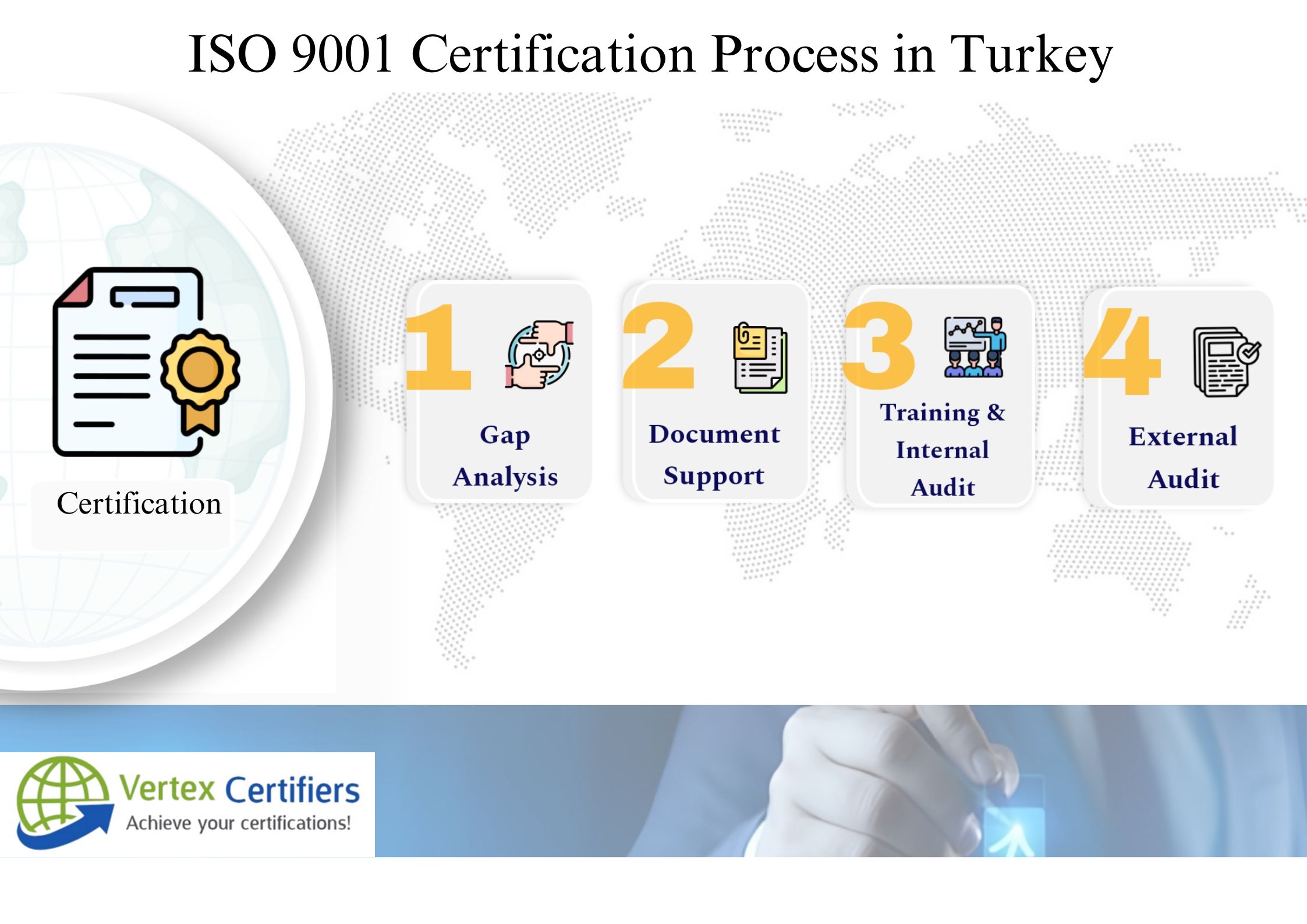
Getting ISO 9001 certified in Turkey follows a streamlined, accredited path by ISO 9001 Consultants in Turkey. Start with gap analysis: Assess your current processes against ISO 9001:2015 clauses using tools like checklists.
Next, documentation and implementation: Develop a QMS manual, procedures, and records. Train staff on 10 core clauses, from leadership to performance evaluation. Integrate tools like ERP software common in Turkish factories.
Conduct an internal audit: Simulate external checks to fix gaps, ensuring compliance.
Then, the certification audit by IAF-accredited body (e.g., Bureau Veritas or TÜV). Stage 1 reviews documentation; Stage 2 verifies on-site implementation. Minor non-conformities get 90 days to resolve.
Finally, certificate issuance: Valid for 3 years with annual surveillance audits. Total process: 4-8 weeks for SMEs.
Visualize it:
- Gap Analysis
- Implement & Document
- Internal Audit
- Certification Audit
- Certification
Turkish firms love this efficiency—many in Ankara complete it remotely via hybrid audits.