
Procedure & Cost for ISO 9001 Certification in Philippines:
Procedure & Cost for ISO 9001 Certification in Philippines, Vertex Certifiers delivers complete end-to-end ISO consultation, implementation, documentation, internal audit, and certification coordination services across Manila, Cebu, Makati, Quezon, Pampanga, Davao, Pasig, Antipolo, Taguig, Cagayan de Oro, Iloilo City, Baguio City, and Bacolod. implement an effective Quality Management System (QMS). From gap analysis and documentation to internal audits and final certification, our expert ISO 9001 Consultants in Philippines ensure a smooth, time-bound, and audit-ready implementation process. With deep industry experience across manufacturing, construction, logistics, healthcare, IT, and service sectors, Vertex Certifiers enables businesses to improve operational efficiency, enhance customer satisfaction, and achieve sustainable growth through globally recognized ISO 9001 standards.
For Filipino businesses exploring ISO 9001 certification, the two most common questions are: how much will it cost? and how does the process actually work? This page answers both — with real figures, realistic timelines, and a clear picture of what to expect at each stage when working with Vertex Certifiers across the Philippines.
Developed by the International Organization for Standardization (ISO), ISO 9001:2015 emphasizes customer satisfaction, risk-based thinking, and continual improvement. Applicable to organizations of all sizes and sectors, it helps Philippine businesses streamline processes, reduce waste, and comply with regulations like the Bureau of Philippine Standards (BPS) requirements. For exporters targeting ASEAN or EU markets, certification signals reliability, boosting tender wins by up to 30%, per industry data.
What is ISO 9001 Certification?
ISO 9001 is the world’s most popular QMS standard, with over 1 million certifications globally. Updated in 2015, it follows the Plan-Do-Check-Act (PDCA) cycle across 10 clauses, focusing on:
- Customer satisfaction: Meeting requirements consistently.
- Risk-based thinking: Identifying opportunities and threats (Clause 6.1).
- Process approach: Mapping interconnected operations.
- Leadership involvement: Top-down commitment (Clause 5).
- Continuous improvement: Data-driven enhancements (Clause 10).
Achieving ISO 9001 Certification in Philippines proves your dedication to delivering consistent quality. For example, a logistics firm in Pampanga reduced delivery errors by 25% post-certification through standardized SOPs.
What Drives the Cost of ISO 9001 Certification in the Philippines?
There is no single fixed price for ISO 9001 certification in the Philippines because the cost depends on several factors specific to your organization:
Number of employees: Certification bodies calculate audit days based on headcount. A company with 10 employees requires fewer audit man-days than one with 200, so audit fees are lower.
Number of sites: If your business operates from multiple locations — for example, a head office in Makati and a warehouse in Laguna — the certification body will audit both sites, increasing the audit fee accordingly.
Industry and process complexity: A pharmaceutical manufacturer in Quezon City has more complex processes to document and audit than a small IT services firm in BGC. More complexity means more consultant time and more audit days.
Scope of certification: Certifying your entire organization costs more than certifying a single department or business unit, but a broader scope usually delivers more commercial value.
Choice of certification body: Fees vary between IAF-accredited bodies. Some international bodies charge higher fees but carry stronger recognition with multinational clients.
How to Get ISO 9001 Certification in Philippines: Step-by-Step Procedure
The path to ISO 9001 Certification in Philippines is straightforward. Here’s the complete eight-step process:
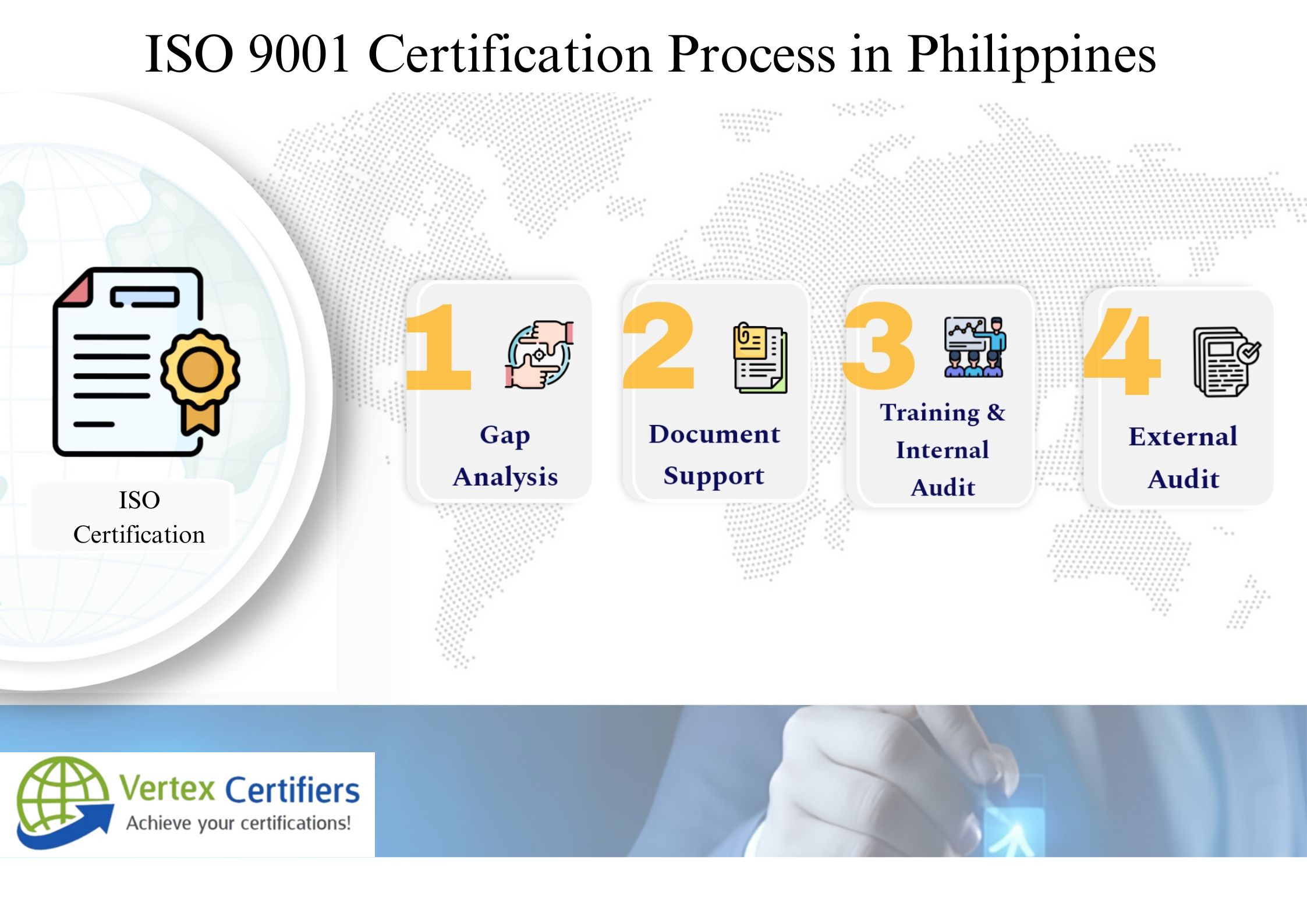
Step 1: Gap Analysis
Assess current practices against ISO 9001 clauses. Tools like checklists reveal gaps, such as undefined quality objectives in a Quezon City SME.
Step 2: Define QMS Scope
Outline products, services, sites, and exclusions (Clause 4.3). A Davao agribusiness might scope banana processing and export logistics.
Step 3: Documentation Development
Build core documents:
- Quality Policy and Objectives (aligned with strategy).
- Process SOPs and flowcharts.
- Risk & Opportunity Register.
- Internal Audit and Corrective Action Procedures.
Step 4: Implementation
Embed controls, monitor KPIs like defect rates, and train staff. Use PDCA for real-time adjustments.
Step 5: Internal Audit
Independent auditors verify compliance per ISO 19011, logging non-conformities.
Step 6: Management Review
Leadership analyzes metrics, customer feedback, and audit results (Clause 9.3).
Step 7: Stage 1 & Stage 2 Audit
ISO 9001 Auditors in Philippines review documentation (Stage 1) and implementation (Stage 2).
Step 8: Certification Issuance
Earn a three-year certificate with annual surveillance audits.
Duration for ISO 9001 Certification in Philippines
Timelines hinge on:
- Organization size and employee count.
- Branch numbers and operational complexity.
- Documentation maturity.
Breakdown:
- Small companies: 1–2 months.
- Medium enterprises: 2–4 months.
- Large organizations: 3–6 months.
ISO 9001 Consultation in Philippines accelerates this via expert guidance.
Which Certification Body Should You Choose in the Philippines?
Several IAF-accredited certification bodies operate in the Philippines or conduct remote/hybrid audits for Philippine businesses. The right choice depends on:
- Your client base: If your customers are in the EU or the US, choose a body accredited by an EA or ANAB member. If your clients are in the Gulf or Southeast Asia, check their preferred bodies.
- Government procurement: Philippine government agencies accept certificates from any IAF-accredited body.
- Budget: Fees vary. We will recommend 2–3 options matched to your budget and target market.
Vertex Certifiers works with multiple certification bodies and will guide you to the right choice — without pushing you toward any body for commercial reasons.
Cities We Serve Across the Philippines
Vertex Certifiers supports ISO 9001 certification for businesses across the entire Philippines, including:
Metro Manila: Makati, BGC (Taguig), Quezon City, Pasig, Mandaluyong, Manila City, Paranaque, Las Pinas
Luzon: Pampanga, Batangas, Laguna, Cavite, Bulacan, Baguio City, Subic Bay
Visayas: Cebu City, Iloilo City, Bacolod, Tacloban
Mindanao: Davao City, Cagayan de Oro, General Santos, Zamboanga
Both on-site and remote (virtual) consultation and audit preparation are available, making geography no barrier for Philippine businesses outside Metro Manila.
Why Philippine Businesses Choose Vertex Certifiers
Fixed, Transparent Pricing: We quote a fixed consultancy fee upfront — no hourly billing surprises.
First-Attempt Certification: Our internal audit process is rigorous. The vast majority of our Philippine clients pass their Stage 2 certification audit on the first attempt.
Philippines-Specific Knowledge: We understand the Filipino business environment — from DOST and DTI quality programs to the procurement rules of Philippine government agencies and GOCCs that require ISO 9001 certified suppliers.
No Template Dumps: Every document we produce is written for your business, not copied from a library of generic ISO templates.