
Procedure & Cost for ISO 27001 Certification in Philippines:
Procedure & Cost for ISO 27001 Certification in Philippines, Vertex Certifiers delivers complete end-to-end ISO consultation, implementation, documentation, internal audit, and certification coordination services across Manila, Cebu, Makati, Quezon, Pampanga, Davao, Pasig, Antipolo, Taguig, Cagayan de Oro, Iloilo City, Baguio City, and Bacolod. As leading ISO 27001 Consultants in Philippines, we not only specialize in ISO 27001 Certification in Philippines but also provide implementation support for ISO 9001 (Quality Management), ISO 14001 (Environmental Management), ISO 45001 (Occupational Health & Safety), ISO 22000 (Food Safety), ISO 22301 (Business Continuity), ISO 27701 (Privacy Information Management), ISO 20000-1 (IT Service Management), ISO 41001 (Facility Management), ISO 13485 (Medical Devices), ISO 50001 (Energy Management), ISO 37001 (Anti-Bribery), ISO 28000 (Supply Chain Security), ISO 55001 (Asset Management), ISO 21001 (Educational Organizations), ISO 29993 (Learning Services), and ISO 27017 & ISO 27018 (Cloud Security & Privacy Controls). Our expert ISO 27001 auditors in Philippines ensure smooth certification aligned with international best practices and local compliance requirements.
Why ISO 27001 Certification in Philippines is Critical in 2026
In 2026, the Philippines stands at the forefront of Southeast Asia’s digital boom, with its IT-BPO sector alone contributing over $30 billion to the economy annually. Sectors like fintech, healthcare, government services, and e-commerce handle vast amounts of sensitive data daily, making cybersecurity non-negotiable. Cyber threats, from ransomware attacks to data breaches, have surged by 25% in the region last year, according to recent reports from the National Privacy Commission (NPC).
Enter ISO 27001 Certification in Philippines—a globally recognized framework that equips businesses with a robust Information Security Management System (ISMS). This certification aligns organizations with international best practices, ensuring they protect confidential information while complying with the Data Privacy Act of 2012 (Republic Act No. 10173). Regulated by the NPC, the Act mandates stringent data protection measures, and non-compliance can lead to fines up to PHP 5 million or even criminal penalties.
For Philippine companies eyeing global expansion, ISO 27001 Certification in Philippines builds trust with international clients, especially in the EU and US markets where GDPR and similar laws demand equivalent security standards. Whether you’re a BPO in Cebu or a fintech startup in Manila, achieving this certification mitigates risks, enhances resilience, and positions your business as a secure partner. In this complete guide, we’ll walk you through the procedure, duration, benefits, and city-specific insights to get you certified efficiently.
What is ISO 27001 Certification?
ISO 27001, published by the International Organization for Standardization (ISO) and the International Electrotechnical Commission (IEC), specifies requirements for establishing, implementing, maintaining, and continually improving an ISMS. First released in 2005 and updated in 2022, the standard follows a risk-based approach outlined in its core clauses (4-10) and 93 controls in Annex A.
At its heart, ISO 27001 Certification helps organizations systematically manage information security risks. It protects confidential data like customer records, intellectual property, and financial details from breaches. Key benefits include preventing cyber threats such as phishing, malware, and insider attacks; ensuring regulatory compliance with laws like the Philippine Data Privacy Act; building client trust through demonstrable security commitments; and strengthening business continuity during disruptions.
Consider a typical BPO firm in Quezon City handling US client data—ISO 27001 ensures encrypted communications, access controls, and incident response plans, reducing breach risks by up to 40%, as per industry benchmarks. Unlike basic compliance checklists, ISO 27001 is holistic, covering people, processes, and technology. It’s scalable for startups to enterprises and remains valid for three years, with annual surveillance audits.
How to Get ISO 27001 Certification in Philippines: Step-by-Step Procedure
Securing ISO 27001 Certification in Philippines follows a structured, eight-step process endorsed by accreditation bodies like the Philippine Accreditation Bureau (PAB) and international certifiers such as JAS-ANZ. Partnering with experienced ISO 27001 Consultants in Philippines streamlines this journey. Here’s the complete procedure:
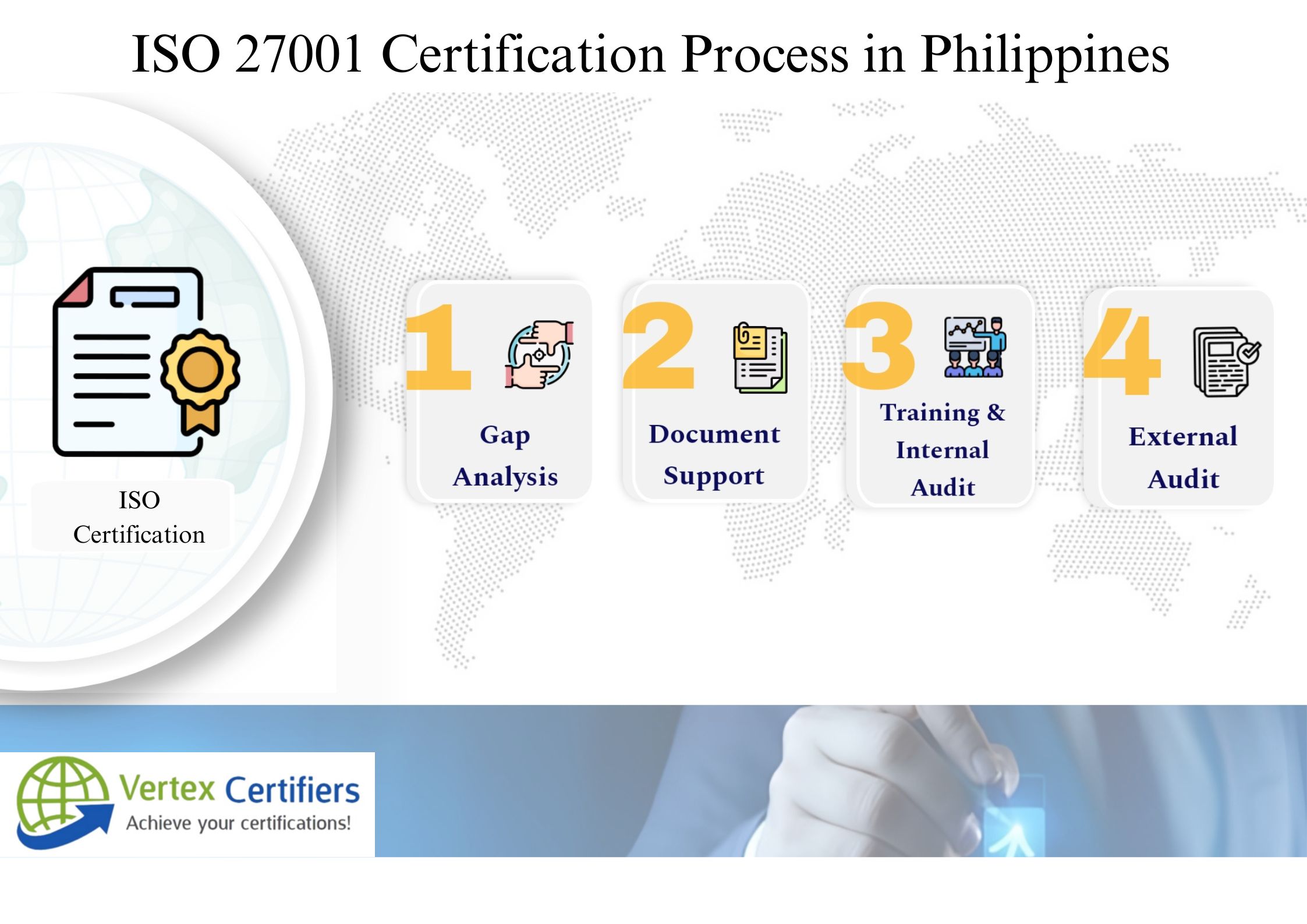
Step 1: Gap Analysis
Begin with a thorough assessment of your current security practices against ISO 27001:2022 requirements. Identify gaps in policies, controls, and processes. For instance, a Manila-based fintech might discover weak access controls or outdated encryption. This phase typically takes 2-4 weeks and forms the roadmap for implementation.
Step 2: Risk Assessment & Risk Treatment
Conduct a formal risk assessment to pinpoint threats (e.g., DDoS attacks), vulnerabilities (e.g., unpatched software), and impacts. Develop a Risk Treatment Plan selecting from Annex A controls like A.5.14 (Information transfer) or A.8.25 (Secure development life cycle). Tools like heat maps visualize risks, prioritizing high-impact areas.
Step 3: ISMS Documentation
Create essential documents, including:
- Information Security Policy: A high-level commitment from leadership.
- Risk Treatment Plan and Risk Register: Detailed mitigation strategies.
- Statement of Applicability (SoA): Justifies included/excluded controls.
- Incident Management Procedures: For breach response within 24 hours, per NPC guidelines.
- Business Continuity Framework: Ensures operations during outages.
Philippine firms often integrate local regulations here, like NPC Circulars on data breach notifications.
Step 4: Implementation of Controls
Roll out 114 potential controls from Annex A, tailored to your scope
Train staff via workshops to foster a security culture.
Step 5: Internal Audit
Perform an internal audit using ISO 19011 guidelines. Competent auditors check compliance, documenting non-conformities. This uncovers issues like incomplete training records before external review.
Step 6: Management Review
Top executives review ISMS effectiveness, analyzing audit findings, incidents, and performance metrics. Decisions on improvements ensure leadership buy-in.
Step 7: Certification Audit (Stage 1 & Stage 2)
Accredited ISO 27001 Auditors in Philippines, from bodies like TÜV Rheinland or Bureau Veritas, conduct:
- Stage 1: Documentation review (1-2 days).
- Stage 2: On-site verification of implementation (3-10 days, depending on size).
Address any major non-conformities within 90 days.
Step 8: Certification Issuance
Successful audits lead to a three-year certificate, with annual surveillance and triennial recertification.