

ISO 14001 Certification in South Africa | ISO 14001 Consultants in South Africa :
Vertex Certifiers is a trusted ISO consulting and certification support firm, helping organizations across South Africa implement and achieve ISO 14001 Environmental Management System (EMS) certification efficiently and cost-effectively. With proven expertise in environmental compliance and international ISO standards, Vertex supports businesses in aligning their operations with sustainable and legally compliant environmental practices.
We provide ISO 14001 certification services to organizations operating in key South African cities such as Johannesburg, Cape Town, Durban, Pretoria, Sandton, Midrand, Centurion, Port Elizabeth (Gqeberha), East London, Bloemfontein, and Polokwane. Whether you are a manufacturing unit, mining operation, construction company, logistics provider, or service organization, our consultants tailor the EMS framework to your specific environmental risks, legal obligations, and business objectives.
Vertex offers end-to-end ISO 14001 implementation support, including gap analysis, EMS documentation, legal compliance mapping, employee training, internal audits, and certification audit coordination with accredited certification bodies. Our practical and industry-focused approach ensures faster certification, reduced environmental impact, and long-term compliance — enabling South African organizations to strengthen sustainability performance, meet tender requirements, and enhance stakeholder confidence.
The ISO 14001 standard defines the criteria for an Environmental Management System that enables organizations to identify, manage, monitor, and control their environmental aspects. It provides a systematic framework helping businesses of all sizes to adopt environmentally responsible practices while maintaining profitability.
In South Africa, where environmental compliance is a strategic priority, many industries—from mining to manufacturing—have adopted ISO 14001 to meet local environmental legislation and international sustainability expectations.
What is ISO 14001 Certification ?
ISO 14001:2015 is an international standard developed by the International Organization for Standardization (ISO) that specifies requirements for a robust Environmental Management System (EMS). The standard encourages organizations to assess the environmental impact of their activities, set improvement objectives, and monitor outcomes over time.
Key Objectives of an Environmental Management System
Identifying and mitigating environmental risks.
Ensuring compliance with applicable environmental regulations.
Promoting sustainable use of resources.
Reducing waste, emissions, and pollution.
Applicability
ISO 14001 applies to organizations of all types and sizes—whether manufacturing plants, service providers, government agencies, or non-profits—because every entity interacts with the environment in some way.
Why ISO 14001 Certification Is Important in South Africa
South Africa’s environmental landscape is governed by stringent regulations and public expectations. The government’s focus on sustainability, coupled with investor and client demand for eco-friendly operations, makes ISO 14001 a critical business asset.
Key Reasons for Adoption
Regulatory pressure: Compliance with national environmental acts and municipal bylaws.
Investor confidence: Global investors prefer companies with verifiable sustainability credentials.
Market competitiveness: ISO 14001 certification offers a competitive edge in tenders, especially for infrastructure and public sector projects.
Sustainable development: Encourages alignment with corporate ESG (Environmental, Social, and Governance) goals.
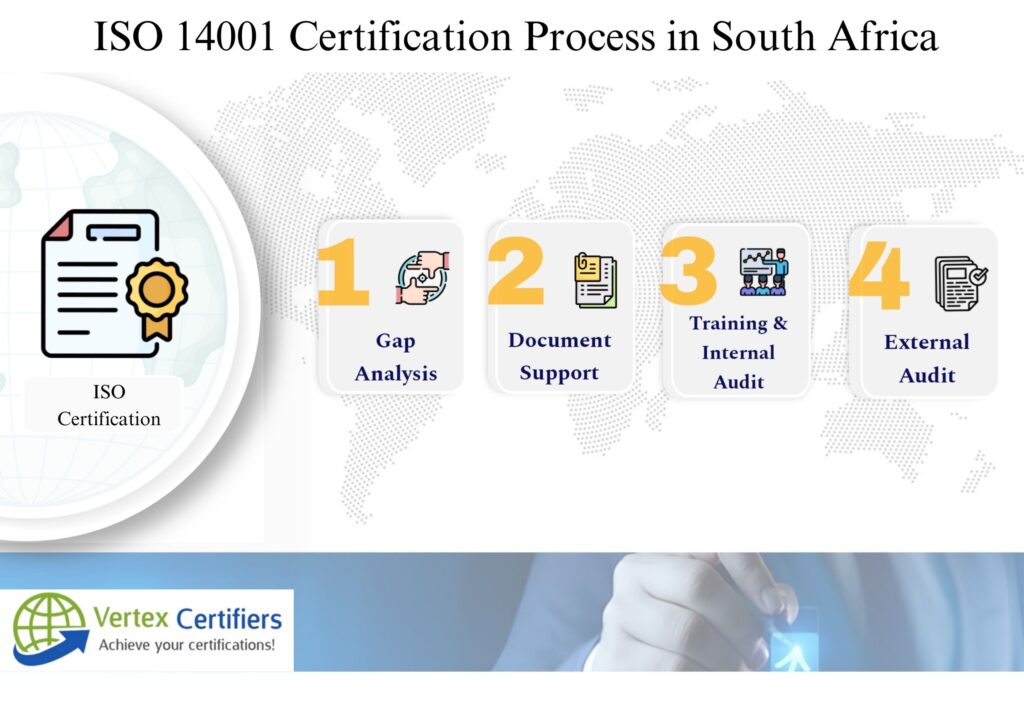
ISO 14001 Certification Process in South Africa
The certification journey typically follows these strategic steps:
Step 1: Gap Analysis
An environmental consultant assesses current operations against ISO 14001 clauses to identify gaps.
Step 2: EMS Documentation
Development of key documentation such as Environmental Policy, Objectives, Procedures, and Records.
Step 3: Implementation & Employee Training
Implementing the EMS framework and conducting awareness training for employees at all levels.
Step 4: Internal Audit & Corrective Action
Identifying nonconformities and taking corrective actions to enhance system effectiveness.
Step 5: Certification Audit (Stage 1 & Stage 2)
Accredited auditors evaluate the EMS documentation and implementation effectiveness.
Step 6: Certification Issuance
Once the organization meets all standard requirements, the accredited body issues the ISO 14001 certificate—valid for three years, subject to annual surveillance audits.
Key Environmental Regulations in South Africa
To operate responsibly, organizations must align their Environmental Management System (EMS) with South Africa’s key environmental laws and frameworks.
🌿 1. National Environmental Management Act (NEMA)
NEMA forms the foundation of South Africa’s environmental governance, emphasizing sustainable development, environmental protection, and strict compliance enforcement.
📊 2. Environmental Impact Assessment (EIA) Regulations
These regulations require organizations to assess the environmental consequences of projects before initiation. ISO 14001 helps establish consistent procedures for impact assessment and mitigation.
♻️ 3. Air Quality Act & Waste Act
These acts regulate air emissions, waste disposal, and resource use. ISO 14001 supports systematic controls over pollution prevention, waste segregation, and emission monitoring.
Compliance Integration: Implementing ISO 14001 ensures continual alignment with legal frameworks, minimizing risks of penalties and environmental liabilities.
Industries in South Africa That Benefit from ISO 14001 Certification
- ⛏️ Mining & Minerals: Controls dust, manages waste, rehabilitates land, and supports sustainable extraction.
- 🏭 Manufacturing & Industrial Operations: Reduces emissions, improves energy efficiency, and optimizes resource use.
- 🏗️ Construction & Infrastructure: Enhances site management, waste control, and tender eligibility.
- ⚡ Oil, Gas & Energy: Manages spills, emissions, and community health risks.
- 🌾 Agriculture & Food Processing: Minimizes chemical use, conserves water, and protects biodiversity.
- 🚛 Logistics, Ports & Transportation: Improves fuel efficiency and reduces greenhouse gas emissions.
Benefits of ISO 14001 Certification for South African Organizations
Identify and reduce environmental impact systematically.
Simplified compliance through documented EMS controls.
Lower energy, material, and waste management costs.
Demonstrates sustainability commitment to stakeholders.
Access eco-sensitive projects and tenders.
Build environmental awareness and accountability.
Cost of ISO 14001 Certification in South Africa
Certification costs vary based on organization size, operational complexity, number of sites, and the selected certification body.
💡 Typical Investment:
Small to medium enterprises may expect costs between
ZAR 50,000 – ZAR 150,000, depending on scope and readiness.
ISO 14001 Certification Timeline
Implementation typically takes 3 to 6 months, depending on documentation readiness, resource availability, training, and process complexity.
ISO 14001 vs Other Management Standards
ISO 14001 vs ISO 9001: Environmental management vs quality management.
ISO 14001 vs ISO 45001: Environmental risks vs occupational health & safety.
Many organizations integrate ISO 9001, ISO 14001, and ISO 45001 into a unified Integrated Management System (IMS).
Common Challenges in ISO 14001 Implementation
- Identifying significant environmental aspects
- Maintaining ongoing legal compliance
- Ensuring employee participation
- Demonstrating continual improvement
Partnering with an experienced ISO consultant helps overcome these challenges efficiently.
How to Get ISO 14001 Certification in South Africa
- Choose the Right ISO Consultant with local regulatory expertise
- Engage an Accredited Certification Body (SANAS or internationally recognized)
- Prepare for Audits through training, documentation, and internal audits
Why Choose Vertex Certifiers for ISO 14001 Certification in South Africa
Vertex Certifiers delivers end-to-end ISO 14001 certification support, combining deep knowledge of South African environmental laws with global ISO best practices.
- ✔ ISO 14001:2015 implementation expertise
- ✔ Complete support from gap analysis to certification
- ✔ Practical, cost-effective solutions
- ✔ IMS integration with ISO 9001 & ISO 45001
Frequently Asked Questions (FAQs)
Is ISO 14001 mandatory? No, but widely required for tenders and contracts.
How long does certification take? Typically 3–6 months.
Is ISO 14001 required for tenders? Yes, especially in construction and energy.
Can SMEs get certified? Yes, ISO 14001 is scalable for all business sizes.
Conclusion
ISO 14001 Certification in South Africa enables organizations to reduce environmental impact, meet legal obligations, and enhance long-term sustainability and profitability.
Ready to Achieve ISO 14001 Certification in South Africa?
Partner with Vertex Certifiers for a seamless, compliant,
and cost-effective ISO 14001 certification journey.
📧 Email us at
info@vertexcertifiers.com
to get started.
Get In Touch With Us
Our Services
- GMP Certification
- GLP Certification
- GDP Certification
- Halal Certificate
- Organic Certificate
- CE Marking Certification
- RoHS Certification
- FDA Certification
- CMMI Certification
- Cyber Security
- VAPT Testing
- Security Assessment
Our Clients


