ISO 17025 Certification in Vietnam:
ISO 17025 Certification in Vietnam, Vertex Certifiers is a globally trusted ISO consulting and certification support firm providing complete end-to-end ISO/IEC 17025 consulting services for testing and calibration laboratories across Vietnam. Our experienced consultants assist organizations through every stage of implementation, including gap analysis, laboratory system implementation, documentation development, quality manual preparation, method validation support, measurement uncertainty guidance, internal audits, technical training, accreditation readiness, certification audit support, and post-certification compliance. We provide ISO 17025 consulting services throughout Hanoi, Ho Chi Minh City, Hai Phong, Da Nang, Can Tho, Bac Ninh, Binh Duong, Dong Nai, and Nha Trang, helping laboratories establish technically competent and internationally recognized management systems. Alongside ISO 17025, Vertex Certifiers also offers implementation and certification support for ISO 9001, ISO 14001, ISO 45001, ISO 22000, ISO 27001, ISO 22301, ISO 50001, and ISO 20000-1, enabling organizations to build integrated management systems that improve quality, operational efficiency, and regulatory compliance. Our ISO 17025 consulting services support testing laboratories, calibration laboratories, food testing laboratories, pharmaceutical laboratories, environmental laboratories, construction material testing laboratories, medical laboratories, textile testing laboratories, electronics testing facilities, automotive testing centers, and chemical laboratories, helping them demonstrate technical competence, produce reliable test results, and meet national and international accreditation requirements.
What is ISO 17025?
ISO/IEC 17025 is the internationally recognized standard that specifies the general requirements for the competence of testing and calibration laboratories. Developed jointly by the International Organization for Standardization (ISO) and the International Electrotechnical Commission (IEC), the current version, ISO/IEC 17025:2017, provides a comprehensive framework for laboratories to consistently produce technically valid, accurate, and reliable testing and calibration results.
Unlike general quality management standards, ISO 17025 focuses specifically on laboratory competence by combining quality management principles with technical requirements. The standard covers laboratory management, personnel competency, equipment calibration, measurement traceability, method validation, sampling, testing activities, reporting, risk-based thinking, and continual improvement. Organizations implementing ISO 17025 establish robust laboratory management systems that ensure impartiality, confidentiality, technical competence, and consistent performance while improving customer confidence and regulatory compliance.
One of the primary objectives of ISO 17025 is to demonstrate that a laboratory is technically competent to perform specific testing or calibration activities. Laboratories implementing the standard establish documented procedures, validate testing methods, maintain calibrated equipment, evaluate measurement uncertainty, and ensure personnel possess the necessary qualifications and technical expertise. These requirements enable laboratories to generate consistent, accurate, and internationally accepted results.
ISO 17025 has a close relationship with ISO 9001, as both standards emphasize customer satisfaction, process management, continual improvement, and effective quality management. However, ISO 17025 goes significantly further by including detailed technical requirements specific to laboratory operations, making it the preferred standard for testing and calibration laboratories seeking accreditation.
The standard also complements ISO 15189, which focuses specifically on medical laboratories. While ISO 15189 incorporates many ISO 17025 principles, it includes additional healthcare-specific requirements related to patient care and medical laboratory services.
International recognition of ISO 17025 accreditation is supported through the International Laboratory Accreditation Cooperation (ILAC), whose Mutual Recognition Arrangement (MRA) promotes global acceptance of accredited laboratory results. Accreditation bodies assess laboratories against ISO/IEC 17025 requirements to verify technical competence, impartiality, and compliance with international best practices. Achieving ISO 17025 accreditation demonstrates a laboratory’s commitment to delivering reliable, accurate, and internationally accepted testing and calibration services.
ISO 17025 Certification Process in Vietnam:
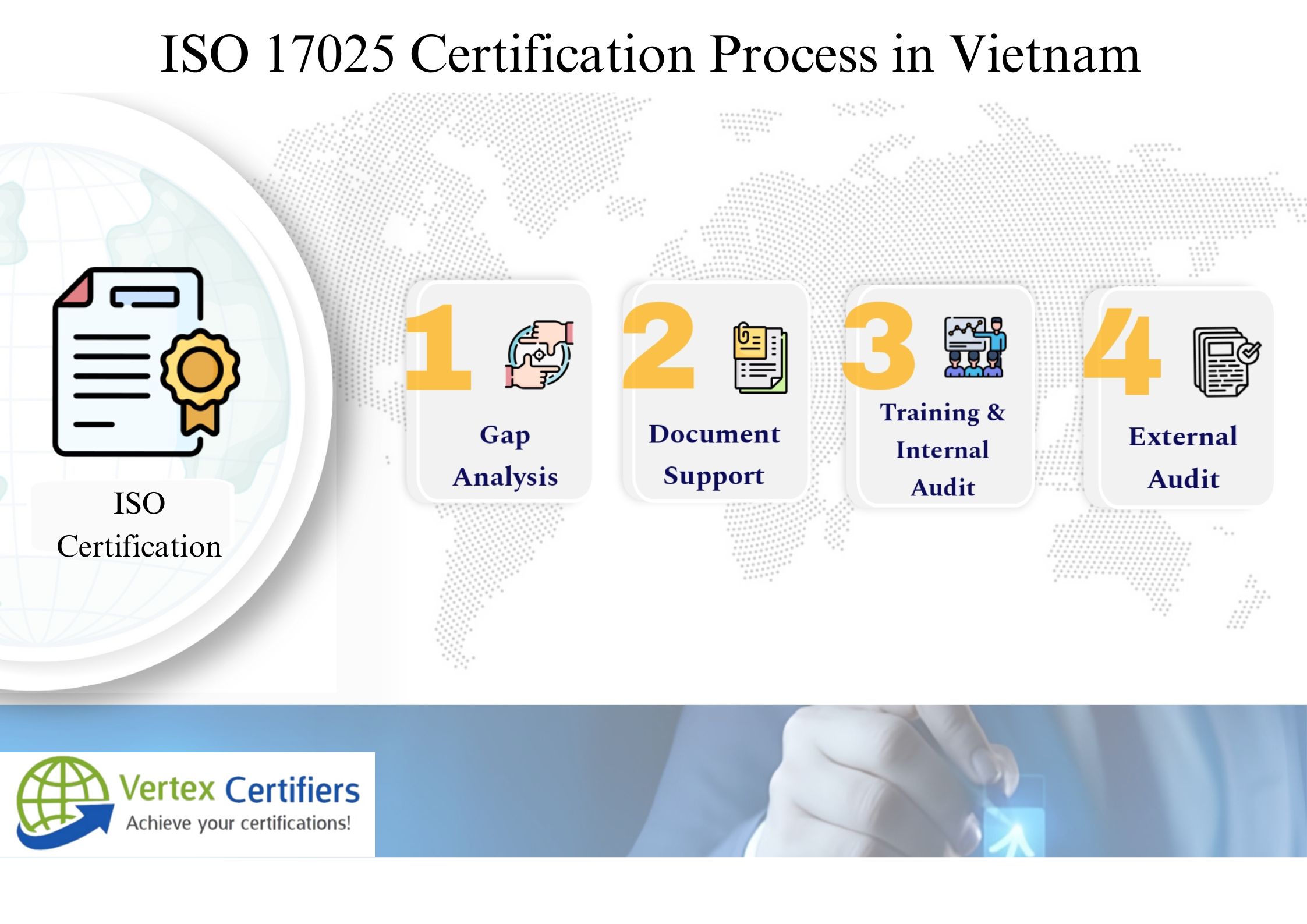
Initial Gap Analysis
Evaluate the laboratory’s existing quality management system, technical procedures, and operational practices against the requirements of ISO/IEC 17025:2017 to identify gaps and improvement opportunities.
Scope Definition
Define the scope of accreditation by identifying the testing or calibration activities, laboratory locations, equipment, and technical capabilities that will be included within the ISO 17025 management system.
Laboratory Assessment
Assess laboratory infrastructure, testing methods, equipment, personnel competency, environmental conditions, and quality control procedures to determine implementation priorities.
Documentation Development
Develop all required documented information, including laboratory policies, quality manuals, standard operating procedures (SOPs), technical procedures, forms, records, and supporting documentation required by ISO/IEC 17025.
Quality Manual Preparation
Prepare a laboratory quality manual describing the laboratory’s quality management system, organizational structure, responsibilities, policies, objectives, and compliance with ISO 17025 requirements.
Technical Procedure Development
Establish validated testing and calibration procedures, work instructions, sampling methods, reporting formats, quality control procedures, and document control systems to ensure consistent laboratory operations.
Equipment Calibration
Verify that all laboratory equipment is properly calibrated, maintained, and traceable to national or international measurement standards, ensuring the accuracy and reliability of testing and calibration results.
Method Validation
Validate testing and calibration methods to demonstrate that they consistently produce reliable, accurate, and repeatable results suitable for their intended purpose.
Measurement Uncertainty
Identify, evaluate, and document measurement uncertainty associated with laboratory activities to improve confidence in test and calibration results and comply with ISO 17025 technical requirements.
Staff Competency Assessment
Evaluate the qualifications, technical competence, training, experience, and ongoing proficiency of laboratory personnel to ensure they are capable of performing assigned testing and calibration activities.
Internal Audit
Conduct internal audits to verify compliance with ISO/IEC 17025 requirements, assess system effectiveness, identify nonconformities, and implement corrective actions before the external assessment.
Management Review
Top management reviews laboratory performance, audit findings, customer feedback, risks, opportunities, resource requirements, and continual improvement initiatives to ensure the ongoing effectiveness of the laboratory management system.
Stage 1 Assessment
The accreditation or certification body reviews the laboratory’s documentation, quality management system, and preparedness for the formal assessment.
Stage 2 Assessment
Assessors perform an on-site evaluation of laboratory operations, observe testing and calibration activities, verify technical competence, interview personnel, and confirm compliance with ISO/IEC 17025:2017 requirements.
Accreditation / Certification
Following the successful completion of the assessment process and closure of any nonconformities, the laboratory is granted ISO/IEC 17025 accreditation or certification, demonstrating internationally recognized technical competence.
Surveillance Assessment
Periodic surveillance assessments are conducted to verify continued compliance with ISO/IEC 17025, monitor continual improvement, and ensure the laboratory consistently maintains high standards of technical competence and quality management.
Our Services
- GMP Certification
- GLP Certification
- GDP Certification
- Halal Certificate
- Organic Certificate
- CE Marking Certification
- RoHS Certification
- FDA Certification
- CMMI Certification
- Cyber Security
- VAPT Testing
- Security Assessment
Our Local Cities

Why ISO 17025 Certification is Important in Vietnam
ISO 17025 Certification is highly important in Vietnam because the country continues to grow as a manufacturing, export, and industrial hub where testing accuracy, calibration reliability, and laboratory competence directly affect product quality and market acceptance. ISO states that ISO/IEC 17025 helps laboratories demonstrate competence and generate valid results, while also supporting wider acceptance of reports and certificates between countries. [web:115][web:120]
As manufacturing growth increases across Vietnam, laboratories play a critical role in product compliance, quality assurance, raw material testing, calibration control, and regulatory verification. Export-oriented businesses also depend on reliable laboratory results to meet buyer expectations, technical specifications, safety standards, and destination-country requirements.
ISO 17025 is especially relevant where testing and calibration results influence product certification, government compliance, supply chain approval, environmental monitoring, and international trade. It strengthens confidence in laboratory outputs and supports consistent, technically valid decision-making across industrial operations.
In Vietnam, this is particularly important for sectors such as food testing, pharmaceuticals, medical devices, construction, electronics, automotive, textile, agriculture, environmental monitoring, oil and gas, and chemicals.
Benefits of ISO 17025 Certification
ISO 17025 helps laboratories improve technical reliability, management control, and recognition of testing and calibration results. ISO highlights competence, valid results, and cross-border acceptance of reports as core outcomes of the standard. [web:115][web:120]
- Demonstrates laboratory competence: Shows that the laboratory operates with technical capability and reliable systems.
- Improves testing accuracy: Helps strengthen control over methods, measurements, and validation activities.
- Produces reliable calibration results: Supports dependable calibration activities and measurement confidence.
- International recognition: Improves wider acceptance of laboratory results in global trade and technical supply chains.
- Better customer confidence: Clients gain stronger trust in the validity and consistency of test and calibration outputs.
- Supports exports: Reliable laboratory results help businesses meet export requirements and buyer specifications.
- Reduces testing errors: Better process control lowers the risk of avoidable laboratory mistakes and result inconsistencies.
- Improves laboratory efficiency: Standardized systems help laboratories operate more effectively.
- Regulatory compliance: Supports laboratories in meeting applicable regulatory and conformity-related expectations.
- Better equipment management: Strengthens control over calibration status, maintenance, and equipment suitability.
- Improved staff competency: Encourages clear competence requirements, training, and technical oversight.
- Risk-based laboratory management: ISO notes that the standard includes an element of risk assessment and risk-based thinking. [web:115]
- Better document control: Helps manage methods, records, procedures, and technical evidence more systematically.
- Competitive advantage: Builds credibility in regulated, export-oriented, and technically demanding markets.
- Continuous improvement: Encourages corrective action, review, and ongoing enhancement of laboratory performance.
Industries That Need ISO 17025 Certification
ISO 17025 is relevant for a wide range of laboratory-based sectors in Vietnam where test and calibration results influence product quality, safety, compliance, and technical decision-making.
- Testing Laboratories: Laboratories performing routine, specialized, or regulatory testing.
- Calibration Laboratories: Facilities responsible for calibration of instruments, devices, and measurement systems.
- Food Testing: Laboratories supporting food safety, quality verification, contamination control, and export compliance.
- Pharmaceutical Labs: Facilities requiring accurate analytical results, validation, and technical traceability.
- Medical Device Testing: Laboratories supporting device quality, safety, and performance verification.
- Environmental Laboratories: Labs performing water, air, soil, effluent, and environmental monitoring activities.
- Construction Material Testing: Laboratories testing cement, concrete, steel, aggregates, and building materials.
- Textile Laboratories: Labs supporting performance testing, quality verification, and export specifications.
- Electronics Laboratories: Laboratories testing product safety, reliability, and technical conformity.
- Automotive Laboratories: Testing facilities used for component validation, materials evaluation, and technical compliance.
- Chemical Testing Laboratories: Labs handling composition, purity, contamination, and chemical analysis.
- Agricultural Laboratories: Facilities testing soil, fertilizers, residues, crops, and agricultural inputs.
- Research Institutions: Organizations requiring robust testing, traceability, and reliable scientific results.
- Universities: Academic laboratories that need stronger technical management and recognized testing practices.
- Government Laboratories: Public laboratories involved in compliance, public safety, standards, and regulatory work.
Requirements for ISO 17025 Certification
ISO/IEC 17025 sets requirements for competence, impartiality, and consistent operation of laboratories. ISO describes it as the international standard for testing and calibration laboratories and notes that it applies to organizations performing laboratory activities, regardless of size. [web:120][web:122]
- Impartiality: The laboratory must operate without bias and protect the objectivity of its activities.
- Confidentiality: Information relating to customers, results, and activities must be properly protected.
- Organizational Structure: Roles, responsibilities, authority, and reporting relationships should be clearly defined.
- Competent Personnel: Staff must be qualified, trained, and technically competent for the activities they perform.
- Laboratory Environment: Environmental conditions should be suitable for valid testing and calibration results.
- Equipment Calibration: Equipment must be controlled, maintained, calibrated, and fit for intended use.
- Measurement Traceability: Results should be traceable through an unbroken chain of calibrations or references.
- Method Validation: Methods should be verified or validated to ensure technical suitability and reliability.
- Sampling Procedures: Sampling activities should be controlled where sampling forms part of laboratory work.
- Handling Test Items: Samples and items should be received, stored, handled, and protected appropriately.
- Quality Control: Laboratories should monitor the validity of results using suitable quality-control activities.
- Risk Management: Risks and opportunities affecting laboratory competence and result validity should be addressed.
- Internal Audit: Internal audits should verify conformity and effective implementation of the management system.
- Management Review: Top management should review the laboratory system and performance at planned intervals.
- Corrective Actions: Nonconformities should be analyzed and corrected to prevent recurrence.
- Continual Improvement: The laboratory should continually improve both technical and management performance.
Cost of ISO 17025 Certification in Vietnam
The cost of ISO 17025 Certification in Vietnam depends on the size, scope, technical complexity, and readiness of the laboratory. There is no single fixed price because each laboratory has different testing methods, calibration scope, documentation maturity, and accreditation requirements.
Important cost factors typically include:
- Laboratory size: Larger laboratories generally require broader implementation effort and audit coverage.
- Number of testing methods: A wider range of methods increases technical complexity and documentation needs.
- Calibration scope: Broader or more specialized calibration activities may increase preparation requirements.
- Number of employees: More personnel may require greater training, competence evaluation, and oversight.
- Equipment: The number and type of instruments affect calibration control and technical-system complexity.
- Number of laboratory locations: Multi-site laboratories require wider coordination and broader assessment scope.
- Existing quality system: Laboratories with mature documentation and controls may require less implementation effort.
- Accreditation body: Assessment fees vary depending on the selected accreditation body and scope.
- Consultancy requirements: The level of support needed for documentation, training, mock assessment, and readiness will influence cost.
A customized quotation is usually the most practical way to estimate the total cost of ISO 17025 implementation and accreditation support in Vietnam.
Why Choose Vertex Certifiers?
Vertex Certifiers supports laboratories across Vietnam with practical consulting designed to improve technical readiness, documentation quality, and accreditation success.
- Experienced ISO 17025 consultants: Practical support tailored to testing and calibration laboratory environments.
- Laboratory implementation experts: Guidance on both management-system and technical laboratory requirements.
- Technical documentation support: Help with procedures, methods, records, quality manuals, and controlled documents.
- Affordable pricing: Flexible implementation support suitable for both private and institutional laboratories.
- End-to-end consulting: Support from gap analysis to accreditation readiness and ongoing improvement.
- Internal auditor training: Training and support for laboratory internal audit teams.
- Mock assessments: Pre-assessment reviews to identify technical and system gaps before formal evaluation.
- Accreditation readiness: Structured support for preparing laboratory teams, records, and technical evidence.
- Fast project execution: Practical implementation planning to reduce delays and improve readiness.
- Nationwide support across Vietnam: Consulting support across major industrial and laboratory locations.
ISO 17025 Certification in Major Cities of Vietnam
Vertex Certifiers provides ISO 17025 consulting and accreditation support across key cities and industrial regions in Vietnam, including:
- Hanoi
- Ho Chi Minh City
- Hai Phong
- Da Nang
- Can Tho
- Bac Ninh
- Binh Duong
- Dong Nai
- Nha Trang
Frequently Asked Questions (FAQs)
What is ISO/IEC 17025:2017?
ISO/IEC 17025:2017 is the international standard that sets general requirements for the competence, impartiality, and consistent operation of testing and calibration laboratories.
Who should obtain ISO 17025 certification in Vietnam?
Testing laboratories, calibration laboratories, research institutions, universities, government laboratories, and sector-specific laboratories can benefit from ISO 17025.
What is the difference between ISO 17025 and ISO 9001?
ISO 17025 is specifically focused on laboratory competence and valid testing or calibration results, while ISO 9001 is a broader quality management standard applicable to many types of organizations. ISO notes that ISO/IEC 17025 also takes into consideration the latest version of ISO 9001. [web:115]
How long does ISO 17025 implementation take?
The timeline depends on laboratory size, number of methods, technical readiness, current documentation, and the complexity of testing or calibration scope.
What is the cost of ISO 17025 certification in Vietnam?
The cost depends on scope, number of methods, equipment, laboratory locations, employees, consultancy needs, and the selected accreditation body.
Is ISO 17025 mandatory?
ISO 17025 is generally not universally mandatory, but it may be required by regulators, customers, tenders, export programs, or product-certification schemes.
What laboratories benefit from ISO 17025?
Laboratories involved in testing, sampling, measurement, analysis, or calibration across regulated and technical sectors benefit significantly from ISO 17025.
How long is ISO 17025 accreditation valid?
Accreditation validity and surveillance arrangements depend on the applicable accreditation body and scheme requirements, so the exact cycle may vary.
Can ISO 17025 be integrated with ISO 9001?
Yes. Laboratories can align ISO 17025 requirements with broader quality-management practices where needed.
Why choose Vertex Certifiers for ISO 17025 certification in Vietnam?
Vertex Certifiers provides implementation-focused consulting, technical documentation support, training, mock assessments, and accreditation readiness assistance across Vietnam.
Get ISO 17025 Certification Support in Vietnam
Looking to achieve ISO/IEC 17025 accreditation for your testing or calibration laboratory in Vietnam? Vertex Certifiers provides complete end-to-end ISO 17025 consulting services including gap analysis, laboratory assessment, documentation, quality manual preparation, technical procedure development, method validation, measurement uncertainty guidance, equipment calibration support, internal audits, staff competency training, management reviews, and accreditation audit support.
Our experienced consultants assist testing and calibration laboratories across Vietnam in implementing ISO/IEC 17025:2017 requirements, improving laboratory competence, ensuring accurate and reliable test results, and preparing for successful accreditation with recognized accreditation bodies.
We provide ISO 17025 consulting services throughout Vietnam, including Hanoi, Ho Chi Minh City, Hai Phong, Da Nang, Can Tho, Bac Ninh, Binh Duong, Dong Nai, Nha Trang, and other major industrial and scientific hubs.
Email: info@vertexcertifiers.com
Contact Vertex Certifiers today for a free consultation and receive a customized quotation for ISO 17025 consulting and laboratory accreditation support in Vietnam.
