

ISO 27001 Certification in Bangkok:
Vertex Certifiers is a trusted ISO consulting company providing end-to-end ISO 27001 Certification services in Bangkok and across Thailand, including Chiang Mai, Phuket, Pattaya, Khon Kaen, Hat Yai, Nakhon Ratchasima, Udon Thani, Surat Thani, Chiang Rai, Ayutthaya, and other major cities. We help organizations establish a robust Information Security Management System (ISMS) through comprehensive consulting, gap analysis, risk assessment, documentation, implementation, employee awareness training, internal audits, and certification audit support. Our experienced ISO consultants also provide end-to-end consulting for ISO 9001 (Quality Management), ISO 14001 (Environmental Management), ISO 45001 (Occupational Health & Safety), ISO 22000 (Food Safety), ISO 13485 (Medical Devices), ISO 22301 (Business Continuity), ISO 20000-1 (IT Service Management), ISO 27701 (Privacy Information Management), ISO 42001 (Artificial Intelligence Management), ISO 50001 (Energy Management), ISO 37001 (Anti-Bribery Management), ISO 55001 (Asset Management), ISO 21001 (Educational Organizations), ISO 28000 (Supply Chain Security), ISO 41001 (Facility Management), ISO 39001 (Road Traffic Safety), ISO 19650 (Building Information Modeling), ISO 17025 (Testing & Calibration Laboratories), and many other internationally recognized ISO management system standards. Whether your organization operates in IT, software development, banking, healthcare, telecommunications, manufacturing, e-commerce, education, or other data-driven industries, Vertex Certifiers delivers practical, cost-effective, and end-to-end ISO certification solutions that help strengthen information security, reduce cyber risks, ensure regulatory compliance, protect critical business data, and build customer trust in Bangkok and throughout Thailand.
Importance of ISO 27001 Certification in Bangkok:
Understanding ISO 27001 Certification
ISO 27001 is a global standard that offers a model for Information Security Management Systems (ISMS) to assist organizations in securing their information assets so that they are safeguarded. Certification becomes important in managing and securing personal, confidential, and sensitive information and can go a long way in minimizing the chances of breach of security. With cyber attacks becoming increasingly sophisticated and potent, adopting ISO 27001 is now a necessity for companies willing to protect their internet transactions and maintain their data integrity.
Benefits of ISO 27001 Certification in Data Security:
There are several advantages of ISO 27001 certification that have immediate impacts on the data security functions of an organization:
Risk Management: Improved risk identification and vulnerability detection prior to them impacting the organization, with ongoing security enhancement.
Compliance: Maintains compliance with other laws like the GDPR by having a formal process to handle personal data.
Avoidance of Financial Losses: Avoids financial losses and fines resulting from data breaches.
Reputation: Maintains customer and partner trust through showing commitment to client and stakeholder data protection.
Competitive Advantage: Distinguishes the company from others, with a clear dedication to risk management and data security.
ISO 27001 Certification Process in Bangkok:
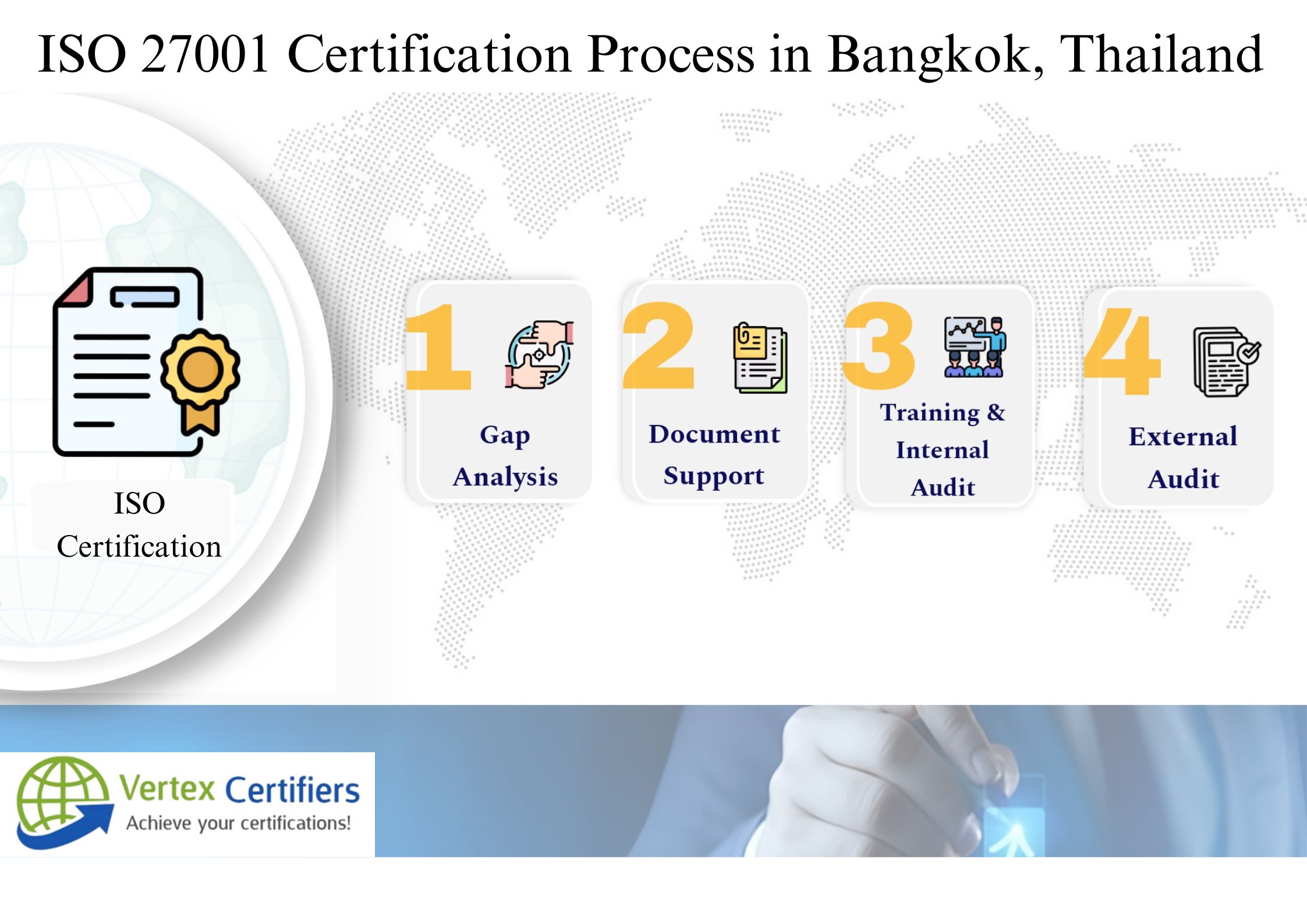
Overview of the Marketing Process: ISO 27001 certification is a set of procedures that are supposed to validate that an organization’s ISMS conforms to International Organization for Standardization standards. Beginning from an overall examination of existing practices and policies, the process proceeds through several phases such as planning, implementation, audit, and continuous improvement. This process does not only offer compliance but also good implementation of best practices in information security.
Cyber Attacks Secured through ISO 27001 Certification: The emerging world of the digitalized era cannot underestimate the importance of robust cybersecurity. ISO 27001 certification is a turning point for any business that aims to strengthen its information security management system (ISMS). The certification not only ensures data security processes but also enhances customer confidence and gives a business advantage in Bangkok’s business community.
The Increasing Significance of Cybersecurity: With the speed of digital evolution, Bangkok businesses are under greater threats of cyber attacks. They span from data theft and phishing scams to more harmful ransomware attacks that can greatly jeopardize business activities and come at huge costs in terms of finances. The importance of cybersecurity is also emphasized by an increasingly demanding regulation landscape in which compliance must be upheld in order to keep business running. Besides, businesses operating in extremely digitalized environments generate huge quantities of sensitive data every day. Protecting such data is not only a matter of compliance and ethics but also a business strategy to sustain reputation and customer relations. Hence, possessing a robust cybersecurity system like ISO 27001 is not an option anymore but a necessity for businesses.
How ISO 27001 Certification Helps Mitigate Cyber Threats?
ISO 27001 certification is beneficial to Bangkok businesses in systematically evaluating, managing, and minimizing the risk of cyber attacks. The standard applies to a comprehensive approach that includes the following:
Risk Assessment and Treatment: Certification includes a comprehensive risk assessment, where certain security risks pertinent to the company are identified and evaluated. It is subsequently followed by practical management and mitigation of the risks.
– Regular Audits and Ongoing Improvement: ISO 27001 calls for regular audits, which permit ongoing monitoring and fine-tuning of the ISMS. This helps reveal weaknesses and correct them prior to becoming severe, leading to ongoing improvement in security controls.
– Employee Training and Awareness: Employee training and awareness is the most important part of ISO 27001, as human error can usually cause security breaches. Through regular training, employees are more vigilant to possible cyber attacks and the measures required to avoid them.
Real-Life Examples of Organizations Benefiting from ISO 27001 Certification:
Many organizations in Bangkok have received tangible advantages from adopting ISO 27001. Below are some examples:
A prominent financial services corporation substantially reduced the occurrences of data breaches by enforcing stringent controls necessary to achieve ISO 27010 certification. This not only protected sensitive customer information but also enhanced investor confidence.
Online commerce technology start-up streamlined business processes under the standard ISO 27001 by reducing downtimes resulting from security breaches and generally getting service operations to optimise towards its customers.
– One of the international hotel chains based in Bangkok was able to standardize its data protection arrangements for all of its branches. Besides the enhancement in efficiency, this consolidation also secured compliance with international data protection legislations, which is very much important for a business that has customers worldwide.
By implementing ISO 27001, the companies not only defend themselves against cyber attacks but also enhance efficiency, demonstrating that proper cybersecurity is a critical requirement in the current digital age.
Get In Touch With Us
Our Services
ISO 27001 Certification in Bangkok for Secure, Trusted, and Future-Ready Businesses
Bangkok is one of Thailand’s most important centers for finance, healthcare, technology, logistics, outsourcing, and digital business. As organizations rely more on cloud systems, remote access, personal data, and third-party platforms, ISO 27001 helps them build a structured information security management system that protects data, reduces cyber risk, and strengthens customer confidence.
1. Why ISO 27001 is Important for Businesses in Bangkok
Bangkok is a major business and technology center where companies handle growing volumes of sensitive information every day. Financial firms process transaction data, hospitals manage patient records, logistics companies handle shipment and routing information, software companies manage cloud-based systems, and service providers often work with confidential customer files. In this environment, information security is no longer an IT-only concern. It has become a strategic business issue that affects reputation, customer trust, compliance, continuity, and long-term growth. ISO 27001 is important because it gives businesses a structured framework for building, maintaining, and improving an information security management system.
Thailand’s digital economy is expanding quickly, and this growth increases both opportunity and risk. As cloud adoption, remote work, AI, digital platforms, and connected systems continue to rise, organizations in Bangkok are exposed to more cyber threats, data handling risks, and supplier-related vulnerabilities. At the same time, regulatory expectations are rising. Thailand’s Personal Data Protection Act has been in effect since June 2022, reinforcing the need for stronger data governance, proper consent handling, controlled processing, and secure information practices. ISO 27001 helps businesses create clear controls around confidentiality, integrity, and availability of information so that security becomes part of daily operations instead of a reactive emergency measure.
The standard is particularly valuable for companies that serve corporate clients, overseas partners, or high-value customers. International clients increasingly want evidence that a supplier can protect shared information, limit unauthorized access, manage incidents, and operate securely across people, processes, and technology. In Bangkok, where many firms support regional operations, shared service functions, outsourcing models, technology delivery, and cross-border trade, ISO 27001 becomes a strong signal of reliability. It shows that the organization treats data security seriously and has a recognized framework to manage risk in a disciplined way.
ISO 27001 is also important because cyber risk is not limited to hacking alone. Information can be lost through weak access control, poor password practices, inadequate backup routines, careless email handling, third-party exposure, lost devices, misconfigured cloud environments, and insufficient employee awareness. Many of these problems occur silently until they become expensive. ISO 27001 helps organizations identify risks early, assign responsibilities, strengthen policies, improve controls, and build a culture of accountability.
For businesses in Bangkok that want to protect information, improve compliance confidence, meet customer expectations, and compete in a digital-first economy, ISO 27001 is more than a certificate. It is a practical business system for securing trust in a world where information is one of the company’s most valuable assets.
2. Challenges Businesses Face Without ISO 27001
Without ISO 27001, many businesses manage information security in a fragmented way. They may have antivirus software, firewalls, passwords, or basic IT support, but they often lack a complete system that connects risk assessment, policy control, supplier security, employee awareness, incident response, and management review. As a result, security becomes inconsistent and difficult to govern properly across the organization.
One of the biggest challenges is unclear control over sensitive information. Businesses may not know exactly what critical information they hold, where it is stored, who has access to it, how long it is retained, or which third parties can view it. This increases the risk of unauthorized disclosure, accidental sharing, data leakage, and poor accountability.
Another challenge is weak response to cyber and operational threats. If there is no formal incident response process, small security issues can turn into major business disruptions. Lost devices, phishing attempts, password compromise, ransomware exposure, or incorrect email handling may not be reported quickly, investigated properly, or closed with effective corrective action.
Supplier risk is another major concern. Many companies in Bangkok rely on software vendors, IT support firms, cloud services, outsourced staff, payment systems, or logistics technology partners. Without a structured security framework, supplier access may be poorly controlled and security obligations may not be clearly defined in agreements. This creates hidden risk across the supply chain.
The final challenge is commercial credibility. More customers now expect suppliers to show evidence of information security maturity. If a business cannot demonstrate recognized controls, it may lose tenders, fail vendor assessments, face repeated security questionnaires, or appear less trustworthy than competitors. ISO 27001 addresses this problem by turning scattered security activities into an organized, auditable, and business-aligned management system.
3. Industries Using ISO 27001 in Bangkok
IT companies use ISO 27001 to manage software delivery, access control, change management, data hosting, client confidentiality, vulnerability handling, and service support. For software firms, SaaS providers, managed service companies, and outsourcing teams, ISO 27001 helps prove that information security is built into operations.
Financial institutions use ISO 27001 to protect customer records, digital transactions, account-related information, internal systems, and third-party integrations. In a city like Bangkok, where finance and digital payment activity are highly relevant, strong security governance is essential.
Healthcare organizations benefit from ISO 27001 by improving protection of patient information, clinical records, appointment systems, billing data, lab systems, and connected medical platforms. Security in healthcare is critical because disruption or data exposure can have serious operational and reputational consequences.
Logistics and transport companies use ISO 27001 to protect route planning data, customer records, shipment information, customs-related data, warehouse systems, tracking platforms, and supplier integrations. This is especially important where digital coordination is central to service delivery.
BPO and shared service centers use ISO 27001 to strengthen control over client data, employee access, screen handling, remote work practices, document security, and internal process confidentiality. For outsourced business services, trust is a major commercial factor.
Hotels and hospitality groups can use ISO 27001 to secure guest information, booking records, payment details, loyalty systems, and internal administrative data. This matters because hospitality businesses increasingly rely on integrated digital platforms and third-party systems.
Educational institutions use ISO 27001 to protect student records, staff data, examination information, research files, learning systems, and digital administration tools. It helps institutions improve governance as their operations become more digital.
Retail and e-commerce businesses use ISO 27001 to control customer data, online payment information, order systems, loyalty platforms, inventory systems, and vendor access. In digital retail, information security is now directly connected to customer trust.
Professional services firms such as law firms, consulting companies, and corporate advisory businesses use ISO 27001 to protect contracts, financial records, client documents, strategic files, and confidential communications. For these organizations, information itself is often the most valuable asset they manage.
4. ISO 27001 Certification Process
Gap Analysis
Gap analysis is the first stage of the ISO 27001 journey. It compares the organization’s current information security practices against the requirements of the standard and identifies missing or weak controls. This usually includes reviewing policies, risk assessment methods, access control, asset identification, backup practices, supplier security, incident response, and awareness levels. A strong gap analysis helps the company build a realistic implementation roadmap and focus first on the areas with the highest information security risk.
Documentation
Documentation is used to build the foundation of the information security management system. This may include the information security policy, risk assessment methodology, statement of applicability, risk treatment plan, access control rules, incident response procedures, asset registers, supplier-related controls, and records required to show implementation. Good documentation should match the business’s real technology environment and operating model rather than being copied from generic templates.
Implementation
Implementation means putting the ISMS into practice in day-to-day operations. Departments begin applying security controls, following documented rules, classifying information, improving user access control, handling incidents properly, reviewing risks, and keeping evidence of control performance. During this stage, businesses often discover weak spots such as excessive user access, poor password hygiene, informal backup practices, insecure file sharing, or lack of approval workflows. Implementation turns security from intention into action.
Training
Training is essential because information security depends heavily on people. Employees need to understand phishing risks, password discipline, handling of confidential data, reporting of incidents, remote work security, and their own responsibilities inside the ISMS. Management teams also need awareness of governance, risk ownership, and decision-making roles. Practical training improves security culture and reduces the human errors that often cause information breaches.
Internal Audit
Internal audit checks whether the ISMS is working as intended and whether the organization is following both ISO 27001 requirements and its own documented controls. Auditors review records, interview staff, test control awareness, and identify nonconformities or weaknesses. This step is valuable because it helps the company detect issues before the certification body or a customer security assessment does.
Management Review
Management review is the formal leadership review of information security performance. Top management evaluates audit findings, incidents, risk status, objectives, resource needs, improvement actions, and overall ISMS effectiveness. This step is important because ISO 27001 requires leadership involvement. Security cannot be delegated entirely to IT; it must be governed at the business level.
Stage 1 Audit
Stage 1 audit is the initial certification audit carried out by the certification body. The auditor reviews the documented ISMS, organization scope, readiness level, and understanding of standard requirements. The aim is to verify whether the company is prepared for the full certification audit and to identify any major gaps that should be closed before Stage 2.
Stage 2 Audit
Stage 2 audit is the main certification assessment. The auditor checks actual implementation of the ISMS, including risk treatment, policy deployment, access control, awareness, supplier controls, records, incident handling, internal audit, management review, and corrective actions. Once the certification body is satisfied that the system is effectively implemented, ISO 27001 certification can be issued.
5. Documents Required for ISO 27001
ISO 27001 requires controlled documented information that supports the design and operation of the information security management system. The exact documents depend on business size, risk level, and scope, but the following are commonly required.
- Information Security Policy: A formal statement of the organization’s commitment to information security and ISMS governance.
- ISMS Scope: A clear definition of which locations, departments, services, systems, or activities are covered by the certification.
- Asset Register: A record of information assets such as systems, applications, databases, devices, records, and services.
- Risk Assessment Methodology: The method used to identify, analyze, and evaluate information security risks.
- Risk Register and Risk Treatment Plan: Documentation of identified risks, chosen controls, responsibilities, and treatment actions.
- Statement of Applicability: A key ISO 27001 document showing which Annex A controls are applicable and how they are addressed.
- Access Control Procedures: Rules for user access, privilege assignment, password requirements, and account review.
- Incident Management Procedure: Steps for reporting, responding to, investigating, and closing information security incidents.
- Backup, Business Continuity, and Recovery Records: Evidence of data protection and continuity arrangements.
- Internal Audit Reports and Management Review Minutes: Records showing system evaluation and leadership oversight.
6. Why International Customers Prefer ISO 27001 Certified Suppliers
International customers often prefer ISO 27001 certified suppliers because information security risk now affects every business relationship. When a supplier handles confidential files, personal data, software access, customer systems, payment information, or outsourced processing, the buyer needs confidence that security is being managed in a recognized and disciplined way. ISO 27001 provides that confidence by showing that the organization has built an auditable information security management system.
Supplier approval is one of the biggest reasons for this preference. Buyers increasingly assess vendors through security questionnaires, due diligence reviews, contractual security clauses, and third-party risk checks. ISO 27001 can make these reviews easier because the supplier already has documented controls, a risk treatment approach, and formal governance over security responsibilities. Guidance around supplier agreements also emphasizes that organizations and suppliers should define mutually acceptable information security obligations to manage risk properly.
ISO 27001 also improves customer confidence in cross-border business. When international clients share proprietary data, operational information, personal data, or access credentials, they want assurance that the receiving organization controls access, monitors risk, responds to incidents, and protects confidentiality. Certification demonstrates a level of maturity that supports trust and can reduce repeated audits or long approval cycles.
In commercial terms, ISO 27001 helps suppliers compete for larger contracts, enterprise customers, outsourcing work, and technology-driven partnerships. It supports tender eligibility, reduces security objections during sales discussions, and positions the company as a lower-risk partner in global business relationships.
7. Common Mistakes During ISO 27001 Implementation
One common mistake is treating ISO 27001 as an IT project only. Information security affects people, processes, leadership decisions, vendor relationships, and business risk, so implementation must involve the wider organization. When only the IT team owns the system, controls often become isolated and weak in practice.
Another mistake is copying policies and risk registers from generic templates. These documents may look complete, but they often do not match the organization’s real systems, data flows, outsourcing model, or operational risks. This creates major gaps between documentation and reality.
Weak asset identification is another frequent issue. If the company has not properly identified what information assets it needs to protect, it becomes difficult to assess risk correctly or choose appropriate controls. The same problem appears when access rights are not reviewed properly and user permissions remain broader than necessary.
Organizations also make mistakes by neglecting employee awareness, supplier security requirements, incident reporting discipline, and testing of backup or recovery arrangements. Internal audits can become superficial, while corrective actions may close findings without solving root causes. ISO 27001 works best when implementation is realistic, risk-based, business-led, and continuously reviewed.
8. Maintaining ISO 27001 Certification
Maintaining ISO 27001 certification requires continuous attention after the certificate is issued. Certification bodies conduct surveillance audits to confirm that the ISMS remains active, effective, and aligned with the standard. This means businesses need to keep their controls current, maintain records, respond to findings, and show evidence of ongoing governance.
Risk management must continue as systems, people, suppliers, threats, and technologies change. New software, cloud tools, remote work arrangements, business expansions, outsourcing, or customer requirements can all create new security risks. The ISMS should therefore be reviewed and updated whenever significant changes occur.
Internal audits, management reviews, incident analysis, corrective actions, employee awareness, and supplier monitoring all remain important. Successful maintenance happens when information security is integrated into normal business operations rather than treated as a one-time audit preparation task. That is how companies keep both certification and customer trust strong over time.
9. Why Choose Vertex
Gap Analysis
Vertex starts with a practical ISO 27001 gap analysis that reviews your actual data environment, business processes, technology use, documentation, and security risks. This helps identify what matters most and creates a realistic implementation plan.
Documentation
Vertex develops ISO 27001 documentation that matches your real operations rather than relying on generic content. Policies, procedures, risk records, and ISMS documents are created to be practical, clear, and audit-ready.
Training
Vertex supports management and employee training so that information security responsibilities are understood across the organization. This improves awareness, control adoption, and day-to-day discipline.
Internal Audit
Vertex helps conduct meaningful internal audits that identify gaps in implementation, access control, evidence, risk treatment, and system effectiveness before the external audit stage.
Certification Support
Vertex provides end-to-end support through the certification process, including readiness review, audit coordination, closure guidance, and structured follow-up. The focus is on making ISO 27001 practical, commercially useful, and easier to manage.
10. Without ISO 27001 vs With ISO 27001
| Without ISO 27001 | With ISO 27001 |
|---|---|
| Unclear information security responsibilities | Defined security roles and governance |
| Reactive handling of cyber incidents | Structured incident response and corrective action |
| Weak control over sensitive data | Better access control and asset protection |
| Inconsistent supplier security management | Improved vendor security expectations and oversight |
| Higher risk of data exposure and disruption | Stronger risk-based control environment |
| Lower customer confidence | Greater trust, audit readiness, and market credibility |
FAQs
Is ISO 27001 mandatory in Thailand?
No. ISO 27001 is generally voluntary, but many customers, contracts, and regulated business environments strongly prefer it.
Can small and medium businesses get ISO 27001 certification?
Yes. ISO 27001 can be implemented by SMEs as well as larger enterprises, as long as the ISMS is scoped properly and aligned with business risk.
How long is ISO 27001 valid?
ISO 27001 certification is typically valid for three years, subject to successful surveillance audits.
Does ISO 27001 help with PDPA readiness?
It can support stronger security governance, access control, and documented management of information risks, which are highly relevant to personal data handling.
Can ISO 27001 be integrated with ISO 9001 or ISO 22301?
Yes. Many organizations integrate information security with quality and business continuity management systems.
Can service companies obtain ISO 27001?
Yes. IT firms, BPOs, logistics companies, healthcare providers, consulting firms, hotels, and many other service businesses can implement ISO 27001.
Who issues ISO 27001 certificates?
Accredited certification bodies issue ISO 27001 certificates after successful audits.
What happens if surveillance audits find major nonconformities?
The organization must address them within the required timeframe, and unresolved serious issues can affect certification status.
How often should internal audits be conducted?
They should be performed at planned intervals based on business risk, process importance, and previous audit performance.
Does ISO 27001 improve international customer trust?
Yes. It often improves supplier credibility because it shows that information security is managed through a recognized framework.
Secure Your Business with ISO 27001 Certification in Bangkok
Partner with Vertex Certifiers for professional, end-to-end ISO 27001 Certification consulting services in Bangkok. We help organizations build a robust Information Security Management System (ISMS) through gap analysis, risk assessment, documentation, implementation, employee awareness training, internal audits, and certification audit support. Our experienced consultants help businesses protect sensitive information, strengthen cybersecurity, achieve regulatory compliance, and earn internationally recognized ISO 27001 certification with confidence.