Vertex Certifiers

ISO Certification in Vietnam for Manufacturing Companies:

ISO Certification in Vietnam for Manufacturing Companies, Vertex Certifiers is an international ISO consulting company providing end-to-end ISO certification consulting services for manufacturing companies throughout Vietnam. We assist electronics manufacturers, automotive component manufacturers, textile and garment companies, footwear manufacturers, furniture manufacturers, food processing companies, packaging manufacturers, chemical manufacturers, plastic manufacturers, steel fabrication companies, industrial equipment manufacturers, OEM manufacturers, contract manufacturers, exporters, and production facilities in implementing internationally recognized ISO standards, including ISO 9001 (Quality Management System), ISO 14001 (Environmental Management System), ISO 45001 (Occupational Health and Safety Management System), ISO 22000 (Food Safety Management System), ISO 27001 (Information Security Management System), ISO 22301 (Business Continuity Management System), ISO 50001 (Energy Management System), ISO 13485 (Medical Devices Quality Management System), ISO 37001 (Anti-Bribery Management System), and Good Manufacturing Practices (GMP). Our comprehensive consulting services include gap analysis, documentation development, risk assessments, employee training, implementation support, internal audits, management review facilitation, and certification audit coordination. We provide both remote and on-site consulting services across Ho Chi Minh City, Hanoi, Hai Phong, Da Nang, Can Tho, Binh Duong, Dong Nai, Bac Ninh, Hung Yen, Vung Tau, and other manufacturing regions throughout Vietnam, helping organizations achieve ISO certification efficiently while meeting international quality and compliance requirements.

Vietnam has emerged as one of Asia’s fastest-growing manufacturing hubs, supported by strong Foreign Direct Investment (FDI), competitive production capabilities, strategic trade agreements, and an expanding export economy. The country’s manufacturing sector continues to attract global investments across industrial parks and industrial zones, making Vietnam a preferred destination for international companies seeking reliable manufacturing partners. Significant growth has been witnessed in electronics manufacturing, automotive component production, textile and garment manufacturing, footwear manufacturing, furniture manufacturing, food processing, packaging, chemical manufacturing, plastic manufacturing, and steel and metal fabrication, contributing substantially to the country’s economic development and export performance.

The rapid expansion of manufacturing companies has also driven the growth of OEM (Original Equipment Manufacturer) companies, contract manufacturers, exporters, industrial manufacturers, production facilities, assembly plants, and industrial suppliers serving both domestic and international markets. As Vietnamese manufacturers continue to integrate into global supply chains, they are increasingly expected to meet internationally recognized management system standards that demonstrate product quality, operational excellence, regulatory compliance, and continual improvement. Many overseas buyers, multinational corporations, and procurement organizations now consider ISO certification an important requirement when selecting manufacturing partners.

Process to get ISO Certification in Vietnam for Manufacturing Companies

Achieving ISO certification requires a systematic implementation process that enables manufacturing companies to establish effective management systems, improve operational performance, reduce business risks, and comply with internationally recognized standards. At Vertex Certifiers, we guide manufacturers through every stage of the certification journey, ensuring practical implementation that supports quality improvement, regulatory compliance, and continual business growth.
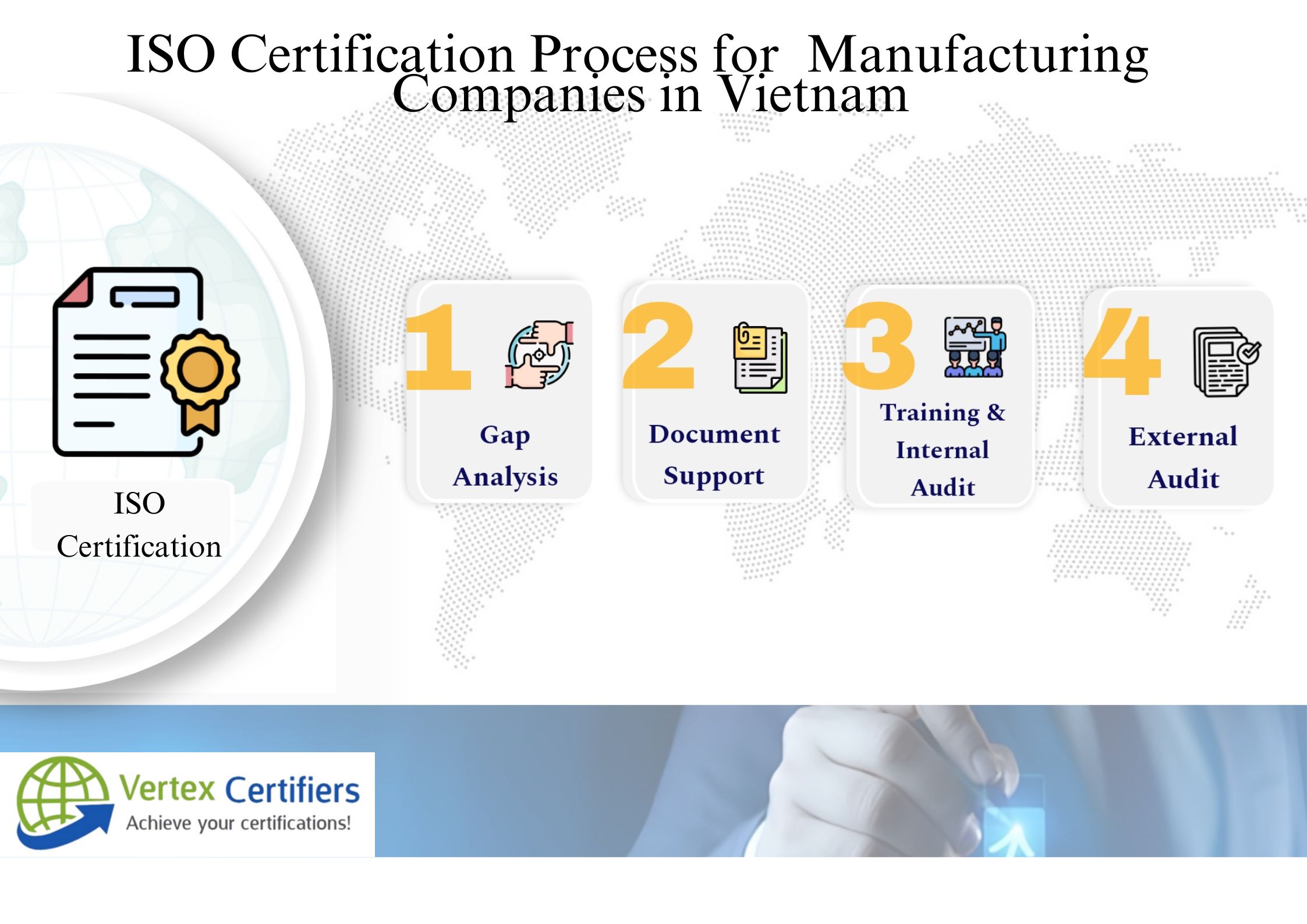
ISO Certification in Vietnam for Manufacturing Companies

Step 1 – Gap Analysis

The certification journey begins with a comprehensive gap analysis to evaluate the organization’s existing management system against the requirements of the selected ISO standard. This assessment identifies compliance gaps, operational risks, process weaknesses, and opportunities for improvement, creating a structured roadmap for successful implementation.

Step 2 – Planning

Following the gap analysis, a detailed implementation plan is prepared outlining the project scope, objectives, responsibilities, timelines, required resources, and implementation milestones. Proper planning ensures that the certification project progresses efficiently with minimal disruption to manufacturing operations.

Step 3 – Documentation

The required management system documentation is developed or updated in accordance with the selected ISO standard. This includes quality manuals, policies, procedures, work instructions, process maps, risk assessments, operational controls, forms, records, and other documented information necessary to support effective implementation and compliance.

Step 4 – Implementation

Once the documentation has been completed, the management system is implemented throughout the organization. Manufacturing personnel begin following the documented procedures and operational controls within daily production activities, ensuring the ISO requirements become an integral part of routine business operations.

Step 5 – Employee Training

Employees, supervisors, production managers, quality personnel, and department heads receive awareness and competency-based training on the implemented management system. The training ensures personnel understand their responsibilities, organizational procedures, compliance obligations, and continual improvement practices required for maintaining an effective ISO management system.

Step 6 – Internal Audit

An internal audit is conducted to verify that the implemented management system complies with ISO requirements and is functioning effectively. The audit helps identify nonconformities, operational improvement opportunities, and corrective actions that should be completed before the certification audit.

Step 7 – Management Review

Top management reviews the overall performance of the management system by evaluating internal audit results, quality objectives, customer feedback, process performance, compliance status, business risks, resource requirements, and opportunities for continual improvement. This review ensures leadership involvement and the long-term effectiveness of the management system.

Step 8 – Certification Audit

The final stage involves an independent certification audit conducted by an accredited certification body. Auditors assess both the documented management system and its implementation across the organization. Upon successful completion of the audit and closure of any identified nonconformities, the manufacturing company is awarded ISO certification, demonstrating its commitment to international quality standards, operational excellence, regulatory compliance, and continual improvement.

Why ISO Certification is Important for Manufacturing Companies | Vertex Certifiers

Why ISO Certification is Important for Manufacturing Companies

ISO certification helps manufacturers improve product quality, meet export requirements, strengthen compliance, reduce waste, protect workers, and build a stronger competitive position in global markets.

Product Quality
Export Compliance
Worker Safety
Environmental Compliance
Business Continuity

Why ISO Certification Matters

Manufacturing companies face pressure to deliver consistent quality, control operational risk, meet international customer expectations, and stay compliant across markets. ISO certification gives organisations a structured management system to improve performance and credibility.

  • Improved product quality.
  • Better export opportunities.
  • Customer confidence and trust.
  • Operational efficiency.
  • Waste reduction.
  • Employee safety and environmental compliance.
  • Business continuity.
  • Supply chain requirements.
  • Risk management and competitive advantage.

Applicable ISO Standards for Manufacturing Companies

These are the most relevant standards for manufacturers across different sectors, from electronics and automotive to food, pharmaceuticals, and heavy industry.

ISO 9001 – Quality Management System

  • Product consistency.
  • Process control.
  • Customer satisfaction.
  • Continual improvement.

ISO 14001 – Environmental Management System

  • Pollution prevention.
  • Waste management.
  • Environmental compliance.
  • Sustainable manufacturing.

ISO 45001 – Occupational Health & Safety Management System

  • Worker safety.
  • Hazard identification.
  • Accident prevention.
  • Legal compliance.

ISO 50001 – Energy Management System

  • Energy efficiency.
  • Utility cost reduction.
  • Sustainable production.
  • Manufacturing optimization.

ISO 27001 – Information Security Management System

  • Intellectual property protection.
  • Manufacturing data.
  • ERP systems.
  • Production information and customer information.

ISO 22301 – Business Continuity Management System

  • Supply chain resilience.
  • Production continuity.
  • Disaster recovery.
  • Emergency preparedness.

ISO 22000 – Food Safety Management System

  • Food manufacturers.
  • Beverage companies.
  • Food processing plants.
  • Food exporters.

ISO 13485 – Medical Device Quality Management System

  • Medical device manufacturers.
  • Healthcare equipment manufacturers.
  • Diagnostic device manufacturers.

GMP (Good Manufacturing Practices)

  • Pharmaceutical manufacturing.
  • Nutraceutical manufacturing.
  • Cosmetics manufacturing.
  • Food supplements.

ISO 37001 – Anti-Bribery Management System

  • Corporate governance.
  • Ethical business practices.
  • International business compliance.
  • Risk reduction.
Practical tip: Many manufacturers start with ISO 9001, then add ISO 14001, ISO 45001, ISO 50001, or sector-specific standards depending on product type, market needs, and customer expectations.

Best ISO Certifications by Manufacturing Industry

Use this table to identify the most suitable certification mix for each manufacturing sector.

Manufacturing IndustryRecommended Standards
Electronics ManufacturingISO 9001, ISO 14001, ISO 45001, ISO 27001
Automotive ComponentsISO 9001, ISO 14001, ISO 45001
Textile & GarmentsISO 9001, ISO 14001, ISO 45001
Food ManufacturingISO 22000, ISO 9001, ISO 14001
Pharmaceutical ManufacturingGMP, ISO 9001, ISO 14001, ISO 45001
Medical Device ManufacturingISO 13485, ISO 9001
Furniture ManufacturingISO 9001, ISO 14001
Plastic ManufacturingISO 9001, ISO 14001, ISO 45001
Chemical ManufacturingISO 9001, ISO 14001, ISO 45001
Steel & Metal FabricationISO 9001, ISO 14001, ISO 45001

Benefits of ISO Certification

  • Improved product quality.
  • Better export opportunities.
  • Increased customer confidence.
  • Reduced operational risks.
  • Better environmental performance.
  • Enhanced worker safety.
  • Reduced production waste.
  • Improved process efficiency.
  • Stronger international competitiveness.
  • Continual improvement.
  • Regulatory compliance.

Manufacturing Companies We Serve

  • Electronics Manufacturers.
  • Automotive Parts Manufacturers.
  • Textile Manufacturers.
  • Garment Manufacturers.
  • Footwear Manufacturers.
  • Furniture Manufacturers.
  • Food Processing Companies.
  • Packaging Companies.
  • Pharmaceutical Manufacturers.
  • Medical Device Manufacturers.
  • Chemical Manufacturers.
  • Plastic Manufacturers.
  • Steel Fabrication Companies.
  • Industrial Equipment Manufacturers.
  • OEM & Contract Manufacturers.

Cities We Serve in Vietnam

Ho Chi Minh City: We support manufacturers in Ho Chi Minh City with ISO certification for quality, safety, export readiness, and operational improvement.

Hanoi: Hanoi manufacturing companies can benefit from practical implementation and certification support for multiple ISO standards.

Hai Phong: We help Hai Phong exporters and production facilities improve compliance and international competitiveness.

Da Nang: Da Nang manufacturers use ISO systems to strengthen quality control, worker safety, and customer trust.

Can Tho: We assist Can Tho companies with documentation, process improvement, and readiness for audit.

Binh Duong: Binh Duong factories can use ISO certification to support growth, compliance, and export opportunities.

Dong Nai: We help Dong Nai manufacturers improve production systems, safety, and operational efficiency.

Bac Ninh: Bac Ninh manufacturing businesses can strengthen quality, data protection, and continuity through ISO adoption.

Hung Yen: We support Hung Yen companies with hands-on consulting and certification preparation.

Vung Tau: Vung Tau manufacturers can improve competitiveness and customer confidence with the right ISO framework.

Frequently Asked Questions

Which ISO certification is best for manufacturing companies in Vietnam?

ISO 9001 is usually the most important starting point, and many manufacturers add ISO 14001, ISO 45001, or sector-specific standards based on their products and markets.

Is ISO 9001 required for exporters?

It is not always legally required, but ISO 9001 is widely expected by international buyers and helps improve export credibility.

Which ISO standards are suitable for electronics manufacturers?

Electronics manufacturers commonly use ISO 9001, ISO 14001, ISO 45001, and ISO 27001.

Do food manufacturers need ISO 22000?

Yes, ISO 22000 is highly relevant for food manufacturers, beverage companies, food processing plants, and food exporters.

Is GMP mandatory for pharmaceutical manufacturers?

In many markets, GMP is a core regulatory expectation for pharmaceutical manufacturing and quality control.

Which ISO certification improves worker safety?

ISO 45001 is the main occupational health and safety standard for improving workplace safety and accident prevention.

How long does ISO certification take?

The timeline depends on organisation size, process maturity, number of sites, selected standards, and how quickly gaps are closed.

What is the cost of ISO certification in Vietnam?

Cost varies based on company size, scope, standard selection, current documentation, and implementation complexity.

Can manufacturers implement multiple ISO standards together?

Yes. Many manufacturers implement several standards together to build an integrated and efficient management system.

How can Vertex Certifiers help manufacturing companies in Vietnam?

Vertex Certifiers can support with consulting, documentation, implementation, internal auditor training, remote and onsite guidance, and certification audit preparation.

Looking for ISO Certification for Your Manufacturing Company in Vietnam?

Whether you operate an electronics manufacturing company, automotive components plant, textile & garment factory, footwear manufacturer, furniture manufacturer, food processing facility, packaging company, chemical manufacturer, plastic manufacturer, steel fabrication unit, OEM, contract manufacturing facility, or industrial production plant, Vertex Certifiers provides complete ISO certification consulting services tailored to your manufacturing operations.

Our experienced consultants provide end-to-end implementation for ISO 9001, ISO 14001, ISO 45001, ISO 22000, ISO 27001, ISO 22301, ISO 50001, ISO 13485, ISO 37001, and Good Manufacturing Practices (GMP), including gap analysis, documentation, risk assessment, employee training, implementation, internal audits, management review, and certification audit support to help your organization achieve international compliance and strengthen its position in global supply chains.

✔ Free Initial Consultation ✔ Manufacturing Industry ISO Specialists ✔ Remote & On-site Consulting Across Vietnam ✔ Complete Documentation & Certification Support

    Get Free
    Consultation


    Our Services

    Our Local Cities

    Iso Certification in vietnam

      Company Logo

      Get ISO certification


      Fill the details below, one of our executives will contact you shortly


      This will close in 0 seconds

      Call Now Button