
ISO 22000 Certification in Greece:
Vertex Certifiers is a trusted international ISO consulting company providing end-to-end ISO certification, implementation, training, internal audit, and certification services for organizations across Greece. Our experienced consultants work closely with businesses of all sizes to develop practical, compliant, and result-oriented management systems aligned with international ISO standards. From initial gap analysis and documentation development to employee training, implementation, internal audits, management review, and certification audit coordination, we offer complete support throughout the certification journey. With a customer-focused approach, industry expertise, and competitive and affordable consulting solutions, Vertex Certifiers helps organizations achieve ISO certification efficiently while improving operational performance, regulatory compliance, customer confidence, and long-term business growth.
ISO 22000 Certification in Greece – ISO 22000 Consultants, Implementation & Certification Services
Introduction
Food safety has become one of the most important priorities for businesses operating in today’s global food industry. Consumers, retailers, importers, and regulatory authorities expect food products to be safe, hygienic, traceable, and consistently manufactured under controlled conditions. For organizations involved in food production, processing, packaging, storage, transportation, distribution, catering, or hospitality, implementing an internationally recognized Food Safety Management System (FSMS) is no longer just a competitive advantage—it is an essential business practice. ISO 22000:2018 is the globally accepted standard that enables organizations to establish effective food safety controls, identify hazards, comply with legal requirements, and continually improve their food safety performance throughout the entire food supply chain.
Greece is one of the world’s leading producers and exporters of olive oil, dairy products, feta cheese, seafood, fish, wine, honey, fruits, vegetables, bakery products, beverages, frozen foods, and organic food products.In addition to food manufacturing, Greece has a strong hospitality sector comprising restaurants, hotels, resorts, catering companies, food packaging manufacturers, agricultural exporters, and logistics providers serving both domestic and international markets.
ISO 22000 integrates the principles of Hazard Analysis and Critical Control Points (HACCP) with a systematic management framework that helps organizations identify biological, chemical, and physical food safety hazards before they affect consumers. The standard emphasizes preventive risk management, operational control, effective communication throughout the supply chain, regulatory compliance, documented procedures, employee competence, traceability, and continual improvement. By implementing ISO 22000, organizations can minimize food safety risks, improve operational efficiency, strengthen supplier management, reduce product recalls, and build long-term trust among customers, regulators, retailers, and business partners.
Vertex Certifiers is an international ISO consulting company providing professional ISO 22000 Certification consulting services in Greece.Our experienced consultants support organizations of every size with complete implementation, documentation, HACCP integration, employee training, internal audits, management review assistance, certification audit preparation, and end-to-end certification support.
What is ISO 22000 Certification?
ISO 22000:2018 is an internationally recognized Food Safety Management System (FSMS) standard published by the International Organization for Standardization (ISO). It provides a structured framework for organizations to identify, evaluate, control, monitor, and continually improve food safety hazards throughout the entire food supply chain. Unlike product-specific food safety regulations, ISO 22000 focuses on creating a comprehensive management system that enables organizations to consistently produce safe food while meeting customer, statutory, and regulatory requirements.
The standard is applicable to every organization involved in the food chain, regardless of its size or complexity. This includes food manufacturers, ingredient suppliers, agricultural producers, dairy companies, olive oil producers, seafood processors, wineries, meat processors, poultry companies, beverage manufacturers, food packaging companies, storage facilities, cold chain logistics providers, distributors, retailers, restaurants, catering companies, hotels, and food service organizations. Whether an organization directly handles food products or provides services that influence food safety, ISO 22000 offers a practical framework for managing food safety risks effectively.
One of the major strengths of ISO 22000 is its strong risk-based approach.Risk management enables businesses to prioritize resources where food safety risks are greatest, ensuring that preventive actions are implemented before hazards affect consumers.
ISO 22000 also adopts the process approach, encouraging organizations to understand how different activities interact throughout the food supply chain. From sourcing raw materials and supplier evaluation to manufacturing, packaging, warehousing, transportation, distribution, and customer delivery, every process is interconnected. Managing these processes systematically improves consistency, efficiency, traceability, and overall food safety performance.
Food safety risks evolve due to changing regulations, emerging biological hazards, technological advancements, customer expectations, climate conditions, and global supply chain challenges.
SO 22000 is based on the internationally recognized Plan-Do-Check-Act (PDCA) Cycle, which provides a structured methodology for managing and improving organizational processes.
- Plan: Establish food safety objectives, identify hazards, assess risks, and develop food safety controls.
- Do: Implement the planned processes, operational controls, training programs, documentation, and communication procedures.
- Check: Monitor food safety performance, conduct inspections, verify HACCP controls, perform internal audits, and review compliance.
- Act: Correct identified issues, implement improvements, update procedures, and strengthen the Food Safety Management System for continual improvement.
A key feature of ISO 22000 is its integration of HACCP (Hazard Analysis and Critical Control Points) principles. HACCP is a globally accepted preventive methodology used to identify and control food safety hazards before they occur. ISO 22000 expands upon HACCP by integrating it into a complete management system that includes leadership commitment, organizational planning, competence management, communication, documentation, operational planning, performance evaluation, and continual improvement. This integrated approach provides organizations with a comprehensive system that goes beyond hazard control to support sustainable business performance.
The standard also emphasizes Prerequisite Programs (PRPs) and Operational Prerequisite Programs (OPRPs). PRPs establish the basic environmental and operational conditions necessary for safe food production, including sanitation, pest control, facility maintenance, personnel hygiene, equipment cleaning, waste management, and supplier management.
Compliance with ISO 22000 demonstrates that an organization has implemented internationally recognized food safety practices aligned with global expectations. Certification helps organizations strengthen regulatory compliance, improve customer satisfaction, enhance supply chain confidence, support export activities, reduce operational risks, and build long-term business credibility. Many international retailers, food distributors, importers, hospitality groups, and multinational organizations prefer working with suppliers that maintain certified Food Safety Management Systems because they provide greater assurance of consistent food safety performance.
For Greek organizations seeking to expand into international markets, strengthen relationships with retailers, improve operational controls, or enhance brand reputation, ISO 22000 certification represents a strategic investment in quality, safety, and sustainable business growth.Vertex Certifiers supports organizations throughout every stage of their ISO 22000 certification journey, ensuring that the management system not only achieves certification but also delivers measurable operational and business benefits.
Why is ISO 22000 Certification Important in Greece?
Greece has established itself as one of Europe’s leading producers and exporters of premium food and agricultural products. Greek olive oil, feta cheese, dairy products, seafood, wine, honey, fresh fruits, vegetables, and organic foods are recognized worldwide for their quality and authenticity. As global demand for safe, traceable, and sustainably produced food continues to increase, businesses across Greece are expected to demonstrate internationally accepted food safety practices. ISO 22000 certification helps organizations meet these expectations while strengthening customer confidence, improving regulatory compliance, and supporting long-term export growth.
ISO 22000 complements these regulatory requirements by providing a structured Food Safety Management System that emphasizes hazard identification, preventive controls, traceability, communication, and continual improvement. For Greek businesses supplying retailers, wholesalers, hospitality groups, and international buyers, certification demonstrates a proactive commitment to food safety and operational excellence.
Food safety incidents can result in product recalls, damaged reputations, regulatory actions, supply chain disruptions, and lost business opportunities. ISO 22000 reduces these risks by encouraging organizations to identify hazards before they become problems, monitor critical processes, maintain documented procedures, and continually improve operational performance. This preventive approach not only protects consumers but also enhances organizational resilience and business continuity.
Certification is particularly valuable for olive oil producers, seafood exporters, dairy manufacturers, feta cheese producers, wineries, agricultural cooperatives, food processing companies, restaurants, hotels, catering businesses, beverage manufacturers, and food packaging organizations operating in Greece. By implementing ISO 22000, these organizations can improve supplier confidence, strengthen relationships with international customers, support export requirements, increase operational consistency, and position themselves as reliable partners in the global food industry.
For organizations aiming to grow in competitive domestic and international markets, ISO 22000 certification is more than a compliance exercise—it is a strategic business decision that supports sustainable growth, enhances brand reputation, and demonstrates an ongoing commitment to delivering safe, high-quality food products.
ISO 22000 Certification Process
Introduce the ISO 22000 certification journey by explaining that achieving certification involves implementing a structured Food Safety Management System (FSMS) aligned with ISO 22000:2018 requirements. Mention that the process focuses on identifying food safety hazards, implementing effective controls, integrating HACCP principles, ensuring regulatory compliance, and continually improving food safety performance. Explain that while the certification process may vary depending on the organization’s size and complexity, the core stages remain the same.
Mention that Vertex Certifiers provides complete end-to-end consulting, implementation, training, internal audits, and certification support throughout every stage of the certification process.
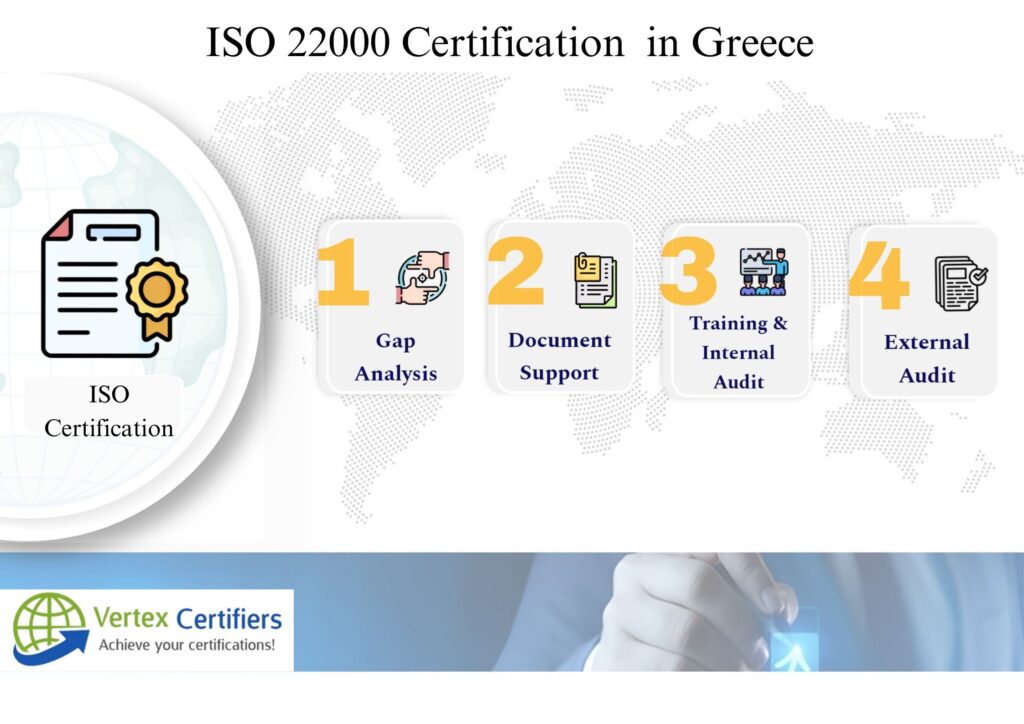
Step 1: Initial Consultation
Cover:
- Understanding business activities
- Scope of certification
- Food products and processes
- Business objectives
- Applicable regulatory requirements
- Certification roadmap
- Project planning discussion
Step 2: Gap Analysis
Explain:
- Review of existing food safety practices
- Evaluation against ISO 22000 requirements
- Identification of compliance gaps
- Process assessment
- Documentation review
- Improvement recommendations
- Gap analysis report
Step 3: Project Planning
Include:
- Certification implementation plan
- Timeline development
- Roles and responsibilities
- Resource allocation
- Project milestones
- Implementation schedule
- Communication plan
Step 4: Documentation Development
Explain:
- Food Safety Management System documentation
- Food safety manual (if applicable)
- Policies
- Procedures
- SOPs
- Work instructions
- Forms and records
- Operational controls
- Document control system
Step 5: Food Safety Policy
Cover:
- Establishing food safety objectives
- Leadership commitment
- Customer focus
- Regulatory compliance
- Communication of policy
- Employee awareness
- Continual improvement commitment
Step 6: HACCP Study
Explain:
- Formation of HACCP team
- Product description
- Process flow diagrams
- Hazard identification
- Hazard analysis
- Risk assessment
- Critical Control Points (CCPs)
- Operational PRPs (OPRPs)
- Critical limits
- Monitoring procedures
- Corrective actions
- Verification activities
Step 7: Implementation
Include:
- Implement documented procedures
- Operational controls
- Hygiene practices
- Supplier management
- Traceability systems
- Monitoring activities
- Food safety controls
- Record keeping
Step 8: Employee Training
Cover:
- ISO 22000 awareness
- HACCP awareness
- Hygiene training
- Food safety culture
- Roles and responsibilities
- Competency development
- Operational training
Step 9: Internal Audit
Explain:
- Conduct internal audits
- Verify implementation
- Evaluate compliance
- Identify nonconformities
- Audit reporting
- Improvement opportunities
Step 10: Management Review
Include:
- Review audit results
- Customer feedback
- Food safety performance
- Risks and opportunities
- Resource adequacy
- Improvement decisions
- Strategic planning
Step 11: Corrective Actions
Explain:
- Root cause analysis
- Corrective action plans
- Implementation of actions
- Effectiveness verification
- Preventive improvements
- Closure of nonconformities
Step 12: Certification Audit – Stage 1
Cover:
- Documentation review
- Readiness assessment
- Scope verification
- FSMS evaluation
- Identification of areas requiring improvement
- Preparation for Stage 2
Step 13: Certification Audit – Stage 2
Explain:
- On-site audit
- Verification of implementation
- Employee interviews
- Process evaluation
- Operational effectiveness
- Compliance assessment
- Audit findings
Step 14: Certification Decision
Include:
- Review of audit findings
- Closure of nonconformities (if applicable)
- Certification approval
- Issuance of ISO 22000 Certificate
- International recognition
Step 15: Surveillance Audits
Explain:
- Periodic surveillance audits
- Ongoing compliance verification
- Continuous monitoring
- Maintaining certification
- Continual improvement
Step 16: Continual Improvement
Cover:
- Monitoring KPIs
- Internal audits
- Management reviews
- Risk reassessment
- Process optimization
- Employee competency
- Customer feedback
- Continuous enhancement of the Food Safety Management System


