3. Why Is ISO 22301 Certification Important in Iraq?
Business continuity has become increasingly important for organizations operating in Iraq as businesses depend on interconnected infrastructure, technology, suppliers, employees, transportation networks, utilities, and communication systems. An unexpected disruption can interrupt critical operations, delay deliveries, affect customer services, and create financial and reputational consequences. ISO 22301 Certification in Iraq provides organizations with a structured framework for identifying business continuity risks, protecting critical processes, preparing for disruptions, and improving their ability to recover essential operations.
ISO 22301 is particularly valuable for organizations that need to demonstrate resilience to customers, contractors, international business partners, government organizations, and other stakeholders. By implementing a Business Continuity Management System (BCMS), organizations can move from reactive emergency response toward a planned and systematic approach to business continuity.
Protecting Critical Business Operations
Every organization has processes that are essential to its ability to deliver products or services. These may include production, customer support, financial transactions, IT services, procurement, logistics, healthcare services, energy operations, or project execution. ISO 22301 helps organizations identify these critical activities and understand what could happen if they become unavailable.
Organizations can then establish suitable alternatives and recovery arrangements. Depending on their operations, these may include backup systems, alternative suppliers, backup facilities, additional resources, alternative communication channels, data recovery arrangements, or trained personnel who can take over critical responsibilities.
- Identify critical business processes and services
- Determine dependencies between processes
- Establish recovery priorities
- Prepare alternative arrangements
- Define responsibilities during disruptions
- Develop and maintain continuity plans
Managing Operational Risks
Organizations in Iraq may face different operational risks depending on their industry, location, infrastructure, supply chain, technology, and workforce. ISO 22301 encourages organizations to systematically identify threats that could interrupt critical activities and determine appropriate continuity strategies.
Important areas of consideration can include:
- Infrastructure: Facilities, buildings, production sites, warehouses, offices, and other essential infrastructure.
- Utilities: Electricity, water, fuel, telecommunications, and other essential utilities.
- IT systems: Servers, applications, networks, cloud platforms, databases, and digital services.
- Suppliers: Critical vendors, contractors, raw-material suppliers, technology providers, and outsourced services.
- Equipment: Production machinery, medical equipment, vehicles, tools, and other critical assets.
- Workforce: Availability of employees, key personnel, technical specialists, and emergency response teams.
- Transportation: Vehicles, logistics networks, delivery routes, and transportation dependencies.
- Communication systems: Telephone, internet, email, emergency communication, and other communication channels.
By understanding these dependencies, organizations can develop continuity strategies that are appropriate to their actual operational environment.
Reducing Business Downtime
Extended downtime can affect production, customer service, revenue, contractual commitments, and organizational reputation. ISO 22301 helps organizations establish recovery priorities and define how critical activities should be maintained or restored following a disruptive event.
Business continuity plans can provide employees with clear instructions regarding what should happen during an incident, who is responsible for specific activities, how communication should take place, and which recovery actions should be prioritized. This structured approach can help organizations respond more effectively and restore important operations in a controlled manner.
Protecting Customer and Stakeholder Confidence
Customers and business partners increasingly expect organizations to demonstrate reliability and preparedness. A major interruption that prevents an organization from delivering products or services can affect customer relationships and future business opportunities.
ISO 22301 can help organizations demonstrate that they have considered potential disruptions and established processes for maintaining critical services. This can strengthen confidence among customers, suppliers, contractors, employees, investors, and other stakeholders.
Supporting Business Growth
As organizations expand into new markets, add locations, increase their workforce, adopt new technologies, or develop larger supply chains, their operational dependencies can become more complex. A structured BCMS helps organizations incorporate business continuity into their growth and operational planning.
ISO 22301 can support organizations in establishing consistent continuity practices across departments and locations. It can also provide a framework for reviewing risks and continuity requirements when significant changes are introduced.
Meeting Customer and Contractual Requirements
For some organizations, demonstrating business continuity capability can be important when working with large customers, international companies, contractors, government organizations, financial institutions, and major oil and gas clients. ISO 22301 certification provides an internationally recognized way to demonstrate that an organization's BCMS has undergone an independent conformity assessment.
It can therefore support organizations seeking to strengthen their credibility when responding to tenders, supplier evaluations, customer requirements, contractual expectations, or international business opportunities.
Ready to Strengthen Your Business Continuity?
Vertex Certifiers provides end-to-end ISO 22301 consulting and certification support for organizations across Iraq. Contact our team to discuss your requirements and start your certification journey.
✉ Email: info@vertexcertifiers.com
Contact Us4. Which Organizations in Iraq Can Obtain ISO 22301 Certification?
ISO 22301 can be implemented by organizations of different sizes and across a wide range of industries. The standard is not limited to a particular sector because every organization has processes, resources, people, technology, suppliers, and services that may need to be maintained during a disruption.
Organizations in Iraq that may benefit from ISO 22301 include:
- Oil and gas companies
- Manufacturing companies
- Construction companies
- Engineering companies
- Banks and financial institutions
- Insurance companies
- Hospitals and healthcare organizations
- Pharmaceutical companies
- IT companies
- Software development companies
- Telecommunications companies
- Logistics companies
- Transportation companies
- Energy and utility companies
- Food and beverage companies
- Retail organizations
- Educational institutions
- Government and public-sector organizations
- Professional and service organizations
The scope of certification can be defined according to the organization's activities, locations, services, departments, processes, and business continuity requirements.
5. ISO 22301 Certification Requirements in Iraq
The ISO 22301 certification requirements in Iraq are based on establishing and maintaining a Business Continuity Management System that enables the organization to prepare for, respond to, and recover from disruptions. The implementation should be practical and proportionate to the organization's size, activities, risks, and complexity.
Define the Organization's Context
The organization needs to understand the internal and external factors that can influence its ability to achieve business continuity objectives. It should also identify relevant interested parties and understand their requirements.
This stage includes defining:
- Internal and external issues
- Relevant interested parties
- BCMS scope
- Locations covered by the system
- Departments and functions included
- Processes, products, and services covered
Leadership and Management Commitment
Business continuity should have visible support from top management. Management establishes the direction of the BCMS, provides appropriate resources, assigns responsibilities, and ensures that business continuity objectives are integrated into organizational activities.
Leadership responsibilities can include establishing the business continuity policy, approving objectives, assigning roles, supporting continuity planning, reviewing BCMS performance, and encouraging continual improvement.
Business Impact Analysis (BIA)
A Business Impact Analysis helps an organization understand the consequences of interruptions to its important activities. It provides a basis for establishing recovery priorities and determining the resources required to continue or restore critical operations.
A BIA can help identify:
- Critical business processes
- Important products and services
- Potential consequences of disruption
- Acceptable downtime and recovery requirements
- Critical personnel and skills
- Technology and information requirements
- Equipment and facility requirements
- Supplier and third-party dependencies
- Recovery priorities
Risk Assessment
Organizations need to identify threats that could interrupt critical activities and evaluate the potential consequences. The assessment should consider risks relevant to the organization's actual operating environment.
Examples include:
- Cyber incidents
- IT system failures
- Equipment breakdown
- Power failure
- Fire
- Supply-chain disruption
- Loss of key personnel
- Communication failure
- Facility disruption
- Transportation interruptions
Business Continuity Strategies
After identifying critical activities and relevant risks, the organization determines how those activities can continue or be recovered following a disruption.
Depending on the organization's circumstances, continuity strategies may include:
- Backup systems
- Alternative suppliers
- Alternative work locations
- Data backup and recovery arrangements
- Backup communication methods
- Emergency resources
- Additional trained personnel
- Alternative equipment or facilities
Business Continuity Plans
Business continuity plans provide documented guidance for responding to specific disruptions. They should explain what needs to happen, who is responsible, how decisions are made, how employees communicate, and how critical operations are maintained or recovered.
Plans should be understandable, accessible, and appropriate for the people expected to use them during an incident.
Training and Awareness
Employees should understand their responsibilities within the BCMS. Training and awareness activities help ensure that business continuity arrangements are not limited to management documentation but are understood throughout relevant parts of the organization.
Employees may need awareness of:
- Their business continuity responsibilities
- Emergency procedures
- Incident reporting processes
- Communication procedures
- Evacuation or emergency arrangements
- Recovery responsibilities
- Business continuity plans applicable to their roles
Testing and Exercises
Testing is essential for determining whether business continuity arrangements work as intended. Organizations should conduct suitable exercises and use the results to identify weaknesses and improve their plans.
Testing methods can include:
- Scenario simulations
- Tabletop exercises
- Emergency drills
- IT recovery tests
- Data restoration exercises
- Communication tests
- Supplier continuity exercises
Monitoring and Improvement
A BCMS needs to be monitored and continually improved. Organizations should evaluate performance, conduct internal audits, review testing results, identify nonconformities, implement corrective actions, conduct management reviews, and make improvements when business conditions or risks change.
6. How to Implement ISO 22301 in Iraq?
ISO 22301 implementation in Iraq should be approached as a structured business improvement project rather than simply a documentation exercise. The organization needs to establish the BCMS, put it into operation, train relevant personnel, test its arrangements, and verify its effectiveness before the certification audit.
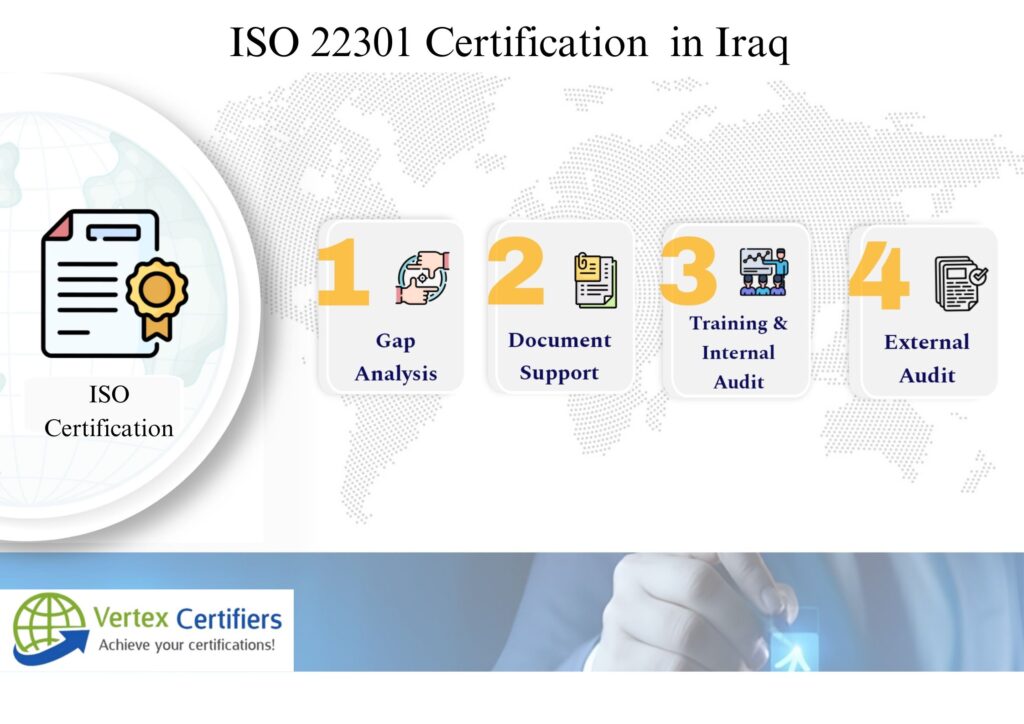
Step 1: Initial Gap Analysis
Begin by reviewing existing business continuity, emergency response, risk management, IT recovery, supplier management, and operational resilience practices against ISO 22301 requirements.
The gap analysis identifies what is already available and what needs to be developed or improved.
Step 2: Define the BCMS Scope
Determine exactly what the Business Continuity Management System will cover.
- Locations
- Departments
- Processes
- Products and services
- Business activities
- Supporting functions
A clearly defined scope helps prevent confusion about which activities are included within the certification.
Step 3: Identify Risks
Identify events and circumstances that could interrupt business operations. The assessment should consider operational, technological, infrastructure, workforce, supplier, transportation, communication, and other relevant risks.
Step 4: Conduct Business Impact Analysis
Determine which processes are critical, how quickly they need to be restored, what resources they require, and which dependencies could affect recovery.
The organization can establish recovery priorities based on the potential consequences of disruption.
Step 5: Develop Business Continuity Strategies
Determine how critical activities will continue or recover following different disruption scenarios. Strategies should reflect the organization's actual resources, operational needs, risks, and recovery requirements.
Step 6: Prepare Documentation
Develop the policies, procedures, plans, records, and other documented information needed to support the BCMS. Documentation should be practical and relevant to the organization's operations.
Step 7: Implement the BCMS
Put the documented processes and continuity arrangements into actual operation. Assign responsibilities, establish communication arrangements, implement strategies, and ensure relevant employees understand what is expected of them.
Step 8: Employee Training
Train employees and relevant personnel on business continuity responsibilities, emergency procedures, communication arrangements, response activities, and recovery procedures.
Step 9: Test Business Continuity Plans
Conduct appropriate exercises and simulations to determine whether plans work as intended. Record the results and use identified weaknesses as opportunities for improvement.
Step 10: Internal Audit
Conduct an internal audit to verify whether the BCMS has been properly implemented and whether it meets applicable ISO 22301 requirements.
Step 11: Management Review
Top management reviews BCMS performance, audit results, testing outcomes, risks, corrective actions, resource requirements, and opportunities for improvement.
Step 12: Certification Audit
Once the organization is ready, an independent and appropriately competent certification body assesses the implemented BCMS against ISO 22301 requirements. The organization addresses applicable audit findings before certification is finalized.
7. ISO 22301 Documentation Required in Iraq
Documentation is an important part of an effective Business Continuity Management System. However, organizations should avoid creating unnecessary paperwork. The documented information should be appropriate to the organization's size, activities, risks, processes, locations, and operational complexity.
Depending on the organization's scope and requirements, documentation and records may include:
- Business Continuity Policy
- BCMS Scope
- Business Continuity Objectives
- Business Impact Analysis
- Risk Assessment
- Business Continuity Strategies
- Business Continuity Plans
- Incident Response Procedures
- Emergency Response Procedures
- Recovery Procedures
- Communication Plans
- Roles and Responsibilities
- Training and Awareness Records
- Testing and Exercise Records
- Internal Audit Records
- Management Review Records
- Corrective Action Records
- Monitoring and Performance Records
The exact documentation required will depend on the organization's BCMS scope and operational circumstances.
9. Benefits of ISO 22301 Certification in Iraq
Implementing ISO 22301 can provide practical benefits beyond achieving certification. It helps organizations develop a more structured understanding of their critical activities, risks, dependencies, recovery priorities, and response arrangements.
- Improved business resilience: Establish a systematic approach to preparing for and responding to disruptions.
- Reduced operational downtime: Define recovery priorities and continuity arrangements for critical activities.
- Better risk management: Identify threats that could affect important business processes.
- Faster recovery: Establish structured response and recovery procedures.
- Protection of critical processes: Identify and prioritize activities essential to business operations.
- Improved emergency preparedness: Give employees clearer responsibilities during disruptive events.
- Better employee awareness: Ensure relevant personnel understand their roles within continuity plans.
- Improved supplier continuity: Consider critical suppliers and third-party dependencies during continuity planning.
- Increased customer confidence: Demonstrate a structured approach to business continuity.
- Improved organizational reputation: Strengthen confidence among customers, partners, and stakeholders.
- Support for international business: Demonstrate internationally recognized business continuity practices.
- Competitive advantage: Strengthen organizational credibility when responding to business opportunities and customer requirements.
- Better preparedness for technology disruptions: Address risks involving IT systems, applications, data, networks, and digital services.
10. ISO 22301 Certification for Different Industries in Iraq
Business continuity requirements differ significantly between industries. ISO 22301 allows organizations to establish continuity arrangements based on their specific processes, risks, services, and operational dependencies.
ISO 22301 for Oil and Gas Companies
Oil and gas organizations often depend on complex production systems, equipment, field operations, contractors, transportation networks, technology, and supply chains. A business continuity framework can help identify critical activities and establish appropriate continuity and recovery arrangements.
Important areas may include:
- Production continuity
- Supply-chain continuity
- Critical equipment
- IT systems
- Field operations
- Emergency response
- Contractor dependencies
ISO 22301 for Banks and Financial Institutions
Banks and financial institutions rely heavily on technology, data, communication networks, payment systems, digital banking platforms, branches, employees, and third-party providers. Business continuity planning can help protect critical financial services and establish recovery priorities.
Key considerations can include:
- Banking systems
- Customer services
- Digital banking
- Data availability
- Payment systems
- Cyber incident response
- Communication systems
ISO 22301 for Manufacturing Companies
Manufacturing businesses can experience significant disruption when machinery, raw materials, utilities, suppliers, production facilities, or logistics operations become unavailable.
ISO 22301 can help manufacturing organizations address continuity of:
- Production operations
- Machinery and equipment
- Raw materials
- Suppliers
- Warehousing
- Distribution
ISO 22301 for IT Companies
IT and software organizations depend on highly available technology infrastructure and skilled personnel. Business continuity planning can address potential disruptions involving servers, cloud services, applications, data, networks, cyber incidents, and service availability.
- Servers and infrastructure
- Cloud services
- Data and databases
- Business applications
- Cybersecurity incidents
- Service availability
- Technical personnel
ISO 22301 for Healthcare Organizations
Healthcare organizations need to maintain critical patient services even when unexpected events affect facilities, personnel, medical equipment, information systems, or essential supplies.
Business continuity planning can address:
- Patient services
- Medical equipment
- Critical medicines and supplies
- Staff availability
- Emergency response
- Healthcare information systems
ISO 22301 for Construction Companies
Construction organizations can face disruptions involving project sites, workforce availability, equipment, contractors, materials, transportation, and site emergencies. ISO 22301 can help construction businesses identify critical project activities and develop suitable continuity arrangements.
12. How Long Does ISO 22301 Certification Take in Iraq?
The time required to implement and prepare for ISO 22301 Certification in Iraq varies from organization to organization. There is no single implementation timeline that applies to every business because the complexity of a BCMS depends on the organization's size, scope, number of locations, business processes, existing management systems, risk profile, employee involvement, testing requirements, and audit readiness.
Organizations with established risk management and continuity practices may have a different implementation journey from businesses starting from the beginning. A gap analysis can provide a clearer understanding of the work required and help establish a practical implementation plan.
13. ISO 22301 Internal Audit in Iraq
An ISO 22301 internal audit in Iraq helps organizations evaluate whether their Business Continuity Management System is properly implemented, maintained, and effective.
The internal audit can help organizations:
- Check BCMS implementation
- Identify nonconformities
- Evaluate business continuity processes
- Verify that plans and procedures are maintained
- Check the effectiveness of testing and exercises
- Identify opportunities for improvement
- Prepare for the external certification audit
- Support continual improvement
Conducting an internal audit before the certification assessment gives the organization an opportunity to identify and address weaknesses proactively.
14. ISO 22301 Training in Iraq
Employee competence and awareness are important elements of an effective BCMS. ISO 22301 training in Iraq can help relevant employees understand the requirements of business continuity management and their responsibilities within the organization's system.
ISO 22301 Awareness Training
Provides employees and management with an introduction to business continuity principles, ISO 22301 requirements, organizational responsibilities, and continuity planning.
ISO 22301 Internal Auditor Training
Designed for personnel responsible for conducting internal audits and evaluating the effectiveness of the organization's BCMS.
ISO 22301 Lead Auditor Training
Provides more advanced knowledge for professionals involved in planning, conducting, reporting, and managing Business Continuity Management System audits.
Business Continuity Management Training
Focuses on practical business continuity principles, including risk assessment, business impact analysis, continuity strategies, response planning, testing, and continual improvement.
Training can be useful for:
- Business continuity managers
- Risk managers
- Compliance teams
- IT managers
- Operations managers
- Internal auditors
- Management representatives
- Emergency response personnel
15. ISO 22301 Certification in Major Iraqi Cities
Vertex Certifiers supports organizations seeking ISO 22301 Certification in Iraq, including businesses operating in major commercial, industrial, financial, energy, healthcare, technology, and service centers.
ISO 22301 Certification in Baghdad
Business continuity support for organizations across Baghdad's diverse commercial and service sectors.
ISO 22301 Certification in Basra
Support for organizations operating across oil and gas, logistics, construction, industrial, and service activities.
ISO 22301 Certification in Erbil
Business continuity consulting for organizations across commercial, construction, energy, IT, and professional services.
ISO 22301 Certification in Mosul
Support for businesses and organizations strengthening operational resilience and continuity planning.
ISO 22301 Certification in Najaf
Consulting support for healthcare, hospitality, services, retail, education, and other organizations.
ISO 22301 Certification in Karbala
Business continuity support for service, hospitality, healthcare, retail, and other organizations.
ISO 22301 Certification in Sulaymaniyah
Support for organizations across technology, services, construction, education, and commercial sectors.
ISO 22301 Certification in Kirkuk
Consulting support for organizations operating in energy, industrial, commercial, and service sectors.
ISO 22301 Certification in Fallujah
Support for organizations looking to strengthen continuity planning and operational resilience.
ISO 22301 Certification in Duhok
Business continuity consulting for organizations across commercial, construction, healthcare, tourism, and service sectors.
Organizations with multiple branches, facilities, offices, production sites, or operational locations can also establish a BCMS scope that reflects their actual organizational structure and business continuity requirements.
16. Why Choose Vertex Certifiers for ISO 22301 Certification in Iraq?
Vertex Certifiers provides end-to-end ISO 22301 consulting and certification support for organizations across Iraq. Our approach focuses on helping organizations establish practical business continuity systems that are aligned with their operations rather than creating documentation that is difficult to maintain.
Our ISO 22301 services can include:
Gap Analysis
Evaluate existing business continuity practices and identify areas requiring improvement.
Documentation Development
Develop policies, procedures, plans, records, and other relevant BCMS documentation.
Business Impact Analysis
Support organizations in identifying critical activities, dependencies, impacts, and recovery priorities.
Risk Assessment
Identify and evaluate risks that could affect critical business operations.
BCMS Implementation
Support the practical implementation of ISO 22301 requirements across relevant functions.
Employee Training
Build awareness and competence regarding business continuity responsibilities.
Business Continuity Plans
Support the development of practical response, continuity, and recovery plans.
Testing & Exercises
Help organizations evaluate their continuity arrangements through appropriate exercises and simulations.
Internal Audit
Evaluate BCMS implementation and identify potential nonconformities before certification.
Management Review Support
Support management in reviewing BCMS performance and improvement requirements.
Certification Audit Support
Prepare organizations for the independent certification assessment.
Vertex Certifiers supports organizations across Iraq, including major locations such as Baghdad, Basra, Erbil, Mosul, Najaf, Karbala, Sulaymaniyah, Kirkuk, Fallujah, and Duhok, as well as organizations operating in other locations.
In addition to ISO 22301, our consulting services cover a broad range of management system standards, including ISO 9001, ISO 14001, ISO 45001, ISO 27001, ISO 22000, ISO 50001, ISO 13485, ISO 20000-1, ISO 41001, ISO 19650, ISO 27701, ISO 37001, and other internationally recognized standards.
17. Frequently Asked Questions About ISO 22301 Certification in Iraq
What is ISO 22301 Certification in Iraq?
ISO 22301 Certification in Iraq is the independent assessment and certification of an organization's Business Continuity Management System against applicable ISO 22301 requirements. It demonstrates that the organization has established a structured approach to preparing for, responding to, recovering from, and continually improving its ability to manage disruptive events.
Is ISO 22301 applicable to small businesses in Iraq?
Yes. ISO 22301 can be applied by organizations of different sizes. The scope and complexity of the BCMS should be appropriate to the organization's activities, risks, resources, processes, locations, and business continuity requirements.
Who needs ISO 22301 certification?
ISO 22301 can benefit organizations that depend on the continuity of critical products, services, processes, technology, infrastructure, suppliers, or personnel. This includes oil and gas, manufacturing, banking, healthcare, IT, telecommunications, logistics, construction, energy, retail, government, and professional service organizations.
What are the requirements of ISO 22301?
ISO 22301 requires an organization to establish a Business Continuity Management System covering relevant areas such as organizational context, leadership, planning, risk and impact analysis, continuity strategies, documented information, operational planning, performance evaluation, internal auditing, management review, and continual improvement.
How do I implement ISO 22301 in Iraq?
The implementation process generally includes conducting a gap analysis, defining the BCMS scope, identifying risks, conducting a Business Impact Analysis, developing continuity strategies and plans, implementing the system, training employees, testing continuity arrangements, conducting an internal audit, completing management review, and preparing for the certification audit.
What documents are required for ISO 22301?
Depending on the organization's scope and circumstances, documentation may include the BCMS scope, business continuity policy, objectives, Business Impact Analysis, risk assessment, continuity strategies, business continuity plans, incident response procedures, recovery procedures, communication plans, training records, testing records, internal audit records, management review records, corrective action records, and performance monitoring information.
How much does ISO 22301 Certification cost in Iraq?
The overall investment depends on factors such as organizational size, scope, number of locations, business processes, existing continuity arrangements, implementation requirements, training needs, and certification audit requirements. Organizations can contact Vertex Certifiers for a tailored assessment based on their specific requirements.
How long does ISO 22301 certification take?
The implementation timeline varies according to the organization's size, scope, existing systems, operational complexity, risk profile, documentation requirements, employee involvement, testing requirements, and audit readiness. A gap analysis can help determine the implementation activities required for a particular organization.
Is ISO 22301 certification mandatory in Iraq?
ISO 22301 is generally a voluntary management system certification unless a particular customer, contract, tender, regulator, or sector-specific requirement makes business continuity certification or related controls a requirement. Organizations should review the specific contractual and regulatory requirements applicable to their activities.
Who provides ISO 22301 certification consulting in Iraq?
Vertex Certifiers provides end-to-end ISO 22301 consulting and certification support in Iraq. Services can include gap analysis, documentation, Business Impact Analysis support, risk assessment, implementation, training, business continuity planning, testing, internal auditing, management review support, and certification audit preparation.
Can ISO 22301 be integrated with ISO 9001 or ISO 27001?
Yes. Organizations can integrate ISO 22301 with other management systems such as ISO 9001 and ISO 27001 where their processes and objectives overlap. An integrated management approach can help reduce duplication and establish consistent processes for risk management, documentation, auditing, management review, and continual improvement.
Is ISO 22301 useful for oil and gas companies in Iraq?
Yes. Oil and gas organizations can use ISO 22301 to establish a structured approach to business continuity across production, field operations, equipment, suppliers, contractors, IT systems, logistics, communication, and emergency response. This can be particularly valuable where operational interruptions can affect multiple interconnected activities.
18. Conclusion
Business continuity is an important consideration for organizations operating in Iraq's evolving commercial and industrial environment. Businesses increasingly depend on technology, infrastructure, utilities, employees, suppliers, contractors, transportation, communication systems, and interconnected operational processes. A disruption affecting one critical dependency can potentially create consequences across multiple areas of the organization.
ISO 22301 Certification in Iraq provides a structured framework for organizations to identify critical activities, understand business continuity risks, conduct Business Impact Analysis, establish appropriate continuity strategies, develop response and recovery plans, train employees, test arrangements, conduct internal audits, and continually improve their Business Continuity Management System.
For organizations working with international customers, major contractors, government organizations, multinational companies, oil and gas clients, financial institutions, or other stakeholders, an independently assessed ISO 22301 management system can also demonstrate a commitment to operational resilience and preparedness.
Vertex Certifiers provides end-to-end ISO 22301 consulting and certification support in Iraq, from initial gap analysis and documentation through implementation, training, testing, internal audit, management review, and certification audit preparation. Our practical approach helps organizations build a BCMS that is relevant to their actual business operations and continuity requirements.
If your organization is planning to implement ISO 22301 or wants to strengthen its existing business continuity arrangements, speak with Vertex Certifiers to discuss your requirements and determine the next steps toward certification.